Studying in Flagstaff: universities, housing and student life at 7,000 feet
A practical guide to Northern Arizona University and living in Flagstaff — where students sleep, what rooms cost, how the buses work, and the honest trade-offs of a high mountain town.
A campus in a ponderosa forest at 7,000 feet
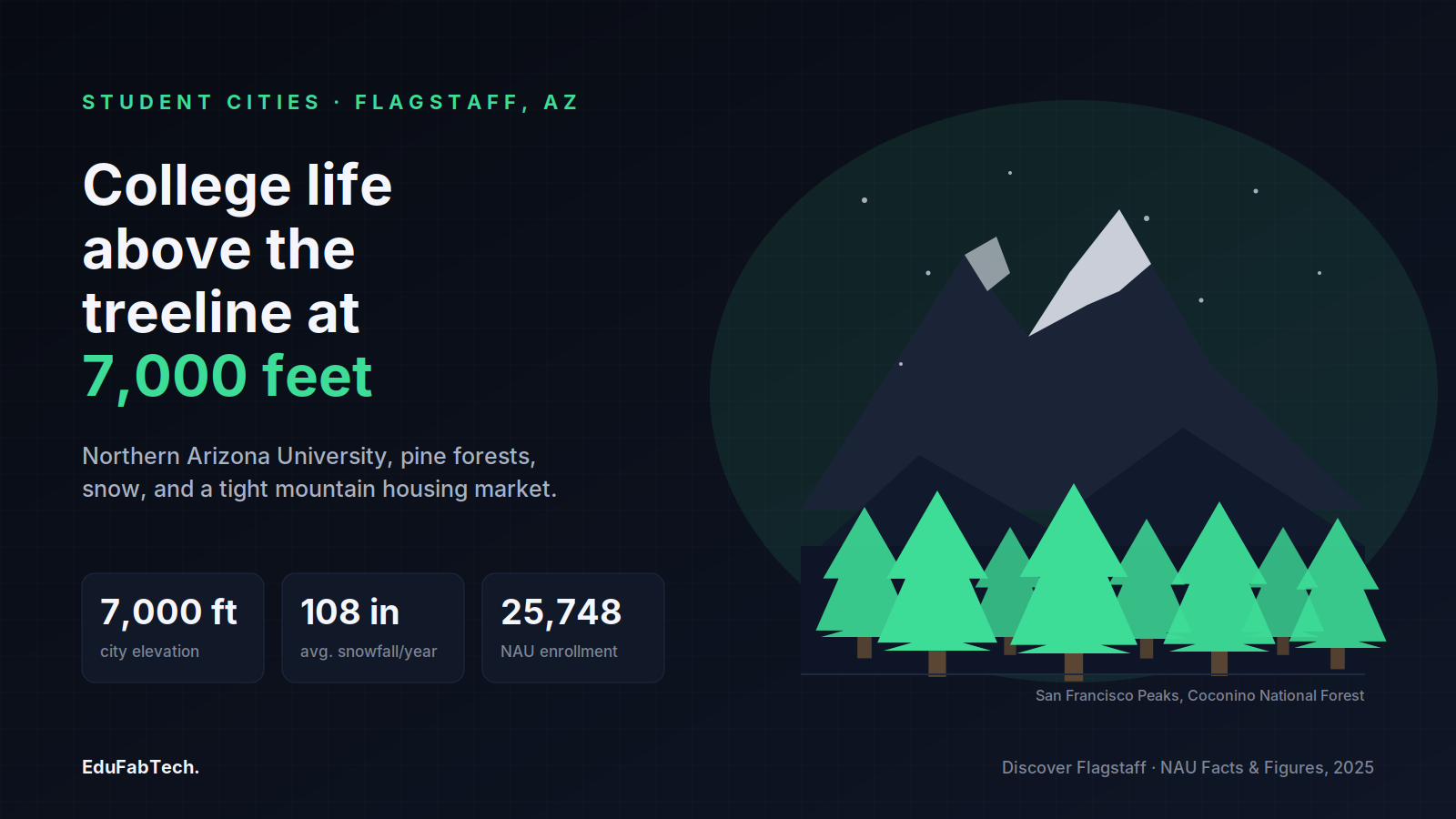
Flagstaff is not a typical American college town, and the first thing that tells you so is the air. The city sits at roughly 7,000 feet of elevation in the pines near the San Francisco Peaks, inside what the local visitor bureau describes as the world's largest ponderosa pine forest, with an average of about 108 inches of snow a year, according to Discover Flagstaff's fast-facts page. That combination — thin mountain air, long winters, a forest that begins where the parking lots end — shapes everything a student does here, from what jacket to own to how early to leave for class after a storm.
The town grew up along the railroad and historic Route 66, which still runs through the centre, and it has long been an astronomy outpost: Pluto was identified from Lowell Observatory on a hill above the city, as the same visitor bureau notes. Downtown is small, walkable and busy with students; beyond it the land climbs toward ski slopes and drops toward the Grand Canyon, about ninety minutes north by road. It is a place where "going outside" is the main form of recreation, and where a car buried under fresh snow is a normal March morning.
Almost everything about student life in Flagstaff orbits one institution, so it makes sense to start there before turning to rooms, buses, work and the honest trade-offs of living at altitude.
Northern Arizona University: what it is known for
Northern Arizona University (NAU) is the city's public research university, founded in 1899 as a teacher-training school and now, by its own description on its about page, a doctoral university sited at the base of the San Francisco Peaks on Native American homelands. It is a sizeable institution: NAU's facts and figures page reports a total enrolment of 25,748 (spring 2025), of whom 17,422 were Arizona residents and 8,326 were from outside the state. A large share of that total is based on the Flagstaff mountain campus; NAU also runs statewide, online and Yuma operations that are counted in the same figure.
The university's reputation is tied to its setting. Its College of the Environment, Forestry, and Natural Sciences works in the surrounding pine forest, and NAU is widely associated with forestry, environmental science, astronomy and planetary science, hospitality (hotel and restaurant management), and health fields including physical therapy. The campus itself is unusually self-contained — residence halls, dining, the library and the main academic buildings sit within a walkable core on the south and central sides of town — which is part of why so many first-year students choose to live on it rather than commute.
Where students live, from the halls to the Southside
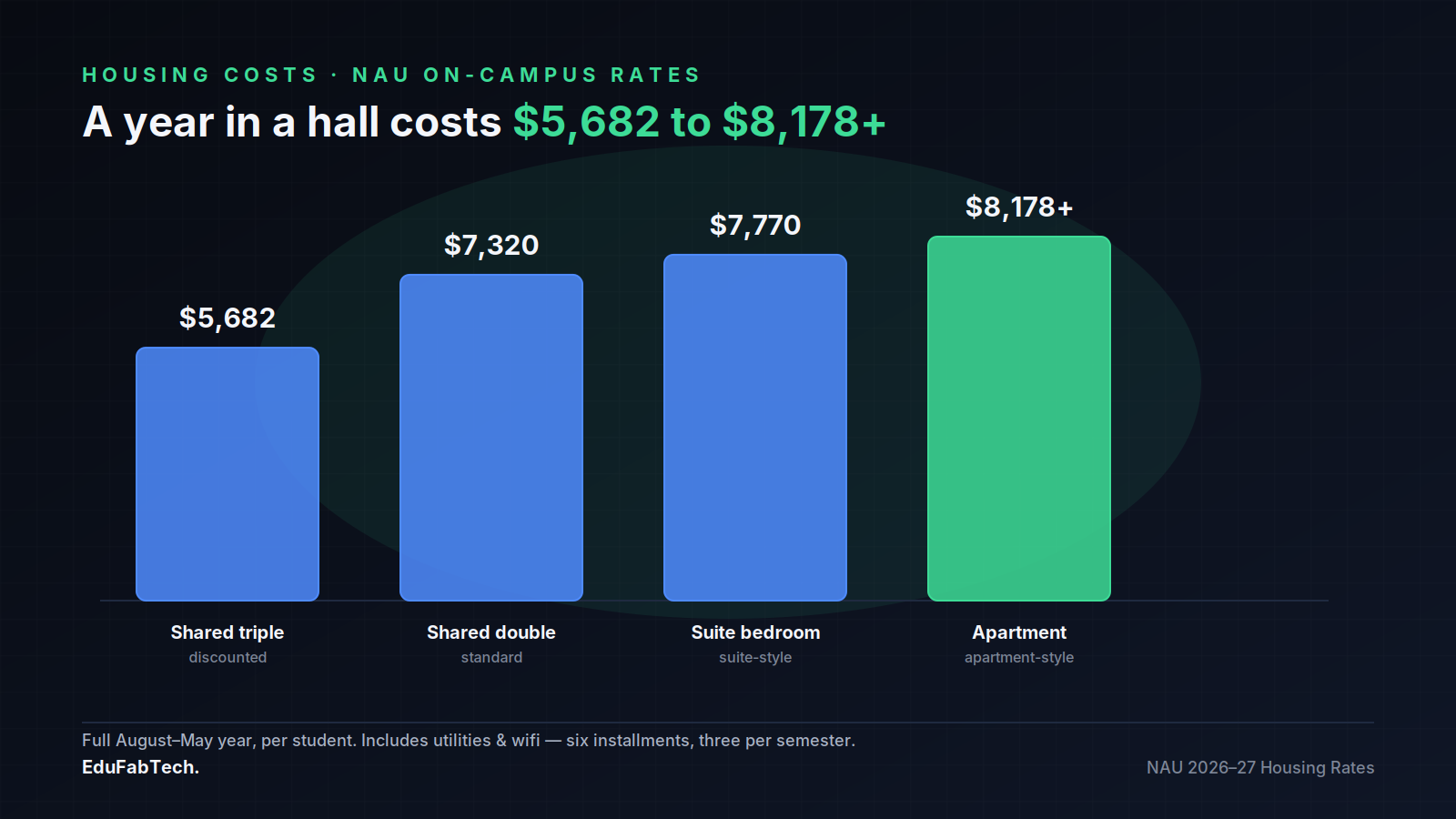
On-campus housing is the default for new students, and NAU's residence halls span the usual range: traditional shared rooms, suite-style buildings and apartment-style units, grouped into communities across the campus core. The published rates for the coming year are concrete. NAU's 2026–27 academic-year housing page lists a discounted shared triple at $5,682 per student, a standard shared double at $7,320 per student, suite-style shared bedrooms at $7,770, and apartment-style options from $8,178 upward for the full August-to-May year. Those rates include all utilities — electricity, gas, water, sewer and trash — plus wired and wireless internet and free laundry, and the cost is split into six installments, three per semester.
Off campus, the geography of student life is easy to read. The Southside, just south of the railroad tracks and the downtown core, is the historic student quarter — older houses, short walks to campus and to bars and cafés, and a fair amount of competition for rooms. Downtown itself draws students who want to live above the shops around Heritage Square. Further out, the area around Woodlands Village and the Country Club district on the east side offers newer, larger apartment complexes, generally cheaper per room but dependent on the bus or a car. Because Flagstaff is hemmed in by national forest on most sides, the supply of housing is genuinely limited, and rents run high for a town of its size — a constraint worth planning around rather than discovering in August.
Renting off campus in a tight, snowbound market
Start early. Rooms in the Southside and downtown turn over on the academic calendar, and the best of them are gone months before term. If you want to live on campus, note that NAU's housing contract is a binding licence agreement for the full academic year, that a non-refundable $100 application fee applies, and that a $175 Housing Rent Confirmation Payment holds your space and is credited toward your first-semester rent, per NAU's how-to-apply page; applications for the following year open on 1 October. For the private market, treat the search the way you would anywhere housing is scarce: see the actual room before committing.
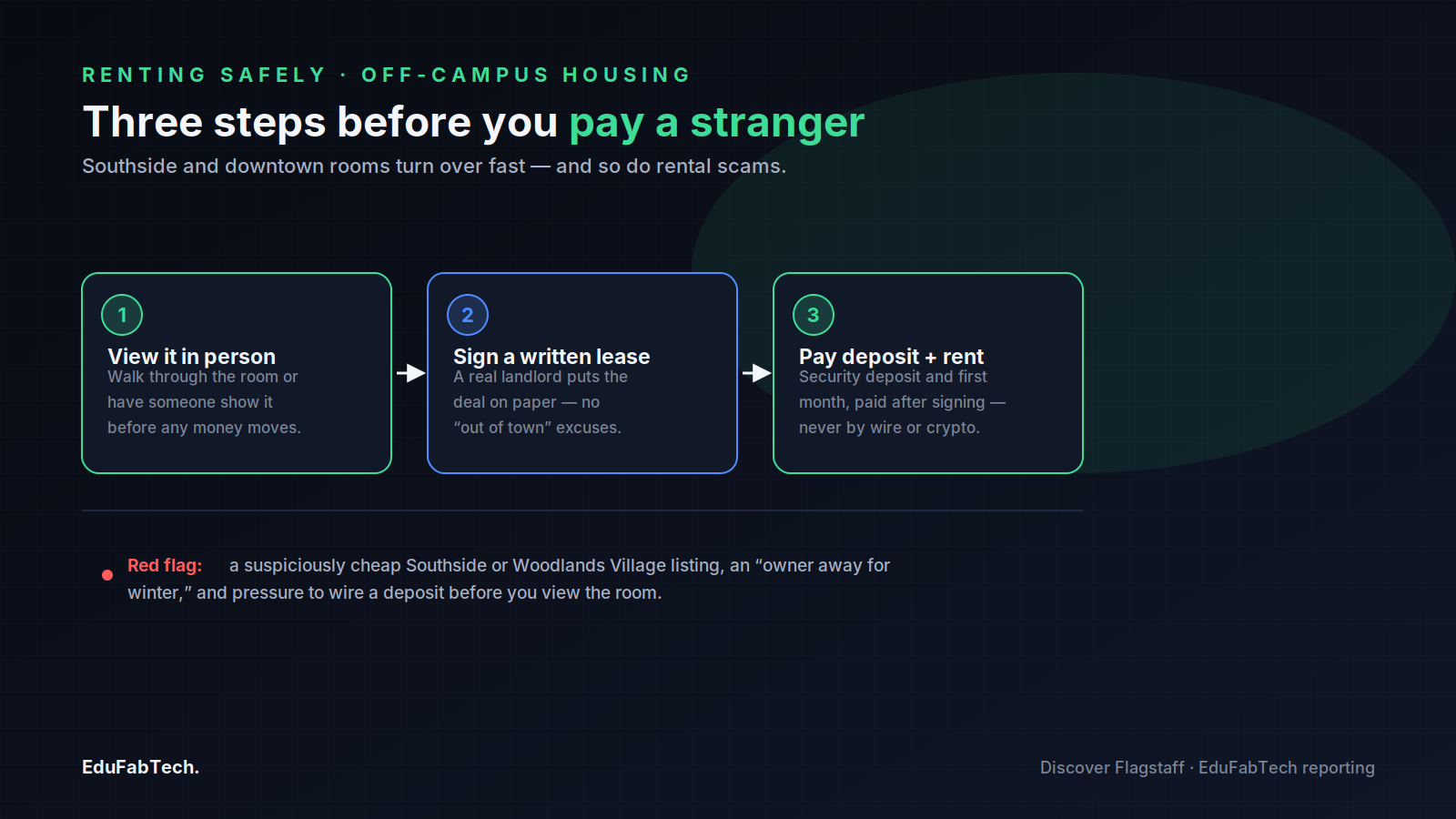
Scams in Flagstaff follow a predictable shape. A listing appears for a Southside house or a Woodlands Village apartment at a suspiciously low rent; the "owner" is conveniently out of town — often said to be away for the winter — and asks you to send a deposit to "hold" the place before you can view it. Do not. A legitimate landlord in Flagstaff will let you walk through the unit, or have someone show it, before any money changes hands, and a normal arrangement is a security deposit plus first month's rent paid once you sign a written lease. Never send money by bank wire, gift card or cryptocurrency to reserve a room, and be wary of anyone who refuses an in-person viewing or pushes you to decide the same day. If you are arriving from abroad and cannot view in person, ask a current student or the university's housing office for help rather than paying a stranger remotely.
Furnishing a room: thrift charities and the City Hall markets
Flagstaff has an unusually deep bench of charity thrift shops, most of them run by local nonprofits, which makes furnishing a room cheaply straightforward. Discover Flagstaff's guide to local thrifting names several worth knowing: the Habitat for Humanity ReStore on North Fourth Street, which specialises in furniture and appliances; the Society of St. Vincent de Paul Thrift Store on North East Street; Cedar Closet, run by the Assistance League on North West Street; Hodgepodge, operated by Northland Hospice on North Switzer Canyon Road; and Goodwill, with stores along Route 66 and South Milton Avenue. Between them they cover most of what an empty room needs, and the proceeds stay local.
For food and the occasional second-hand find, the markets gather at City Hall. The Flagstaff Community Market has run on Sundays from 8 a.m. to 1 p.m., May through October, since 2000, according to Discover Flagstaff's farmers'-market overview, which also lists the Flagstaff Urban Flea Market at City Hall on the second and fourth Saturdays from June to October, plus a Wednesday farmers' market at Heritage Square and an East Flagstaff Community Market in the mall parking lot. If you are starting from nothing, EduFabTech's own listings for second-hand things and furniture in the city are a reasonable first stop, especially in the move-out weeks of May and December when departing students give furniture away for free.
Working while you study
Many students look for part-time work, and the rules differ sharply depending on your status. For international students on an F-1 visa, the U.S. government's framework is specific: according to U.S. Citizenship and Immigration Services (USCIS), F-1 students may not work off campus during their first academic year but may accept on-campus employment subject to conditions, and any off-campus work — such as Curricular Practical Training or Optional Practical Training — must be authorised in advance by the school's Designated School Official and USCIS. This is a general description, not legal advice: before accepting any job, confirm the details with NAU's international student advisers, who serve as the Designated School Officials able to authorise work and maintain your SEVIS record. Domestic students face none of these restrictions and typically find campus jobs, retail and hospitality work in a tourism-driven town. Current openings aggregated for the city sit on EduFabTech's Flagstaff jobs page.
Cline Library and other places to read
The centre of academic life is Cline Library on the NAU campus. Its learning-and-study-spaces page describes bookable individual study rooms (up to four hours a day, reservable up to two weeks ahead), group study rooms (two hours a day), and graduate-only rooms, alongside walk-in quiet study areas, open computers and open seating. The same building houses a Learning Studio for group work and a MakerLab with 3D printers and a laser cutter — useful if your coursework involves prototyping or design.
Off campus, the Flagstaff City-Coconino County Public Library downtown is a genuine alternative, open to anyone and a short walk from the Southside. Its main branch at 300 West Aspen Avenue — across from City Hall, next to Wheeler Park — is open Monday to Thursday 9 a.m. to 8 p.m., with shorter hours Friday to Sunday, and offers public computers, internet and reservable meeting rooms, per the library's hours page. Downtown cafés fill in the gaps for anyone who prefers a bit of background noise. More desks and quiet corners around town are listed on EduFabTech's Flagstaff study-spaces page.
Getting around: Mountain Line, the Lumberjack Loop and winter
Flagstaff's public transport operator is Mountain Line, run by the Northern Arizona Intergovernmental Public Transportation Authority. Its fares are low: a single cash ride is $1.25, a day pass $2.50, and the 30-day FlagPass $34 for adults, according to Mountain Line's fares and passes page. The same page lists a college/post-high-school student pass at $99 per semester or $239 for the year, giving unlimited access to the whole network.
For most NAU students the headline benefit is simpler. Through a partnership with Mountain Line, NAU students ride Route 10 fare-free with a valid student ID, as NAU's transit services page explains; that route links campus, downtown and Woodlands Village and keeps running during most holiday periods when the campus shuttle does not. On campus, NAU operates the free Lumberjack Loop shuttle around the campus perimeter on weekdays, funded through a transportation fee charged to Flagstaff-campus students. Cycling is popular in the warmer months, but plan realistically for winter: snow and ice are routine from roughly November into spring, sidewalks and bike lanes are not always clear, and a walk that takes ten minutes in September can take longer and require sturdier boots in January. EduFabTech keeps city-wide listings for Flagstaff on its main city page, and listings close to campus on the Northern Arizona University page.
The honest ledger — and a first-weeks checklist
What is genuinely good about studying in Flagstaff: a compact, walkable campus set in forest; cheap and well-used public transport, with free rides on Route 10 for students; immediate access to skiing, hiking and the Grand Canyon; clean air and dark skies; and a real downtown rather than a strip of chain stores. What is hard is equally real. Housing is tight and expensive relative to the town's size, because the national forest limits how far the city can sprawl, so you must search early. The winters are long and snowy, which affects commuting, heating bills and how much daylight you get for fieldwork. The altitude takes a week or two to adjust to, and some newcomers feel it. And a tourism-and-university economy means seasonal, often modestly paid, part-time work.
A short checklist for the first weeks:
- If you are living on campus, confirm your housing application, pay the $175 confirmation payment on time, and read the licence agreement — it binds you for the full year.
- If you are renting privately, view the room in person before paying anything; expect a deposit plus first month's rent, and never wire money to "hold" a place sight unseen.
- Get your NAU ID early so you can ride Route 10 fare-free; decide whether the $99 semester Mountain Line pass is worth it for trips beyond that route.
- Buy real winter gear before November — proper boots and a warm coat — and factor snow into your commute.
- Furnish from the thrift charities and the City Hall markets rather than buying new; watch the May and December move-out weeks for free furniture.
- Learn Cline Library's bookable rooms and the downtown public library's hours before the first deadline crunch.
- International students: meet your Designated School Official at NAU's international office before taking any job, and keep your SEVIS record current.
None of this is unique advice dressed up as local knowledge — it is the shape the semester actually takes in a forested town at 7,000 feet, where the weather, the forest boundary and one large university between them set the terms of student life.
A quick question for readers
Do you work part-time while you study?
Many students work to pay the bills. See how common it is — and how many hours people really do.
Pick an answer, create a free account in a minute, and your vote counts. Already a member? Sign in
Comments 0
CommentNo comments yet. Members start the conversation.
Source: Northern Arizona University
Sources (5)
- Northern Arizona University. 2026–27 academic year housing rates. Northern Arizona University, 2026. in.nau.edu ↗ · checked 16 Oct 2026
- Mountain Line. Fares & Passes. Northern Arizona Intergovernmental Public Transportation Authority, 2025. mountainline.az.gov ↗ · checked 16 Oct 2026
- Cline Library. Learning and study spaces. Northern Arizona University, 2026. in.nau.edu ↗ · checked 16 Oct 2026
- Northern Arizona University. Facts and figures. Northern Arizona University, 2025. nau.edu ↗ · checked 16 Oct 2026
- Flagstaff City-Coconino County Public Library. Downtown library hours and location. City of Flagstaff and Coconino County, 2026. flagstaffpubliclibrary.org ↗ · checked 16 Oct 2026