Studying in Fort Worth: universities, housing and student life
A practical, sourced guide to Fort Worth for students — its universities, where to live, what a room costs, how to get around without a car, and what the city asks of you in return.
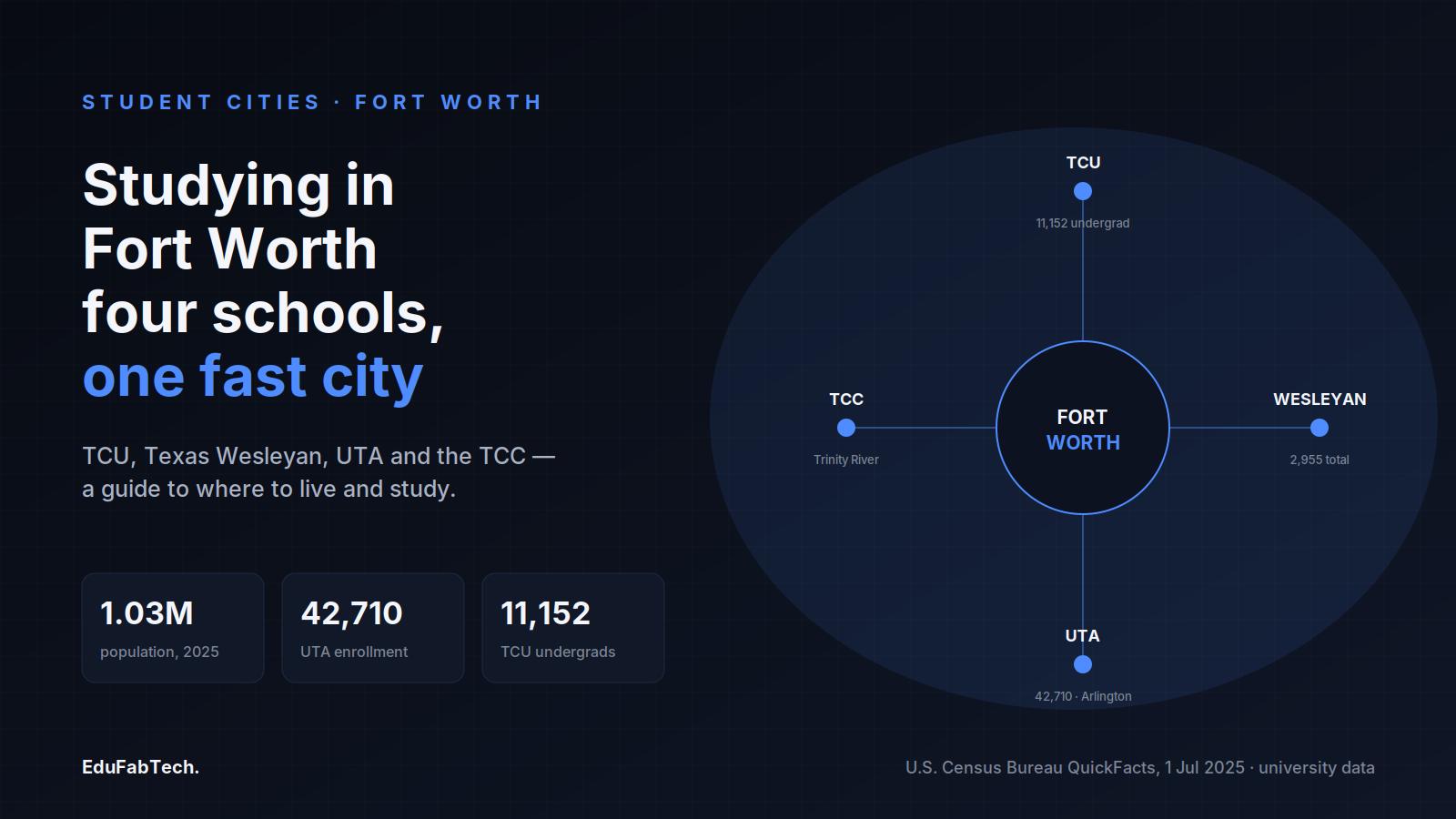
Fort Worth still answers to its old nickname, Cowtown. The Stockyards on the north side keep a working cattle drive, and the city's identity runs through rodeo, ranching and the oil money that built downtown. But it is no longer a small place: the U.S. Census Bureau's QuickFacts put the population at 1,028,117 as of 1 July 2025, up 11.9% from the 2020 count, which makes Fort Worth one of the fastest-growing large cities in the United States. It sits at the western end of the Dallas–Fort Worth metroplex, close enough to Dallas to share a commuter railway and far enough to feel like a separate city with its own museums, music and sprawl.
For a student, that combination matters. You get a genuine mid-size city — a cultural district full of museums, a lively Near Southside, a growing downtown — without Dallas prices, but you also inherit the car-shaped geography of North Texas and a housing market pulled upward by all that growth. Four very different institutions sit in or beside the city, and where you study shapes almost everything else about your time here.
Four campuses, from University Drive to Arlington
Texas Christian University (TCU) is the university most people mean when they say they study in Fort Worth. Its campus sits at 2800 South University Drive, south-west of downtown near the Cultural District, and the university's own about page describes a private institution founded in 1873 with 11,152 undergraduates and 1,828 graduate students and an average class size of 26. It is known nationally for its Horned Frogs athletics and for a tightly residential, traditions-heavy undergraduate culture; it is also the most expensive of the local options by a wide margin.
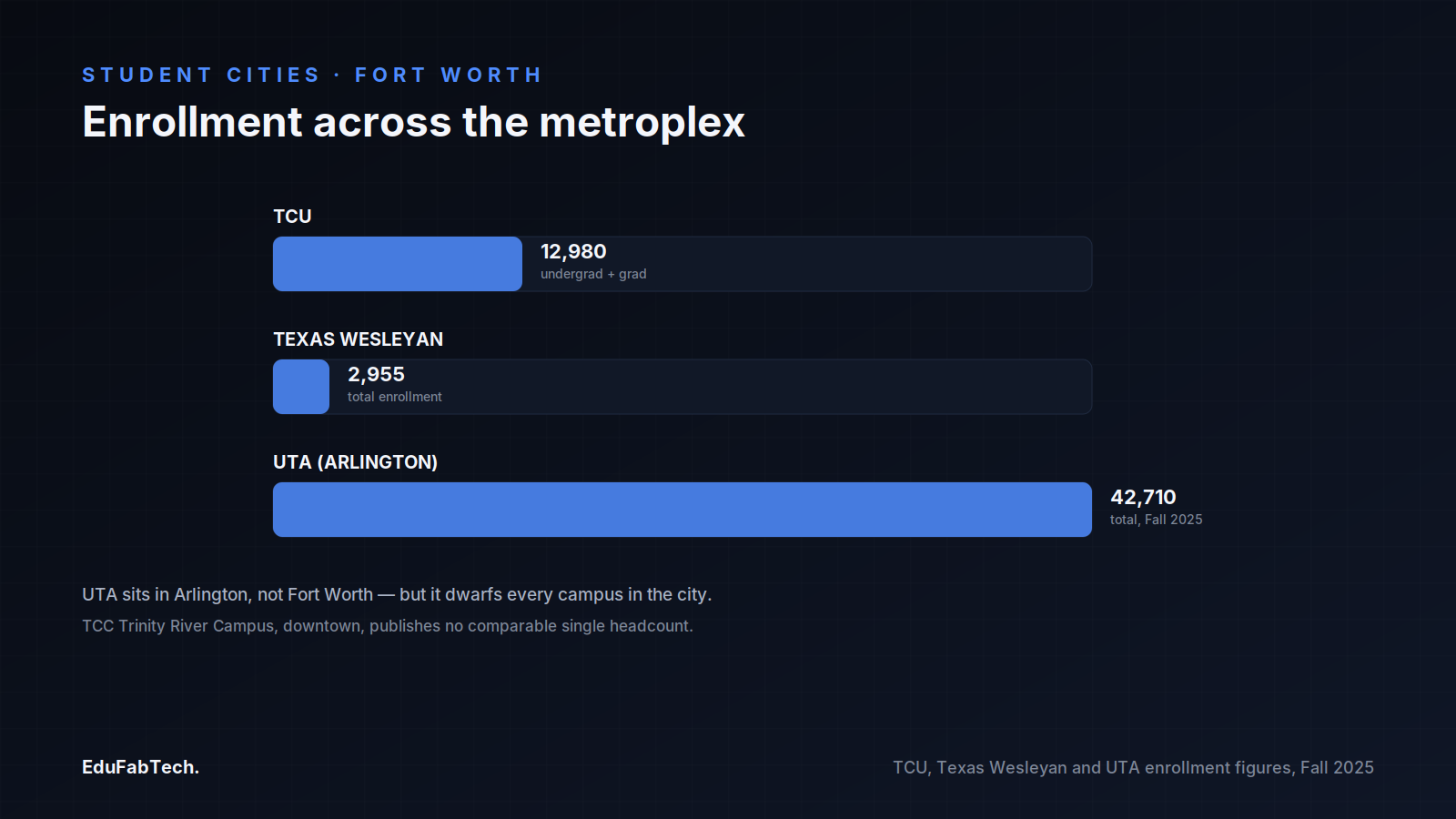
Texas Wesleyan University is smaller and older in feel. Its about page records a total enrollment of 2,955 and an average class size of 16, and dates the university to 1890; it opened as Polytechnic College in 1891. It still sits in the Polytechnic Heights neighbourhood on the east side, a few miles from downtown, and leans on personal attention and professional programmes rather than scale. Arlington Baptist College — which took the name Arlington Baptist University in 2017, as its own history page notes — is a small Bible college on the west side of Arlington granting bachelor's and master's degrees; it is a niche, faith-centred choice rather than a general university.
The giant next door is the University of Texas at Arlington. It is not in Fort Worth — its 420-acre campus sits in Arlington, between Fort Worth and Dallas — but it is close enough that many Fort Worth residents commute to it, and it dwarfs the others. UTA's Fast Facts report a Fall 2025 enrollment of 42,710 (30,706 undergraduates), more than 180 degree programmes, and a Carnegie "Research 1 / very high research activity" designation; the university calls itself the fifth-largest in Texas. Two of its divisions are worth naming for anyone weighing the cross-metroplex commute: the University of Texas at Arlington College of Engineering, which grants bachelor's, master's and doctoral degrees across a dozen fields, and the University of Texas at Arlington School of Architecture, now part of the College of Architecture, Planning and Public Affairs. If you want a large public research university with strong engineering and nursing, UTA is the metroplex's workhorse. Finally, the community-college system has a downtown foothold: the TCC Trinity River Campus sits on the river's edge north of downtown and is a common, low-cost route into a four-year degree.
Where students put down roots
Fort Worth has no single student quarter; housing follows the campus you attend. Around TCU, students cluster in the blocks immediately south and west of University Drive — Frisco Heights, Bluebonnet Hills and the Berry Street corridor — where older houses have been carved into student rentals and newer purpose-built complexes have gone up. It is walkable to campus but pricey and competitive. A short way north, the Near Southside around Magnolia Avenue is the city's most pedestrian-friendly district, popular with graduate students and anyone studying at the TCC Trinity River Campus or working downtown.
Texas Wesleyan students mostly live in and around Polytechnic Heights on the east side, which is cheaper and historically working-class; it rewards knowing the specific streets before you sign. UTA students generally live in Arlington itself rather than in Fort Worth, since the commute across the metroplex without a car is slow. Wherever you look, start early: Fort Worth's fast population growth has tightened the rental market, and the best-priced rooms near campus for an autumn start are usually gone by late spring. You can browse current rooms and places to stay in Fort Worth on EduFabTech, or narrow the search to listings near Texas Christian University.
Signing a lease in Fort Worth without losing your deposit
Rental scams in Fort Worth follow the growth: the hottest listings are the cheap ones near TCU and in walkable Near Southside, and those are exactly where fake adverts appear. The pattern is familiar — an unusually low rent for a desirable block, a "landlord" who is conveniently out of state, and pressure to send money before you can see the place. Treat any request to wire a deposit, pay with gift cards, or send cryptocurrency "to hold the room" as a scam full stop; no legitimate Fort Worth landlord needs money that way.
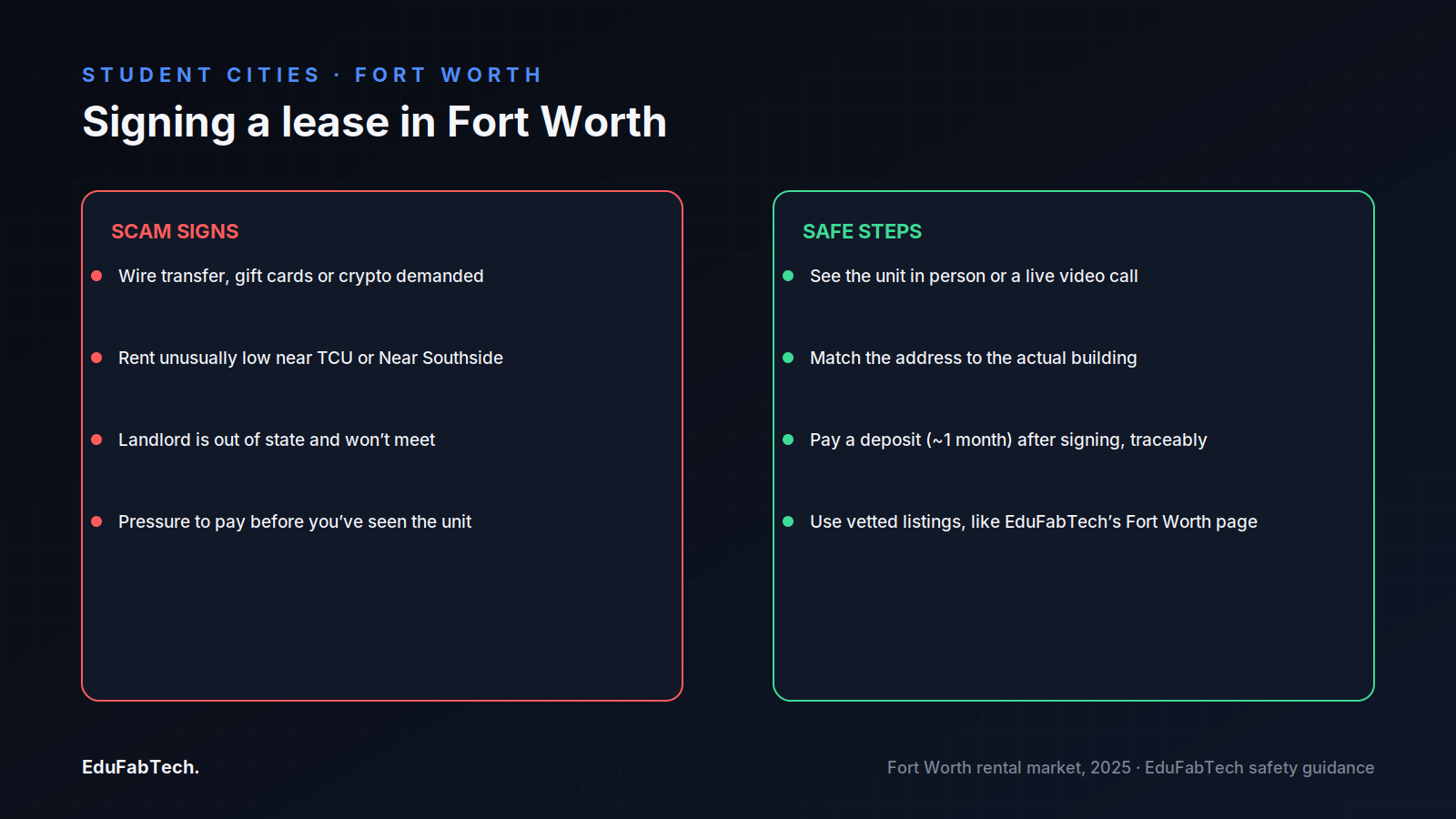
See the actual unit before you pay anything, in person or over a live video walk-through of that specific apartment, and match the address to the building. Expect a deposit of roughly one month's rent, paid by a traceable method once you have a signed lease in hand — not before. If you are arriving from abroad and cannot view in person, ask someone already in the city to go for you, or use short-term housing for the first weeks and sign a longer lease only once you have walked the neighbourhood. EduFabTech's Fort Worth listings are a safer starting point than chasing bargains on open marketplaces.
Furnishing a room: the Cattle Barn, resale and giveaways
Furnishing cheaply is one thing Fort Worth does well, because the metroplex is thick with resale. The Cattle Barn Flea Market, a Fort Worth fixture that ran for more than 40 years at the Will Rogers Memorial Center before relocating to Camp Bowie West Boulevard on the west side, is the city's best-known flea market; as WFAA reported, its vendors sell everything from tools to household goods. For food rather than furniture, the year-round, producer-only Cowtown Farmers Market on the western edge of the city is the place for local produce. Charity resale stores and student move-out giveaways each May and August are the other reliable sources of near-free desks, chairs and kitchenware.
Rather than buy new, check what other students are selling or giving away as they leave. EduFabTech has a dedicated Fort Worth page for second-hand things — worth watching in the weeks around the start and end of each semester, when supply is highest and prices are lowest.
Earning money while you study
Rules for part-time work depend heavily on your immigration status, and you should not treat anything here as legal advice. If you are an international student on an F-1 visa, the U.S. Department of Homeland Security's Study in the States guidance states that you may work on campus but no more than 20 hours per week while school is in session, that you need approval from your designated school official before starting, and that off-campus training such as CPT and OPT has its own separate authorisation. The programme is run by the Student and Exchange Visitor Program (SEVP); breaking the rules can end your SEVIS record. Always confirm your own case with your university's international-student office before you accept any job.
Domestic students face no such cap, and a city of a million people with a large hospitality and campus economy offers the usual student jobs. Current openings in the city are listed on EduFabTech's Fort Worth jobs page.
Where to read, on campus and across the city
TCU's main study building is the Mary Couts Burnett Library on campus, reopened in 2024 after a renovation that added a ground-floor café, open lounges and bookable group-study rooms, with quieter reading floors above. UTA students have the large Central Library at the heart of the Arlington campus, and the TCC Trinity River Campus has its own learning commons downtown. Off campus, the Fort Worth Public Library system offers free study space and Wi-Fi across its branches — though note that, as the Fort Worth Report reported, the downtown Central Library closed permanently in mid-2023, with service shifted to a small downtown express location and the neighbourhood branches. For independent desks and quiet rooms around the city, see EduFabTech's Fort Worth study-spaces page.
Moving around a car-shaped city
Fort Worth is built for driving, and that is the honest starting point: distances are long and most students eventually rely on a car or on friends with one. The public operator is Trinity Metro, the Fort Worth Transportation Authority, which runs local buses, the TEXRail line linking downtown to DFW International Airport, and — jointly with Dallas's DART — the Trinity Railway Express (TRE) commuter train toward Dallas. Tickets are handled through the GoPass app. Per Trinity Metro's fares page, a local single ride is $2 (reduced $1), a local one-day pass is $4 and a seven-day pass $18, with the regional monthly pass at $192, under the structure effective 1 March 2026. Reduced fares apply, with valid ID, to seniors 65+, people with disabilities, Medicare cardholders, youth aged 5–19 and veterans.
There is one genuinely good deal: Tarrant County College's EasyRide programme lets enrolled TCC students ride Trinity Metro free, as TCC's own transportation page describes, now administered through the GoPass app. If you are at the Trinity River Campus downtown, that turns the bus and rail network into free transport. Students at TCU, Texas Wesleyan or UTA do not get that blanket benefit, so budget for fares or a car.
What it costs — and the honest trade-offs
The clearest campus figure comes from TCU. Its cost-of-attendance page lists on-campus housing at $12,080 for the 2026–2027 academic year (with food adding $6,700), against tuition of $66,520 — a reminder that TCU is a high-cost private university. For the wider rental market, the U.S. Census Bureau's QuickFacts give a median gross rent of $1,509 a month across Fort Worth for 2020–2024 and a median household income of $79,507, so a shared flat split two or three ways is the realistic student path to living below that median. Texas Wesleyan, Arlington Baptist and TCC all sit well under TCU on price, which is a large part of their appeal.
What is good about Fort Worth for students: it is a real, growing city with museums, music and a distinctive culture, cheaper than Dallas, with a strong resale economy for setting up a room and, for TCC students, free transit. What is hard: the car dependence is real, the summers are long and very hot, rents are climbing with the population, and the campuses are scattered enough that your social life bends toward whichever one you join. If you choose UTA, remember you are really choosing Arlington, not Fort Worth proper.
Your first two weeks
- Confirm your housing in person before transferring any deposit, and never pay by wire, gift card or crypto to "hold" a room.
- If you are on an F-1 visa, see your university's international-student office about work rules and a Social Security Number before accepting any job.
- Download the GoPass app; if you are a TCC student, register for EasyRide to ride Trinity Metro free.
- Get a library account — your campus library plus a free Fort Worth Public Library card for branch study space.
- Set a furnishing budget and watch the second-hand and free-stuff listings during move-in week, when giveaways peak.
- Work out your commute honestly: if you are far from campus without a car, plan bus or rail routes, or reconsider the neighbourhood before you sign.
A quick question for readers
Do you work part-time while you study?
Many students work to pay the bills. See how common it is — and how many hours people really do.
Pick an answer, create a free account in a minute, and your vote counts. Already a member? Sign in
Comments 0
CommentNo comments yet. Members start the conversation.
Source: U.S. Census Bureau
Sources (5)
- Texas Christian University. Cost of Attendance — Undergraduate 2026–2027. TCU Scholarships & Financial Aid, 2026. financialaid.tcu.edu ↗ · checked 15 Oct 2026
- U.S. Census Bureau. QuickFacts: Fort Worth city, Texas. U.S. Census Bureau, 2025. census.gov ↗ · checked 15 Oct 2026
- Trinity Metro. Tickets and Fares. Fort Worth Transportation Authority, 2026. ridetrinitymetro.org ↗ · checked 15 Oct 2026
- University of Texas at Arlington. Fast Facts. The University of Texas at Arlington, 2025. uta.edu ↗ · checked 15 Oct 2026
- U.S. Department of Homeland Security. Working in the United States (F-1 students). Study in the States, SEVP, 2026. studyinthestates.dhs.gov ↗ · checked 15 Oct 2026