Studying in Greenville, North Carolina: universities, housing and student life
A practical, sourced guide to East Carolina University, where students live, what a year costs, and how to get around a Tar River city built around one campus.
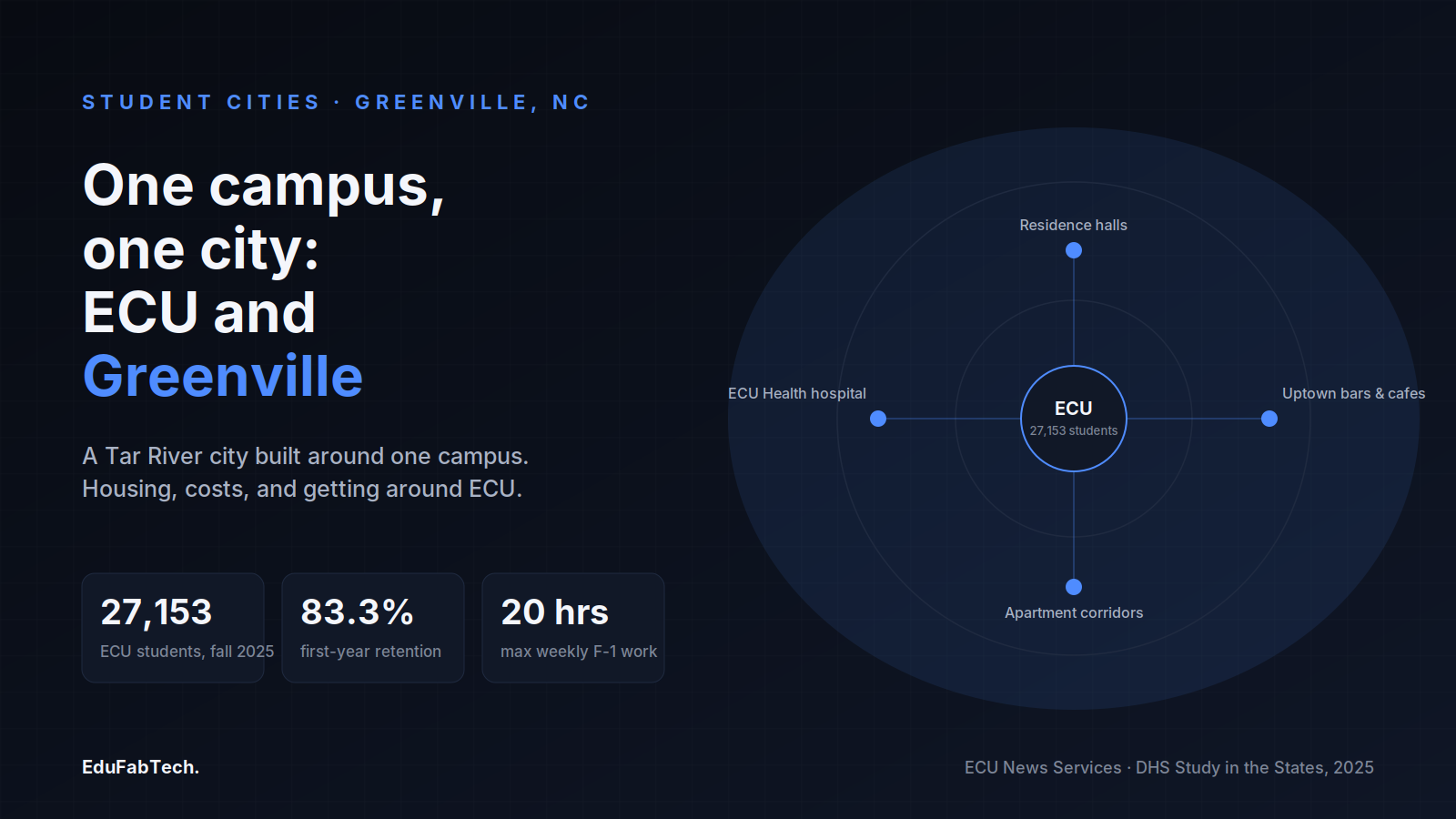
Greenville sits on the south bank of the Tar River in Pitt County, out on the coastal plain of eastern North Carolina — far from the mountains and the postcard beaches, the largest city in a mostly rural stretch of the state that locals call the east. For a student, the place makes sense quickly, because almost everything orbits one institution. The campus, the hospital that trains its doctors, the bars and coffee shops of the uptown district, the apartment corridors south of downtown: they all take their rhythm from East Carolina University.
That gives Greenville a particular texture. It is not a college town bolted onto a larger economy; the university is much of the economy. East Carolina University counted 27,153 students on its census day of 10 September 2025, the highest enrollment since fall 2021, according to ECU News Services. In a city whose population is a fraction of a major metro, a student body that size shapes the rent, the traffic on game weekends, and which shops survive the summer lull.
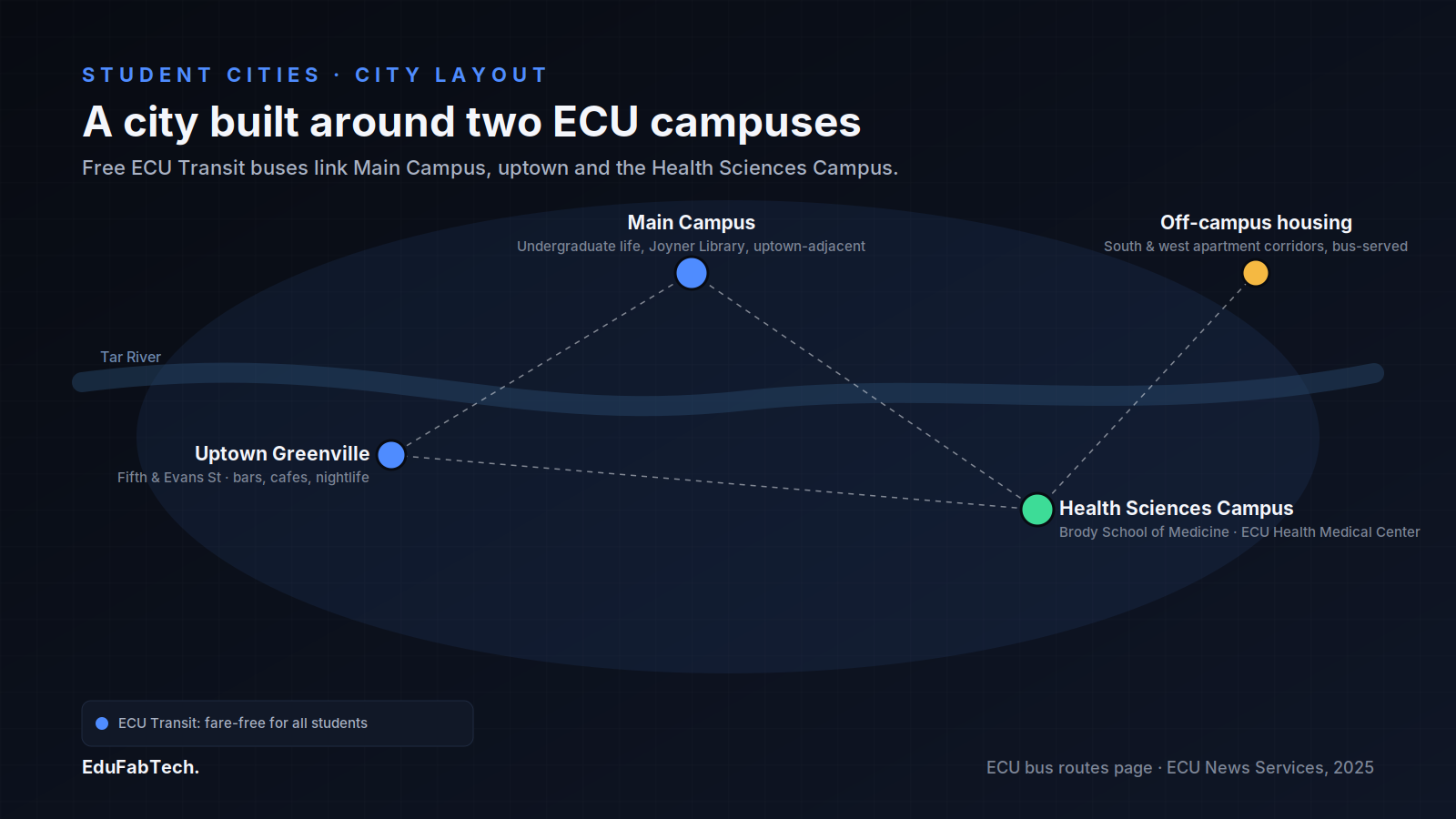
The second thing to know is that ECU is not only an undergraduate campus. Its Health Sciences Campus, a short distance west of the main grounds, holds the Brody School of Medicine, the colleges of nursing and allied health, and the ECU Health Medical Center that serves as a regional referral hospital for the east. The university describes itself as holding Carnegie R1 status and sitting "among the top 5% of research universities," and calls itself the top public university in North Carolina for helping students improve their economic futures, on its about page. For a prospective student, that mix matters: undergraduate life clusters around uptown, while health-sciences students spend their days on a separate campus with its own routine.
East Carolina University: a big public campus beside uptown
ECU's main campus runs right up against uptown Greenville — the walkable downtown grid around Fifth and Evans Streets, where much of the student social life happens. That adjacency is the single most useful fact about studying here: a first- or second-year student living on or near campus can reach lectures, the main library, coffee and nightlife on foot. The university's colours (purple and gold) and its Pirate identity are inescapable on a football Saturday, when Dowdy–Ficklen Stadium draws crowds that briefly swell the city.
Academically, the university is broad rather than boutique: large programmes in education, business, nursing and allied health, the arts, and the sciences, plus the Brody School of Medicine and the dental school on the Health Sciences Campus. ECU reported a first-time, full-time first-year retention rate of 83.3% — the highest since the fall 2019 class — in the same ECU News Services release. Online enrollment is a real part of the picture too, so some of your classmates may never set foot in Greenville.
Where students live, and how to rent without losing a deposit
On campus, ECU groups its residence halls into neighbourhoods — College Hill on the higher ground near the athletics facilities, Central near the academic core, and West End toward uptown. First-year students generally live on campus, and the halls are assigned through the Campus Living contract rather than hunted for individually, which removes a lot of the risk from your first year.
Off campus, students spread south and west of the core, along the corridors that the city's apartment construction has followed over the past two decades — the areas reached by ECU's own off-campus bus routes toward the south and the medical campus. Uptown and the blocks immediately around it hold older houses split into student rentals; the newer purpose-built apartment blocks sit farther out and usually assume you have a car or ride the bus. If you are coming from abroad and want a realistic sense of what is available and at what price before you arrive, the local listings on EduFabTech's Greenville rooms page and the wider Greenville student page are a reasonable place to calibrate.
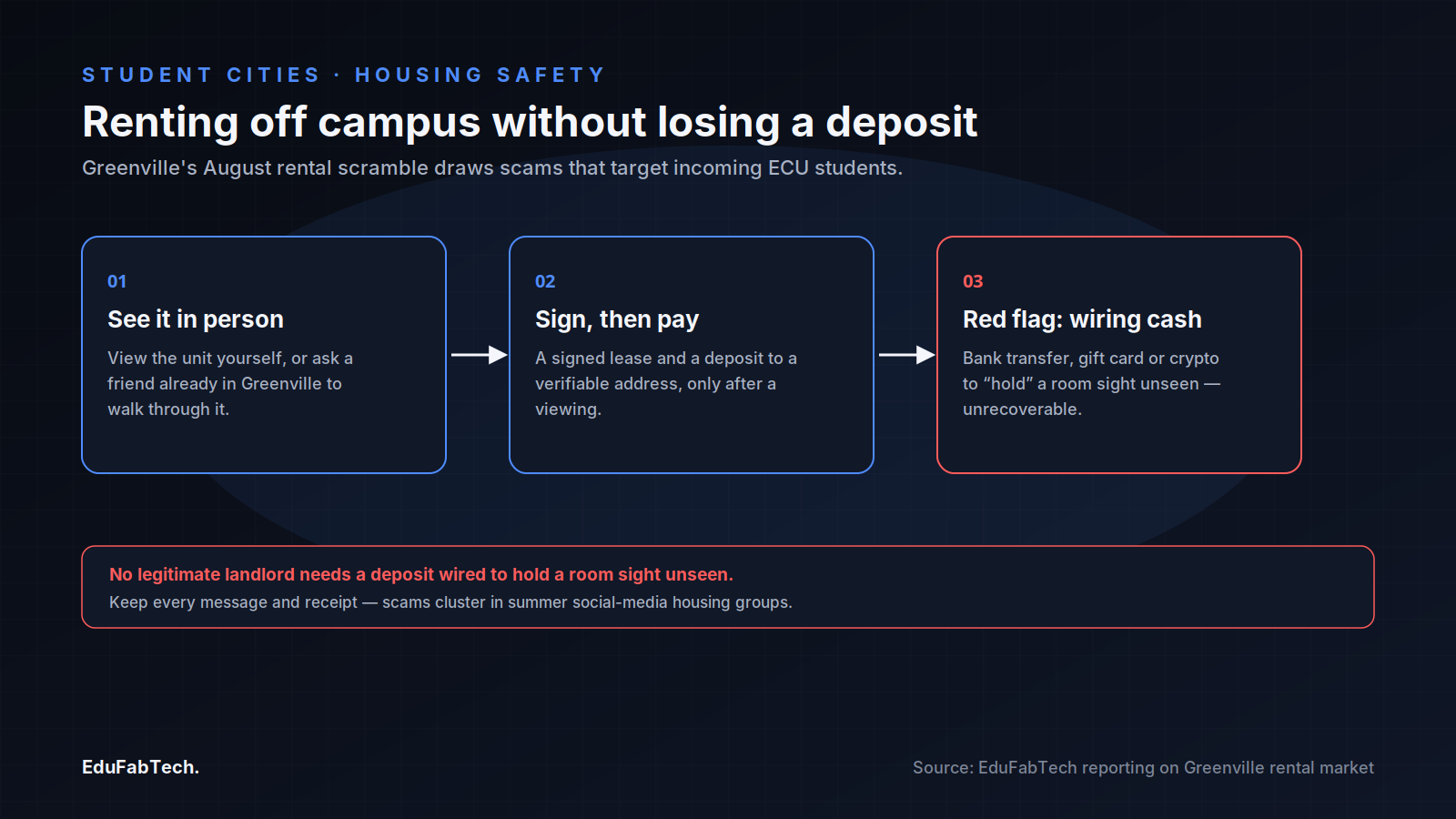
Renting off campus in Greenville carries the same hazard it does in any university market with more demand than supply in August: the listing that is too cheap, too available, and whose "owner" is conveniently out of town. The scams here tend to appear where students look first — social-media housing groups and free classified posts aimed at incoming ECU students over the summer. Treat any of them with suspicion if the person will not let you (or a friend already in Greenville) see the unit in person before money changes hands. A normal local arrangement is a signed lease and a security deposit paid to a verifiable address after a viewing; no legitimate landlord in Greenville needs a deposit wired to "hold" a room sight unseen. Never send money by bank transfer, gift card or cryptocurrency to secure a place — those payments cannot be recovered, and that is exactly why fraudsters ask for them. If you cannot travel to view a unit, ask someone local to walk through it, and keep every message and receipt.
Furnishing a room on the cheap
Greenville rewards the second-hand shopper, partly because a transient student population is constantly furnishing and un-furnishing apartments. Dickinson Avenue, west of uptown, is the reliable hunting ground: the Dickinson Avenue Antique Market at 701 Dickinson Ave carries a rotating stock of household goods, and the indoor Farmers' and Makers' Market sits across the street. On the edges of town you will find the larger flea markets — Second Chance Flea Market on North Memorial Drive and River Road Storage & Flea Market among them — plus the usual chain thrift and charity stores for cheap kitchenware, lamps and desks.
For produce and the social side of shopping, the city runs the Uptown Greenville Umbrella Market, an open-air farmers' and makers' market at the Five Points plaza near Fifth and Evans Streets through the warmer months, listed by the Greenville–Pitt County Convention and Visitors Bureau. Because the student calendar turns over hard in May and August, the best time to furnish a room for free or near-free is late spring, when departing tenants give away what they cannot carry. EduFabTech's local pages for second-hand things and free items in Greenville are worth watching in those weeks.
Working while you study
Many domestic students work part-time on or around campus — dining halls, the library, retail and the hospital all hire students. For international students the rules are stricter and non-negotiable, and you should read them from the source rather than from a landlord or a forum. The U.S. Department of Homeland Security's Study in the States guidance states plainly that an F-1 student "may not work more than 20 hours per week when school is in session," and sets out which on-campus jobs are allowed, on its Working in the United States page. Off-campus work, and training such as CPT and OPT, requires separate authorisation; the limits and the paperwork are the province of DHS, U.S. Citizenship and Immigration Services and your university's international office, not of this guide. Confirm your own status with ECU's international student advisers before accepting any job. Current openings students post locally are gathered on the EduFabTech Greenville jobs page.
Libraries and places to read
The anchor study space is ECU's J.Y. Joyner Library on the main campus, which offers reservable individual and group study rooms booked through its room-reservation system; it keeps long hours during term and is where most undergraduate study happens. Health-sciences students have their own building, the Laupus Health Sciences Library, over on the medical campus, which spares a Brody or nursing student the trip back to the main grounds between clinics.
Off campus, the city's public library is the Sheppard Memorial Library at 530 Evans Street, a short walk from uptown, with branches elsewhere in Pitt County; its hours and locations are published on the Sheppard Memorial Library site. A public card is useful for quiet daytime study, meeting rooms and borrowing beyond the academic collection. Cafés in uptown fill the gaps for anyone who studies better with background noise, and students trade tips on the quieter desks on EduFabTech's Greenville study-spaces page.
Getting around: free campus buses, paid city buses
Greenville is a driving city by design, but a student can function without a car if they live along the right corridor. ECU Transit runs a network of fixed routes — on-campus loops and off-campus routes reaching apartment areas, shopping and a park-and-ride — and it is free to ride; the university describes it as "fare-free bus service" on its bus routes page. For most students this is the workhorse: it connects the main campus, the Health Sciences Campus and the big off-campus housing clusters at no cost.
The city-run system, Greenville Area Transit (GREAT), is separate and covers the wider town. Here the news is a change: the Greenville City Council voted to charge a $1 one-way fare on GREAT, with reduced 50-cent fares for riders 65 and over, Medicare cardholders and ADA-eligible riders, and a $3 daily cap for those using the GoGREAT card or app, to begin in January, as reported by The Daily Reflector. The same report describes GREAT+, a curb-to-curb on-demand service in north Greenville, at $2 per trip. In short: ride ECU Transit free where it goes; budget a little for GREAT where it does not.
What it costs, honestly
On-campus housing figures are published and precise. For 2026-27, ECU Campus Living lists academic-year residence-hall rates from $6,093 for a standard room in Umstead or Garrett to $8,841 for a single in College Hill Suites, with most standard double rooms at $6,694, on its Residence Hall Prices 2026-27 page.
For a fuller picture, ECU's Office of Student Financial Aid publishes an estimated cost of attendance. For 2026-27 it lists, for a continuing undergraduate living on campus, a housing budget of $8,313 and a food budget of $3,088, with a total estimated budget of $25,366 for an in-state resident and $41,643 for a non-resident, on its Estimated Cost of Attendance page. The same page estimates a commuter resident's total at $20,672 for the year. These are the university's own budgeting figures rather than guaranteed prices, but they are the most reliable numbers to plan against.
| Item (ECU, 2026-27) | Figure |
|---|---|
| Residence-hall room, standard double (most halls) | $6,694 / year |
| Residence-hall room, range (standard to single) | $6,093–$8,841 / year |
| On-campus housing budget (cost of attendance) | $8,313 / year |
| Food budget (cost of attendance) | $3,088 / year |
| Total budget, in-state on-campus undergraduate | $25,366 / year |
| Total budget, non-resident on-campus undergraduate | $41,643 / year |
The trade-offs, and a first-fortnight checklist
What is good about Greenville for a student is also what is hard about it. The cost of living is low by the standards of larger American university cities, the campus and uptown are genuinely walkable, and ECU Transit will carry you free to most places you need. The Pirate culture gives the place real identity, and a smaller city means you are not anonymous. Against that: Greenville is isolated, the nearest big cities are a long drive, summers on the coastal plain are hot and humid, and a car becomes close to essential the moment you live beyond a bus corridor. The housing market tightens sharply every August, and the city's dependence on one employer means the quiet months are very quiet. None of that is a reason to stay away — but it is worth choosing where you live with the bus map and the August rush in mind.
A short checklist for your first two weeks:
- If you are an international student, see ECU's international student advisers in person and confirm your work status before taking any job; rely on the DHS Study in the States rules, not hearsay.
- Map your commute against the free ECU Transit routes before signing any off-campus lease.
- Never pay a deposit before an in-person viewing, and never by wire, gift card or crypto.
- Get a GoGREAT card if you will use city buses, so the daily and weekly fare caps apply.
- Reserve a Joyner Library study room early in term, and get a Sheppard Memorial Library card for quiet daytime study off campus.
- Furnish from Dickinson Avenue and the flea markets, and watch the second-hand and free-stuff listings in late spring, when leases turn over.
A quick question for readers
Do you work part-time while you study?
Many students work to pay the bills. See how common it is — and how many hours people really do.
Pick an answer, create a free account in a minute, and your vote counts. Already a member? Sign in
Comments 3
Comment-
The GREAT fare change is the part worth thinking about in practice. A dollar fare, a fifty-cent reduced rate, a three-dollar daily cap, a Go…
-
The transit section is the most useful thing here because it's unambiguous: ECU Transit is free, GREAT is going to $1/ride (or a $3 daily ca…
-
The split between fare-free ECU Transit and the newly priced GREAT system is the detail worth flagging. $1 a ride, 50 cents for reduced fare…
Join free to read the full comments and reply Comments are between members; an account takes a minute.
Source: East Carolina University
Sources (5)
- ECU Campus Living. Residence Hall Prices 2026-27. East Carolina University, 2026. housing.ecu.edu ↗ · checked 21 Oct 2026
- ECU Office of Student Financial Aid. Estimated Cost of Attendance (COA). East Carolina University, 2026. financialaid.ecu.edu ↗ · checked 21 Oct 2026
- ECU News Services. Enrollment up at ECU for third consecutive year. East Carolina University, 2025. news.ecu.edu ↗ · checked 21 Oct 2026
- U.S. Department of Homeland Security. Working in the United States. Study in the States, 2025. studyinthestates.dhs.gov ↗ · checked 21 Oct 2026
- The Daily Reflector. GREAT buses to begin charging fares in January. The Daily Reflector, 2026. reflector.com ↗ · checked 21 Oct 2026