Studying in Lafayette, Louisiana: universities, housing and student life
A practical, sourced guide to the University of Louisiana at Lafayette and life in the capital of Acadiana — where students live, what rooms and transport cost, and the real trade-offs.
A college town in the middle of Acadiana
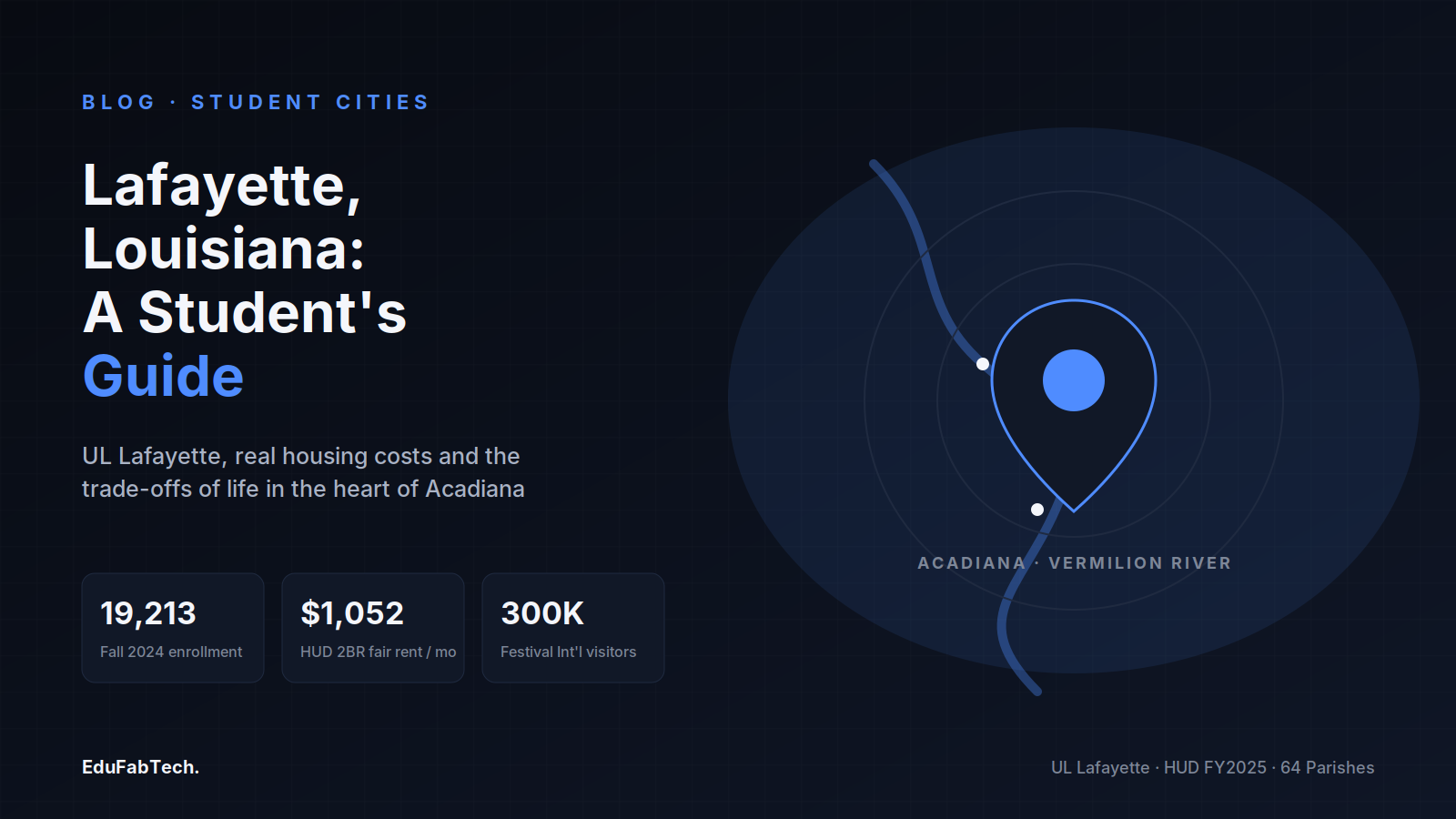
Lafayette sits in south Louisiana, on the Vermilion River, roughly halfway between Baton Rouge and the Texas line. It is the commercial and cultural hub of Acadiana — the French-speaking crescent of the state settled by Acadian exiles and shaped since by Creole, Afro-Caribbean and Vietnamese communities. That heritage is not a museum piece here: Cajun and zydeco music still fill weekend dance halls, French phrases turn up in ordinary speech, and the city's biggest annual event, Festival International de Louisiane, is a free downtown music festival founded in 1987 that the Louisiana Endowment for the Humanities' encyclopedia 64 Parishes describes as drawing some 300,000 visitors each April.
For a student, this means a city that is smaller and far cheaper than New Orleans but with an outsized appetite for live music, food and festivals. It also means a city built around the car, a climate that runs hot and wet for much of the year, and a local economy still tied to oil and gas — all of which shape daily life more than any brochure admits. This guide walks through the university, where and how to find a room, furnishing it cheaply, working, studying and getting around, with figures tied to sources you can check.
You can browse current student listings for the city on EduFabTech's Lafayette page, but read the sections below first so you know what a fair price and a safe arrangement actually look like here.
The University of Louisiana at Lafayette
The University of Louisiana at Lafayette (UL Lafayette, home of the Ragin' Cajuns) is the anchor of student life in the city. Its main academic campus occupies about 145 acres just south-west of downtown, with athletic facilities, a research park and an ecology centre spread across roughly 1,300 acres in total, according to the university's own fast-facts page. That page also notes the Carnegie Foundation's classification of UL Lafayette as a research university with very high research activity, and highlights that U.S. News & World Report recognised its education, engineering, nursing and business graduate programmes in the 2020 edition of Best Graduate Schools.
In terms of size, the university reported total enrollment of 19,213 for Fall 2024, of whom 15,665 were degree-seeking — 13,432 undergraduates and 2,233 graduate students — in its announcement that fall enrollment topped 19,200. The same release recorded 3,064 first-time freshmen and noted that 39% of them were first-generation college students. The University of Louisiana System describes UL Lafayette as the largest institution in the system and the second-largest university in the state, and the fast-facts page lists more than 50 undergraduate and 40 graduate programmes. If you are weighing it against other institutions, note that any ranking claim should come with the ranking body and year attached; treat loose "top school" language without that as marketing.
Campus life clusters around the Student Union, Cypress Lake (a small cypress swamp in the middle of campus), and Girard Park next door, where the free Festivals Acadiens et Créoles is held each October.
Where students settle, on campus and off
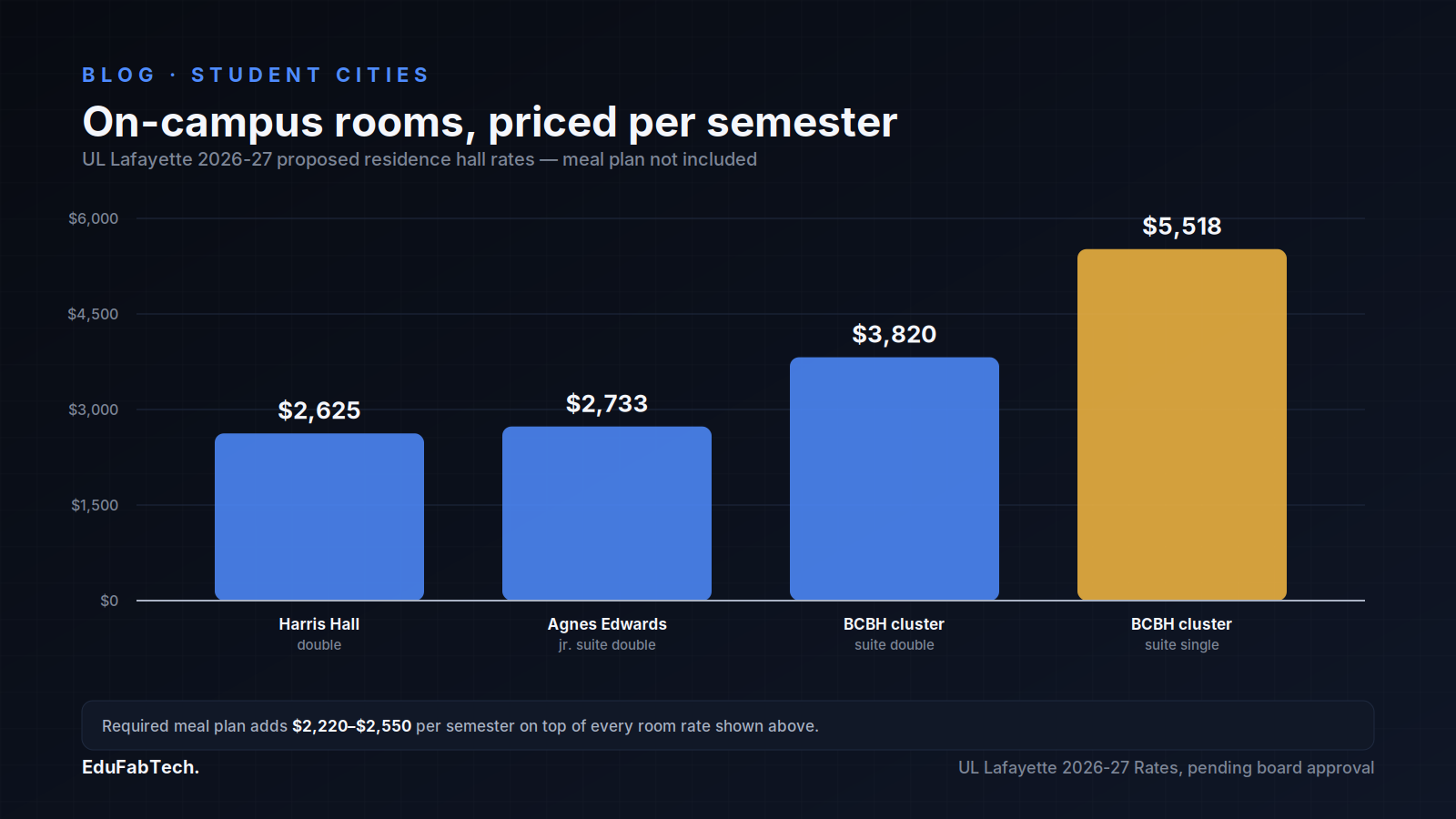
University housing sits on campus and is the simplest option for a first year, especially if you are arriving from abroad and cannot view a place in person. UL Lafayette's residence halls each require a meal plan, and its 2026–2027 rates page (with figures listed as proposed pending board approval) prices rooms per student, per semester: a traditional double in Harris Hall at $2,625, a junior suite-style double in Agnes Edwards Hall at $2,733, and a suite-style double in the Bonin, Coronna, Baker and Huger halls at $3,820. Singles run higher — up to $5,518 per semester for a suite-style single in that same cluster. The required meal plan adds either $2,220 (Cajun Select) or $2,550 (Cajun Freedom) per semester on top. Those are per-semester numbers, so double them for a rough academic-year cost.
Most students, though, live off campus. First-time freshmen are the exception: the university's housing office states that anyone starting their freshman year is required to live on campus, and it runs six residence halls and three apartment complexes for them. After that first year most students move out, and the usual off-campus pattern is a shared house or apartment in the neighbourhoods ringing campus — the Saint Streets and Freetown-Port Rico just north and east, the areas off Johnston Street and University Avenue, and the student-apartment complexes further south toward the Oil Center and Kaliste Saloom Road. A car is the default here; if you will not have one, prioritise walking or cycling distance to campus over a cheaper rent further out.
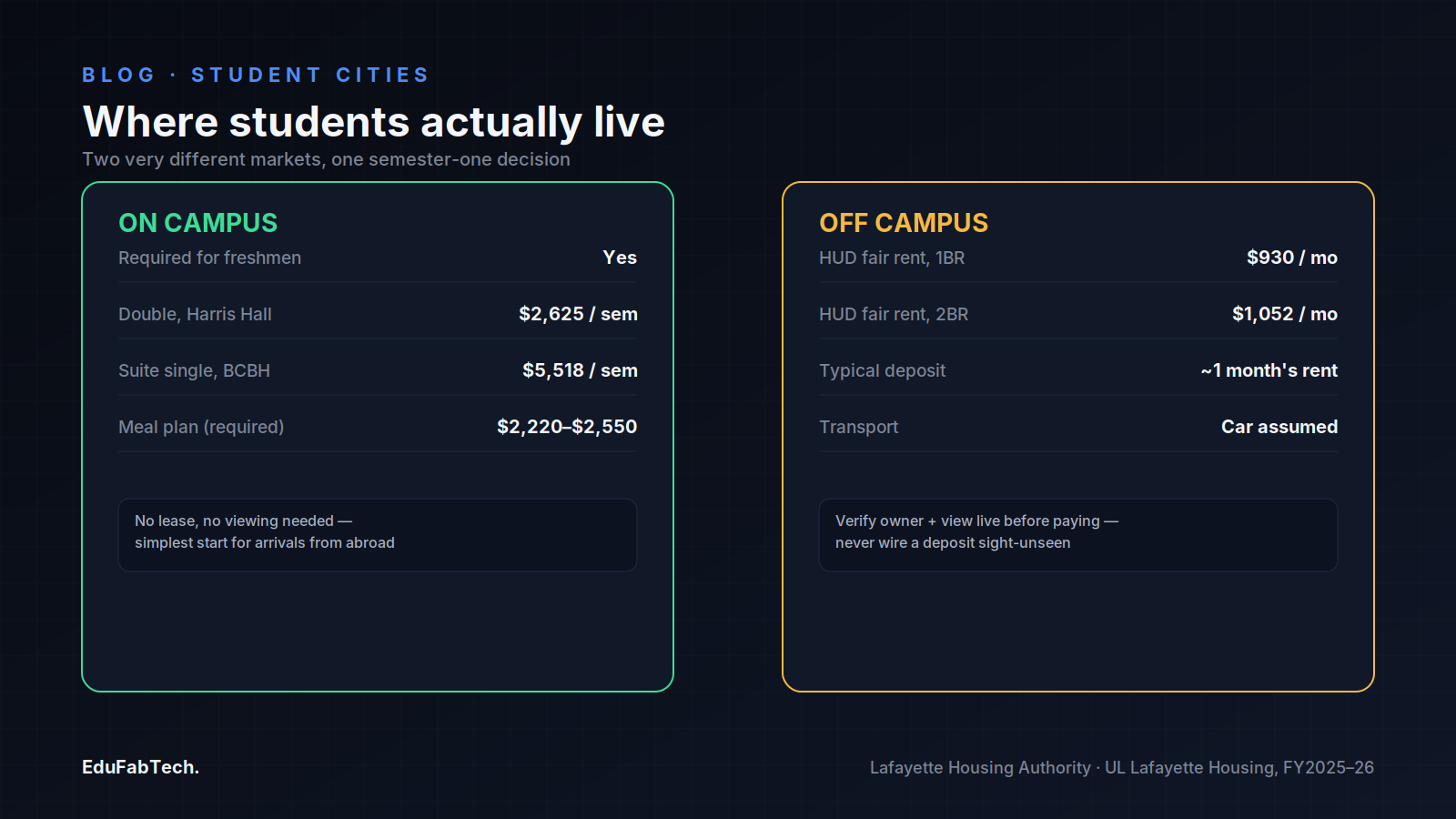
For off-campus budgeting, the clearest public benchmark is the Fair Market Rent that the U.S. Department of Housing and Urban Development sets for the Lafayette area. The Lafayette Housing Authority publishes those figures: for the FY2025 schedule it lists a one-bedroom at $930 and a two-bedroom at $1,052 a month. These are HUD reference rents, not an average of listings, but they give you a defensible yardstick: a two-bedroom shared between two people should land well under the on-campus suite figures above. You can compare live rooms on EduFabTech's Lafayette rooms page.
Renting safely: what is normal here, and what is not
Off-campus renting in Lafayette is largely informal — individual landlords and small complexes advertising on social media and listing sites. That informality is where scams appear. The pattern is consistent: a room priced noticeably below everything comparable, a "landlord" who is conveniently out of town, and pressure to send a deposit to "hold" it before you can see it. Do not. Never send money by bank wire, gift card or cryptocurrency to reserve a place you have not entered — those transfers cannot be reversed, and no legitimate Lafayette landlord needs them.
A normal arrangement here is a written lease, a security deposit of roughly one month's rent, and a viewing — in person or over a live video call where the person shows you the actual unit, the street sign and the keys working in the door. If you are still overseas, lean on university housing or a verified complex for your first term and switch to a shared house once you are on the ground and can inspect it. Confirm that the person collecting rent is the owner or a named manager, not a stranger who "inherited" the listing. Check the unit for the practical things Lafayette tests hard: working air conditioning (summers are long and humid), signs of past water damage, and whether the property sits in a flood-prone low area — the 2016 floods were a reminder that drainage matters here.
Furnishing a room: markets, thrift and giveaways
Lafayette rewards the patient second-hand shopper. The city's tourism office, Lafayette Travel, maps a working circuit of resale shops, including the ARC of Acadiana Resale Store — a nonprofit stocking furniture, appliances and bedding in the Goodwill vein — along with MiMi's Attic and Hand Up Thrift for housewares and furniture, and downtown vintage-clothing spots such as Lilou and Advintage on and around Jefferson Street. For produce and local goods, the Lafayette Farmers and Artisans Market runs every Saturday from 8 a.m. to noon at Moncus Park on Johnston Street, and the long-running Acadiana Farmers Market trades on Tuesday, Thursday and Saturday mornings on Foreman Drive.
Because so many students move in and out around the semester boundaries, late May and mid-August are the best windows for cheap or free furniture as leases turn over. EduFabTech's second-hand pages for Lafayette are worth checking in those weeks; a desk and a decent mattress are the two things worth buying new or near-new, and almost everything else can be found used.
Working while you study
On-campus jobs — dining, the library, departmental assistantships — are the most accessible part-time work for students and the only kind that international students can take without extra paperwork. For anyone on an F-1 student visa, the rules are set federally, not by the university: the Student and Exchange Visitor Program explains on its employment page that F-1 students may work on campus up to 20 hours per week while school is in session, and that off-campus work through Curricular Practical Training or Optional Practical Training must be authorised in advance — CPT by your Designated School Official on your Form I-20, and OPT by U.S. Citizenship and Immigration Services via an Employment Authorization Document. Read that official page and talk to UL Lafayette's international office before accepting any job; this guide is not legal advice, and the penalties for working out of status are serious. Local openings aimed at students are collected on EduFabTech's Lafayette jobs page.
Libraries and places to study
The university's main library is the Edith Garland Dupré Library at 400 E. St. Mary Blvd, on the eastern edge of campus. Its published fall-semester hours run Monday–Thursday 7 a.m. to midnight, with shorter Friday, Saturday and Sunday hours, and the library extends to around-the-clock opening during finals week — useful to know when every seat on campus fills up in early December. Off campus, the Lafayette Public Library runs a parish-wide system; its Main Library is downtown at 301 W. Congress St, and the system operates nine branches across Lafayette Parish, several within the city, giving you quiet desks and free wifi beyond campus hours. For cafés and co-working-style desks that other students rate, see the study spaces listings.
Getting around without assuming a car
Lafayette is a driving city, and most students have a car, but there is a public option. The Lafayette Transit System (LTS) runs fixed bus routes through a downtown terminal; the Lafayette Consolidated Government's transit information lists an adult fare of $1.00 per trip, a reduced fare of $0.50 for seniors, Medicare and disabled riders, a day pass at $3.00 and a 12-ride pass at $10.00, with day service generally running about 5:45 a.m. to 5:30 p.m. and more limited night service until about 9:30 p.m., Monday through Saturday, and no Sunday service. No university-specific student discount is listed on that page, so budget the standard fares; the low base price is the real benefit. The flip side is coverage and span — night service is limited and there is no Sunday service at all, so students who rely solely on the bus should check that their route reaches campus at the hours they need. Within the campus-and-Saint-Streets core, walking and cycling are realistic; further out, they are not.
What is good, and what is hard
The good is genuine. Lafayette is affordable by U.S. standards, the HUD reference rents above sit well below those of large coastal cities, and the city's music, food and festival culture gives students a social life that costs little — Festival International and Festivals Acadiens et Créoles are both free. UL Lafayette's size means a full range of programmes and campus life without a megacity's anonymity, and the university was named a national leader for social mobility by the Brookings Institution for its access for lower-income students, as its fast-facts page records.
The hard parts are equally real. The climate is demanding: summers are long, hot and humid, and the broader region carries hurricane and flood risk, so air conditioning and flood exposure are things to check before you sign anything. The car-centric layout and limited evening transit make life harder without a vehicle than the fare table alone suggests. And Lafayette's economy is tied to energy prices, which can make the off-campus rental and job markets swing more than in a diversified city. None of this is a reason to stay away — it is a reason to plan.
A short checklist for your first weeks
- Sort housing for term one before you arrive — university halls or a verified complex if you cannot view in person; never wire a deposit to hold an unseen room.
- If you are an international student, meet UL Lafayette's international office and read the SEVP employment rules before taking any job.
- Get a state ID and, if you can, a vehicle or a confirmed bus route to campus; check LTS night and weekend coverage against your schedule.
- Use the Dupré Library and the Lafayette Public Library for study space and wifi beyond café hours.
- Furnish from the second-hand circuit — ARC of Acadiana, MiMi's Attic, the Moncus Park market — and time big purchases to the May and August lease turnover.
- Check your apartment's air conditioning and flood history before move-in, and keep deposit and lease paperwork in writing.
For everything current — rooms, jobs, free items, study spaces and events — start from EduFabTech's Lafayette listings and the pages for listings near the University of Louisiana at Lafayette.
A quick question for readers
Do you work part-time while you study?
Many students work to pay the bills. See how common it is — and how many hours people really do.
Pick an answer, create a free account in a minute, and your vote counts. Already a member? Sign in
Comments 0
CommentNo comments yet. Members start the conversation.
Source: University of Louisiana at Lafayette
Sources (5)
- University of Louisiana at Lafayette. University Housing and Residential Life — Rates (2026–2027). University of Louisiana at Lafayette, 2026. louisiana.edu ↗ · checked 17 Oct 2026
- University of Louisiana at Lafayette. Fall enrollment tops 19,200. University of Louisiana at Lafayette, 2024. louisiana.edu ↗ · checked 17 Oct 2026
- Lafayette Consolidated Government. Parking and the Lafayette Transit System. Lafayette Consolidated Government, 2026. lafayettela.gov ↗ · checked 17 Oct 2026
- Lafayette Housing Authority. Fair Market Rents & Payment Standards (FY2025, HUD). Lafayette Housing Authority, 2025. thelha.com ↗ · checked 17 Oct 2026
- U.S. Immigration and Customs Enforcement. Employment (Student and Exchange Visitor Program). U.S. Department of Homeland Security, 2026. ice.gov ↗ · checked 17 Oct 2026