Studying in Lexington, Virginia: universities, housing and student life
A practical guide to living and studying in Lexington, Virginia — a Shenandoah Valley town of about 7,500 shared by Washington and Lee, VMI and nearby Southern Virginia University.
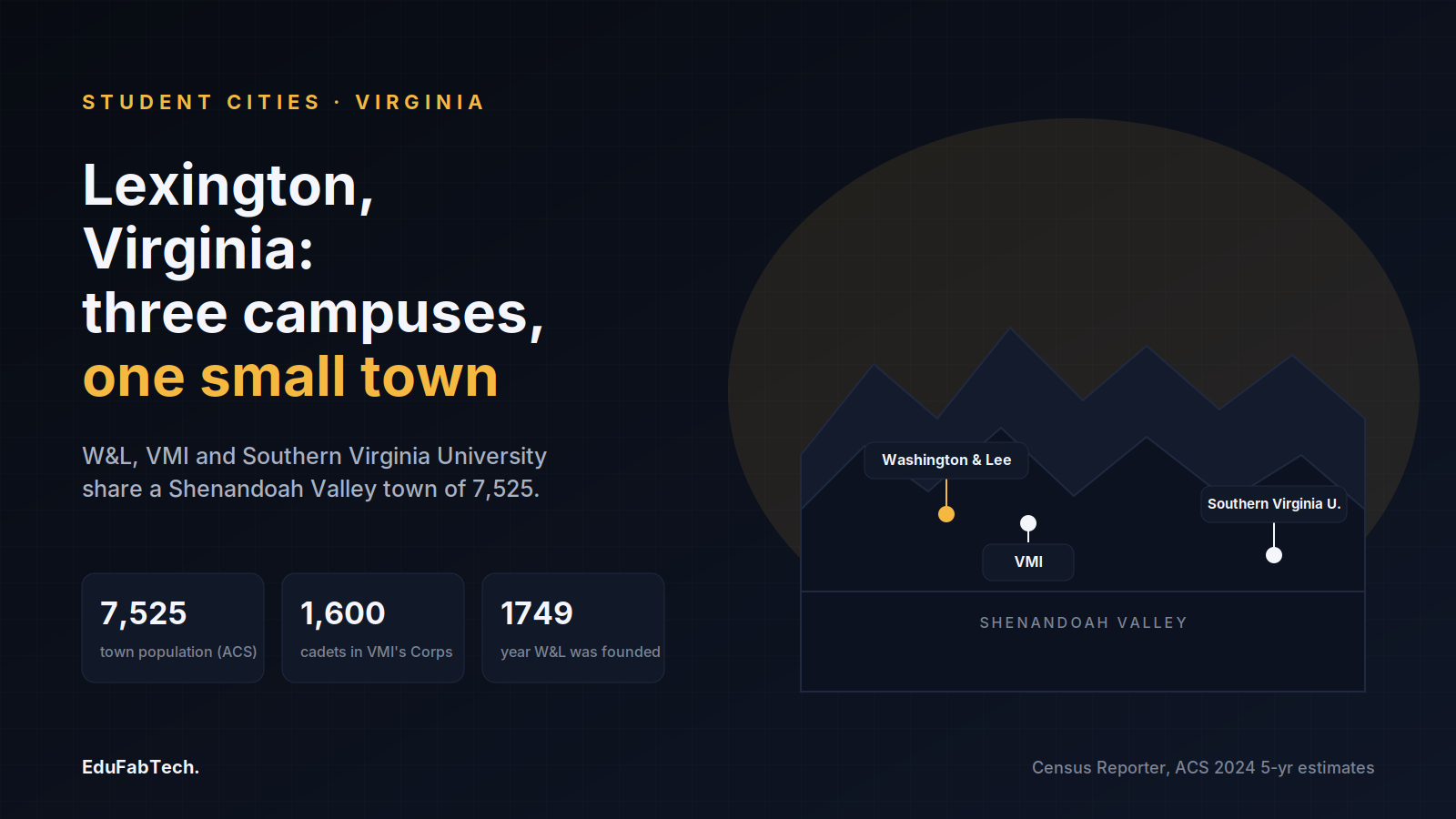
Lexington is an independent city in Rockbridge County, set in Virginia's Shenandoah Valley between the Blue Ridge and the Allegheny ranges. It is small in a way that shapes everything about student life here: the U.S. Census Bureau's American Community Survey put the population at 7,525 in its 2024 five-year estimates (as compiled by Census Reporter), and two campuses stand almost shoulder to shoulder at the edge of its historic downtown. A third degree-granting university sits a few miles southeast, in the neighbouring city of Buena Vista.
That concentration means the town's rhythm follows the academic calendar closely. The streets fill in late August and empty over the winter break; the cheap rooms, the part-time shifts and the weekend events all move with the student population. If you are coming from a larger city or from abroad, the adjustment is less about navigating a big system and more about the fact that the market for almost everything — rooms, furniture, jobs — is thin, and timing matters more than it would in a metropolis.
This guide walks through the universities, where students actually find rooms and how to avoid being cheated, furnishing a place cheaply, part-time work, libraries, getting around, what it costs, and the honest advantages and frustrations of studying in a town this size. You can browse local student listings on EduFabTech at /in/united-states/lexington-va.
Three universities, three very different experiences
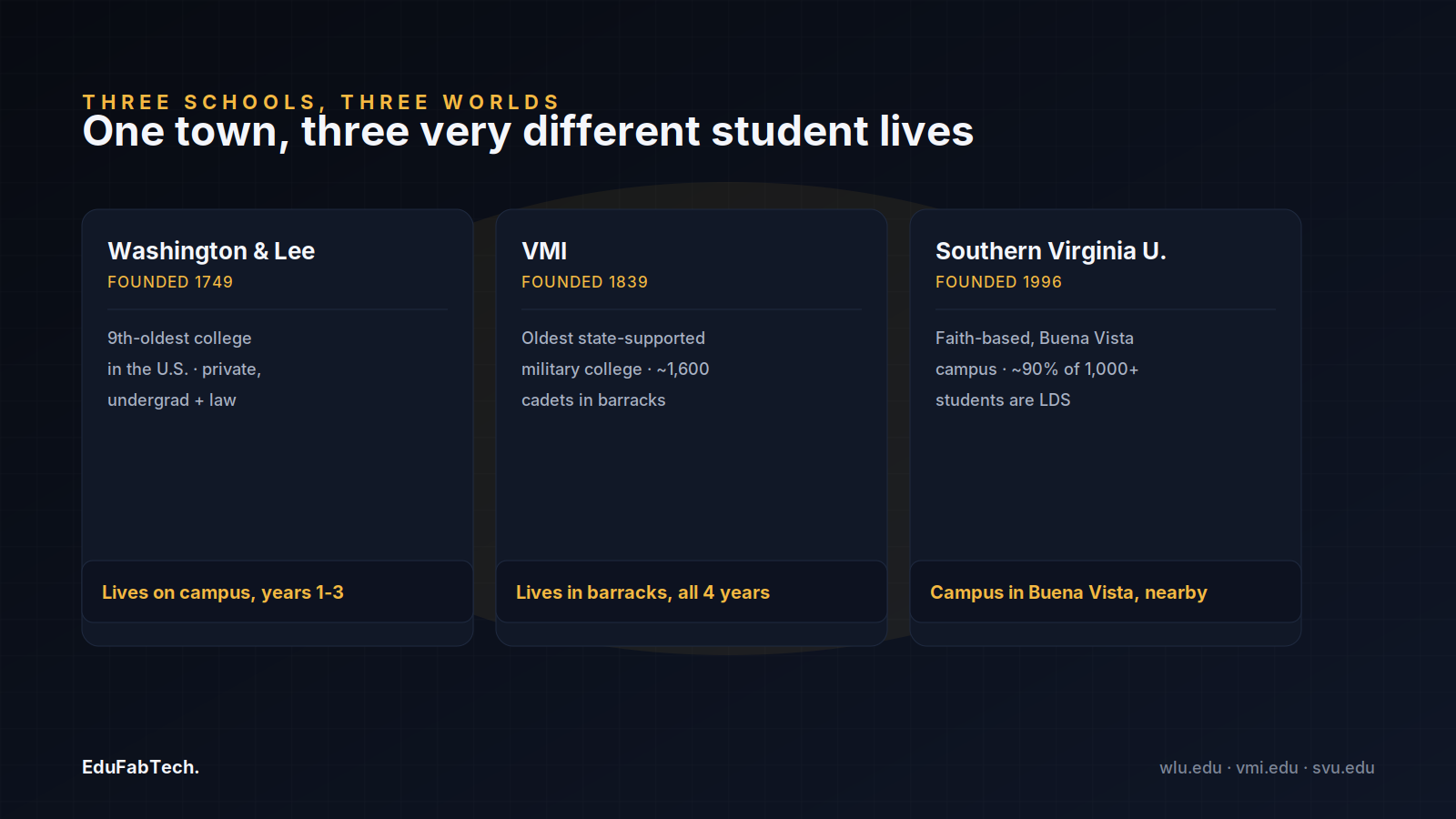
Washington and Lee University is the institution most visible in the town centre. On its own pages it describes itself as "Founded in 1749" and "the ninth-oldest college in the U.S.", a private institution in Lexington's Shenandoah Valley whose front campus — the colonnade of Classical Revival buildings around Washington Hall — is its signature image (wlu.edu). It is a small undergraduate college that also runs accredited programmes in business, journalism and law, with a long-standing student-run Honor System. Its address, 204 West Washington Street, places it directly on the edge of downtown.
Next door is the Virginia Military Institute. On its history page VMI calls itself "the nation's oldest state-supported military college," established in 1839, and every student is a cadet within a Corps of Cadets numbering roughly 1,600 (vmi.edu). The grounds are a recognised national historic district. Studying at VMI is unlike studying anywhere else in Lexington: cadets live under military discipline, wear uniform, and follow a regimented day, so the "student life" of a VMI cadet and a W&L undergraduate, though they share a town, barely overlap.
Southern Virginia University, in Buena Vista, is the third option. It describes itself as "a private, faith-based institution of higher education aligned with the restored gospel of Jesus Christ as taught by The Church of Jesus Christ of Latter-day Saints," founded in 1996 by a group of local Latter-day Saints, with more than 1,000 students on campus and about 90% of them members of the church (svu.edu). Its campus sits in the Blue Ridge foothills at the southern end of the valley, built around the historic Main Hall. Prospective students who are not Latter-day Saints should understand that the faith environment is central to the university, not incidental to it. For listings close to each campus, see /near/washington-and-lee-university, /near/virginia-military-institute-historic-district and /near/southern-virginia-university.
Where students live, and how to find a room safely
Housing in Lexington is unusual because so much of it is controlled by the universities. Washington and Lee requires undergraduates to live on campus "for your first three years," with first-years placed in one of two first-year residence halls and most seniors moving off campus (wlu.edu). VMI cadets are housed in barracks for the duration. Southern Virginia houses a large share of its students on its Buena Vista campus. The practical result is that the genuinely open rental market is small: it is mostly W&L seniors, graduate and law students, and people connected to the town who are looking for houses, apartments and rooms in and around the downtown grid and out along the Route 11 corridor.
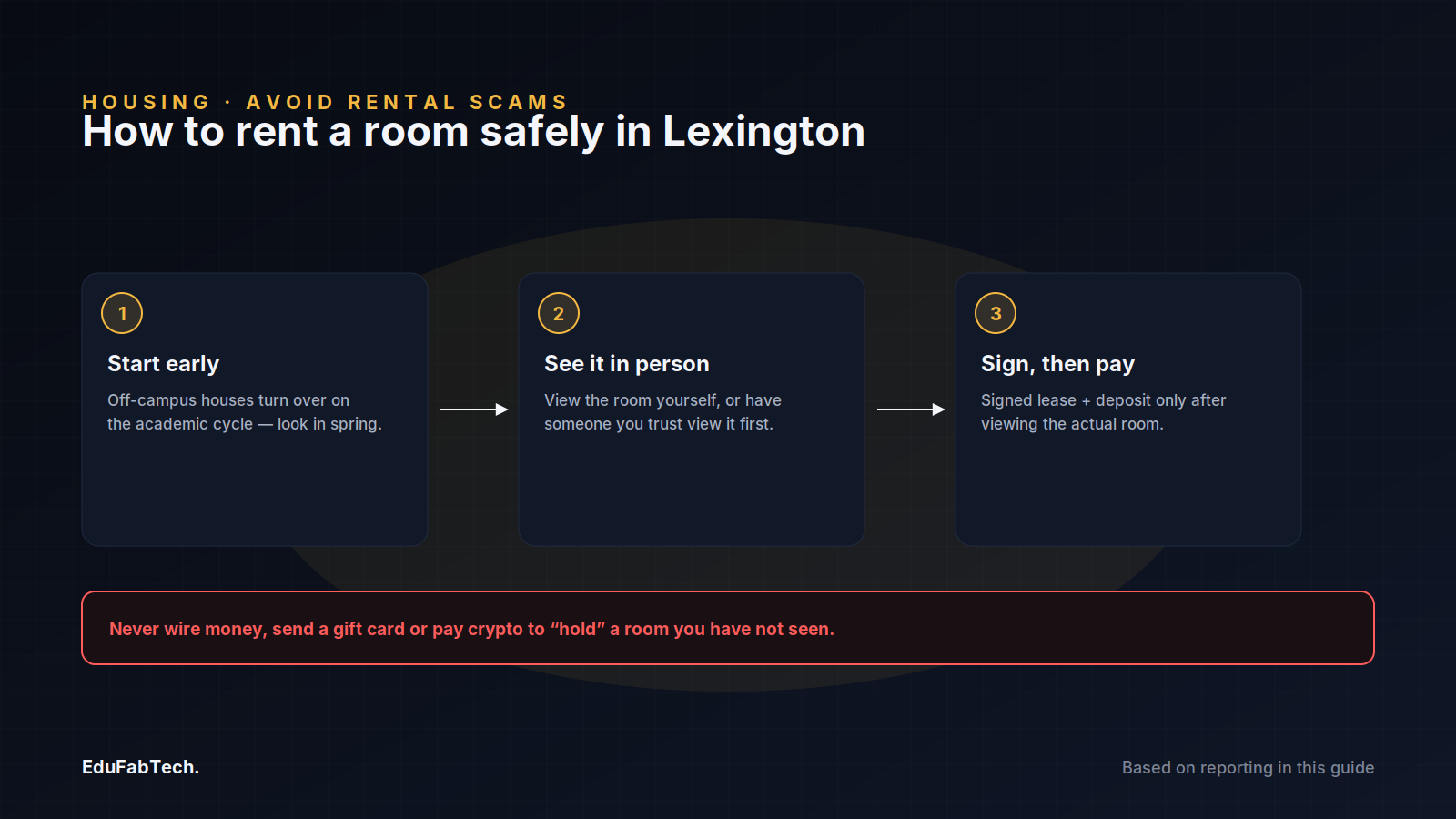
Because the supply is thin, the useful advice is about timing and verification rather than choice. Start looking early — the best off-campus houses near downtown turn over on the academic cycle, so spring is not too soon for the following autumn. Before you pay anything, see the actual room in person or have someone you trust see it; in a town this small it is usually possible to walk to any address from the W&L or VMI campus in a few minutes. Ask who the other tenants will be, what the heating is (valley winters are cold, and old houses vary enormously), and get every figure in writing.
Rental scams in small college towns tend to follow a pattern: an attractive listing, a landlord who is conveniently "out of town," and pressure to send a deposit to hold the place before you can view it. Treat that as the warning sign it is. Never send a deposit or first month's rent by bank wire transfer, gift card or cryptocurrency to secure a room you have not seen — those payments are effectively irreversible, and no legitimate Lexington landlord needs them. A normal arrangement is a signed lease and a security deposit paid once you have viewed the property and met the person renting it. Rooms and sublets posted by students are collected at /in/united-states/lexington-va/rooms.
Furnishing a room without spending much
Lexington and Rockbridge County have a real second-hand economy, partly because the Shenandoah Valley is known for its antique trade and partly because students cycle through furniture every year. The Rockbridge Area Habitat for Humanity ReStore at 114 Walker Street sells donated furniture, housewares, small appliances, books and artwork to the public, open 10am–5pm Monday to Saturday, with proceeds funding local home-building (rockbridgehabitat.org). It is the single most useful stop for a student setting up a room on a budget, and it offers free pickup of donated goods within the county — handy when you leave and need to clear out.
For food and the smaller things, the Lexington Farmers Market runs every Wednesday morning in the McCrum's parking lot on South Jefferson Street in the walkable historic downtown (lexvafm.com). Its vendors are local farmers, artisans and neighbours selling produce, baked goods, preserves and handmade crafts, so it is more a weekly source of food and local goods than of cheap furniture — but it is a fixed point in the week and a good way to learn the town. Beyond those, downtown Lexington and the Route 11 corridor hold a cluster of antique and consignment dealers typical of the valley. EduFabTech's own local boards for second-hand goods, furniture and free items are at /in/united-states/lexington-va/second-hand, /in/united-states/lexington-va/furniture and /in/united-states/lexington-va/free-stuff; the end-of-year move-out period is when free furniture appears fastest.
Part-time work, and what it means for international students
On-campus jobs — in dining halls, libraries, athletics and administrative offices — are the most common form of student work in Lexington, because the town itself is small and the universities are the largest employers. If you hold an F-1 student visa, the rules on working are set by U.S. federal immigration authorities, not by the university or the city. The Department of Homeland Security's Study in the States guidance states that F-1 students may generally work on campus, but "may not work more than 20 hours per week when school is in session," and that other categories of employment require specific authorisation (studyinthestates.dhs.gov).
This is not legal advice, and the details of your own situation matter: before accepting any job, talk to the Designated School Official (DSO) in your university's international-student office, who maintains your SEVIS record and can tell you what you are permitted to do. Off-campus work, including the common post-study options, has its own rules and approvals. Start from the official source and your DSO rather than second-hand accounts. Local and campus job postings students have shared are at /in/united-states/lexington-va/jobs.
Libraries and places to study
The main academic library for W&L students is Leyburn Library, on campus at the Washington Street address. During the academic term, W&L reports that its Leyburn and Telford library buildings are open to students around the clock, with card-swipe access during late-night and early-morning hours (my.wlu.edu). VMI cadets have Preston Library on the Institute grounds, and Southern Virginia students use the Von Canon Library on the Buena Vista campus. Because the campuses are compact, the libraries double as the town's main quiet study space; downtown cafés and the public spaces around Washington Street fill the gap for group work and casual revision. More desks and study-space listings are gathered at /in/united-states/lexington-va/study-spaces.
Getting around: the Maury Express and a town you can walk
Lexington is small enough that most students walk or cycle; the W&L and VMI campuses and the downtown grid are all within a few minutes of one another. For longer trips, the local public transport is the Maury Express, a deviated fixed-route service operated by RADAR that links Lexington, Buena Vista and Rockbridge County. The standard fare is $0.50 per trip paid on boarding, and — importantly — "Washington & Lee University and Virginia Military Institute (VMI) students ride free upon presentation of a valid student ID card" (radartransit.org). The service runs Monday to Friday 8am–6pm and Saturday 10am–4pm, with no Sunday service and closures on major holidays, so it is useful for getting between Lexington and Buena Vista or running errands, but it is not a late-night or weekend-nightlife network. Note that the free-fare benefit is specified for W&L and VMI students; Southern Virginia students should confirm their own position with the operator. Lexington has no passenger rail or airport of its own; the nearest larger city, Roanoke, is roughly 50 miles south, which means a car, a ride, or planning around the Maury Express for anything beyond the valley.
What it costs
The clearest dated housing figures come from Washington and Lee's own 2026-27 tuition letter, approved by its Board of Trustees: room is listed at $10,580 and board at $9,995 for the year, alongside tuition of $73,575 (wlu.edu). W&L is a private institution with correspondingly high sticker prices, though it is also known for substantial financial aid; the posted figure is the list price, not what every student pays. VMI, as a state-supported college, and Southern Virginia, as a smaller private university, sit at very different price points, and prospective students should take tuition and housing numbers directly from each institution's current official cost pages rather than from aggregators, which often lag a year or mix figures. For off-campus renters, Lexington does not publish a single reliable municipal rent figure that is current and student-specific, so budget from the actual rooms you view rather than a headline average.
The good and the hard
What is good about Lexington is genuine. It is compact, walkable and set in some of the most striking landscape in the eastern United States, with the Blue Ridge Parkway, the Appalachian Trail and the Maury River close by. The historic downtown is intact and pleasant, the pace is calm, and the two central campuses give the town an unusually dense academic life for its size. Transport costs are low, and for W&L and VMI students the local bus is free.
What is hard is mostly a function of scale. A city of about 7,500 has a thin rental market, limited nightlife, few large shops, and little public transport in the evenings or on Sundays. Winters in the valley are cold, and getting to a major city or airport takes planning and usually a car. For international students in particular, the small size can mean fewer established communities from your home country and a quieter social scene than a big university city would offer. At the private end, the cost of study is high. None of this is hidden if you visit before committing — which, for a town this walkable, is entirely feasible.
A short checklist for your first weeks
- Confirm your housing status first: if you are a first- to third-year W&L undergraduate or a VMI cadet, your accommodation is arranged, so check in with residence life before chasing off-campus rooms.
- If you are renting off campus, view the property in person before paying, get a signed lease, and never wire a deposit or pay by gift card or crypto to "hold" a place.
- Register with your university's international-student office and meet your DSO early if you hold an F-1 visa, before taking any job.
- Pick up a student ID and try the Maury Express once — it is free for W&L and VMI students and connects you to Buena Vista.
- Furnish from the Habitat ReStore on Walker Street and watch the local free-furniture boards around move-out periods.
- Learn the Wednesday farmers market and the walking routes between campus, downtown and the library before term gets busy.
- Browse current local listings and events on EduFabTech at /in/united-states/lexington-va/events.
A quick question for readers
Do you work part-time while you study?
Many students work to pay the bills. See how common it is — and how many hours people really do.
Pick an answer, create a free account in a minute, and your vote counts. Already a member? Sign in
Comments 0
CommentNo comments yet. Members start the conversation.
Source: Washington and Lee University
Sources (5)
- Washington and Lee University. 2026-27 Tuition Letter. Washington and Lee University Business Office, 2026. wlu.edu ↗ · checked 16 Oct 2026
- Virginia Military Institute. The History of VMI. Virginia Military Institute, 2026. vmi.edu ↗ · checked 16 Oct 2026
- RADAR. Maury Express — Ridership Information. RADAR Transit, 2026. radartransit.org ↗ · checked 16 Oct 2026
- U.S. Census Bureau. Lexington, VA — American Community Survey 2024 five-year estimates. Census Reporter, 2024. censusreporter.org ↗ · checked 16 Oct 2026
- U.S. Department of Homeland Security. Working in the United States (F-1 students). Study in the States, 2026. studyinthestates.dhs.gov ↗ · checked 16 Oct 2026