Studying in Logan: universities, housing and student life
A practical, sourced guide to living and studying in Logan, Utah — Utah State University, where students find rooms, zero-fare buses, study spaces, costs and the honest trade-offs of a mountain-valley college town.
Logan and Utah State University
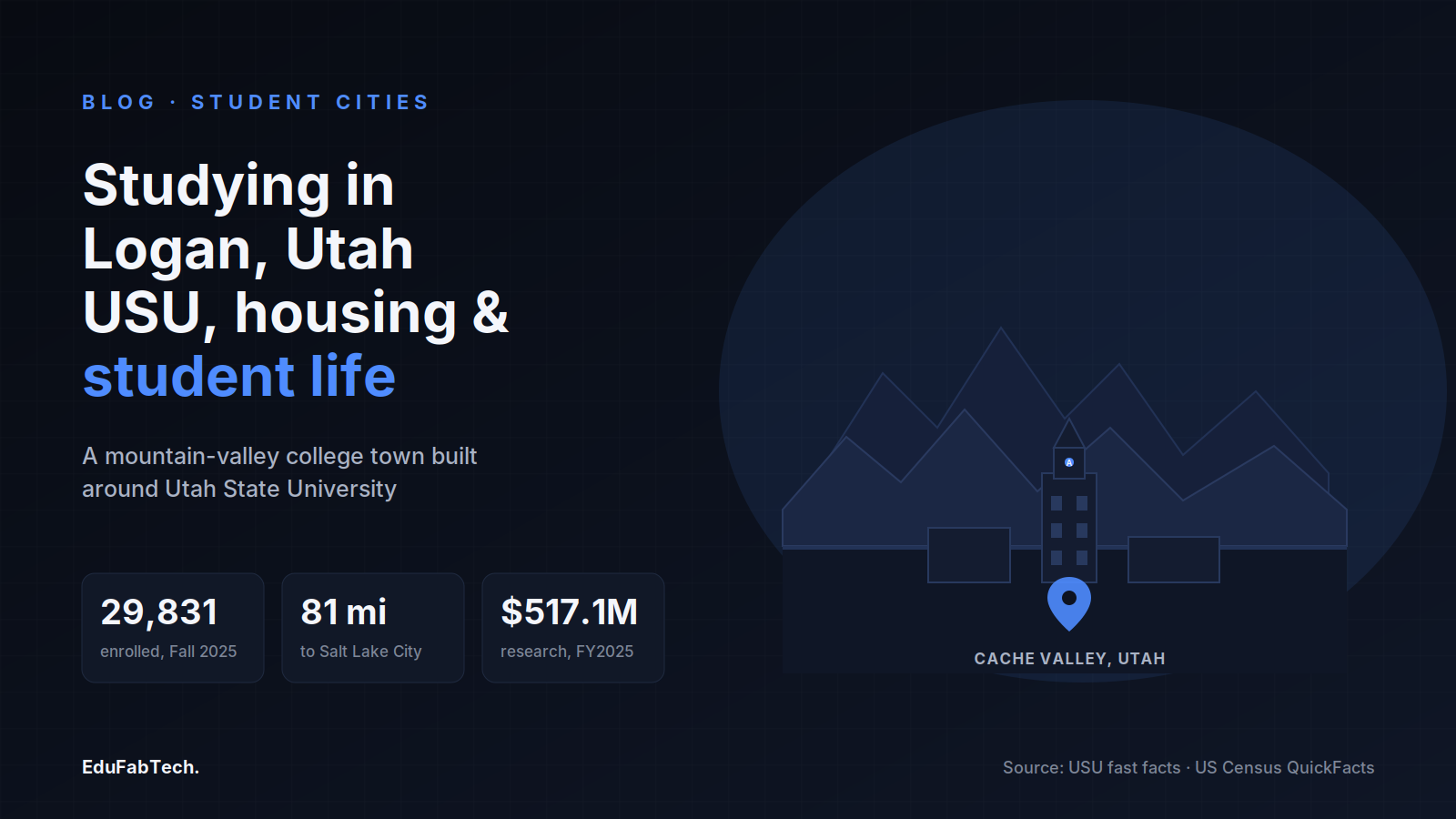
Logan sits at the bottom of Cache Valley, a flat-floored basin ringed by the Bear River Range to the east and the Wellsville Mountains to the west, about 81 miles northeast of Salt Lake City — a distance Utah State University states on its fast-facts page. The university occupies a bench of raised ground on the valley's eastern edge, so the walk between the residence halls and the Quad runs uphill past Old Main, the 1889 building whose tower (with its lit "A") is visible from most of town. The same page notes the Logan campus is "two minutes to Logan Canyon," the limestone gorge that carries U.S. 89 up toward Bear Lake and is the reason so many students own skis, climbing shoes or a fishing rod before they own a sofa.
Utah State is the anchor of the city and, for most students, the reason they are here. According to its own fast-facts page, USU was founded in 1888 as a land-grant institution, is classified by the Carnegie framework as an R1 "very high research" university, and enrolled 29,831 students in Fall 2025 — 26,629 undergraduates and 3,202 graduate students — while drawing $517.1 million in sponsored awards in FY2025. The agricultural and engineering roots run deep: USU began as an agricultural college, and the Space Dynamics Laboratory, which builds instruments for NASA and defence missions, grew out of the same campus. The same page records that Washington Monthly named USU "Best bang for the buck in the West" in its 2025 rankings.
Not every Aggie studies on the Logan campus. USU runs a statewide system of regional campuses, and the nearest, USU-Brigham City, sits at 989 South Main Street in Brigham City — in Box Elder County, about a 25-mile, half-hour drive south over Sardine Canyon rather than in Logan itself. If you are weighing a shorter commute from the south against the full on-campus experience, it is worth knowing the regional option exists before you sign a lease in Logan.
Where students live
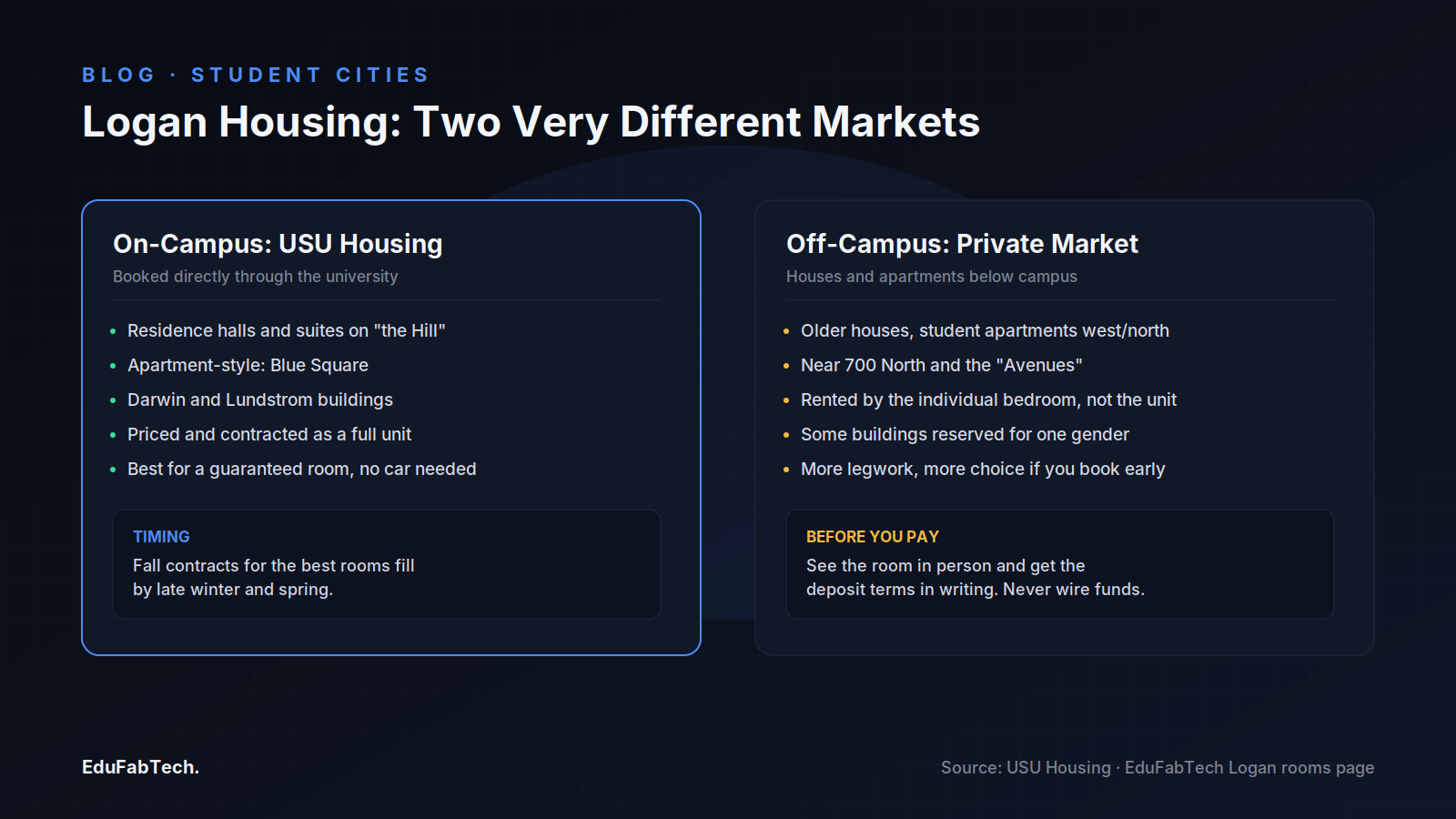
Housing in Logan divides cleanly into two worlds. The first is university housing: the traditional residence halls and suite buildings on the Hill, plus apartment-style complexes such as Blue Square and the Darwin and Lundstrom buildings, all booked through USU Housing. The second is the private market in the neighbourhoods below campus — the grid of older houses and purpose-built student apartments on the streets west and north of the university, especially around 700 North and the "Avenues" close to downtown. Logan's single-student off-campus housing is heavily shaped by local norms: many complexes are rented by the individual bedroom on a contract, not by the whole unit, and some are reserved for one gender per building, a pattern you will not see in most American college towns.
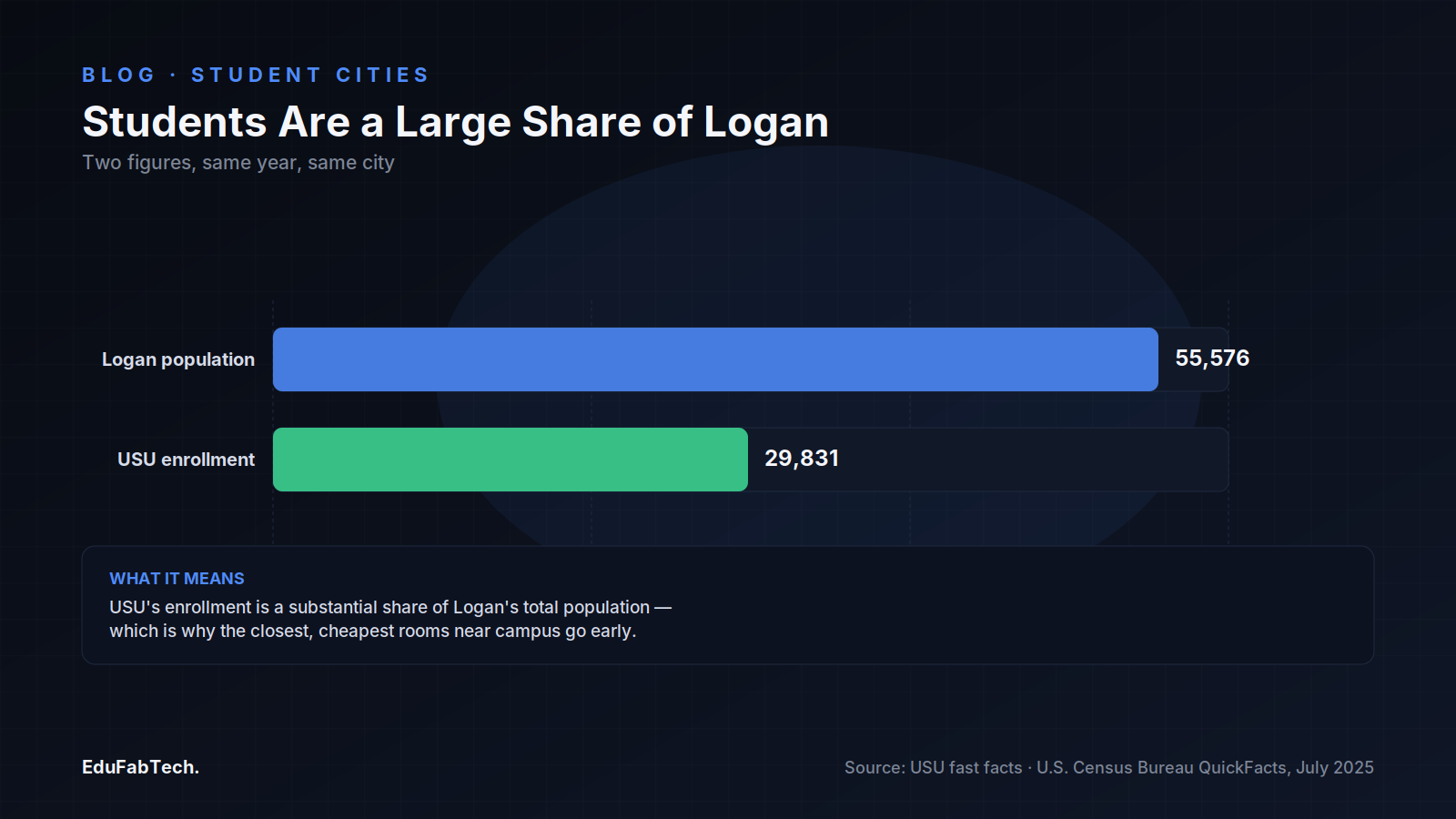
Timing matters more than newcomers expect. Because USU's intake is large relative to the city — Logan's estimated population was 55,576 in July 2025, per U.S. Census Bureau QuickFacts, so students are a substantial share of residents — the best rooms near campus are claimed months ahead. On-campus contracts and the better private bedrooms for a fall start are typically settled in late winter and spring. If you are arriving from abroad in August, assume the closest and cheapest options are already gone and plan to either take a university contract early or accept a longer walk from further down the valley. You can browse current listings and rooms for the city on EduFabTech's Logan page and its rooms section.
Renting safely in Logan
The mechanics of a Logan lease are specific enough that generic advice misses the point. By-the-bedroom contracts mean the deposit and the "shared areas" clause are what you actually negotiate, not a whole-flat rent. A deposit of one month or a fixed few hundred dollars is normal; anything far larger, or a demand to pay before you have seen the room, is the warning sign. The scams that appear here follow the national pattern but land on students new to the valley: a "landlord" who is conveniently out of state, a room advertised below the going rate, and pressure to send money to "hold" it before a viewing.
Three rules cover almost all of it. See the actual room in person — or have someone you trust see it — before any money changes hands; Logan is small enough that a genuine room can almost always be viewed within a day or two. Get the contract and the deposit terms in writing before you pay. And never send a deposit by bank wire transfer, gift card or cryptocurrency to reserve a place, because those payments cannot be reversed and no legitimate Logan landlord needs them. If a listing you found through EduFabTech's rooms section asks for any of those, treat it as a red flag and walk away.
Furnishing a room cheaply
Second-hand supply in Cache Valley is unusually good for a town this size, largely because the student population turns over every spring and because the surrounding community donates heavily. The big one is the Deseret Industries thrift store at 175 West 1400 North in Logan — a large warehouse-style shop with furniture, kitchenware and clothing, useful for kitting out a first apartment in an afternoon. Downtown, Somebody's Attic at 39 West 100 North is a non-profit resale shop that, according to The Family Place, has operated since 1985 and channels its proceeds to CAPSA (Citizens Against Physical and Sexual Abuse) and The Family Place; there is a second location in nearby Smithfield.
For food and the seasonal flavour of the place, the Cache Valley Gardeners' Market runs on Saturday mornings behind the Historic Courthouse at 199 North Main Street from spring through to mid-October, as the market's own site describes — produce, prepared food and local makers rather than cheap furniture, but a good way to eat well and meet people in your first weeks. For the kitchen gear and the end-of-semester giveaways that flood Logan every April and December, EduFabTech keeps city-specific pages for second-hand things and things given away free.
Part-time work and the rules
If you are an international student, the limits on work are set by your visa, not by your employer, and getting this wrong has serious consequences — so read the official sources and ask USU's advisers rather than relying on word of mouth. The U.S. Department of Homeland Security's Study in the States guidance states plainly that an F-1 student doing on-campus employment "may not work more than 20 hours per week when school is in session." USU's Office of Global Engagement spells out the local application: F-1 and J-1 students may work for USU entities up to 20 hours per week during the fall and spring semesters and up to 40 hours per week during school breaks, and F-1 students "may not work or engage in internship activities with non-USU entities without Curricular Practical Training or Optional Practical Training (OPT) authorization."
In practice that makes on-campus jobs — dining, the library, research labs, the recreation centre — the straightforward route for most international students, since they count as on-campus employment and are easy to combine with classes. Domestic students have no such cap and often work in the shops and restaurants downtown. Whatever your status, confirm the current rules with the Office of Global Engagement before you accept anything, and treat this guide as a pointer, not legal advice. Current openings posted for the city sit on EduFabTech's Logan jobs page.
Libraries and places to study
The centre of academic life is the Merrill-Cazier Library on the north side of campus. According to the library's own profile, the building opened in September 2005, covers 305,000 square feet, and offers an overall seating capacity of 3,843 including 39 group study rooms; its automated storage system, the BARN, holds capacity for more than 1.5 million volumes retrieved on request. The group rooms can be booked online in advance, which matters during the two or three weeks around finals when seats become genuinely scarce.
Beyond the library, the Taggart Student Center and the quieter corners of departmental buildings give you fallback options, and much of campus has long opening hours during term. Because so many students live within walking distance, study space is as much about timing as location — late mornings fill the library, late evenings empty it. EduFabTech lists desks, rooms and quiet corners around the city on its study-spaces page.
Getting around without a car
Logan is one of the easier American college towns to live in without a car, because the local bus network is genuinely free. Connect Public Transit — the Cache Valley Transit District, which dropped the old CVTD name in 2024 — states on its hours page that "all Connect Transit services are zero fare," with no charge to ride. Its in-town routes (1–9) run roughly 6:30 a.m. to 8:30 p.m. Monday to Friday and 10:30 a.m. to 6:30 p.m. on Saturdays, with longer regional routes reaching out across the valley; there is no Sunday service and no service on major holidays.
On campus, the natural-gas Aggie Shuttle circulates on several weekday routes plus an evening loop, and USU's arrival guide for international students confirms both that "Connect works hard to provide FREE transportation to all members of the community" and that the Aggie Shuttle is "a completely FREE transportation service." The same page notes that USU offers free bike rentals through Aggie Blue Bikes, from a day up to three months — a practical way to cover the flat valley floor in the warmer months. Between the zero-fare buses, the shuttle and a bike, a student can reach classes, groceries and downtown without ever paying a fare.
Costs, climate and the honest trade-offs
On housing, the most reliable figures are USU's own. Its 2026–2027 rates show a wide range on the Hill: a shared room in Richards Hall is listed at $1,640 per semester and a private room there at $2,920, a shared room in the Living Learning Community at $2,810, and at the high end a studio in Blue Square Apartments at $5,670 per semester. Most traditional halls require a meal plan on top, with USU's 2026–27 plans ranging from $1,400 to $2,650 per semester. For the private market, the broadest dated benchmark is the U.S. Census Bureau's QuickFacts for Logan, which puts the median gross rent at $1,149 for 2020–2024 and median household income at $60,687 — a reminder that, as a student, you are renting in a town where many households earn modestly too.
| Option (USU, 2026–27) | Per semester |
|---|---|
| Richards Hall, shared room | $1,640 |
| Richards Hall, private room | $2,920 |
| Living Learning Community, shared | $2,810 |
| Blue Square Apartments, studio | $5,670 |
The honest difficulties are climate and air. Logan winters are long, cold and snowy, and the valley's geography traps cold air: Cache County is, in the City of Logan's own words on its air-quality page, "designated as a non-attainment area for PM2.5," with "periodic serious winter inversions when PM2.5 levels are high." During a bad inversion the air near the valley floor can rank among the worst in the country for days at a time, which matters if you have asthma or plan to run outdoors in January. Set against that, the upsides are real: free transit, a walkable campus, outdoor access within minutes, and a cost base lower than Utah's Wasatch Front cities. The hard parts are the winter air, a housing market that tightens every August, and the isolation of a small valley an hour and a half from the nearest big city.
Your first weeks: a short checklist
- Sort housing before you arrive. Either take a USU on-campus contract early or view a private room in person before paying — and never wire a deposit to hold a place unseen.
- Download the Connect and Aggie Shuttle tracking apps; both are zero-fare, so you can reach groceries and downtown from day one without a car.
- If you are on an F-1 or J-1 visa, meet the Office of Global Engagement before accepting any job, and keep to the 20-hour on-campus limit during term.
- Furnish from Deseret Industries and Somebody's Attic, and watch the end-of-semester free-stuff wave in December and April.
- Book a group room at the Merrill-Cazier Library early in finals weeks, and prepare for winter inversions — a well-fitting mask and an indoor exercise plan help.
A quick question for readers
Do you work part-time while you study?
Many students work to pay the bills. See how common it is — and how many hours people really do.
Pick an answer, create a free account in a minute, and your vote counts. Already a member? Sign in
Comments 0
CommentNo comments yet. Members start the conversation.
Source: Utah State University
Sources (5)
- Utah State University. General Information (Fast Facts). Utah State University, 2025. usu.edu ↗ · checked 15 Oct 2026
- Utah State University. Housing Rates & Dates: 2026-2027. Utah State University, 2026. usu.edu ↗ · checked 15 Oct 2026
- U.S. Census Bureau. QuickFacts: Logan city, Utah. U.S. Census Bureau, 2025. census.gov ↗ · checked 15 Oct 2026
- Connect Public Transit. Hours & Holidays. Cache Valley Transit District, 2026. rideconnectutah.gov ↗ · checked 15 Oct 2026
- Utah State University. International Student Employment / Experiential Learning. Utah State University Office of Global Engagement, 2026. usu.edu ↗ · checked 15 Oct 2026