Studying in Middlebury (village): universities, housing and student life
A practical, sourced guide to studying in Middlebury, Vermont — one college that houses nearly everyone, a thin off-campus market, fare-free buses, and what it all costs.
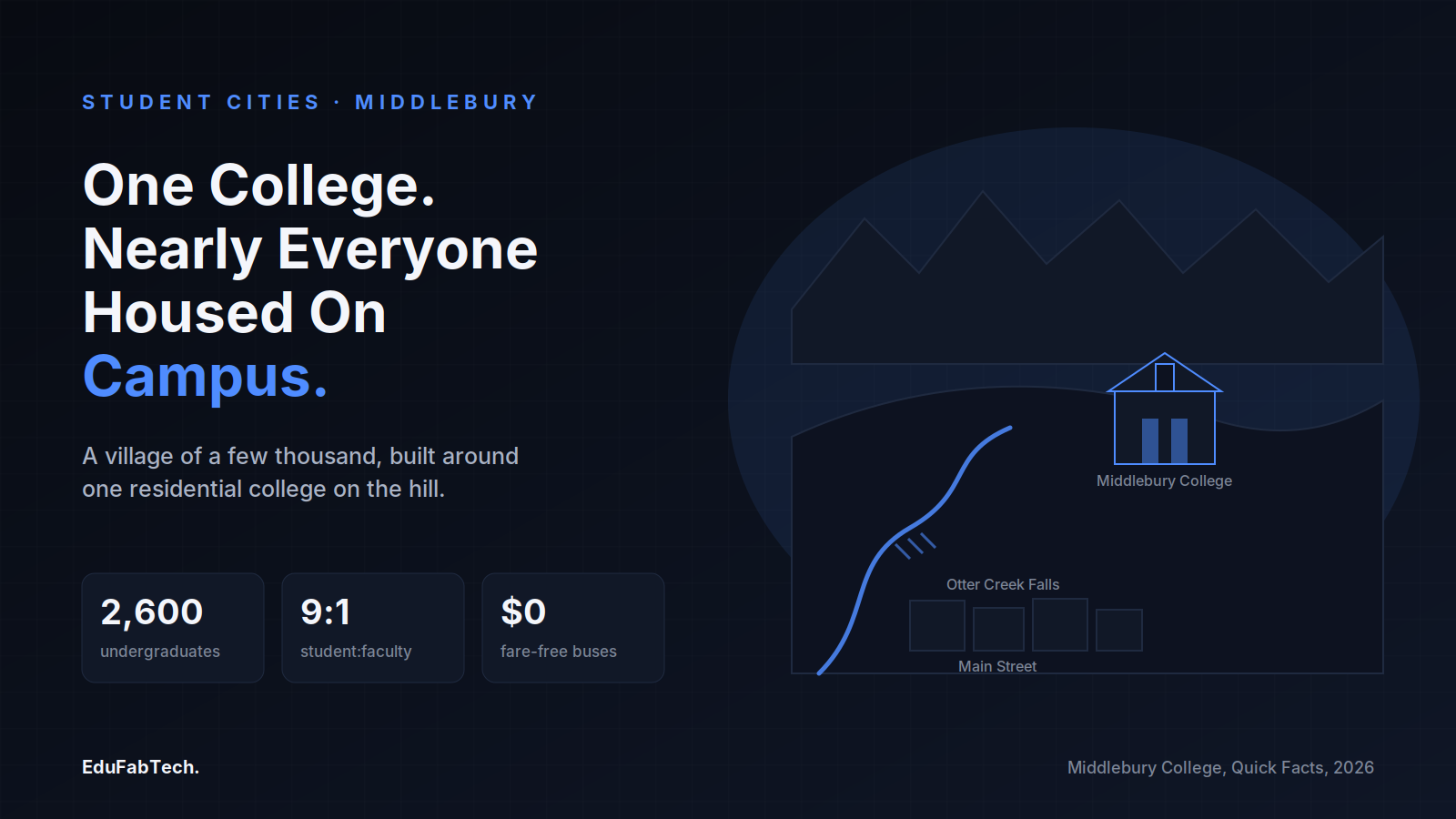
Middlebury sits in Vermont's Champlain Valley, in the narrow band of farmland between the Green Mountains to the east and New York's Adirondacks across Lake Champlain to the west — a geography the college names in its own description of itself (Middlebury College, Quick Facts, 2026). The village sits on Otter Creek, whose falls run through the centre of town; the restored Marble Works complex beside them now houses downtown shops and offices (Experience Middlebury).
For a student, the first thing to understand is scale. This is a village of a few thousand people whose character is set almost entirely by one institution on the hill above downtown. There is essentially one four-year college here, it is residential by rule, and the walk from a dorm to the bookshops and cafés on Main Street is a matter of minutes. That shapes everything that follows — where you can live, what you pay, how you get around, and what you give up for the quiet.
Middlebury is not a big university town with a crowded rental market and a dense transit network, and little here pretends otherwise. What follows is how studying and living in the village actually works, with each figure tied to the page it came from.
The one college on the hill
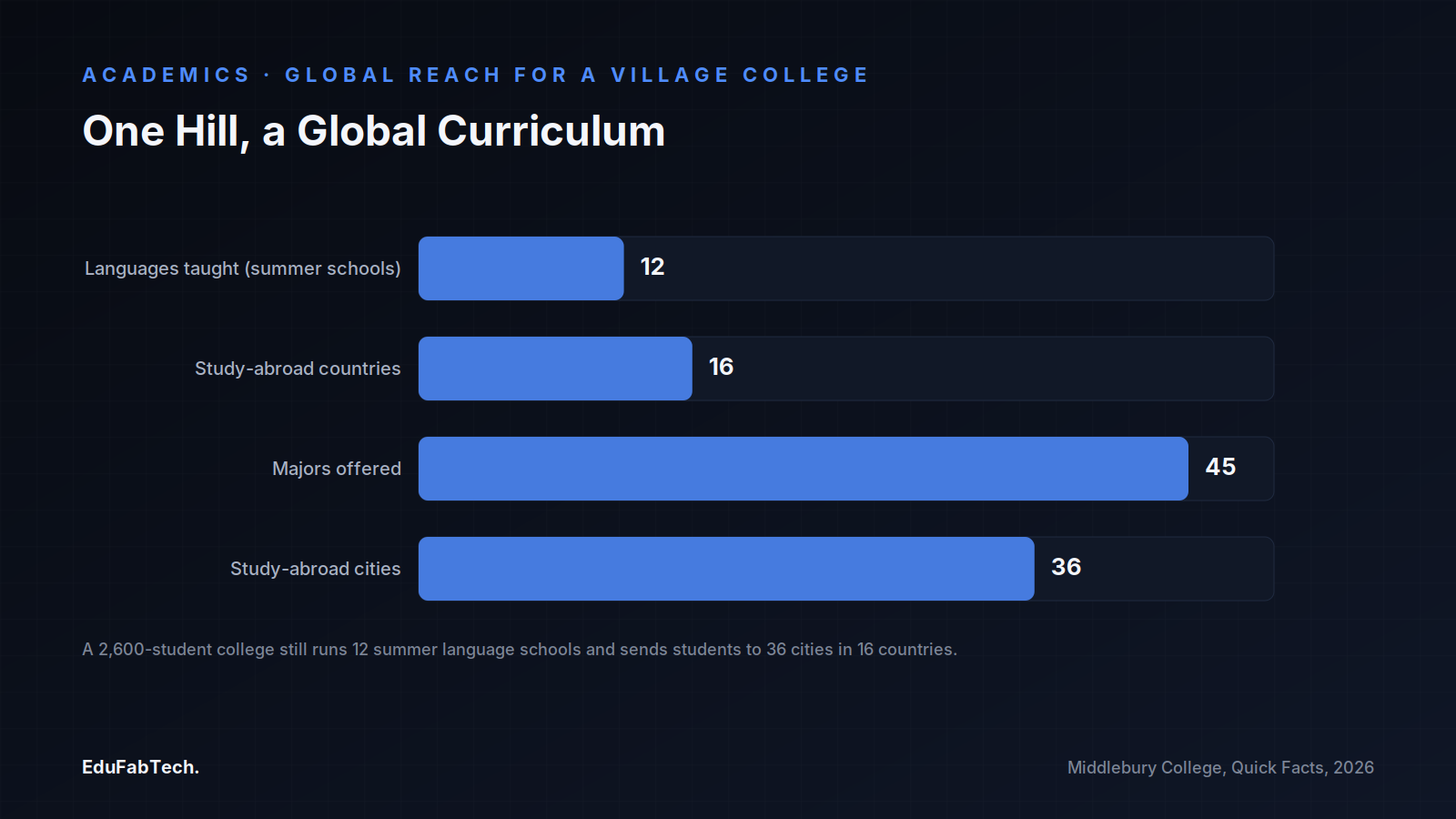
Middlebury College was founded in 1800 and enrolls about 2,600 undergraduates, offering more than 850 courses across 45 majors alongside STEM and preprofessional programs, with a 9:1 student-to-faculty ratio and an average of 16 students per class (Middlebury College, Quick Facts, 2026). It describes itself as nationally known for environmental studies and international studies, and it is unusual in the reach of its language teaching: the summer Language Schools cover 12 languages, it runs study-abroad programs in 16 countries and 36 cities, and it operates the Bread Loaf School of English (Middlebury College, Quick Facts, 2026).
One point of cost worth knowing before you apply: on 24 September 2026 the college announced that, beginning with students admitted for fall 2027 (the Class of 2031), it would be tuition-free for admitted students from families with annual incomes up to $175,000 and typical assets, as reported by the local newspaper the Addison Independent (Addison Independent, 24 September 2026). For students who do not qualify for aid, the full sticker price is high — see the costs section below.
If you see "Middlebury Institute of International Studies" in a search, note it is a separate graduate campus in Monterey, California, not in this village; it is not part of life in Middlebury, Vermont. (See NOTES.)
Living on campus is the default — and nearly the only option
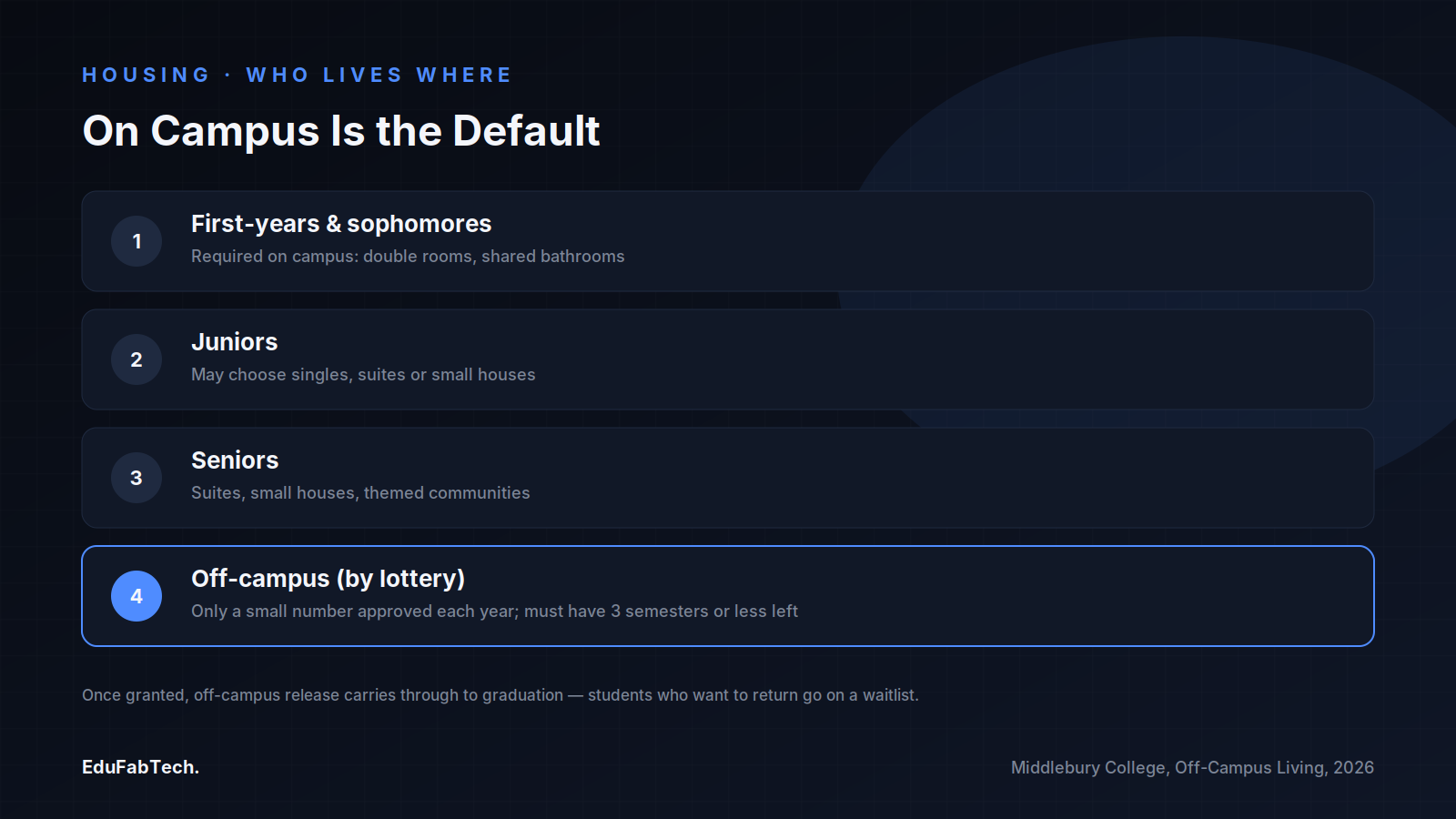
Middlebury requires all active, full-time students to live on campus, and each year only a small number are approved to live off campus (Middlebury College, Off-Campus Living, 2026). You cannot even apply to the off-campus lottery until you have three semesters or less until graduation, and the release, once granted, carries through to graduation — students who later want to return to campus housing go on a waitlist and are approved only as space allows (Middlebury College, Off-Campus Living, 2026).
In practice this means first-years and sophomores live in residence halls — typically double rooms with shared bathrooms — while juniors and seniors can choose singles, suites, small houses and themed communities. For most undergraduates the whole "finding a room" problem that dominates other college towns simply does not exist: the college places you. You can browse what student life in the village looks like on EduFabTech's Middlebury listings.
The thin off-campus market, and how not to lose a deposit
Because the college houses almost everyone, Middlebury's off-campus rental pool is genuinely small — a handful of senior-lottery households, people tied to the summer Language Schools and Bread Loaf sessions, and the usual local tenants. That thinness is exactly what makes scams work: when real listings are scarce, a fake one that is cheap, available now and "close to campus" stands out and tempts people to act fast.
Treat any of these as a stop sign. A landlord who will not let you see the unit in person or on a live video walk-through before you pay; a request to wire a deposit, send a gift-card code, or pay in cryptocurrency to "hold" a room; a price well below everything else; or pressure to decide today because "someone else is interested." No legitimate Middlebury landlord needs a bank transfer, gift card or crypto payment before you have stood inside the room or signed a lease you have read. See the place first, confirm the person showing it actually controls it, and keep a paper record of what you pay. If you are hunting for the small amount of off-campus stock, our rooms listings for Middlebury and the page for places near Middlebury College are starting points — but the in-person rule still applies to everything you find anywhere.
Furnishing a room without buying new
The anchor for second-hand goods here is HOPE — Helping Overcome Poverty's Effects, the Addison County community-action group — which runs Marion's Place Resale Store at 334 Boardman Street in Middlebury, open 9:00 to 4:30 Tuesday through Saturday, selling donated clothing, books, records, lamps, artwork and household items, with proceeds funding HOPE's anti-poverty programs (HOPE, Marion's Place, 2026). It is the obvious first stop for a lamp, a desk chair or kitchen basics.
For food and local goods, the Middlebury Farmers' Market runs at the Marble Works by the falls — Wednesdays and Saturdays in season — selling produce, baked goods and Vermont crafts (Vermont Farm to Plate, Middlebury Farmers' Market). The downtown and the Marble Works also hold independent shops, including Otter Creek Used Books, if you prefer browsing to ordering online. On EduFabTech you can watch for second-hand things around the village, which tend to appear in volume at the end of each term as students move out.
Working while you study
Most undergraduate work here is on campus. For F-1 international students, Middlebury's International Student and Scholar Services sets out the rules clearly: you do not need ISSS approval to start an on-campus job if your I-94 shows F-1 status and page 2 of your I-20 carries a current semester signature, but all student employment is capped at 20 hours per week total while school is in session, as an institutional policy (Middlebury College ISSS, On-Campus Employment, 2026). During official breaks — summer, winter and spring — F-1 students may work full time, and ISSS warns that working more than 20 hours during the term may be read as a status violation by U.S. Homeland Security and lead to termination of the SEVIS record (Middlebury College ISSS, On-Campus Employment, 2026).
Work off campus is more restricted and must be authorised first: Curricular Practical Training (CPT) and Optional Practical Training (OPT) are the usual routes, both requiring approval before you begin (Middlebury College ISSS, Curricular Practical Training). None of this is legal advice — confirm your own situation with ISSS, which is the official authority for your paperwork, before you accept any job. Local openings as they come up are collected on EduFabTech's Middlebury jobs page.
Libraries and places to work
The main academic library is the Davis Family Library, a 135,000-square-foot building on three levels — each roughly an acre — with 851 student seats, 298 individual study carrels (many set in tower-like structures), group study rooms, a lecture hall and video-viewing rooms (Middlebury College, Davis Family Library). The same page notes the historic Starr Library now houses the Axinn Center for Literary and Cultural Studies, and that Davison Library is a separate library on campus (Middlebury College, Davis Family Library).
Off campus, the town's Ilsley Public Library is a genuine alternative desk, though with a caveat worth checking: it is operating from a temporary site at 30 Main Street (the Duclos Building) while its main building at 75 Main Street is renovated, with hours of 9am–4pm Monday to Thursday, 9am–5pm Friday and 9am–4pm Saturday (Town of Middlebury, 2026). Downtown cafés and the Marble Works add a few more options. Desks and study spots as members post them are on our Middlebury study-spaces page.
Getting around a village built for walking
Middlebury is compact enough that walking and cycling handle most of daily life, and the public option is unusually simple: the local operator, Tri-Valley Transit (formed from the former Addison County Transit Resources, or ACTR), runs the Middlebury weekday shuttle as an "Always FARE-FREE" service, with both one-way and ten-ride fares listed at $0 (Tri-Valley Transit, Middlebury Weekday Shuttle, 2026). The same operator runs MyRide by TVT, a reservation-based service from 7am to 6pm that you book through the MyRide app, the online portal, or by calling 802-388-2287 (Tri-Valley Transit, Middlebury Weekday Shuttle, 2026).
Because fares are already zero, there is no separate student discount to chase — the saving is universal. What a free local bus does not solve is distance: Middlebury is about 35 miles south of Burlington, and reaching a larger city, an airport or a wider job market means a longer regional trip or a car. For a village this size, that trade-off is real and worth planning around.
What it costs, and the honest trade-offs
Middlebury charges a single comprehensive fee rather than an itemised dorm rate. For 2026–27 the Board of Trustees approved a comprehensive fee of $94,386, a 4% increase, made up of $72,924 in tuition, $20,920 for room and board (housing plus unlimited meals), and a $542 student activity fee, as reported by the college's student newspaper, The Middlebury Campus (The Middlebury Campus, February 2026). Because housing and dining are bundled into that room-and-board line, there is no standalone per-room price to compare — the $20,920 figure is the housing-and-meals cost for the year for students who pay it, before any financial aid.
The good side of Middlebury is specific and real: you are housed for essentially your whole degree without fighting a rental market, the campus and downtown are a short walk apart, the local bus costs nothing, and the valley setting is quiet and genuinely beautiful. The hard side is the flip of the same coins. The off-campus market is thin, so if you do want to live independently your choices are few and scam-prone. Winters in the Champlain Valley are long and cold. The village is small, so nightlife, shopping and work options are limited compared with a city, and anything bigger is a drive away. And for full-pay students the sticker cost is among the highest you will see. Whether that balance suits you depends on whether you want an immersive, self-contained college or a city at your door.
A short checklist for the first weeks
- Confirm your housing assignment and move-in details through Residential Life before arriving; nearly everyone lives on campus, so this, not a lease, is your starting point (Middlebury College, Off-Campus Living, 2026).
- If you are an F-1 student, check in with ISSS and verify your I-94 status and I-20 signature before starting any on-campus job (Middlebury College ISSS, 2026).
- Furnish cheaply at HOPE's Marion's Place on Boardman Street, open Tuesday–Saturday (HOPE, 2026), and watch for end-of-term giveaways.
- Save the MyRide number, 802-388-2287, and learn the fare-free weekday shuttle (Tri-Valley Transit, 2026).
- Find the temporary Ilsley Public Library at 30 Main Street as a downtown study alternative to Davis Family Library (Town of Middlebury, 2026).
- If you ever look off campus, never send money to hold a place you have not seen in person or on a live video call — and never by wire, gift card or crypto.
NOTES: skipped: Middlebury Institute of International Studies at Monterey — located in Monterey, California, not in Middlebury, Vermont, so outside the city.
A quick question for readers
Do you work part-time while you study?
Many students work to pay the bills. See how common it is — and how many hours people really do.
Pick an answer, create a free account in a minute, and your vote counts. Already a member? Sign in
Comments 0
CommentNo comments yet. Members start the conversation.
Source: Middlebury College
Sources (5)
- Middlebury College. Quick Facts. Middlebury College, 2026. middlebury.edu ↗ · checked 18 Oct 2026
- The Middlebury Campus. Board of Trustees talk tuition increase and improved budget deficit. The Middlebury Campus, 2026. middleburycampus.com ↗ · checked 18 Oct 2026
- Tri-Valley Transit. Middlebury Weekday Shuttle. Tri-Valley Transit, 2026. trivalleytransit.org ↗ · checked 18 Oct 2026
- Middlebury College. On-Campus Employment (International Student and Scholar Services). Middlebury College, 2026. middlebury.edu ↗ · checked 18 Oct 2026
- HOPE (Helping Overcome Poverty's Effects). Marion's Place Resale Store. HOPE, 2026. hope-vt.org ↗ · checked 18 Oct 2026