Studying in Missoula: universities, housing and student life
A practical, sourced guide to the University of Montana, where students live, what a room costs, the fare-free Mountain Line bus, and the honest trade-offs of a year in Missoula.
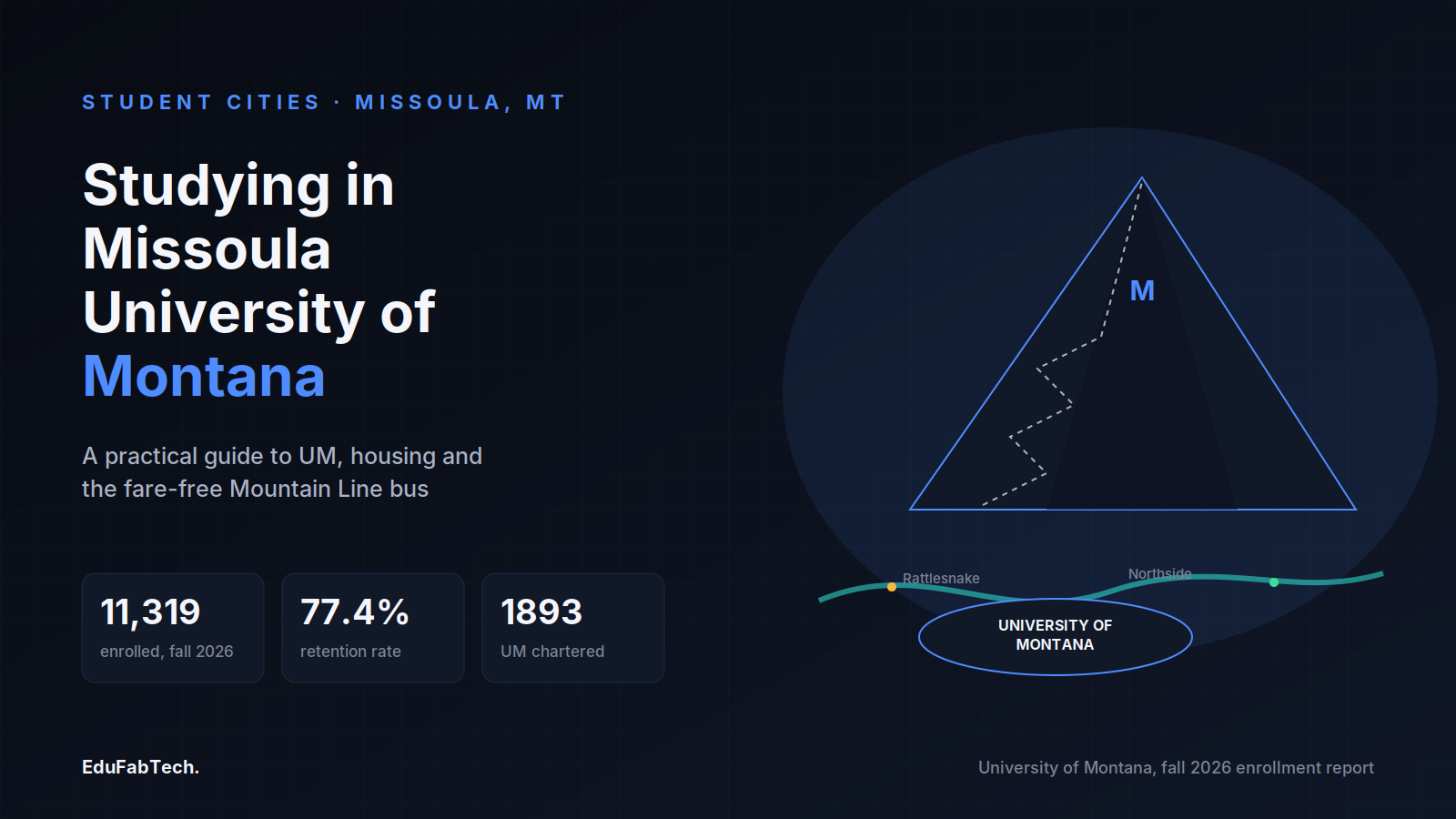
Missoula sits in a bowl where five valleys meet in western Montana, with the Clark Fork River running straight through the middle of town and Mount Sentinel rising just behind the university. The University of Montana describes its main campus as sitting "under the shadow of Mount Sentinel," in a city of about 80,000 residents, on its about page. For a student, that geography shapes almost everything: the campus, downtown and the main student neighbourhoods are packed into a flat, walkable core along the river, while the mountains that make the place beautiful also funnel winter cold and summer wildfire smoke into the same valley.
This guide is for anyone weighing a year or a degree here — a first-year from elsewhere in Montana, a transfer from out of state, or an international student arriving with an F-1 visa. It sticks to things you can check: the university's own rate pages, the city's transit operator, federal housing figures and the campus offices that handle visas. Where a number matters, the source and the year are in the sentence.
The University of Montana, and what a year there is like
The University of Montana is a public, R-1 research university in Missoula and part of the Montana University System; by its own account it was chartered in February 1893. Its main campus sits on the south bank of the Clark Fork, built around a grassy oval with Mount Sentinel and the switchback trail up to the hillside concrete "M" directly behind it. Its degree-granting units include the College of Humanities and Social Sciences, the College of Science, the College of the Arts and Media, the College of Business, the Phyllis J. Washington College of Education, the W.A. Franke College of Forestry and Conservation, the College of Health and the Alexander Blewett III School of Law, with the two-year Missoula College offering associate and workforce programmes; forestry and conservation, wildlife biology, journalism and creative writing are among the fields it is best known for.
It is a mid-sized campus that has been growing. The university reported that it enrolled 11,319 students in fall 2026, including more than 1,500 first-time freshmen — which it called its largest first-year class in a dozen years — along with 2,937 graduate students and 1,726 students at Missoula College, and a retention rate of 77.4 percent. "More students are choosing the University of Montana, and more students are choosing to stay," UM President Jeremiah Shinn said in that announcement. For a newcomer, the practical meaning of growth is competition for the best dorm rooms and the closest off-campus rentals, so timing matters.
Where students settle: the University District, the Rattlesnake and the Northside
Most undergraduates start in the residence halls, which cluster at the north edge of campus within a few minutes' walk of classes. Off campus, the obvious first choice is the University District — the grid of tree-lined streets immediately north and east of campus, full of older houses, many of them long since carved into student rentals. It is the most walkable option and the most sought-after, which keeps rents firm. Just north-east, the Lower Rattlesnake offers a quieter, leafier feel with quick access to the Rattlesnake Creek trails and still-reasonable bike times to campus; the Northside and Westside, across the railroad tracks, tend to be cheaper and are well served by the bus.
The Hip Strip — the stretch of South Higgins Avenue just across the footbridge from campus, lined with cafés, a bookstore and cheap eats — is the social seam between campus and downtown, and living near it means you can reach both on foot. Wherever you look, start early: demand peaks in August as the fall term approaches, and the closer-in houses are often spoken for months ahead. You can browse what is currently listed near campus on EduFabTech's pages for rooms in Missoula and listings near the University of Montana.
Renting without losing a deposit
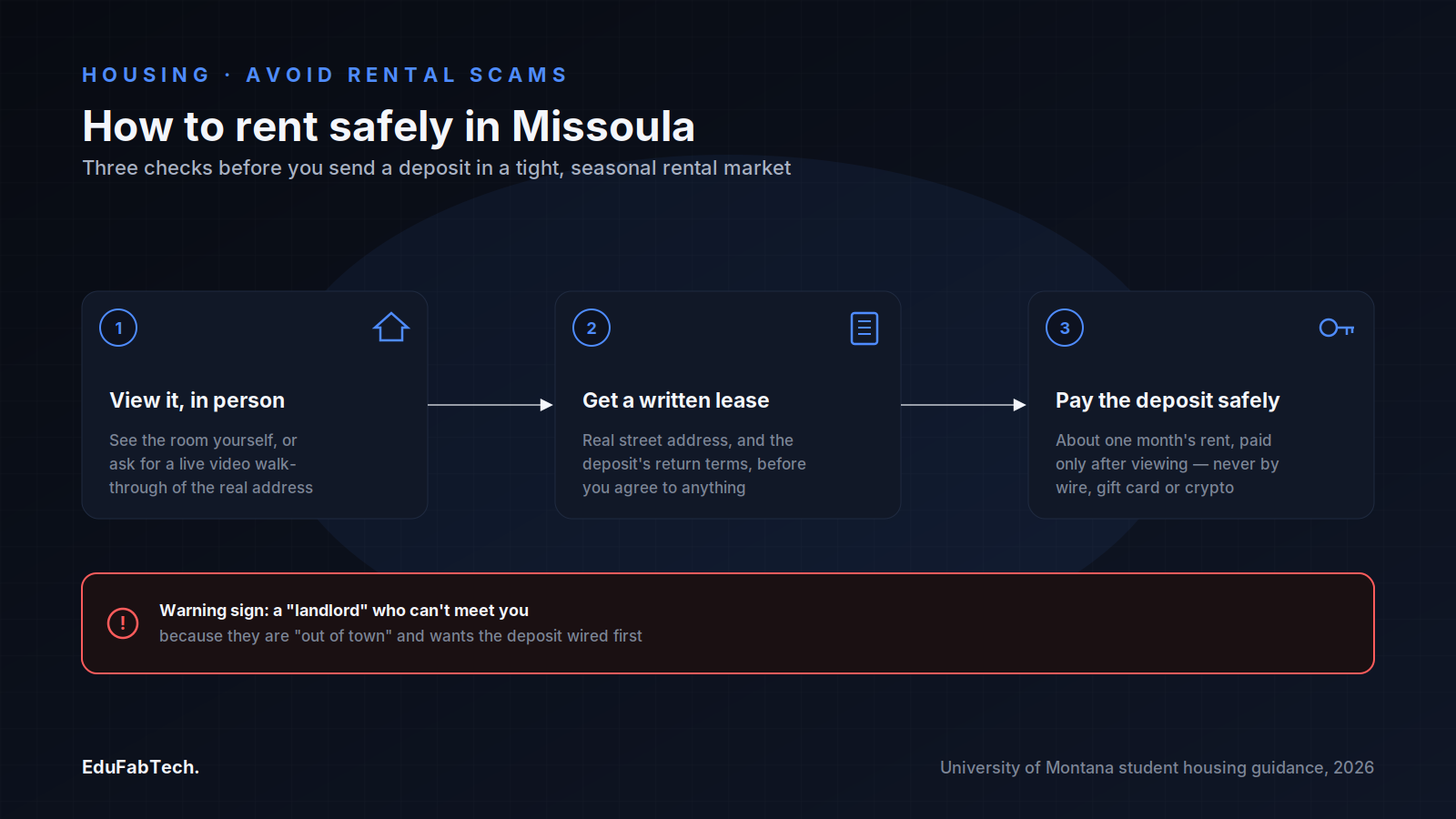
Missoula's rental market is tight and seasonal, and that is exactly the condition rental scams exploit. The usual trap here is a listing priced a little below the University District market, posted when demand is highest, from someone who cannot meet you because they are "out of town" and wants a deposit wired to "hold" the room before you have seen it. Do not send money that way. Never pay a deposit or first month by bank wire, gift card or cryptocurrency to secure a place sight unseen — those payments are effectively irreversible, and a genuine local landlord does not need them.
See the actual unit before you pay anything, or if you are still abroad, insist on a live video walk-through where the person can show the specific address, the room and the view on request rather than a set of polished photos. Get a written lease with the real street address, and expect a security deposit of roughly one month's rent — Montana does not require the deposit to be held in a special account, so read the lease's return terms before signing. If a "landlord" refuses an in-person viewing, pressures you to decide within hours, or asks for payment through an app meant for sending money to friends, treat it as a warning. EduFabTech's Missoula hub keeps the city's student listings in one place.
Furnishing a room for almost nothing
Missoula takes second-hand seriously, which is good news when you arrive with two suitcases and an empty room. The university's own guide to thrifting points students first to The Loop @ Lommasson, a campus thrift store in the Lommasson Center where move-in essentials — mini-fridges, microwaves, bedding — turn up cheaply, and then to a cluster of local shops: Goodwill on South Reserve Street, the YWCA's Secret Seconds, ReStyle Clothing Exchange, Funk It Coffee and Thrift, and Missoula Thrift run by Flathead Industries. Between them you can furnish a room for a fraction of retail.
In the warmer months the city's markets are worth the Saturday morning. The Clark Fork River Market runs Saturdays from 9am to 1pm, May through mid-October, on South Pattee Street downtown, selling local produce, bread and crafts along the river, while the Missoula Farmers Market sets up the same mornings at the north end of Higgins Avenue by the old railroad depot. For hunting down a desk, a bike or a bed frame, EduFabTech lists second-hand things around the city.
Working while you study
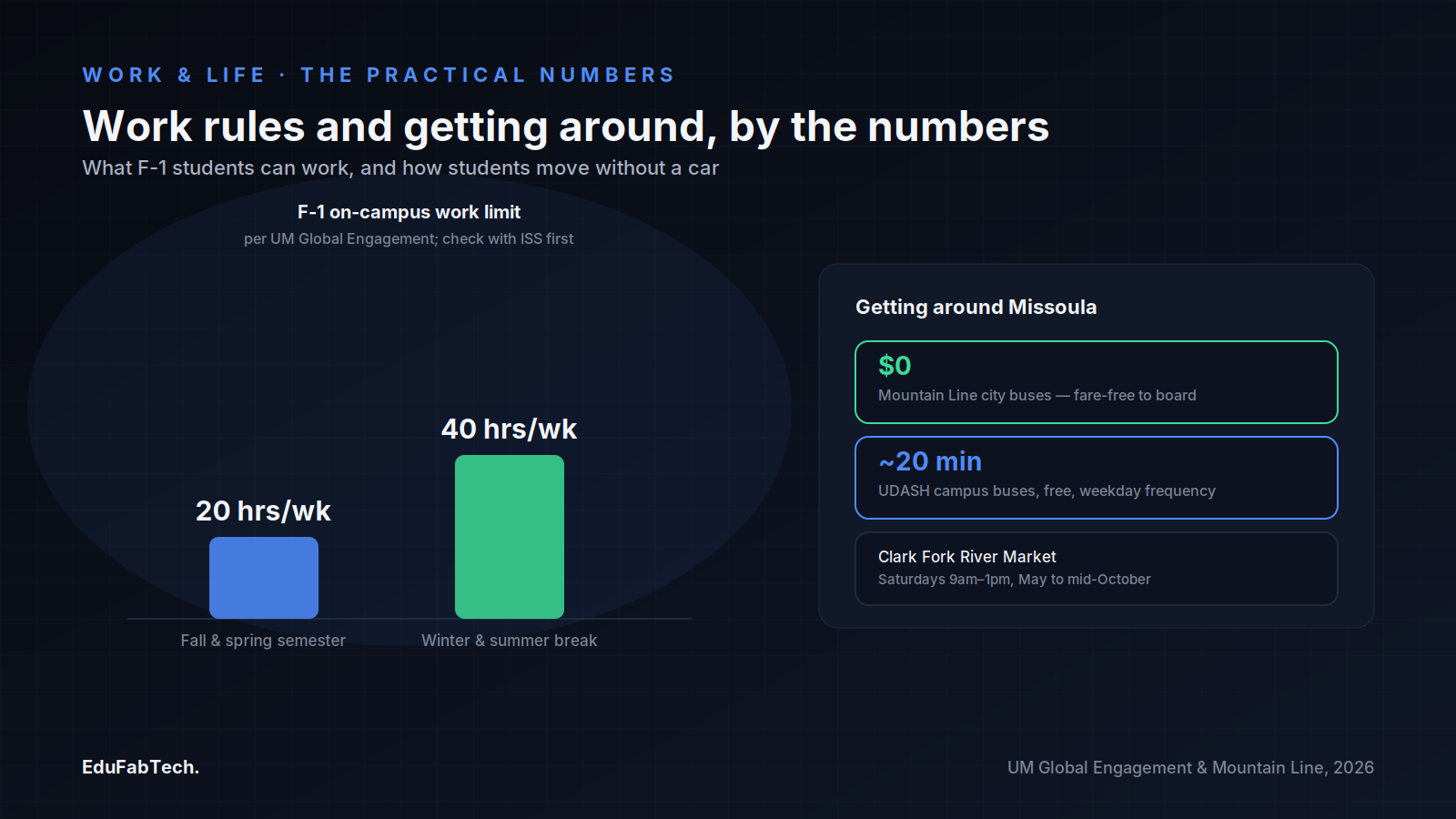
Most students look for part-time work, and the rules are stricter for international students than for domestic ones. The University of Montana's Global Engagement office sets out that F-1 students may work up to 20 hours per week on campus during the fall and spring semesters, and up to 40 hours per week during winter and summer breaks, but warns that not all forms of on-campus employment are allowed, so you must check with International Students and Scholars (ISS) first. The same page explains that an off-campus internship tied to your degree runs through Curricular Practical Training (CPT), which must be required for degree completion, while Optional Practical Training (OPT) covers work related to your major after graduation. A Social Security Number can only be issued once you have an offer of employment.
This is a summary, not legal advice, and the regulations behind it come from the US federal government, not the university; its guidance is to "always consult International Students and Scholars (ISS) on immigration matters and before beginning employment." Confirm your own status with ISS before you accept any work, and treat that office as the authority on what your visa allows. You can see what students are hiring for locally on EduFabTech's Missoula jobs page.
Libraries and places to study
The Maureen and Mike Mansfield Library anchors campus study life. Its study spaces include group study rooms that any student with a UM NetID can book — one three-hour reservation per day, up to two weeks ahead — first-come study carrels with a chair, an overhead light and a power outlet, and a Veterans Study Room reached through Military and Veteran Services. Check current library hours before planning a late session, as they shorten over the winter and summer breaks, and Missoula College keeps its own library on the south campus.
Off campus, the Hip Strip's cafés and the downtown Missoula Public Library give you quieter alternatives when the Mansfield fills up during exams. EduFabTech also maps bookable desks and quiet corners on its Missoula study-spaces page.
Getting around: the fare-free bus, UDASH and a bike
Missoula is unusually easy to live in without a car. Mountain Line, the city's community bus service operated by the Missoula Urban Transportation District, provides fare-free bus and paratransit service in and around Missoula — you never pay to board. The university adds its own free UDASH buses, which the university's commuting guide says run roughly every 20 minutes on weekdays, linking off-campus housing to the main campus and Missoula College. Because both systems are free, there is no fare card to buy and no student discount to chase — the whole network is simply open.
The flat valley floor and the riverside Kim Williams Trail make cycling genuinely practical for much of the year, and ASUM Transportation on campus rents out bikes with a lock, helmet and lights. The catch is winter: snow, ice and short January days mean a lot of cyclists switch to the bus for a few months.
What it costs
The clearest dated housing figures are the university's own. For 2026–27, UM's residence hall rates put a standard double room in Aber, Duniway, Elrod or Jesse Hall at US$3,106 per semester (US$6,212 for the academic year), with all utilities and high-speed internet included and a US$20 per-semester program fee; a single room in Craig, Knowles or Turner Hall is US$4,046 per semester, and the single or four-person suite in Pantzer Hall is US$4,370 per semester (US$8,740 per year). Residence-hall students must also buy a dining plan: UM's 2026–27 plans cost US$3,954 per semester for the Maroon seven-day plan and US$3,283 for the Silver five-day plan.
Off campus, a room usually costs more per month than the dorm equivalent in a tight market. As a benchmark, the US Department of Housing and Urban Development set the FY2026 Fair Market Rent for the Missoula, MT area, in effect from October 2025, at US$1,400 a month for a one-bedroom and US$1,655 for a two-bedroom — figures that assume a standard, non-luxury unit including most utilities. Sharing a house in the University District or on the Northside, and splitting a two-bedroom, is how most students bring the monthly cost down.
The good and the hard
What students tend to like about Missoula is concrete: a compact, walkable town where a free bus and a bike cover almost everything; a genuinely outdoor culture with trails, rivers and the "M" hike starting at the edge of campus; and a small-city scale where the university and downtown are the same place. The campus setting against Mount Sentinel is, on a clear September afternoon, hard to beat.
The hard parts are also concrete. Housing is tight and the closest rooms go early, and the HUD benchmark above shows two-bedrooms around US$1,655 a month before a single student splits it. Winters are long and cold, which reshapes how you move around from roughly November to March. And the same valley that holds the town can trap wildfire smoke in late summer, occasionally pushing air quality down for days at a time. Missoula is also remote — it is a long drive or a connecting flight to most major cities — so plan travel home around that, not around a quick trip.
A checklist for your first weeks
- If you have a residence-hall place, confirm your move-in slot and dining plan; if not, start the off-campus search before August and view any room in person or by live video before paying.
- Never wire a deposit, or send gift cards or crypto, to hold a place you have not seen; expect a written lease and a deposit of about one month's rent.
- International students: book an appointment with International Students and Scholars to confirm what your F-1 visa allows before accepting any job, and apply for a Social Security Number only after you have an offer.
- Learn the Mountain Line and UDASH routes near your home — both are free — and consider an ASUM bike rental for the warm months.
- Get a UM NetID set up so you can book Mansfield Library group rooms, and scout the Hip Strip cafés as backups.
- Furnish from The Loop @ Lommasson, Goodwill and the Saturday markets rather than buying new; check EduFabTech's Missoula listings for free and second-hand finds.
- Buy real winter gear early — a proper coat and boots are not optional here from November onward.
A quick question for readers
Do you work part-time while you study?
Many students work to pay the bills. See how common it is — and how many hours people really do.
Pick an answer, create a free account in a minute, and your vote counts. Already a member? Sign in
Comments 0
CommentNo comments yet. Members start the conversation.
Source: University of Montana
Sources (5)
- University of Montana. 2026-2027 Residence Hall Rates. University of Montana, 2026. umt.edu ↗ · checked 16 Oct 2026
- Missoula Urban Transportation District. About Mountain Line. Mountain Line, 2026. mountainline.com ↗ · checked 16 Oct 2026
- US Department of Housing and Urban Development. FY2026 Schedule of Metropolitan & Non-Metropolitan Fair Market Rents. HUD User, 2025. huduser.gov ↗ · checked 16 Oct 2026
- University of Montana Global Engagement Office. Immigration and Employment. University of Montana, 2026. umt.edu ↗ · checked 16 Oct 2026
- Missoula Downtown Association. Clark Fork River Market. Missoula Downtown Association, 2026. missouladowntown.com ↗ · checked 16 Oct 2026