Studying in Norfolk, Virginia: universities, housing and student life
A practical, honest guide to studying in Norfolk and the wider Hampton Roads — its universities, the neighbourhoods students settle in, how to find a room safely, what it costs, and how to get around a region split by water.
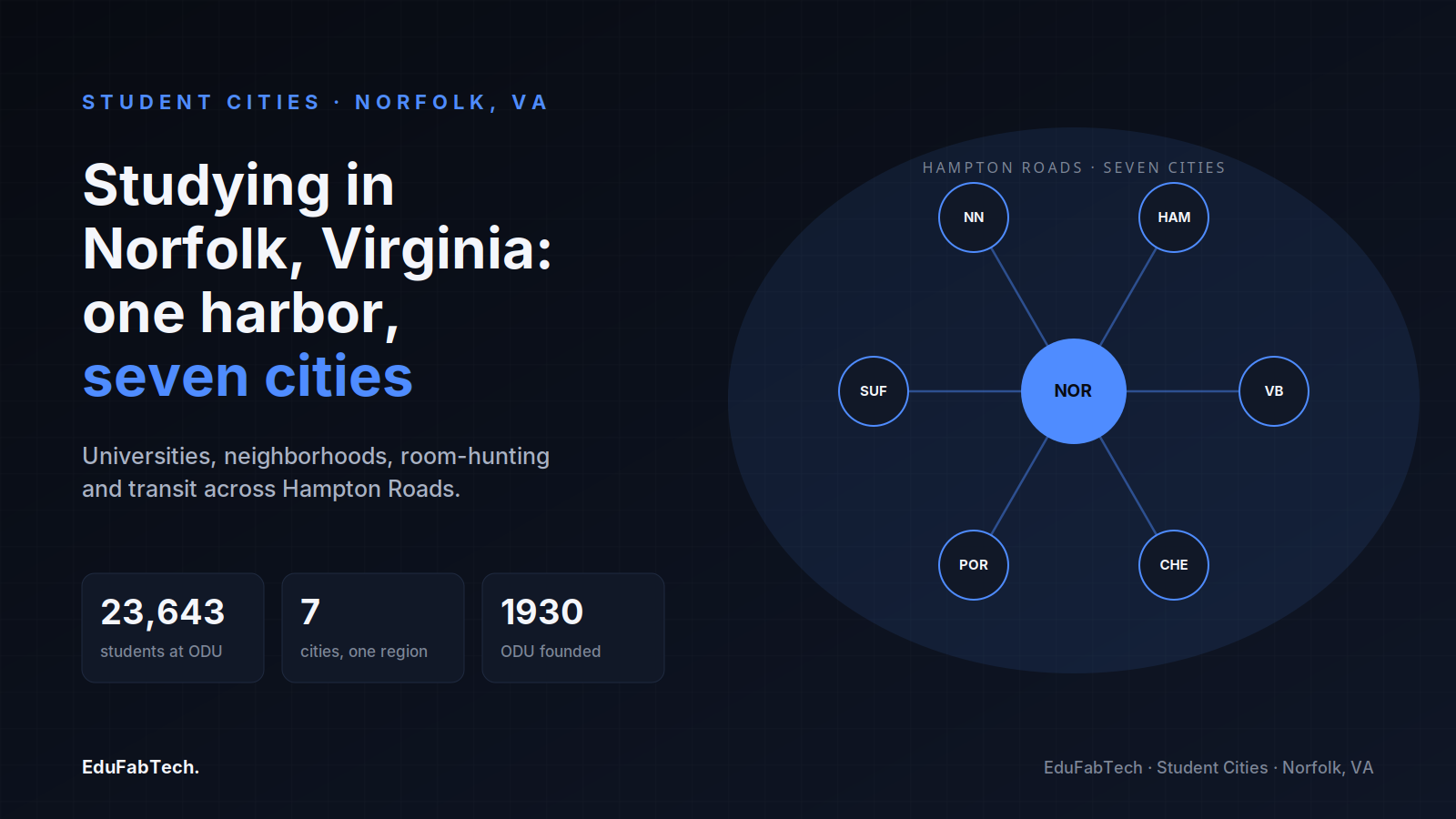
Norfolk sits where the Elizabeth River opens into Hampton Roads, one of the largest natural harbours in the world and the home of Naval Station Norfolk, the biggest naval base on the planet. That geography shapes almost everything about being a student here. The city is not a self-contained college town built around one quad; it is one corner of a seven-city region — Norfolk, Virginia Beach, Chesapeake, Portsmouth, Suffolk, Newport News and Hampton — stitched together by bridges, two harbour tunnels, a light-rail line and a passenger ferry. The water is never far, and neither is the Navy.
For a student, that means your university might be in Norfolk while your cheapest room, your part-time job and your weekend plans are each in a different city across the water. It also means commuting patterns and rents that make more sense once you think of the whole region rather than a single campus postcode. The upside is variety: public research universities, a historically Black university with deep roots, small liberal-arts and faith-based campuses, and career-focused schools, all within about an hour of each other on a good traffic day — and traffic is the local obsession.
This guide walks through the universities in and around Norfolk, where students actually settle, how to rent without being scammed, how to furnish a room cheaply, how to move around a region divided by water, where to study, the rules that apply if you are on a student visa, and an honest account of what the city does well and what it does not.
The universities around one harbour
Old Dominion University (Norfolk) is the city's largest campus and its research anchor. It opened in 1930 as the two-year Norfolk Division of the College of William & Mary, became independent in 1962 and reached university status in 1969. On its facts-and-figures page, Old Dominion University (2026) reports 23,643 students on a 335-acre campus along Hampton Boulevard, the Carnegie R1 research classification, and research strengths it names as coastal resilience, modelling and simulation, bioelectrics, cybersecurity, port logistics and maritime engineering. Coastal resilience is not a marketing line here — Norfolk is one of the most flood-prone cities on the U.S. East Coast, and the university studies the problem on its own doorstep.
Norfolk State University (Norfolk) is one of the country's larger historically Black universities. Its history and mission page records that Norfolk State traces its origin to 1935, when it opened as the Norfolk Unit of Virginia Union University, and that it became Norfolk State University in 1979. The campus sits on Park Avenue just east of downtown, with its own stop on the light-rail line, and it is known for engineering, cybersecurity and the sciences alongside a strong liberal-arts tradition.
Across the water in the Peninsula and the southern cities are several more. Christopher Newport University (Newport News) began, its history page states, in 1960 as a two-year branch of the College of William & Mary and is now a public liberal-arts university that emphasises small classes, leadership and civic engagement. Hampton University (Hampton) is a private historically Black university founded in 1868; the university reported in a November 2025 post that overall enrolment rose 44% between 2022 and 2025, from 3,264 to 4,686 students, and it offers programmes through schools including engineering, nursing, pharmacy and journalism. Regent University, according to its about page, was founded in 1977, is based in Virginia Beach, and serves nearly 14,000 students on campus and online as a private Christian university.
Several smaller and career-focused institutions round out the picture. ECPI University (Virginia Beach) is a for-profit career university founded in 1966, concentrated in nursing, health sciences and technology. Atlantic University (Virginia Beach) is a small graduate school offering master's degrees in transpersonal and mindfulness studies, largely online. The Apprentice School (Newport News), part of Newport News Shipbuilding, runs a paid, competitive shipbuilding apprenticeship and now also awards an associate of applied science in maritime technology to apprentices who complete the programme. Riverside College of Health Sciences, on Main Street in Newport News, grants associate and bachelor's degrees in nursing and allied-health fields. For two-year and vocational study, Tidewater Community College has a downtown Norfolk campus, and Miller-Motte College and South University both run career programmes in the region.
Which part of Norfolk to live in
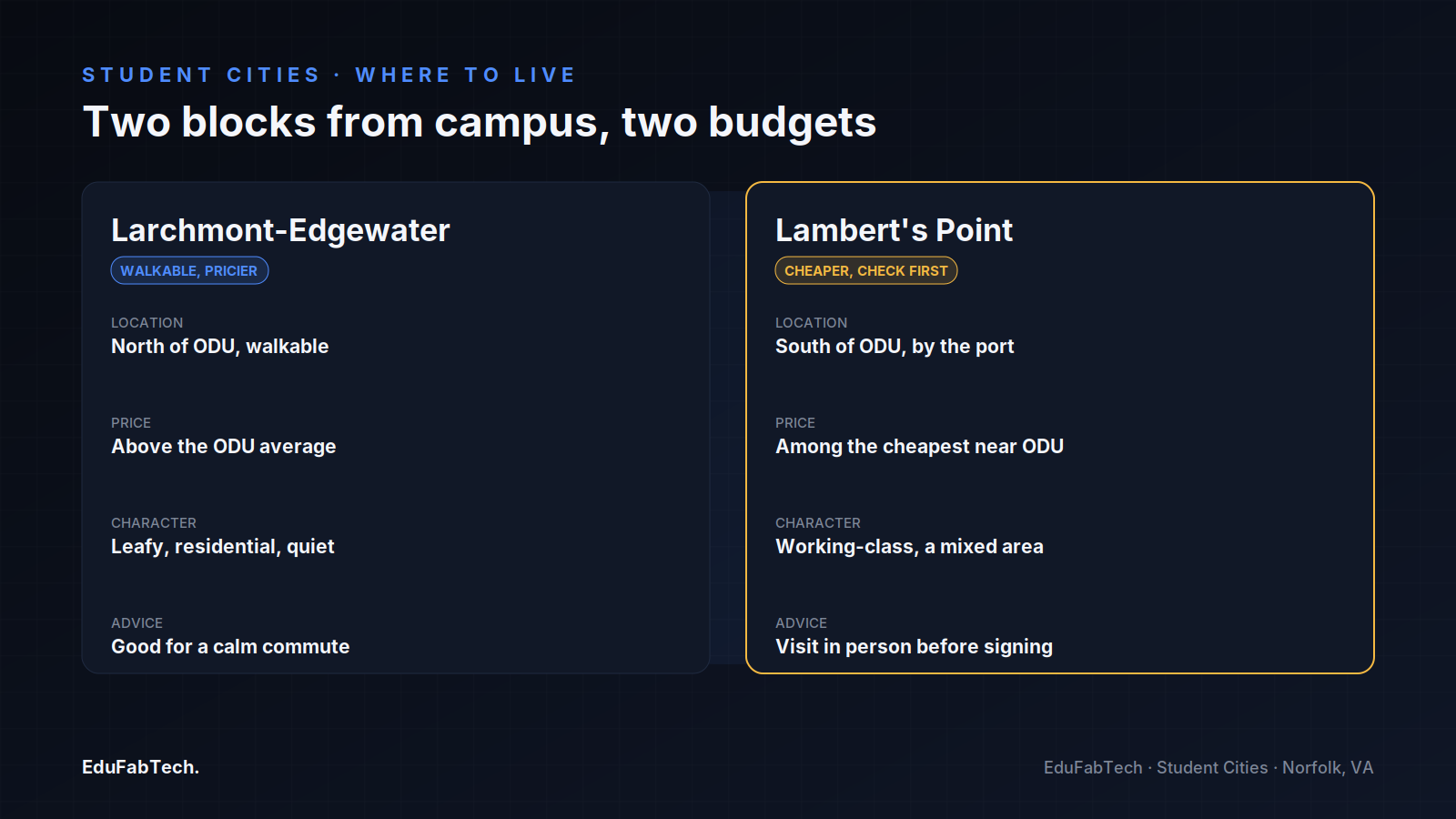
Larchmont–Edgewater is the closest thing Old Dominion has to a neighbourhood of its own: leafy, residential and directly north of campus. Fittingly, the Norfolk Division's first classes in 1930 were held in the old Larchmont School building. It is walkable to campus, quieter and a little pricier than the streets immediately around the university, and it suits students who want calm within a short cycle of Hampton Boulevard.
Lambert's Point lies directly south of Old Dominion, wedged between campus and the coal terminal on the river. It is historically working-class, among the cheaper places to rent near the university, and popular with students for that reason — though it is a mixed area and worth visiting in person before committing.
Ghent is Norfolk's best-known walkable district, centred on Colley Avenue and the Hague inlet: historic rowhouses, independent restaurants, a cinema and an easy ride to both Old Dominion and downtown. It is one of the more desirable and more expensive areas, and street parking is tight. Park Place, just north of Ghent, is a transitional neighbourhood with older homes and newer apartments, generally cheaper, and close to campus and the highways.
Colonial Place and Riverview sit along the Lafayette River north-east of the university — residential, reasonably priced and favoured by graduate students and those who want a quiet street with water views. Downtown Norfolk puts you on the light rail near Norfolk State, the medical campus and the waterfront, in newer apartment blocks that cost more but cut out the commute. Further north, Ocean View faces the Chesapeake Bay: cheaper rents and a beach, but a longer drive to any campus and limited transit.
You can browse current student listings across Norfolk on EduFabTech, or filter to rooms near Old Dominion University if you want to stay within walking distance of class.
Finding a room without losing a deposit
Most undergraduates at Old Dominion and Norfolk State start in university housing and move off campus from the second year, so the private market near those campuses churns heavily in late summer. Start looking in late spring for a September tenancy; the best-value rooms around Hampton Boulevard, Larchmont and Ghent are gone by July, and what is left in August is often overpriced or far out. Houses shared three or four ways are the usual budget option near Old Dominion.
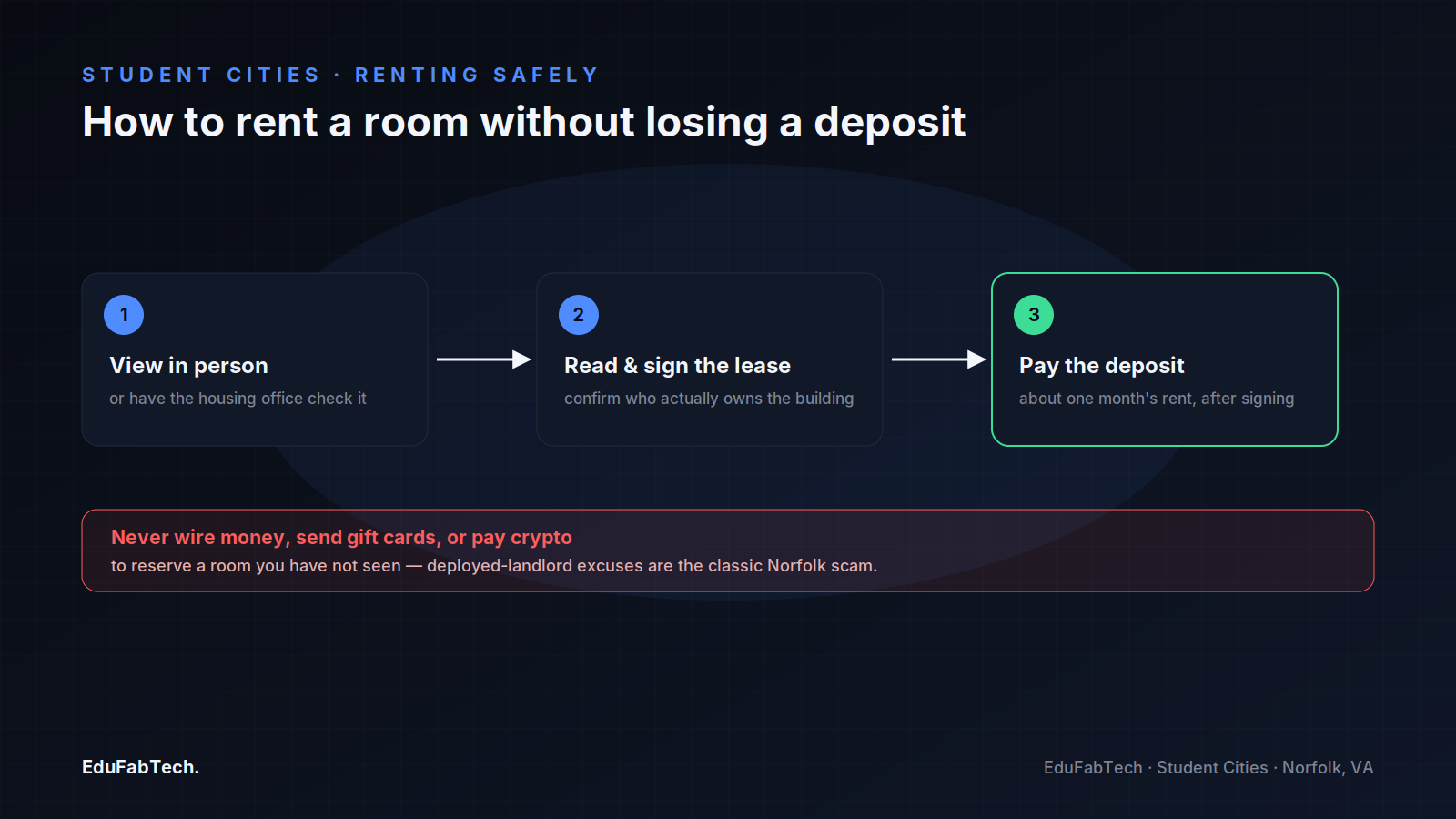
Scam listings cluster exactly where demand is highest — the Hampton Boulevard corridor near Old Dominion, Ghent and Park Place — and they spike just before term. In a Navy town, the classic pretext is a "landlord" who claims to be deployed or stationed elsewhere and therefore cannot show the place, then asks you to send a deposit to hold it. Do not. A legitimate deposit in Virginia is paid once you have seen the unit and signed a lease, and a security deposit is commonly about one month's rent. Never send money by bank wire, gift card or cryptocurrency to reserve a room you have not entered; those payments cannot be recovered, and no honest landlord in Norfolk requires them. View the property in person (or have a trusted friend or your university's off-campus housing office do so), read the lease, and confirm who actually owns the building before paying anything. EduFabTech's Norfolk rooms listings are a place to begin, but the in-person check is what protects you.
Furnishing a room for very little
Because students and Navy families cycle in and out of the region constantly, Norfolk has a deep second-hand market, and furnishing a room cheaply is genuinely easy here. The Habitat for Humanity of South Hampton Roads ReStore at 900 Tidewater Drive sells new and gently used furniture, appliances and housewares well below retail, and Goodwill and Salvation Army thrift stores are scattered across the city.
For moving-day and end-of-term timing, pay attention to the academic calendar: the weeks when leases turn over are when the most furniture appears second-hand or free on the kerb. EduFabTech keeps a Norfolk-specific page for used furniture, busiest in August and again in May.
Getting around a region split by water
Public transport is run by Hampton Roads Transit (HRT), which operates the buses, the light-rail line called The Tide, and the Elizabeth River Ferry between downtown Norfolk and Portsmouth. The Tide runs from the medical campus through downtown and past Norfolk State University to Newtown Road near the Virginia Beach line, so it directly links two of the region's universities to the centre. HRT's fares page (effective July 2023) lists a one-way trip at $2.00, a 1-Day GoPass at $4.50, a 7-Day pass at $22.00 and a 30-Day pass at $70.00, with reduced fares for eligible riders. HRT also offers an annual GoPass365, valid for 365 days across bus, rail and ferry and purchased through colleges, employers and consortiums; check current student arrangements with your university before buying.
Be honest with yourself about geography, though. Transit is useful within Norfolk and along the rail corridor, but the region was built for cars, and crossing the water to Virginia Beach, Chesapeake or the Peninsula by bus is slow. The tunnels — the Hampton Roads Bridge-Tunnel and the Midtown and Downtown tunnels — are notorious chokepoints at rush hour, and some carry tolls. If your campus, job and home are all in Norfolk, you can manage without a car; if they are spread across cities, a car (and a tolerance for traffic) becomes hard to avoid.
Where to study
Each campus has its own library, and the city adds a striking public one. At Old Dominion, the Patricia W. and J. Douglas Perry Library is the main building, with a Learning Commons offering individual and group study space, computers, printing, specialised software and a bookable sound room (odu.edu/library). At Norfolk State, the Lyman Beecher Brooks Library at 700 Park Avenue provides the usual research collections plus media services, a Mac lab and makerspace facilities including 3D printing (lbbl.nsu.edu).
Off campus, the Slover Library downtown is one of the best free study spaces in the city — a modern public library beside the waterfront. The Norfolk Public Library lists the Downtown Branch at Slover at 235 E. Plume Street, open to anyone. For quieter corners, cafés and desks beyond the libraries, EduFabTech collects study spaces around Norfolk.
Working while you study
If you are an international student, the rules on work are set by U.S. immigration authorities, not by your university, and they are strict about timing. The U.S. Citizenship and Immigration Services Students and Employment page states that F-1 students may not work off campus during their first academic year but may accept on-campus employment subject to conditions and restrictions, and that any off-campus training (such as Curricular or Optional Practical Training) must relate to the field of study and be authorised in advance by the student's Designated School Official and USCIS. This is a summary, not legal advice: before accepting any job, confirm your specific situation with your university's international-student office and the official USCIS guidance. For domestic students, the campuses, the port economy, the hospitals and the service sector around the universities are the usual sources of term-time work; current openings in the area are listed on EduFabTech's Norfolk jobs page.
What it costs, and what is hard
The clearest sourced housing figures come from the universities themselves. For the 2026-2027 academic year, Old Dominion University's room-rates page lists a standard double room in traditional halls such as Virginia House, England House and Ireland House at $9,046 per year, with doubles in Gresham, Rogers and Whitehurst halls at $8,150 per year; apartment-style singles run considerably higher, up to $18,976 per year for a one-bedroom in University Village. Those are per-year figures set by the university and subject to board approval.
| Item | Figure | Source (year) |
|---|---|---|
| ODU double room, traditional hall | $9,046 / year | Old Dominion University (2026-2027) |
| ODU double room, Gresham/Rogers/Whitehurst | $8,150 / year | Old Dominion University (2026-2027) |
| HRT one-way trip | $2.00 | Hampton Roads Transit (2023) |
| HRT 30-Day GoPass | $70.00 | Hampton Roads Transit (2023) |
What is good about Norfolk for a student is real: a genuine research university and a historic HBCU in one city, a deep and cheap second-hand market, a walkable core in Ghent and downtown, free study space at Slover, and the water everywhere — beaches, the bay, the harbour. What is hard is equally real. The region is spread across cities and divided by tunnels, so without careful planning you can lose hours to traffic. Housing near Old Dominion tightens sharply every August, and the better neighbourhoods cost more. And Norfolk floods: it is among the most flood-exposed cities on the East Coast, so when you choose a street, ask neighbours how it drains after a storm and a high tide.
First weeks: a short checklist
- Confirm your housing in person before paying — see the room, read the lease, and never wire a deposit to "hold" a place.
- Decide early whether you need a car; if you will stay within Norfolk and the rail corridor, test the bus and The Tide first, and ask your university about student transit arrangements.
- Get your campus library and Slover Library access sorted, and scout a quiet desk before coursework ramps up.
- Furnish from the ReStore, thrift shops and end-of-lease giveaways rather than buying new.
- If you are on a student visa, meet your Designated School Official in week one and read the official USCIS work rules before taking any job.
- Learn the flood-prone streets and the tunnel rush hours — both will shape your daily life more than you expect.
A quick question for readers
Do you work part-time while you study?
Many students work to pay the bills. See how common it is — and how many hours people really do.
Pick an answer, create a free account in a minute, and your vote counts. Already a member? Sign in
Comments 0
CommentNo comments yet. Members start the conversation.
Source: Old Dominion University
Sources (5)
- Old Dominion University. University Facts & Figures. Old Dominion University, 2026. odu.edu ↗ · checked 15 Oct 2026
- Old Dominion University. 2026-2027 Room Rates. Old Dominion University Housing & Residence Life, 2026. odu.edu ↗ · checked 15 Oct 2026
- Hampton Roads Transit. Fares. Hampton Roads Transit, 2023. gohrt.com ↗ · checked 15 Oct 2026
- U.S. Citizenship and Immigration Services. Students and Employment. USCIS, 2026. uscis.gov ↗ · checked 15 Oct 2026
- Norfolk Public Library. Downtown Branch at Slover. City of Norfolk, 2026. norfolkpubliclibrary.org ↗ · checked 15 Oct 2026