Studying in Poughkeepsie: universities, housing and student life
A practical, sourced guide to Marist, the Culinary Institute of America and SUNY New Paltz — where students live along the Hudson, what a dorm costs, how the LOOP buses and the Hudson Line work, and the honest trade-offs.
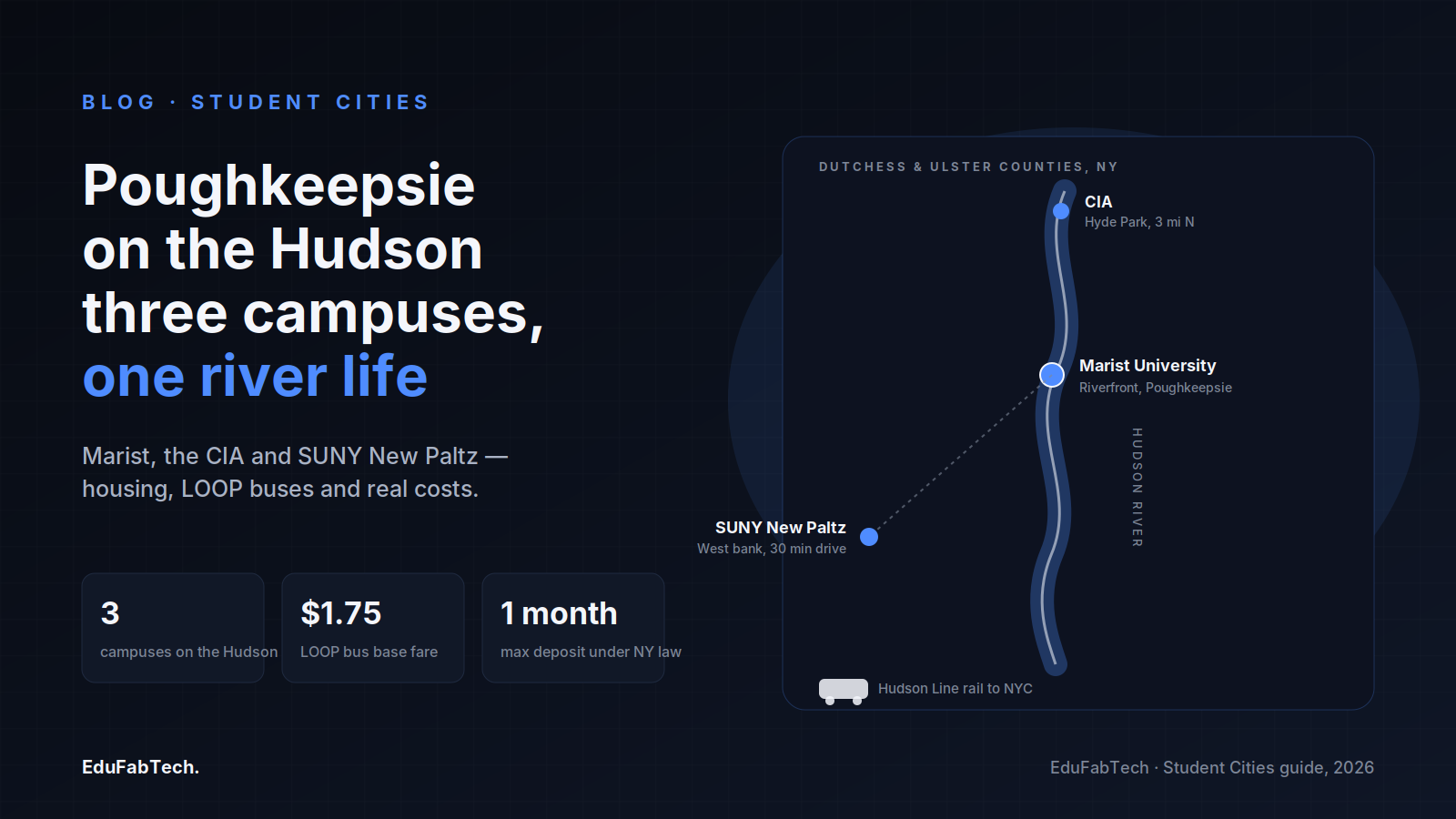
Poughkeepsie sits on the east bank of the Hudson River, roughly midway between New York City and Albany, at the point where the commuter rail from Manhattan runs out of track and the river valley opens toward the Shawangunk and Catskill ridges to the west. It is a small city — the county seat of Dutchess County — with a long industrial Main Street, a riverfront crossed by two bridges, and a ring of campuses that give it a steady student presence without turning it into a single-college town.
For a student deciding whether to come here, the first thing to understand is that "studying in Poughkeepsie" usually means one of three quite different institutions, two of which are a short drive outside the city itself. They share the valley, the weather and the Hudson Line, but little else. This guide covers all three, then the practical business of living here: rooms, second-hand furniture, part-time work, study spaces, transport and costs — with figures tied to the source and year that produced them.
Three campuses on the Hudson, and what each is like
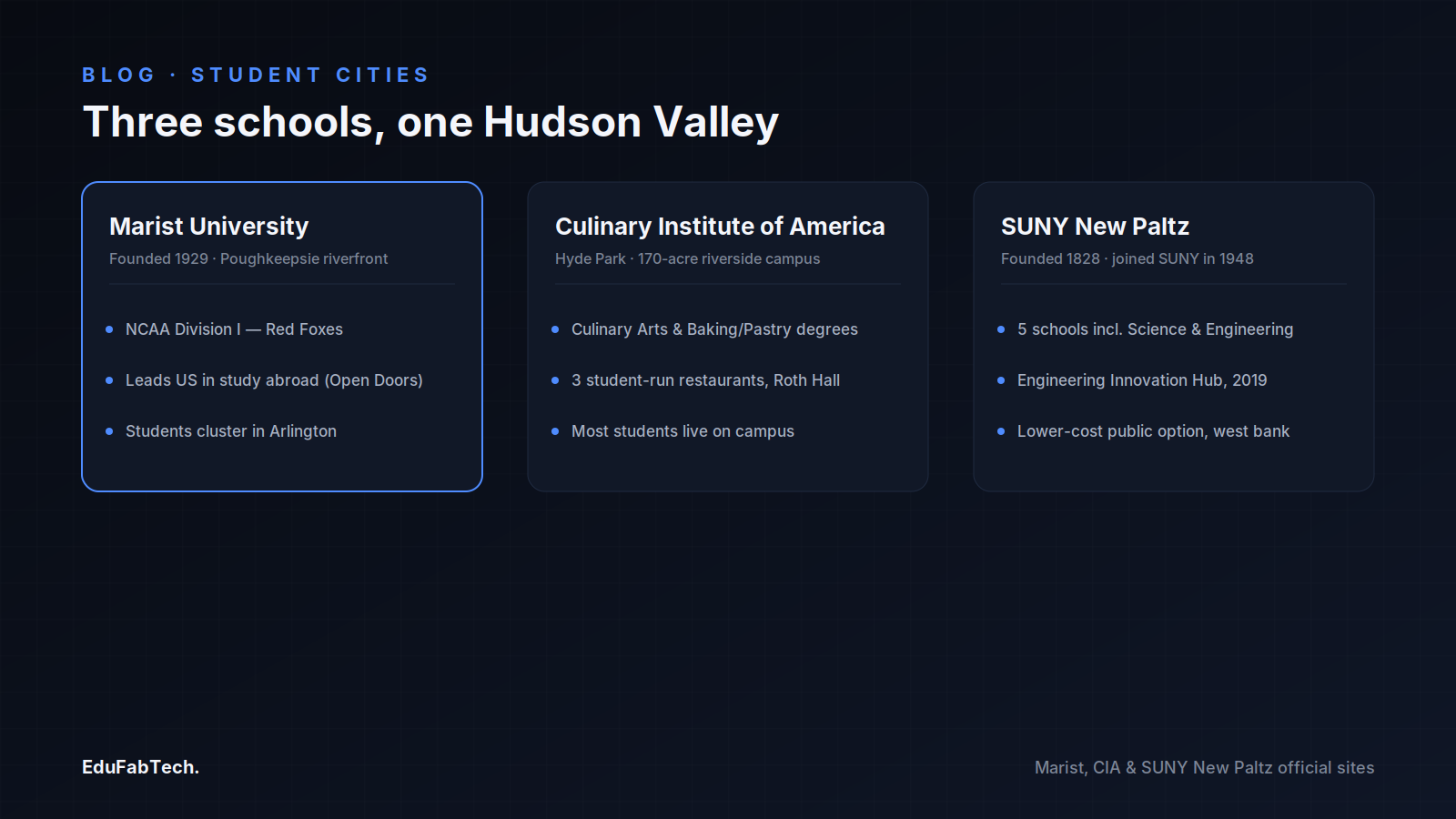
Marist University is the institution most people mean by "studying in Poughkeepsie." Its main campus runs along the riverfront on the north side of the city. Marist says it was founded in 1929 and that its teaching "blends the liberal arts with pre-professional studies and emphasizes experiential learning," with a branch campus in Florence, Italy; the university reports that it leads the nation for study-abroad participation in the Institute of International Education's Open Doors report. It is strong in communications, business, information technology and fashion, and it competes in NCAA Division I as the Red Foxes.
The Culinary Institute of America is not in Poughkeepsie proper but a few miles north up US Route 9 in Hyde Park, close enough that CIA students are part of the local rental and shopping scene. The CIA describes its New York home as a 170-acre riverside main campus offering bachelor's and associate degrees, with majors including Culinary Arts and Baking and Pastry Arts and three student-staffed restaurants housed in Roth Hall. It is a specialist school: you go there to cook professionally, not to read for a general degree.
State University of New York at New Paltz sits on the west side of the river, in the village of New Paltz in Ulster County, about a half-hour drive from Poughkeepsie. Its catalogue traces the institution to 1828, notes that it joined the State University of New York system in 1948, and lists five schools including a School of Fine & Performing Arts and a School of Science & Engineering with an Engineering Innovation Hub opened in 2019. As a SUNY campus it is the lower-cost public option of the three, and worth knowing about even if your own campus is on the Dutchess side.
Where students live: Arlington, downtown and the villages
Most first- and second-year Marist students live on the riverfront campus, and the CIA houses the large majority of its students on site in Hyde Park. The off-campus market really matters for Marist upperclassmen, graduate students and international arrivals. The neighbourhood immediately south and east of Marist — Arlington, built around Raymond Avenue and the eastern stretch of Main Street — is the natural first place to look: it is within walking or short-bus distance of campus and has the mix of older houses divided into student flats that you would expect around a university. Beyond it, the Fairview corridor along Route 9 and parts of the town of Poughkeepsie offer apartments at a range of prices, while the restored blocks near the waterfront and the train station appeal to students who want to be close to the Hudson Line.
For CIA students, Hyde Park itself and the hamlets along Route 9 are the practical options; for New Paltz, the compact village around the campus is walkable and in high demand. Start looking early. The tightest competition for the better Arlington houses is in the spring for a September move-in, and leases in New York are typically annual, so a room you take in August usually commits you through the following summer.
Renting without losing a deposit
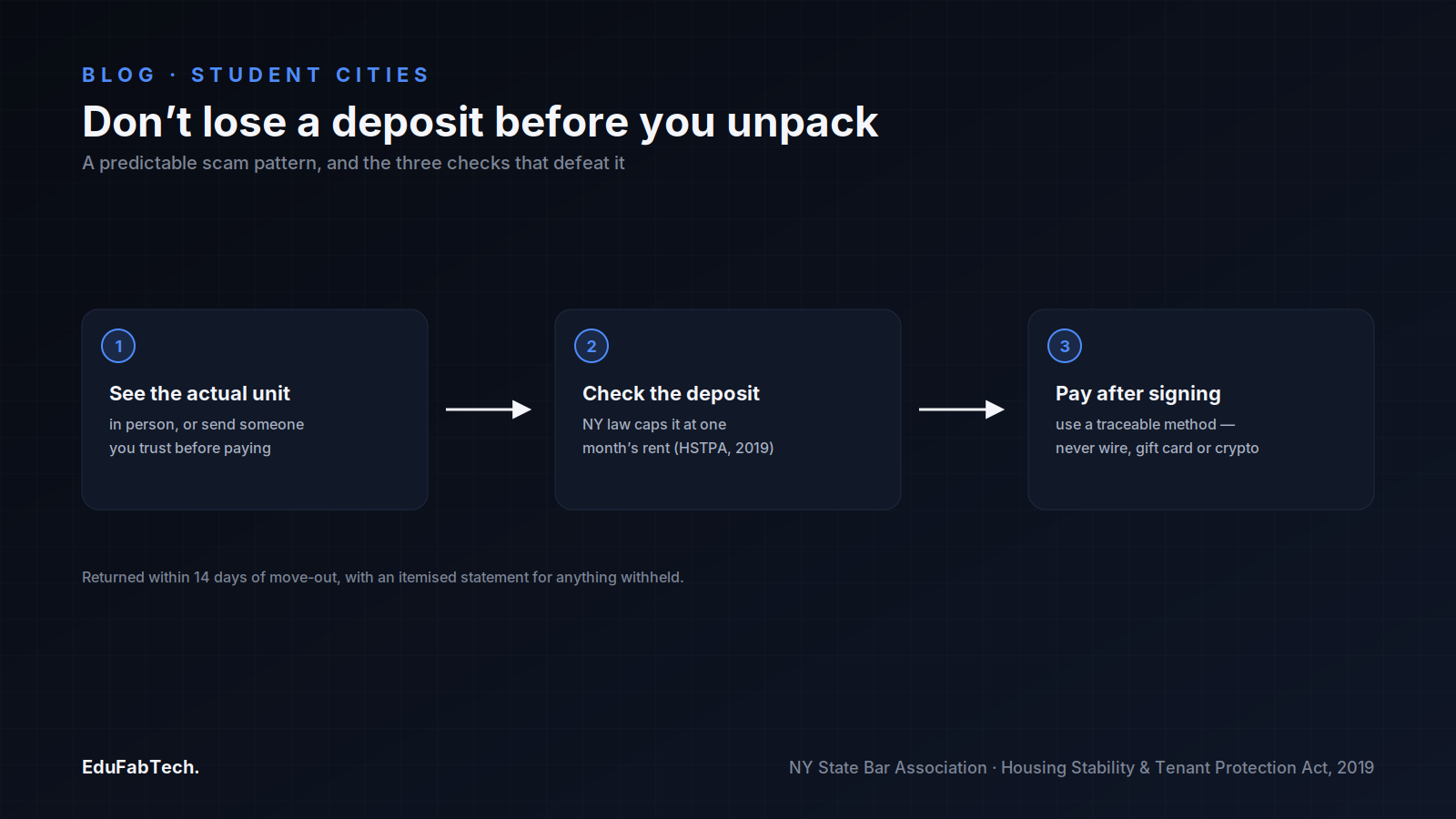
The scams that hit students here follow a predictable pattern: a listing for an Arlington or downtown apartment at a suspiciously low rent, a "landlord" who is conveniently out of state or abroad, and a request to wire a deposit to "hold" the place before you have seen it. Treat any of those as a warning. See the actual unit in person, or have someone you trust see it, before paying anything — this is doubly important if you are arranging a room from overseas before you arrive.
Know what a normal deposit looks like so an abnormal one stands out. Under New York's Housing Stability and Tenant Protection Act of 2019, summarised by the New York State Bar Association, a landlord may not charge more than one month's rent as a security deposit and must return it within 14 days of your moving out, with an itemised statement for anything withheld. A demand for several months' rent "to secure" a student let is not standard practice. Never pay a deposit or first rent by bank wire, gift card or cryptocurrency to someone you have not met and a unit you have not entered; use a traceable method once you have a signed lease. EduFabTech's own rooms listings for Poughkeepsie and the wider city listings page are places to begin a search, but the same cautions apply wherever you find a room.
Furnishing a room: Rinaldi's and the valley's flea markets
The Hudson Valley has an unusually deep second-hand and antiques culture, which works in a student's favour when a bare room needs filling. Rinaldi's Flea Market, listed by the county tourism body at 900 Dutchess Turnpike (Route 44) in Poughkeepsie, runs every Sunday from April through October and is the obvious local hunting ground for cheap furniture, kitchen gear and oddments. The same county list points to two more within reach: the Beacon Flea Market, open Sundays off Main Street in Beacon to the south, and the larger Stormville Flea Market on Route 216 east of the city, which gathers dealers from across the region on its scheduled weekends.
Thrift stores along the Route 9 and Main Street corridors cover the everyday basics — desks, lamps, crockery — and at the end of each semester departing students shed furniture that can be had free or nearly so. EduFabTech keeps running local lists of second-hand items in Poughkeepsie that are worth checking before you buy anything new, especially in the move-in and move-out weeks when supply is highest.
Working while you study
If you are an international student, what you may do for paid work is set by federal immigration rules, not by the university or by anything in this guide — and it is worth reading the official text rather than second-hand summaries. For students in F-1 status, the US Department of Homeland Security's Study in the States service states that on-campus employment is generally limited to 20 hours per week while school is in session, with more permitted during breaks, and that most off-campus work requires specific authorisation. Any question about a particular job should go to your school's designated school official before you accept it; this is immigration compliance, not a place to improvise.
For domestic students and for on-campus roles, the usual student-job landscape applies: dining halls, libraries, departmental assistant work and — distinctively here — the hospitality and food businesses the CIA feeds into. Current openings and part-time roles around the city are gathered on EduFabTech's Poughkeepsie jobs page.
Libraries and places to study
On the Marist campus, the James A. Cannavino Library is the main study building. By the library's own account it offers reservable collaborative rooms for group work, laptops and technology to borrow, and campus Wi-Fi, with term-time hours that run late into the evening most nights. SUNY New Paltz students have the Sojourner Truth Library, rebuilt in 2016, on their own campus.
Off campus, the city's public library is the Adriance Memorial Library of the Poughkeepsie Public Library District, at 93 Market Street downtown, with a Boardman Road branch to the east; both offer free public computers, Wi-Fi and quiet reading space open to anyone, which is useful when campus buildings close or you simply want a change of desk. For cafés, co-working desks and other quiet corners that students actually use, see EduFabTech's Poughkeepsie study-spaces listings.
Getting around: the LOOP buses and the Hudson Line
Local buses are run by Dutchess County Public Transit — the LOOP system — whose fares page lists a base one-way fare of $1.75 and a reduced fare of $0.75 for, among others, "students with current valid school photo identification" (2026). Note an important local wrinkle: the county's Youth & College Fares page says Vassar College, Dutchess Community College and Bard College students ride free with ID, but Marist and the CIA are not on that free-ride list, so plan on the student fare rather than a free pass unless your own institution has arranged otherwise.
The bigger connection is the railway. Poughkeepsie is the northern terminus of the MTA Metro-North Railroad's Hudson Line, which runs down the east bank to Grand Central Terminal in Manhattan. As the Times Union reported, a peak one-way ticket from Poughkeepsie to Grand Central rose to $29.75 under the fare changes that took effect in early January 2026. Amtrak also stops at Poughkeepsie on its Hudson-valley route. For getting between the river and the hills on foot or by bike, the Walkway Over the Hudson — a former railway bridge that New York State Parks describes as a 1.28-mile elevated pedestrian bridge — links the Poughkeepsie waterfront to Highland on the west bank and joins the valley's rail-trail network.
What it costs, and the honest trade-offs
On-campus housing figures are the most reliable local benchmark because the university publishes them. Marist's 2026-27 cost page puts the standard first-year residence-hall charge at $12,430 for the academic year, with upperclass housing ranging from $12,430 in the standard halls up to $16,020 for North Campus apartments; meal plans on the same page run from $1,720 for the smallest Flex 825 plan to $8,410 for the Murray Plus plan. Those are Marist's own rates and do not transfer to the other campuses.
The private rental market is harder to pin to a dependable, student-specific figure: the published rent benchmarks for this area cover family-sized units across two counties rather than single student rooms, so treat any single headline number with caution and compare several current listings before you commit. As a rule of thumb that holds here, sharing a two-bedroom with a housemate brings the per-person cost well below renting a one-bedroom alone, which is why most Arlington student lets are shared houses rather than solo flats.
What is good about Poughkeepsie for a student is real. The valley setting is genuinely beautiful; the Hudson Line puts New York City within a direct train ride; costs are lower than in the city while the cultural pull of the region — food, river, trails — is high; and the mix of a mainstream university, a world-known cooking school and a public SUNY nearby gives the area more variety than its size suggests. What is hard is also real. The three campuses are spread across two counties and both banks of the river, so without a car you lean heavily on buses and the train, and Marist and CIA students do not get the free county-transit ride their Vassar and Bard neighbours do. Housing in the desirable Arlington blocks is tight and leases are annual. And the winters are cold Hudson-valley winters — snow, grey river fog and short days from December through February — which newcomers from warmer places consistently underestimate.
A checklist for your first weeks
- See any off-campus room in person before paying, and pay a deposit of no more than one month's rent only after signing a lease — never by wire, gift card or crypto to hold a place sight-unseen.
- Get a campus ID immediately; it is what unlocks the library collaborative rooms, borrowable laptops and the reduced $0.75 LOOP bus fare.
- If you are an international student, confirm your work limits with your designated school official before taking any job, using the DHS Study in the States guidance as your reference.
- Register for a public-library card at Adriance Memorial on Market Street for free off-campus study space, computers and Wi-Fi.
- Work out your Hudson Line plan early if you will travel to New York City often — weekly and monthly tickets cost far less per trip than peak singles.
- Furnish from Rinaldi's Flea Market and the end-of-semester give-aways rather than buying new; check the local second-hand listings first.
- Pack for a real winter: the cold here is longer and damper than the map suggests.
A quick question for readers
Do you work part-time while you study?
Many students work to pay the bills. See how common it is — and how many hours people really do.
Pick an answer, create a free account in a minute, and your vote counts. Already a member? Sign in
Comments 0
CommentNo comments yet. Members start the conversation.
Source: Marist University
Sources (4)
- Marist University. Upperclassman Expenses and Cost of Attendance 2026-27. Marist University, 2026. marist.edu ↗ · checked 16 Oct 2026
- Dutchess County Public Transit. Youth & College Fares. Dutchess County Government, 2026. dutchessny.gov ↗ · checked 16 Oct 2026
- US Department of Homeland Security. Working in the United States. Study in the States, 2026. studyinthestates.dhs.gov ↗ · checked 16 Oct 2026
- The Culinary Institute of America. CIA New York Campus. The Culinary Institute of America, 2026. ciachef.edu ↗ · checked 16 Oct 2026