Studying in Reno: universities, housing and student life
A practical, sourced guide to the University of Nevada, Reno — where students live, what rooms and transport cost, and the honest trade-offs of a high-desert city that keeps growing.
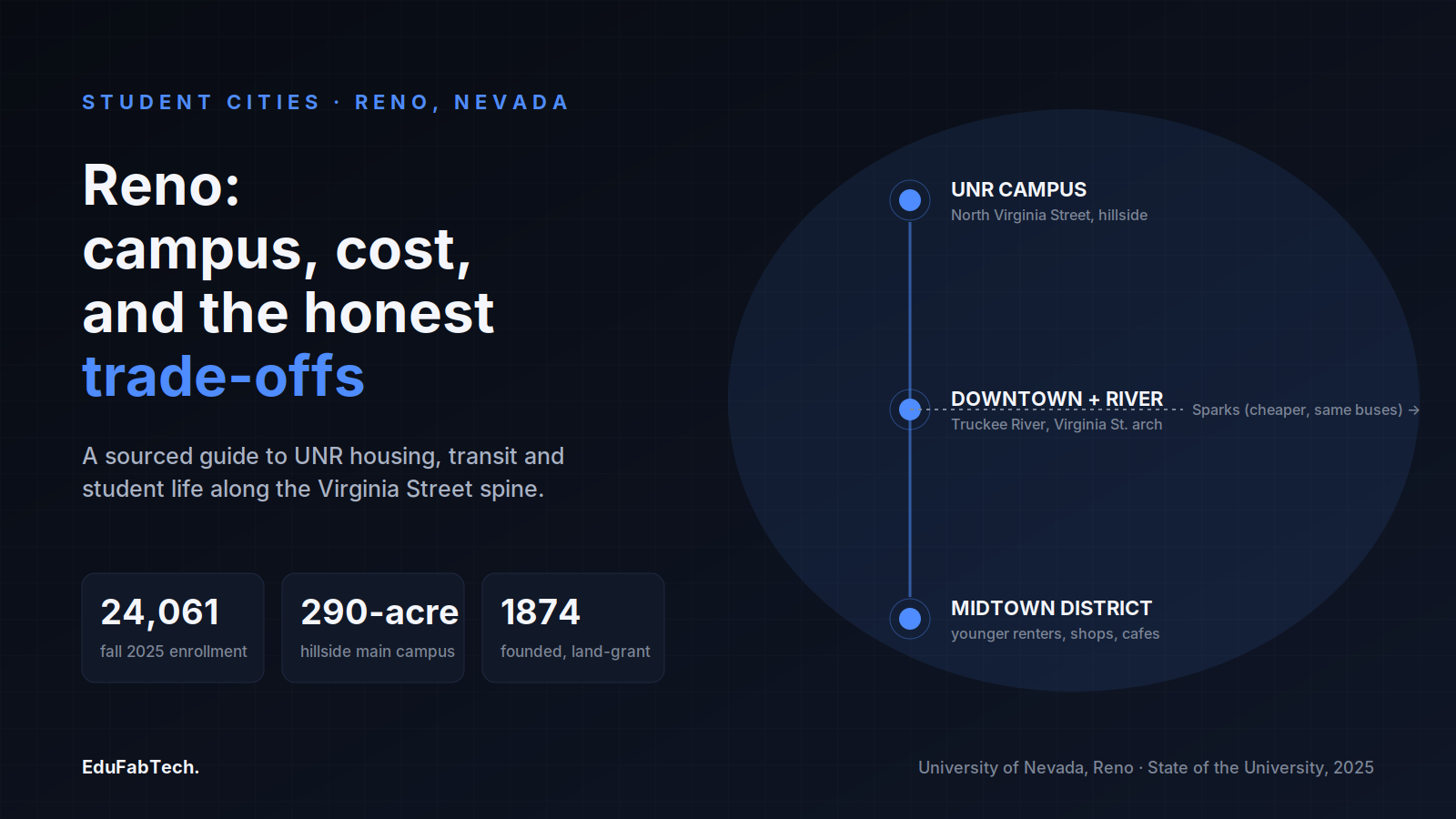
Reno sits in the Truckee Meadows, a wide valley at the eastern foot of the Sierra Nevada, with Lake Tahoe about an hour's drive to the southwest and the Nevada desert opening out to the east. The Truckee River runs through the centre of town, and the lit arch over North Virginia Street still carries the old slogan that the city is the biggest little city in the world. For students, the geography that matters most is simpler: the university sits at the north end of Virginia Street, downtown and the river lie a short way south, and the Midtown District continues south of that. Much of student life strings along this single spine.
This guide covers the university, where students actually live and how to rent without being cheated, what things cost with figures you can check, furnishing a room cheaply, getting around, part-time work, and the parts of Reno that are genuinely hard. Where a number appears, the institution and year appear with it, and the exact page is linked.
The University of Nevada, Reno, and its neighbours
The University of Nevada, Reno is the state's land-grant institution, established under the Morrill Act of 1862 and, by its own account, founded in 1874; the university describes itself as Nevada's flagship, with 13 colleges and schools and a roughly 290-acre main campus on the hillside north of downtown. In his 2025 State of the University address, president Brian Sandoval reported a record enrollment of 24,061 for fall 2025, a figure the university says includes non-degree-seeking students. The campus is compact and walkable, built around the Quad and Manzanita Lake, and the School of Journalism, engineering, mining and the medical school are among the programmes it is best known for.
Reno has a second, larger pool of students most guides forget. Truckee Meadows Community College (TMCC) and Western Nevada College grant their own degrees and certificates, and — along with UNR and the Desert Research Institute — their students share the same city and, usefully, the same free transit arrangement described below. If you are weighing a two-year associate degree, a transfer path, or cheaper first-year credits, TMCC's campuses in and around Reno are worth knowing about alongside the university.
Where students live
First-year students mostly start in the residence halls on the north and east edges of campus — Argenta, Nye, Peavine, Sierra, Great Basin, Canada, Juniper, Manzanita and the Nevada Living Learning Community hall among them. Beyond the halls, the usual move is south: the older streets immediately below campus toward downtown, the Wells Avenue and University gateway areas, and Midtown, where a lot of the city's younger renters cluster. Sparks, the adjacent city to the east, is cheaper and well served by the same bus network but adds a commute. Northwest Reno is quieter and more suburban, and generally needs a car.
Demand matters here in a way it does not everywhere. Reno's population and job market have grown quickly over the past decade as warehousing and manufacturing expanded east of the city, and rental vacancy has been tight. In practice that means starting early: for a hall place, apply through the university's housing portal as soon as you have accepted your offer; for an off-campus room, begin looking a couple of months before the semester rather than the week before, because the gap between campus and downtown fills up fast in August.
Renting without being cheated
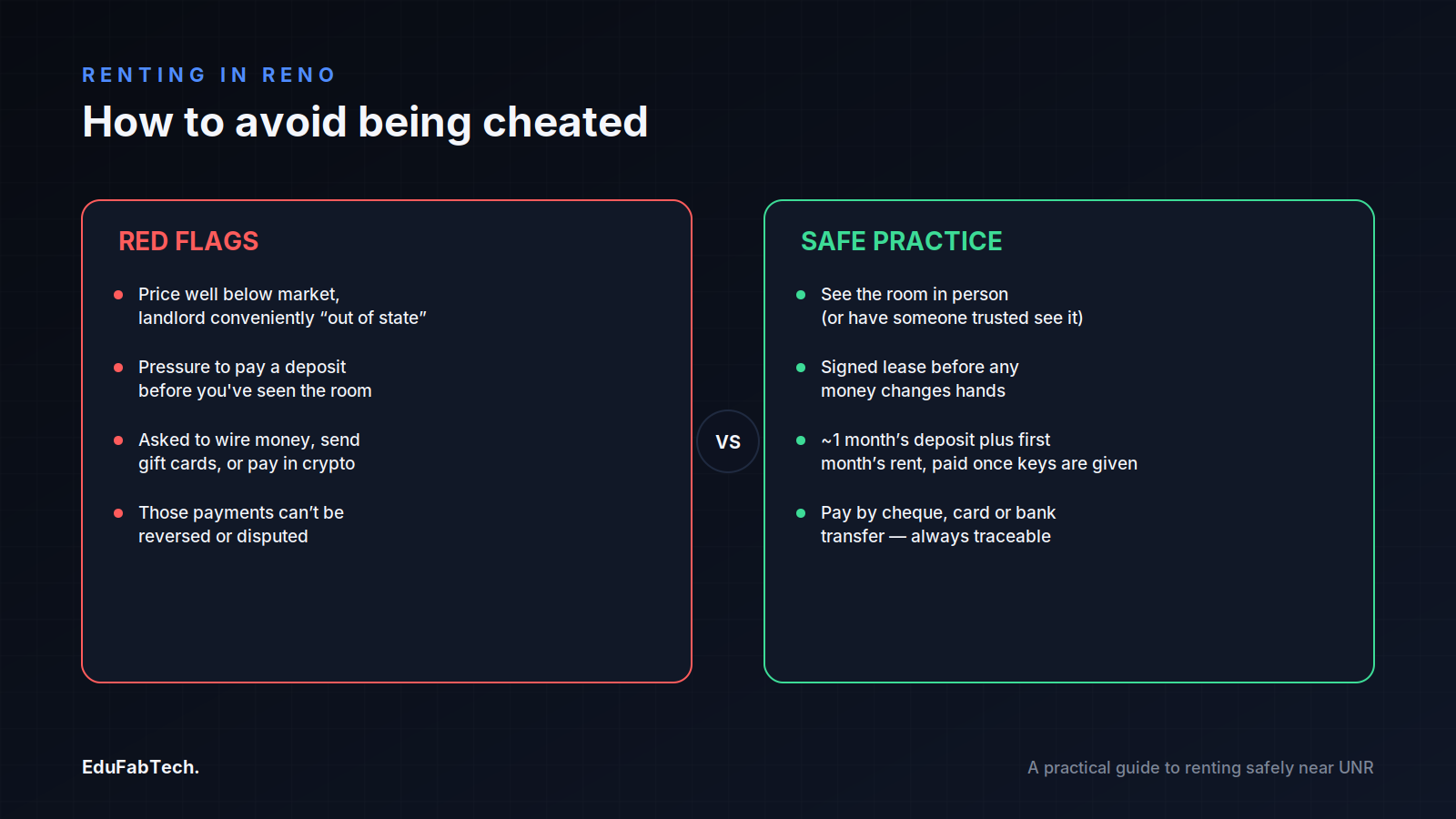
The scams that appear in Reno are the ones that appear in any tight rental market: a room or whole apartment advertised below the going rate, a landlord who is conveniently out of state or travelling, and pressure to send a deposit to hold it before you have seen anything. Two rules cover most of it. First, see the place in person — or have someone you trust see it — before any money moves; if that is impossible from abroad, do not pay more than is needed to reserve, and never pay the full deposit sight unseen. Second, pay in a way that can be traced and disputed. A request to wire money, send a bank transfer, buy gift cards, or pay in cryptocurrency to "secure" a room is the clearest warning sign there is, because those payments cannot be reversed. A normal arrangement in Reno is a signed lease, a security deposit of around one month's rent held against damage, and first month's rent — paid by cheque, card or bank payment once you have keys and a signed agreement in hand. If you are arriving for your first term, the university's housing and international offices are a safer first stop than an open listing, and EduFabTech keeps a running list of rooms and places to stay in Reno.
What it costs — the figures you can check
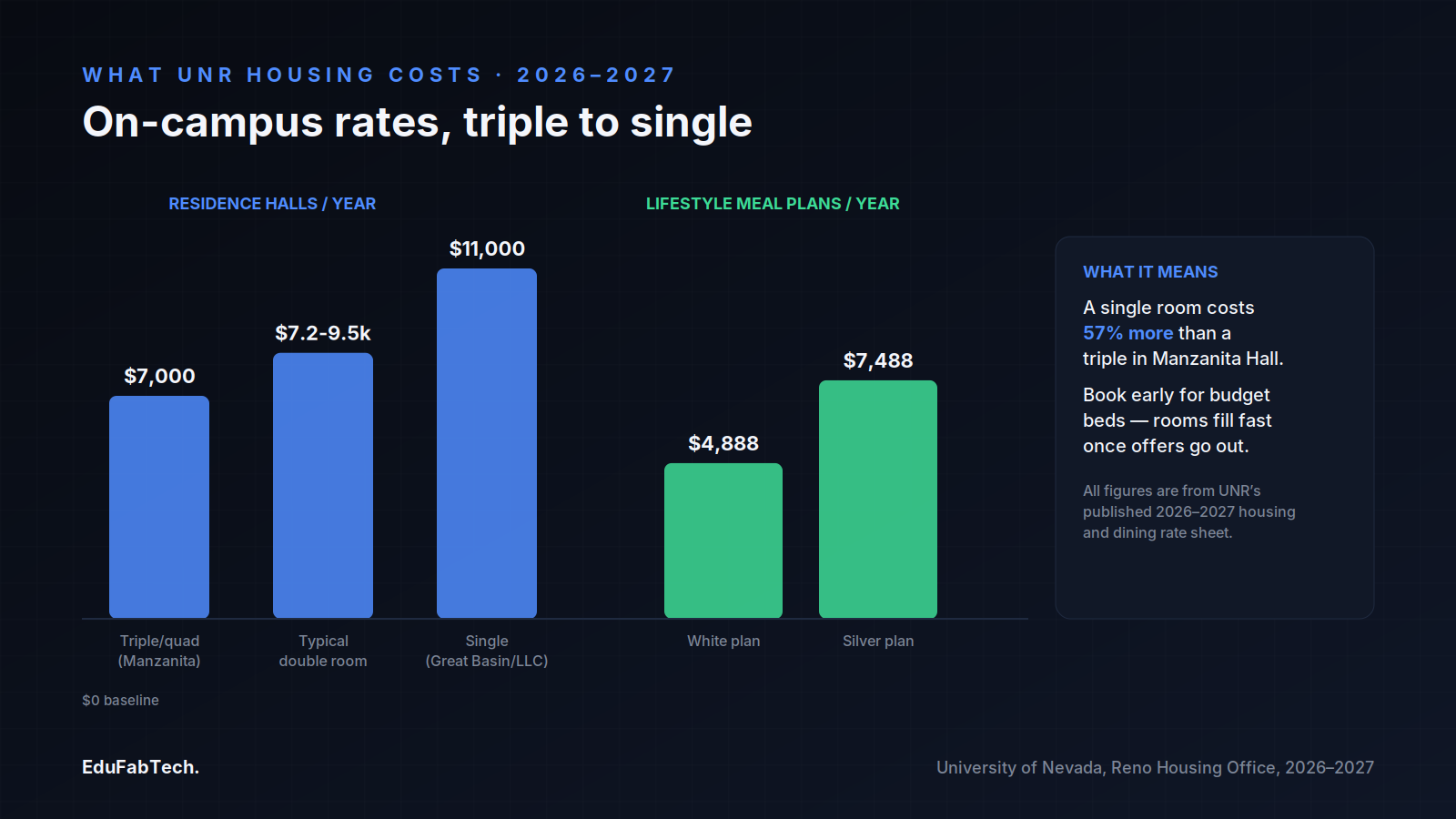
On-campus is the easiest cost to pin down because the university publishes it. For the 2026–2027 academic year, the University of Nevada, Reno's housing office lists residence-hall rates ranging from $7,000 per year for a triple or quad room in Manzanita Hall up to $11,000 for a single in Great Basin Hall or the Nevada LLC Hall, with most double rooms falling between roughly $7,200 and $9,500. Dining is separate: for the same 2026–2027 year the university's lifestyle meal plans run from $4,888 (the White plan) to $7,488 (the Silver plan), per the same page.
Off campus, prices move with the market and are harder to source cleanly, so treat any single advertised average with caution. The most reliable public anchor is the residence-hall sheet above; it tells you what a bed, utilities and amenities bundled together cost from the university itself, which is a fair yardstick against which to judge a private room. Budget beyond rent for a security deposit, winter heating, and — if you live away from the Virginia Street corridor — the cost of running a car, because Reno is a driving city once you leave the centre.
Furnishing a room for very little
Setting up a room cheaply is realistic in Reno. For second-hand goods, the Savers thrift store at 3800 S Kietzke Lane carries housewares, dishes, books and furniture-adjacent items alongside clothing, and Midtown has a cluster of vintage and resale shops within walking distance of each other. For fresh food and local makers, the Riverside Farmers Market runs at Idlewild Park, 2055 Idlewild Drive, on Sunday mornings — generally 9 a.m. to 1 p.m., with the start time shifting seasonally, so check before you go. Students in the halls often hand down desks, lamps and kitchen kit at the end of each semester; it is worth asking. EduFabTech also lists second-hand things, used furniture and items given away free in Reno, which can save you a car trip across town.
Getting around
The single best thing about student transport in Reno is the price. The Regional Transportation Commission of Washoe County (RTC) runs the fixed-route RIDE buses, and it states on its Fares & Passes page that students, faculty and staff of the University of Nevada, Reno, TMCC, Western Nevada College and the Desert Research Institute ride the fixed-route network for free simply by showing a valid student or employee ID to the driver. For everyone else, RTC lists a single-ride fare of $2.00, a day pass at $3.00 and a 31-day pass at $65, with reduced fares at half price for qualifying riders. The backbone route for students is the RAPID line along Virginia Street, which links the campus, downtown, Midtown and the shopping to the south, so a lot of daily life can be done without a car. Reno–Tahoe International Airport sits a few minutes southeast of downtown. Outside the Virginia Street corridor, though, a car becomes much more useful, and winter weather occasionally complicates both driving and walking.
Libraries and places to study
The main library is the Mathewson-IGT Knowledge Center on North Virginia Street, which the University Libraries describe as offering lendable technology, computers, poster printing, research help and quiet and group study space across several floors. For science and engineering students, the DeLaMare Library runs a makerspace with 3D printing and fabrication tools, and the Savitt Medical Library serves the health programmes. Library opening hours extend late in term and shift around exams, so check the libraries' hours page rather than assuming. Beyond the library, EduFabTech collects study spaces and desks and other listings near the University of Nevada, Reno.
Part-time work, and the rules for international students
Domestic students take the usual campus and service jobs, and the university's student employment office is the normal route in. International students face specific limits. The university's Office of International Students and Scholars states that F-1 students in a full course of study may work on campus up to 20 hours per week during the fall and spring semesters, and full-time during official breaks, without separate federal authorisation, and that options such as Curricular Practical Training become available only after the required time in F-1 status. These rules are set by federal immigration authorities, not by the university, and they change; treat the OISS office and the U.S. government's own Study in the States guidance as the authority, confirm your own situation with a designated school official before you accept any job, and read nothing here as legal advice. EduFabTech lists part-time jobs in Reno, but your visa status, not the listing, decides what you may take.
What is good, and what is hard
The good is real. Reno is a compact, flagship-university town where the bus is free for students, the campus is walkable, and the Sierra Nevada and Lake Tahoe are close enough for a day trip. The high desert gives it a dry, sunny climate for much of the year, and the city is small enough to learn quickly. The hard parts are honest too. Housing is tight and has grown more expensive as the region has boomed, so cheap rooms near campus go fast. Winters are cold and can bring snow and icy mornings; summers are hot and dry, and wildfire smoke drifting in from California can foul the air for stretches in late summer. Reno is still a casino town at its core, with the 24-hour gaming floors of the downtown casinos a short walk from campus — a feature some students enjoy and others find wearing. And once you leave the Virginia Street spine, the city spreads out in a way that rewards having a car.
A short checklist for your first weeks
- Confirm housing first: accept a residence-hall place through the university's portal, or do not pay an off-campus deposit until you have seen the room and signed a lease.
- Bring or borrow a student ID straight away — it is your free RTC RIDE pass on day one.
- Map the RAPID line along Virginia Street; it connects campus, downtown and Midtown and covers most daily needs.
- If you are an international student, visit the Office of International Students and Scholars before taking any job, and get your paperwork for a Social Security number started only once you have an on-campus offer.
- Furnish from Savers on Kietzke Lane, the Midtown resale shops and end-of-semester hand-downs before buying anything new.
- Prepare for the climate: warm layers and something for icy pavements in winter, and a plan for smoky-air days in late summer.
- Get a library account at the Knowledge Center and find your quiet floor before the first round of deadlines.
Reno rewards students who settle the basics early — a safe room, the free bus pass, a study spot — and then use the small, walkable core and the mountains beyond it. For current rooms, second-hand finds, jobs and events, EduFabTech's Reno listings and local events are kept up to date.
A quick question for readers
Do you work part-time while you study?
Many students work to pay the bills. See how common it is — and how many hours people really do.
Pick an answer, create a free account in a minute, and your vote counts. Already a member? Sign in
Comments 0
CommentNo comments yet. Members start the conversation.
Source: University of Nevada, Reno
Sources (5)
- University of Nevada, Reno. Housing and Meal Rates 2026–2027. University of Nevada, Reno, 2026. unr.edu ↗ · checked 21 Oct 2026
- University of Nevada, Reno. President Sandoval's State of the University address (recap). University of Nevada, Reno, 2025. unr.edu ↗ · checked 21 Oct 2026
- Regional Transportation Commission of Washoe County. Fares & Passes. RTC Washoe, 2026. rtcwashoe.com ↗ · checked 21 Oct 2026
- University of Nevada, Reno. Office of International Students and Scholars — Resources. University of Nevada, Reno, 2026. unr.edu ↗ · checked 21 Oct 2026
- Riverside Farmers Market. Riverside Farmers Market (Idlewild Park). Reno Farmers Market, 2026. renofarmersmarket.com ↗ · checked 21 Oct 2026