Studying in Springfield, Missouri: universities, housing and student life
A practical, sourced guide to Missouri State, Drury and Evangel, where students rent in the Queen City of the Ozarks, what a year costs, and how to get around on The Bus.
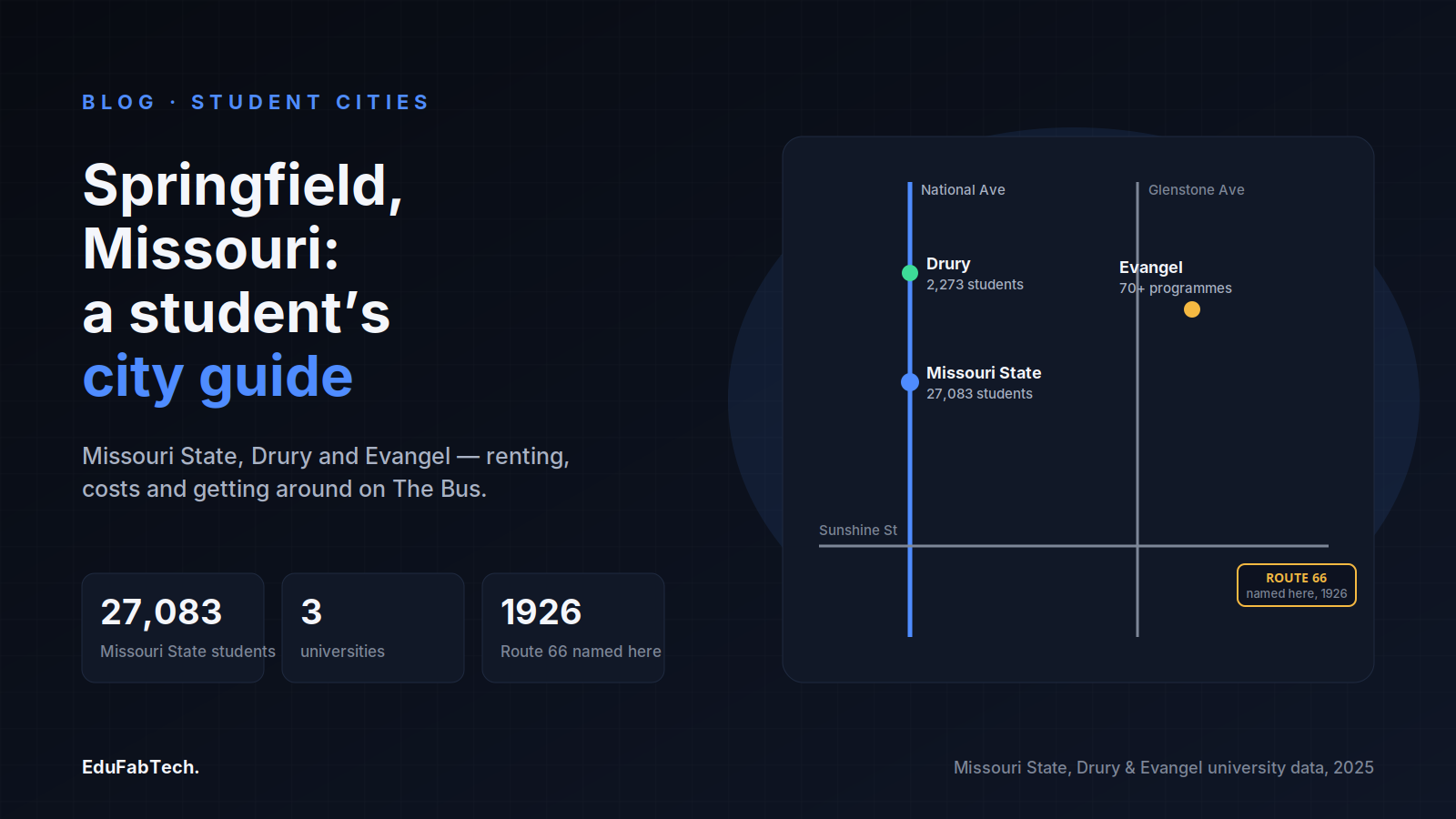
Springfield sits on the Springfield Plateau in the Missouri Ozarks, the third-largest city in Missouri and the seat of Greene County. Locals call it the Queen City of the Ozarks, and it has a second claim worth knowing: the plan to number a transcontinental highway "Route 66" was first proposed here in 1926, which is why the road still threads through town as a tourist draw. For students, the useful fact is simpler. Three residential universities grant degrees within a few miles of each other, and the cost of living runs below the national average, which is a large part of why people study here rather than in St. Louis or Kansas City.
The city is flat to gently rolling, laid out on a grid, and spread out in the way of mid-American cities built around the car. National Avenue, Glenstone Avenue and Sunshine Street are the arteries you will learn first; downtown and the historic Commercial Street district ("C-Street") sit to the north, and the universities cluster just south and east of the centre. Winters are cold and occasionally icy, summers are hot and humid, and spring brings the severe thunderstorms common to this part of the country — Springfield is near the eastern edge of what is loosely called Tornado Alley, and you will hear the outdoor sirens tested.
This guide covers the universities, where students actually rent, how to furnish a room cheaply, working rules for international students, libraries, transport and real costs — with sources named in the text so you can check anything that matters to your budget. You can also browse current student listings for Springfield on EduFabTech as you read.
Four ways to earn a degree in Springfield
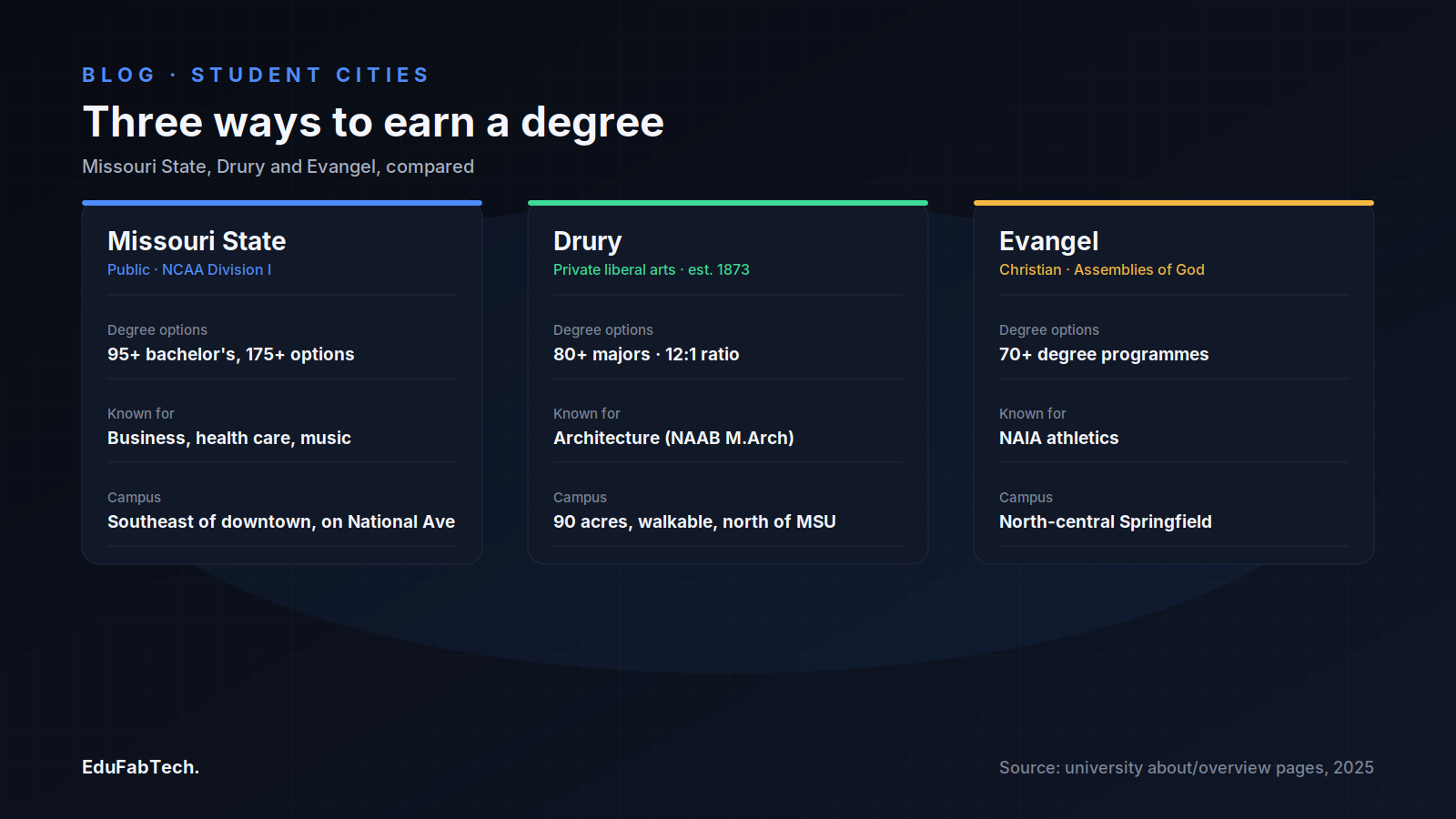
Missouri State University is the giant. Its own figures put total enrolment at 27,083 students across the Missouri State system, and the university carries a legislatively defined statewide public-affairs mission built around "ethical leadership, cultural competence and community engagement," according to its about page. That same page lists more than 95 bachelor's programmes with 175-plus options, and the Carnegie "Research College and University" designation. The main campus sits just southeast of downtown, along and east of National Avenue, so the student district and the city centre blur together. Business is among its largest fields of study, with strong health-care, music, theatre and teacher-education programmes; the Bears compete in NCAA Division I.
Drury University is the private counterpart: a liberal-arts university founded in 1873 on a 90-acre residential campus just north of Missouri State, near downtown. Drury reports 2,273 total students for 2025 and an 80-plus-major catalogue on its overview page, with a 12:1 student-to-faculty ratio. Its best-known programme is architecture: the Hammons School of Architecture runs a five-year Master of Architecture accredited by the National Architectural Accrediting Board, which the university describes as one of the few liberal-arts-based architecture programmes in the country. The campus is compact and walkable, with Stone Chapel — the oldest stone building in Springfield — as its landmark.
Evangel University is a Christian university affiliated with the Assemblies of God, whose national headquarters is also in Springfield. Evangel's about page says it has been preparing students "for over 60 years" and offers more than 70 career-focused degree programmes across fields from biology and finance to forensic science; it competes athletically in the NAIA. Its campus lies on the north-central side of the city.
A fourth degree-granting institution, Global University, also operates in Springfield at 1211 South Glenstone Avenue. It is a distance-education Christian university formed in 2000 from the merger of the former ICI University and Berean University, and it teaches almost entirely by correspondence and online rather than on a residential campus — worth knowing if you see its name but not its students. Two older names you may still encounter locally — Central Bible College and Everest College — no longer enrol students; the former was consolidated into Evangel in 2013 and the latter, a for-profit career college, closed in 2017.
Where students find rooms, from Rountree to C-Street
Most first-year students at Missouri State live on campus — the university runs room-style halls, suite-style halls and apartments — but after the first year the search moves outward, and it moves on foot and by car into the neighbourhoods around National Avenue. Rountree, the historic district immediately east of the Missouri State campus, is the classic student neighbourhood: early-twentieth-century houses, tree-lined streets, and a short walk to class. Phelps Grove and the blocks around Sunshine Street attract graduate students and those wanting a quieter street. Closer to Drury and downtown, converted houses and small apartment buildings put you within walking distance of the centre and Commercial Street. Students who prioritise rent over walkability look south and southeast, where larger complexes line Battlefield Road and Campbell Avenue but a bus or bike becomes necessary.
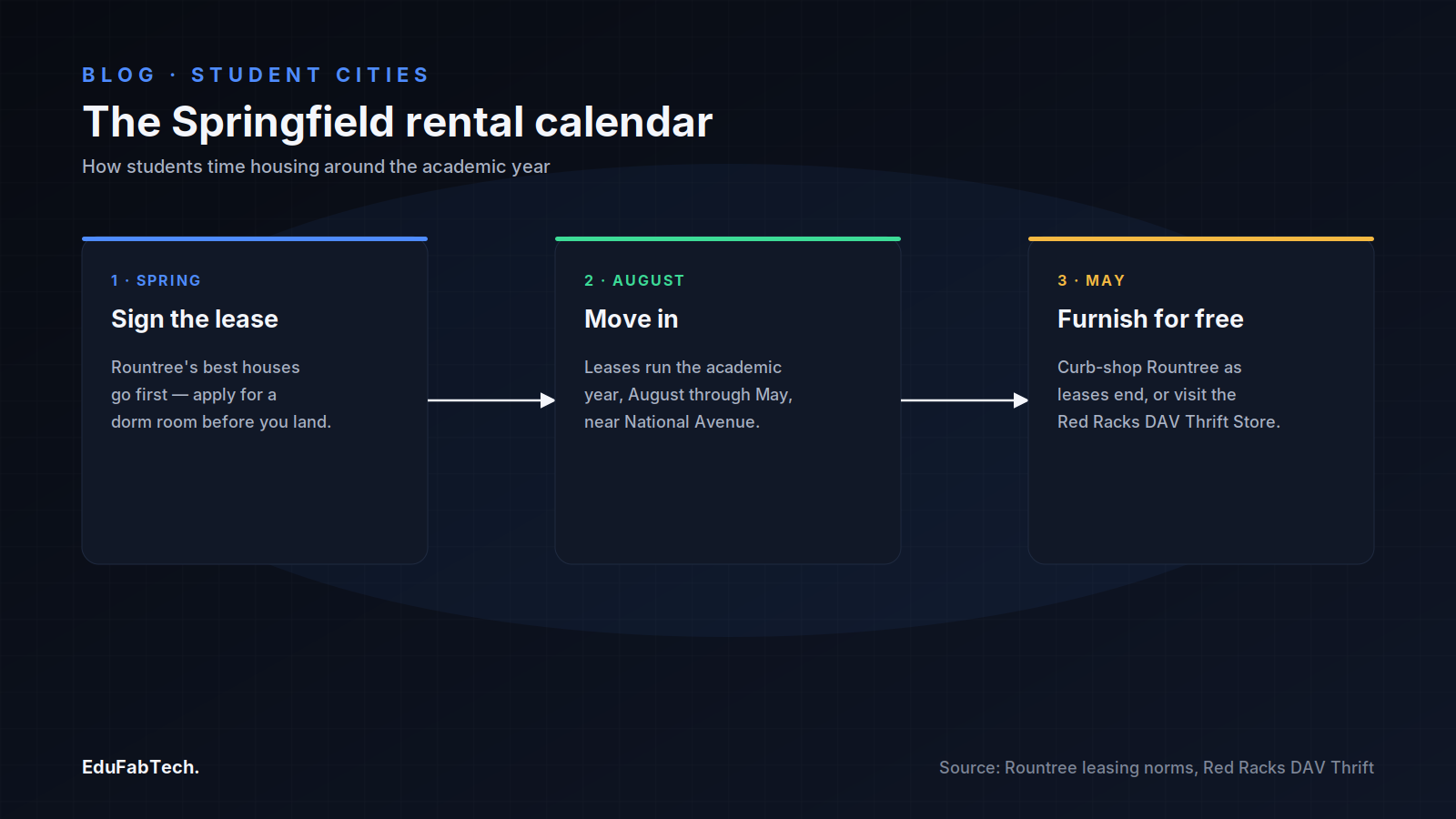
Start looking earlier than feels natural. Leases for the August-to-May academic year are commonly signed in the spring, and the best-located houses in Rountree go first. If you are arriving from abroad, apply for a university room before you land — it is the one option you can secure without seeing the place — and treat your first weeks in a hall as time to scout off-campus for the following year. You can compare what is currently available through rooms listed for Springfield and listings near Missouri State University.
Renting without losing your deposit
Springfield's rental market is ordinary and mostly low-pressure, which is exactly why scams here rely on urgency rather than sophistication. The pattern to distrust is a house listed well below the going rate — a Rountree bungalow for far less than its neighbours — by someone who cannot meet you because they are "out of state" or "on a mission trip," and who asks you to wire a deposit or send gift-card or cryptocurrency codes to "hold" it. No legitimate Springfield landlord needs a crypto deposit. See the actual unit, or have someone you trust see it, before any money changes hands; meet the person who holds the keys; and keep the deposit and first month's rent on a traceable, reversible method. A security deposit of roughly one month's rent is normal here. If a listing's photos look too polished for the street it claims to be on, search the address — recycled photos are the commonest tell.
Furnishing a room: markets and the Ozarks' second-hand circuit
Springfield has a genuine second-hand culture, helped by a steady turnover of student households every May. For donated furniture, clothing and household goods, the Red Racks DAV Thrift Stores — run for Disabled American Veterans — are the volume option; the city's tourism office also points visitors to flea markets and antique malls such as Mike's Unique Collectable and Antique Flea Market, with its dozens of booths of books, toys and household items, and The Vintage Peddler on East Trafficway Street, on its antiques and flea markets page. For food and local goods, the city's farmers' markets run year-round: the Farmers Market of the Ozarks at Farmers Park and the C-Street City Market on historic Commercial Street are both listed by the Springfield convention and visitors bureau on its farmers' markets page.
The cheapest furniture of all is the kind left behind. At the end of the spring term, kerbs in Rountree and other student blocks fill with abandoned desks, chairs and shelves; a slow drive around the week leases end is a local tradition. EduFabTech also tracks second-hand goods and jobs and part-time work in the city if you would rather search from a phone than a pickup truck.
Working while you study
If you are on an F-1 student visa, the baseline rule set by U.S. Immigration and Customs Enforcement is that you may work on campus up to 20 hours per week while school is in session, and full-time during official breaks, generally without separate approval, according to ICE's employment guidance. Off-campus work, and the training categories known as Curricular Practical Training (CPT) and Optional Practical Training (OPT), carry their own conditions and approvals. These rules change, and your own situation can differ, so this is not legal advice: confirm everything with your university's international-student office — Missouri State's International Services, for example — before you accept any job. On-campus roles in dining, the library and residence life are the usual starting points and keep you inside the rules by default.
Libraries and quiet desks
Each campus has its own library — Missouri State's Duane G. Meyer Library is the largest of the three — but the resource many students underuse is the public one. The Springfield-Greene County Library District runs ten branches, and its headquarters, The Library Center at 4653 South Campbell Avenue, is an 82,000-square-foot building with free study rooms and small conference rooms you can reserve at no cost, according to the branch's own page. For students living on the south side, it is often a closer and quieter desk than campus during exam weeks, and it stays open to everyone regardless of which university you attend. More options are collected under study spaces in Springfield.
Getting around on The Bus
Public transport in Springfield is run by City Utilities, the municipally owned utility, under the name The Bus. It is a fixed-route daytime network built around a downtown transfer station, not a frequent all-hours system — useful for a weekday commute, less so for a late shift or a Sunday. The relevant number for students is the fare. City Utilities lists a single adult cash ride at $1.00 and a 31-day pass at $36.00, and — most usefully — a semester pass for full-time college students at $100.00, on its fares page (2026). Passes can be loaded through the Token Transit app. Because service is limited in the evenings and on weekends, most students treat a bike or a car as the real backbone and the bus as the cheap daytime fallback; the city is flat enough that cycling is realistic for the campus-to-downtown trips.
What a year costs
Housing is where your choices show up most, and the clearest dated figures come from Missouri State itself. For the 2026-2027 academic year, its residence hall rates run from $3,453 per semester for a shared community-bathroom room in Wells or Freddy Hall up to $4,947 per semester for a two-person en-suite in Hammons or Hutchens; university apartments are cheaper per head, with a four-person Sunvilla unit at $2,987 per semester. Meal plans on the same page range from $1,499 to $1,655 per semester. Those are per-semester numbers, so double them for a full year.
For a budget that combines housing and food, Missouri State's cost-of-attendance estimates for 2026-2027 allow $11,538 for a year living on campus and $10,976 living off campus — figures the university says it builds from averages of its own residence options and surveys of local housing. The off-campus number being close to the on-campus one tells you something true about Springfield: renting a shared house does not necessarily beat a dorm once utilities and food are counted, so weigh it on space and independence rather than assuming it is cheaper. These are allowances, not prices; your actual rent in Rountree or near C-Street will depend on the house and how many people share it.
The good and the hard
The honest case for Springfield is affordability and scale. Three universities in one mid-sized city mean a real student population, a thrift and second-hand economy fed by annual turnover, and rents and living costs below what the coasts demand — the Missouri State allowances above sit well under equivalent figures in large metros. The city is walkable and bikeable in its student core, and the Ozarks landscape of lakes and rivers is close for weekends.
The hard parts are the flip side of a car-built city. Transit is daytime and limited, so life without a bike or car shrinks to a few corridors; Springfield has long debated whether its bus system is adequate for the people who depend on it. The weather asks something of you — summer humidity, winter ice, and spring storm season with real tornado warnings. And Springfield is a regional city, not a global one: the international community is smaller than in a coastal university town, and some services and flights route through Kansas City or St. Louis two to three hours away. None of this is a reason to stay away; it is a reason to arrive with a plan for getting around.
A checklist for your first weeks
- Secure a university room before arrival if you can; use your first term in it to scout Rountree and nearby streets for the next year's lease.
- Never send a deposit by wire, gift card or cryptocurrency, and see any off-campus unit — in person or through someone you trust — before paying.
- If you hold an F-1 visa, meet your university's international-student office before taking any job and confirm the current on-campus hours rule with them.
- Buy the City Utilities semester pass if you will commute by bus, and decide early whether a bike or car is worth it for evenings and weekends.
- Get a Springfield-Greene County Library card — the study rooms are free and open to all three universities' students.
- Furnish from Red Racks, the flea markets and end-of-term kerbs rather than buying new; check local second-hand listings first.
- Save the outdoor-siren test schedule and a storm-alert app before spring; learn where your building's shelter space is.
A quick question for readers
Do you work part-time while you study?
Many students work to pay the bills. See how common it is — and how many hours people really do.
Pick an answer, create a free account in a minute, and your vote counts. Already a member? Sign in
Comments 0
CommentNo comments yet. Members start the conversation.
Source: Missouri State University (Residence Life, Housing and Dining Services)
Sources (5)
- Missouri State University, Residence Life, Housing and Dining Services. University Housing Rates (2026-2027). Missouri State University, 2026. reslife.missouristate.edu ↗ · checked 17 Oct 2026
- Missouri State University, Office of Financial Aid. Cost of Attendance. Missouri State University, 2026. missouristate.edu ↗ · checked 17 Oct 2026
- City Utilities of Springfield. Fares. City Utilities of Springfield, 2026. cityutilities.net ↗ · checked 17 Oct 2026
- Drury University. University Overview. Drury University, 2025. drury.edu ↗ · checked 17 Oct 2026
- U.S. Immigration and Customs Enforcement. Employment (SEVP, Students and Exchange Visitors). U.S. Department of Homeland Security, 2026. ice.gov ↗ · checked 17 Oct 2026