Studying in Starkville: universities, housing and student life
A practical, sourced guide to living and studying in Starkville, Mississippi — the Cotton District, residence-hall costs, the free SMART bus, part-time work rules and the honest trade-offs of a one-university town.
A college town in Mississippi's Golden Triangle
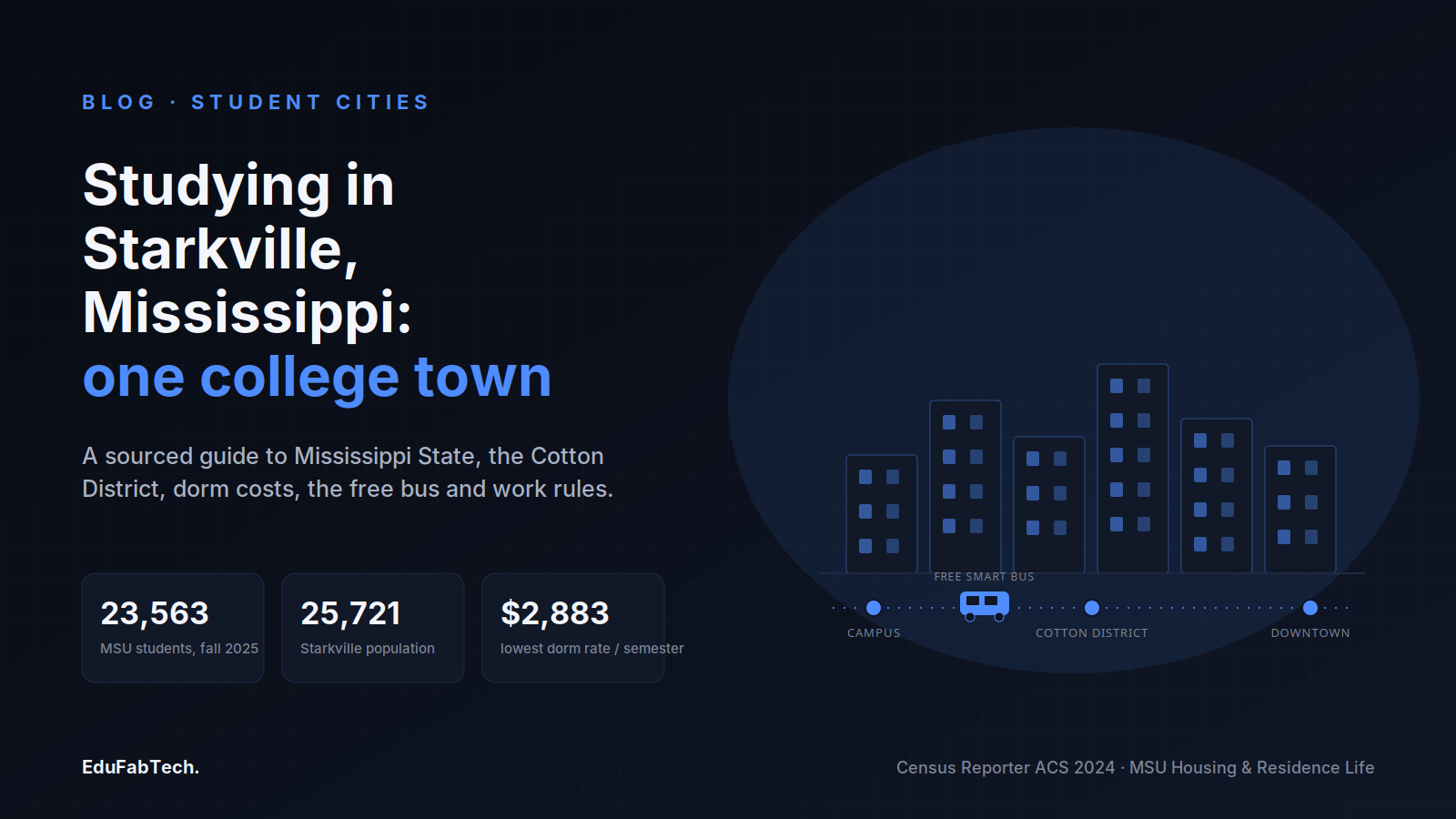
Starkville sits in Oktibbeha County in the hill country of northeast Mississippi, roughly midway between Jackson and Birmingham, Alabama, and anchored to the cluster of small cities — with Columbus and West Point — that locals call the Golden Triangle. It is a small place: the U.S. Census Bureau's American Community Survey 2024 five-year estimates, compiled by Census Reporter, put the city's population at about 25,721, with a median household income of $42,125 over that period. A large share of those residents are students, because the town's economy, rhythm and reputation run through a single institution.
That institution is Mississippi State University, and Starkville is very much shaped around it. The university's admissions office points out that the town was named USA Today's "Best Small Town in the South" and, on its Starkville page, says it earned the title "for the third year in a row". For a student, the practical meaning of a one-university town is simple: almost everything — housing, work, the bus network, the social calendar — is organised for undergraduates and their professors, which is convenient, but also means the city empties and quiets sharply when the semester ends.
Mississippi State University: studying as a Bulldog
Mississippi State is the state's land-grant university. Its own history page records that it was established on 28 February 1878 as the Agricultural and Mechanical College of the State of Mississippi, one of the land-grant institutions created under the 1862 Morrill Act; it received its first students in the autumn of 1880 and took the name Mississippi State University in 1958. The main campus lies just east of downtown Starkville in the community of Mississippi State, and it is sprawling and distinctly agricultural in feel, with research farms, a veterinary college and engineering facilities alongside the usual lecture halls.
The university is large for its setting and still growing. In its own newsroom, MSU reported a record total of 23,563 students in autumn 2025, describing itself as the only public institution in the state to grow in overall numbers for ten of the past eleven years. The strongest and most visible programmes are in agriculture, engineering, architecture, business and veterinary medicine, and the campus is a founding member of the Southeastern Conference — which is why autumn Saturdays at Davis Wade Stadium, and the clang of cowbells that students bring to games, dominate the town's calendar in a way they would not in a larger city.
For an international or out-of-town student, the day-to-day experience is that of a big public campus wrapped inside a small town: large first-year courses, extensive labs and library facilities, and a short walk or free bus ride between almost everything. The flip side is that your academic life and your social life both orbit the same place, and there is little of the wider-city distraction — or escape — that a student in a metropolis would have.
Finding somewhere to live: halls and the Cotton District
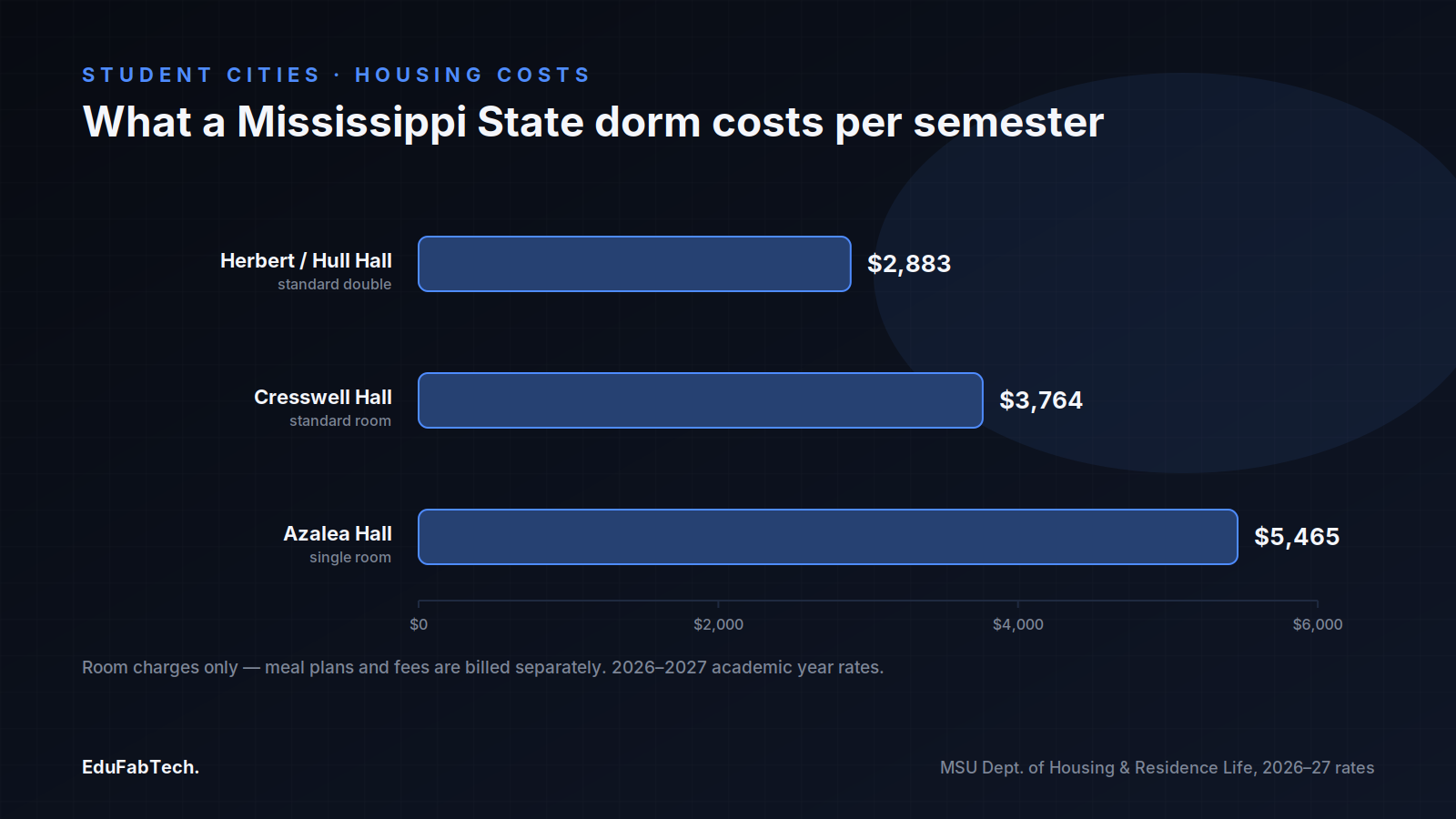
Most first-year undergraduates start in university housing, and that is the simplest and safest way to arrive, especially from abroad. Mississippi State's Department of Housing and Residence Life publishes its rates per semester and by hall. For the 2026–2027 academic year, the lowest listed rate is a standard double room in Herbert Hall or Hull Hall at $2,883.00 per semester, while newer or single-occupancy options run higher — a standard room in Cresswell Hall is listed at $3,764.00 per semester and a single in Azalea Hall at $5,465.00 per semester. Those are room charges only; meal plans and fees are billed separately, so read the housing contract before you sign.
Off campus, the neighbourhood every Starkville student learns first is the Cotton District, a small, dense quarter wedged between downtown and the campus edge. The Congress for the New Urbanism describes it as a Traditional Neighborhood Development built up from 1969 onward by builder Daniel Camp, who turned the remnants of a cotton-mill village — the Sanders family mill had closed in 1964 — into roughly 175 duplexes, four-plexes, town houses and cottages in Greek Revival and Victorian styles along deliberately narrow, walkable streets. It is where a lot of upper-year students and young professionals want to be: bars, coffee and restaurants downstairs, flats upstairs, everything on foot. It is also among the more expensive and sought-after corners of town, so it fills early. Quieter and cheaper rooms tend to be further out along Highway 12 and in the apartment complexes north and east of campus, where you will likely need the bus or a bicycle.
Whatever you are after, start looking early. Rooms in and near the Cotton District and the better complexes are often spoken for months before the autumn term, and you can browse what is currently listed on EduFabTech's Starkville rooms page, and specifically what is near campus via listings near Mississippi State University.
Renting without being cheated
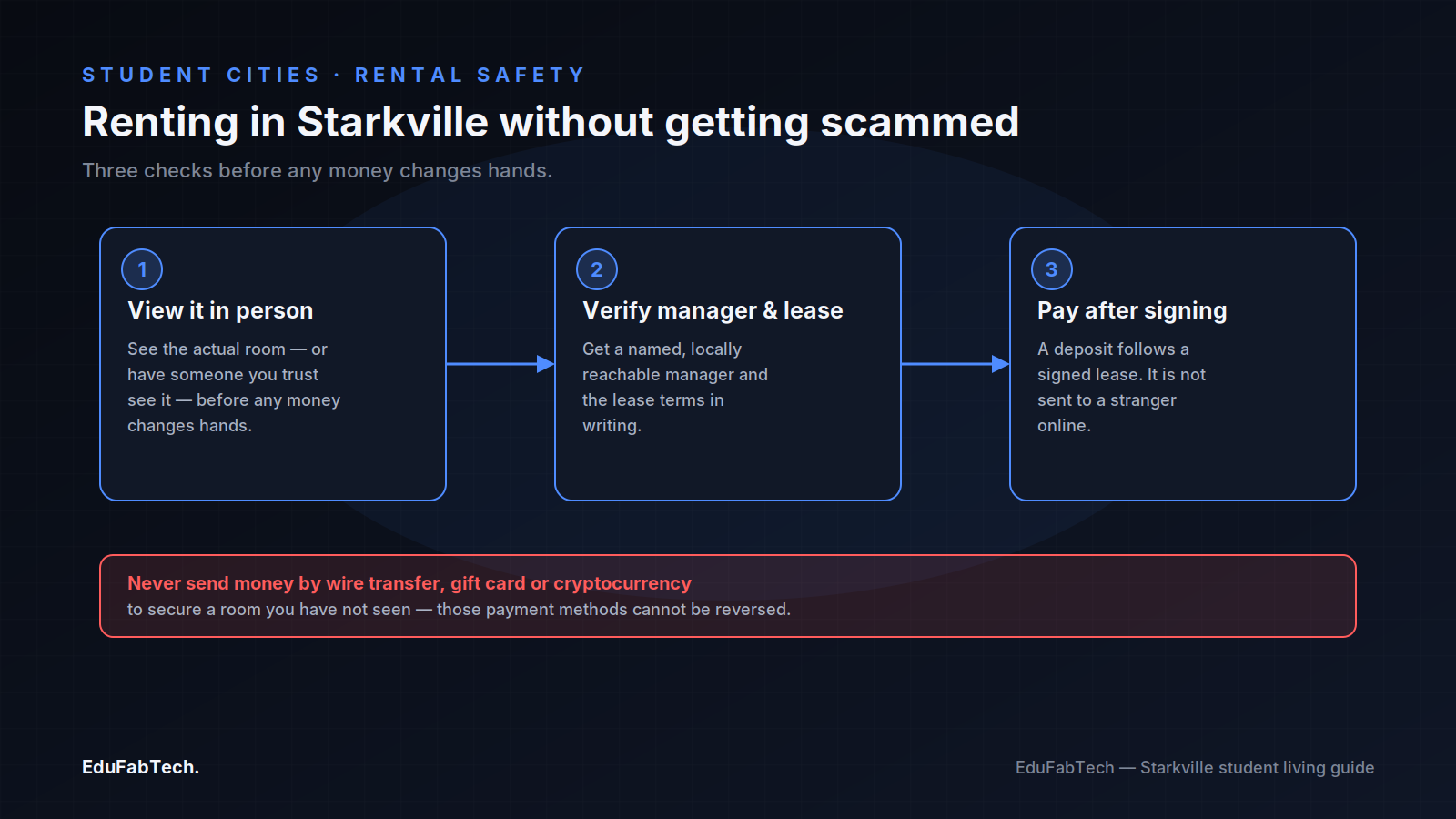
Starkville's rental fraud looks like fraud everywhere: a room that is cheaper and nicer than everything else, a "landlord" who is conveniently out of town, and pressure to pay a deposit immediately to "hold" it. In a town this small, the honest signal is that you can almost always see the actual unit — the Cotton District and the complexes are a short bus ride apart — so insist on viewing the room in person, or having someone you trust view it, before any money changes hands. Ask who manages the property and get the lease terms in writing. Never send a deposit or first month's rent by bank wire transfer, gift card or cryptocurrency to secure a place you have not seen; those methods are the ones scammers ask for precisely because they cannot be reversed. A normal deposit here is paid once you have a signed lease with a named, locally reachable manager, not to a stranger online.
Kitting out a room cheaply, and the Saturday market
A room off campus usually comes unfurnished or part-furnished, and the cheapest way to fill it is second-hand. Starkville has the churn of any student town — people graduate every May and leave furniture behind — plus charity-run thrift stores such as the Starkville Area Habitat for Humanity ReStore on South Jackson Street, which resells donated furniture, appliances and building materials. You can see what students in the city are currently selling or giving away through EduFabTech's second-hand listings, which are worth checking hardest in the week after graduation.
For food and the feel of the town, the Starkville Community Market is the fixture. Mississippi State's own description notes that each Saturday at 8 a.m. beginning in mid-April the market sells locally grown produce and baked goods, alongside artisan crafts, cooking and gardening demonstrations and live music. It runs through the warm months rather than year-round, so it is a spring-to-autumn habit; in winter you are back to the supermarkets along Highway 12.
Part-time work, and the rules that bind international students
Undergraduates in the United States often work a few hours a week, and on a campus this size the jobs are mostly on it — dining halls, the library, recreation facilities, departmental offices. If you are an international student, the rules around that work are strict and not something to improvise. The U.S. Department of Homeland Security's Study in the States guidance states plainly that if you are on an F-1 visa and working on campus, "you may not work more than 20 hours per week when school is in session". The same page explains that off-campus employment is available only to F-1 students who have completed at least one full academic year and can show economic hardship, and that you must get approval from your Designated School Official before taking it.
The person who administers all of this is your Designated School Official in the university's international office; talk to them before you accept any paid work, because a job taken without the right authorisation can put your visa status at risk. Treat the official guidance and your DSO as the authority here — this guide cannot give you legal advice. You can see what part-time openings students in the city are posting through EduFabTech's Starkville jobs page, but verify any role against the rules above first.
Mitchell Memorial Library and other places to study
The centre of study life is Mitchell Memorial Library, the main library on campus. Its own page lists bookable group study rooms and an on-site cafe — an Einstein Bros Bagels — along with notable special collections, including the Ulysses S. Grant Presidential Collection and the John Grisham Collection. The group study rooms, which you reserve for two or five hours, are the thing graduate and project-working students fight over at exam time, so book ahead rather than hoping for a free one.
Beyond the main library, the campus has departmental and specialised study spaces, and quieter corners open up in the town's coffee shops between class blocks. If you want a desk away from campus, or are looking for a specific kind of space, EduFabTech keeps a list of study spaces in Starkville. The practical point for a newcomer is that study space is plentiful on a campus built for more than twenty thousand students — the constraint is the reservable rooms during finals, not seating in general.
Getting around without a car: the free SMART bus
Starkville is one of the easier small American towns to live in without a car, because of the Starkville–MSU Area Rapid Transit system, known as SMART, which is run jointly for the city and the university. Its fare policy is unusually simple: SMART's own FAQ states that "there is no charge to ride S.M.A.R.T." The network of fixed routes covers both the campus and the city of Starkville, with named routes through MSU and the surrounding neighbourhoods, so getting between your flat, class and downtown generally does not cost anything and does not require a car.
What the free bus does not do is run on your schedule in the evenings or on Sundays, and its routes are built around the campus rather than the whole county. Most students who live off campus still keep a bicycle for the gaps, and many eventually buy a car for grocery runs and trips beyond town, because the nearest airport — Golden Triangle Regional, which SMART reaches with a separate GTR Airport Express service — and the larger cities are a drive away. For daily term-time life, though, the combination of a compact town and a free, campus-wide bus is a genuine saving.
The honest balance: costs, climate and distance
The clear advantages of Starkville are cost and simplicity. Rents and living costs are low by national standards — the median household income figure above is a reminder that this is not a wealthy or expensive metro — a dorm room starts under $3,000 a semester, the bus is free, and almost everything a student needs is close together. The town is safe-feeling, walkable at its centre, and genuinely built around undergraduate life.
The honest difficulties are the other side of the same coin. This is a small, somewhat isolated town: the Golden Triangle is hours from any big city, flights out are limited, and students without a car can feel stuck once the campus bus stops for the evening. Summers are long, hot and humid in the Deep South, and the academic-year housing market is tight in the most-wanted areas, so late arrivals end up further out. And because the whole place revolves around one university, the social scene is intensely campus-focused — wonderful if you want to be inside Bulldog life, narrow if you want a city's worth of alternatives. For international students in particular, the adjustment is as much about the quiet and the distance as about the coursework.
Your first two weeks: a checklist
- Confirm your housing in writing before you arrive, and read the Mississippi State housing contract — room charges are per semester and do not include meal plans or fees.
- If you are an international student, meet your Designated School Official in the first days to check your status and understand the on-campus work limit before taking any job.
- Get your student ID and learn the SMART routes between your room, your department and downtown; the ride is free, so use it from day one.
- Furnish cheaply: watch the second-hand and free-stuff listings, especially around move-in and graduation, and the Habitat ReStore for larger items.
- Reserve a Mitchell Memorial Library group study room early in the term rather than at exam time, and find a backup study spot off campus.
- If you are renting off campus, view the unit in person and never wire a deposit for a place you have not seen.
- Check EduFabTech's Starkville events page and get to one Saturday Community Market before the season ends in the autumn.
A quick question for readers
Do you work part-time while you study?
Many students work to pay the bills. See how common it is — and how many hours people really do.
Pick an answer, create a free account in a minute, and your vote counts. Already a member? Sign in
Comments 3
Comment-
The number worth sitting with is twenty hours a week for F-1 students, and the piece that follows it: you can't improvise off-campus work un…
-
The '23,563 students, growing for ten of the past eleven years' line comes straight from MSU's own newsroom, and the 'Best Small Town in the…
-
The number that got my attention is the 23,563 students against a town of 25,721 — that's not a university in a town, that's a near one-to-o…
Join free to read the full comments and reply Comments are between members; an account takes a minute.
Source: Mississippi State University Department of Housing and Residence Life
Sources (5)
- Mississippi State University Department of Housing and Residence Life. 2026-2027 Residence Hall Costs. Mississippi State University, 2026. housing.msstate.edu ↗ · checked 22 Oct 2026
- Study in the States. Working in the United States. U.S. Department of Homeland Security, 2026. studyinthestates.dhs.gov ↗ · checked 22 Oct 2026
- Starkville–MSU Area Rapid Transit. Frequently Asked Questions. Mississippi State University, 2026. smart.msstate.edu ↗ · checked 22 Oct 2026
- Mississippi State University. The University History. Mississippi State University, 2026. msstate.edu ↗ · checked 22 Oct 2026
- Congress for the New Urbanism. Cotton District. Congress for the New Urbanism, 2026. cnu.org ↗ · checked 22 Oct 2026