Studying in Sunbury, Pennsylvania: a riverside base for Bucknell, Susquehanna and Bloomsburg students
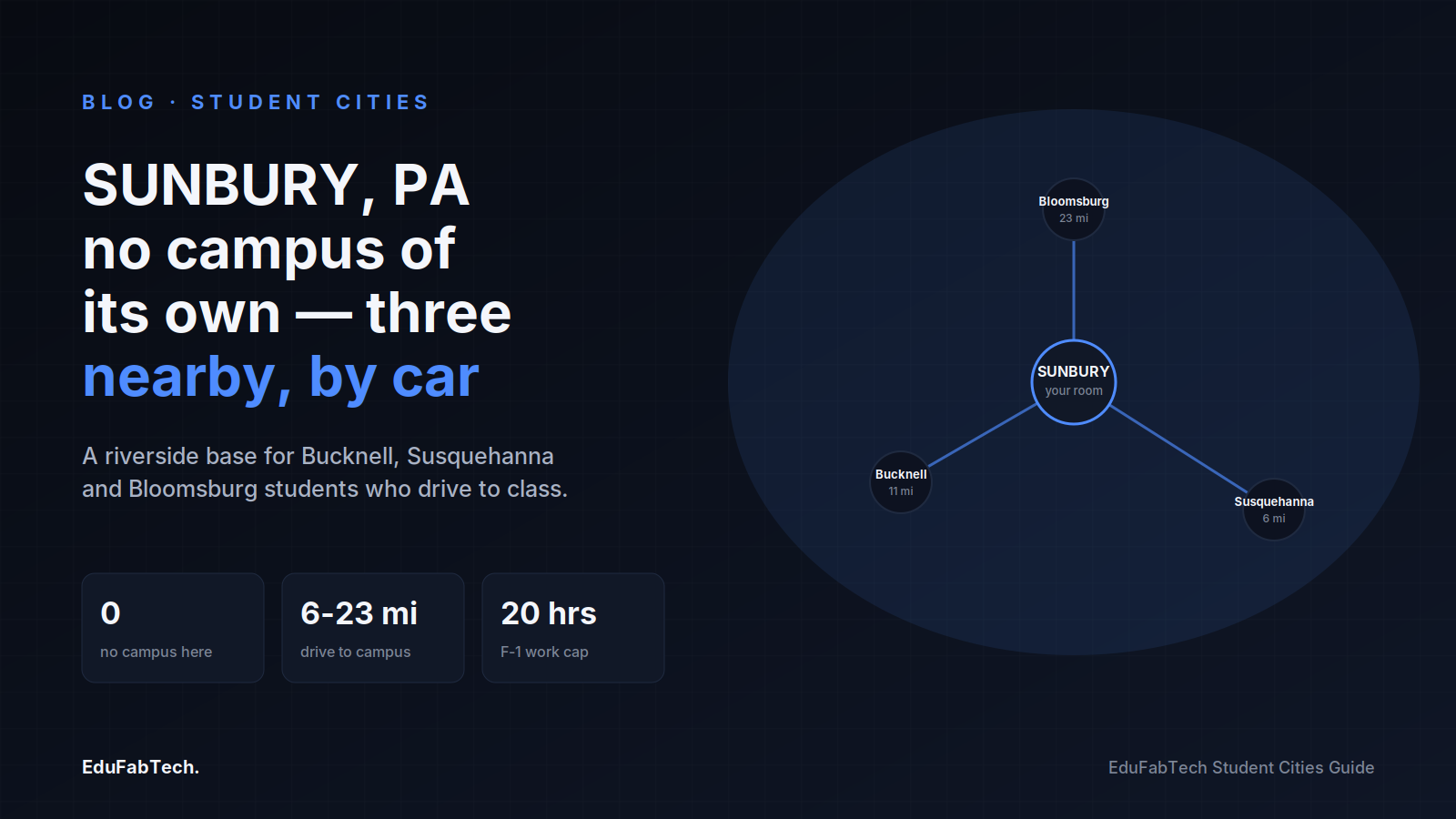
Sunbury has no campus of its own, but it sits within a short drive of three universities — here is how to live there as a student, from rooms and thrift shops to the rabbittransit Stop Hopper and the work rules for international students.
Sunbury sits on the east bank of the Susquehanna River at the point where the river's North and West branches meet, the seat of Northumberland County and about an hour's drive north of Harrisburg. It is a small city — the kind where you can walk from the riverfront levee to the county courthouse in a few minutes — with a dense grid of nineteenth-century brick on Market Street and a long industrial memory still visible in its rail yards and old factory blocks.
The first thing a prospective student should understand is what Sunbury is not: it is not a college town. No university has its main campus inside the city. What Sunbury offers instead is a central, inexpensive base in the middle of a cluster of universities, each a short drive away in a different direction. If you are willing to commute, the arithmetic of living here can work in your favour; if you expect lecture halls and a campus library at the end of your street, it will not.
That geography shapes everything else in this guide. Rooms, shops, buses and the rhythm of the week all follow from the fact that students here are spread between Sunbury and the towns around it, rather than concentrated on one campus. The sections below take the universities first, then work outward to where you might actually sleep, study, shop and get around.
The universities within reach
Three institutions draw students into this stretch of the Susquehanna Valley, and none of them is in Sunbury itself. Closest is Susquehanna University, a private liberal-arts university in Selinsgrove, roughly six miles south across the river; it is a small residential campus best known for its AACSB-accredited Sigmund Weis School of Business and a strong tradition in the arts and sciences. About eleven miles west, in Lewisburg, is Bucknell University, a selective private university whose own pages describe it as "Three Colleges, One Bucknell" — the College of Arts & Sciences, the College of Engineering and the Freeman College of Management — offering, in Bucknell's words, "more than 60 majors and 70 minors" (bucknell.edu/meet-bucknell). Bucknell's engineering and management programmes are the reason many students in this region are here at all.
The third option takes the most driving. The Bloomsburg campus, long known as Bloomsburg University, lies about twenty-three miles up the river. Since 1 July 2022 it has been part of Commonwealth University of Pennsylvania, formed when "Bloomsburg University, Lock Haven University, and Mansfield University integrated as a single, comprehensive university with multiple campuses," according to the university's own history page (commonwealthu.edu/about/history). It is a state-system university, which usually means lower published tuition than the two private institutions — a difference worth checking against each school's own cost page before you commit to anything.
For a student deciding where to live, the practical question is not which university ranks highest but which one you will be commuting to five days a week, and in which direction. A room in Sunbury that is convenient for Selinsgrove is a long haul to Bloomsburg, and vice versa. If your campus is Bucknell or Susquehanna, on-campus or near-campus housing in Lewisburg or Selinsgrove may suit you better than Sunbury; if you want the cheapest rent in the valley and own a car, Sunbury is a genuine option. You can see what is currently listed around each campus on EduFabTech at /near/bucknell-university, /near/susquehanna-university and /near/commonwealth-university-of-pennsylvania-bloomsburg-university.
Where students base themselves, and what it costs
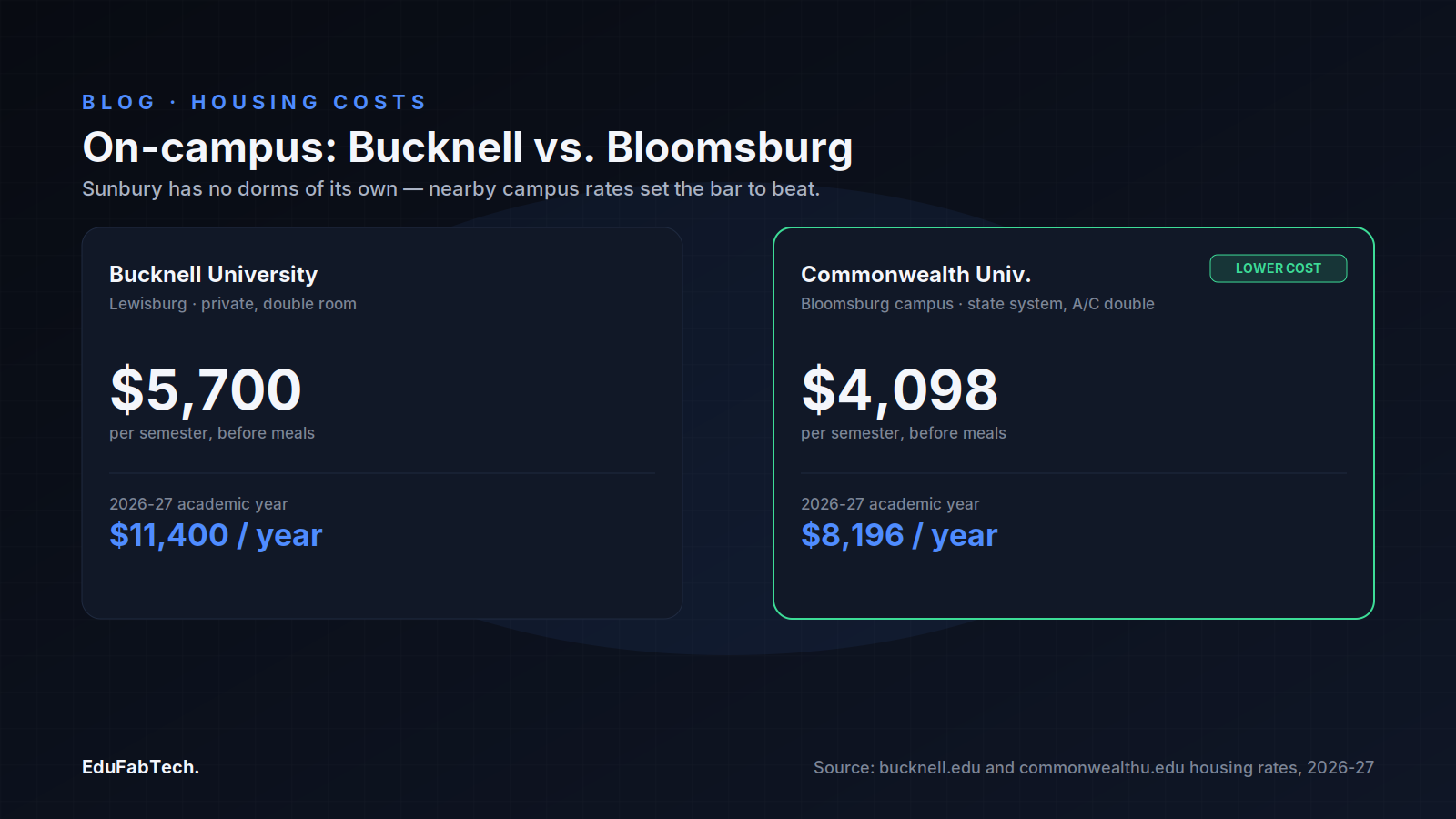
Because Sunbury has no dormitories of its own, the clearest published housing figures come from the campuses. Bucknell University's housing office lists a standard double room at $5,700 per semester for the 2026-27 year, noting that "these prices are per semester, not for the full academic year" (bucknell.edu housing rates) — roughly $11,400 for the nine-month year before meals. At the other end, Commonwealth University of Pennsylvania's own fee schedule puts an air-conditioned two-person residence-hall room on its Bloomsburg campus at $8,196 for the 2026-27 academic year ($4,098 per semester) (commonwealthu.edu housing fees). Those two numbers bracket what on-campus living costs in this valley, and they are the figures to measure any Sunbury room against.
Renting privately in Sunbury itself is typically cheaper than either, which is the whole appeal. Much of the city's housing is older two- and three-storey rowhouses and converted single-family homes divided into flats, concentrated in the blocks between Market Street and the river and in the residential grid north of the downtown. Rooms and small apartments turn over through word of mouth, local notice boards and listings such as those on EduFabTech at /in/united-states/sunbury-pa/rooms; the full set of student listings for the city sits at /in/united-states/sunbury-pa.
Start looking earlier than you think you need to. Demand in the valley rises sharply in July and August as returning students at all three campuses sign leases, and the stock of decent, heated, well-maintained flats in Sunbury is thin. If you can view a place in late spring for a summer or autumn move, you will have more to choose from and less pressure to accept the first thing you see.
Finding a room without losing your deposit
The rental scam you are most likely to meet here is the one that works everywhere: a listing with cheap rent, attractive photographs and a landlord who is conveniently out of town and wants a holding deposit before you can see the property. In a small market like Sunbury, where many genuine lets are advertised informally, a too-good listing stands out — and so should your caution.
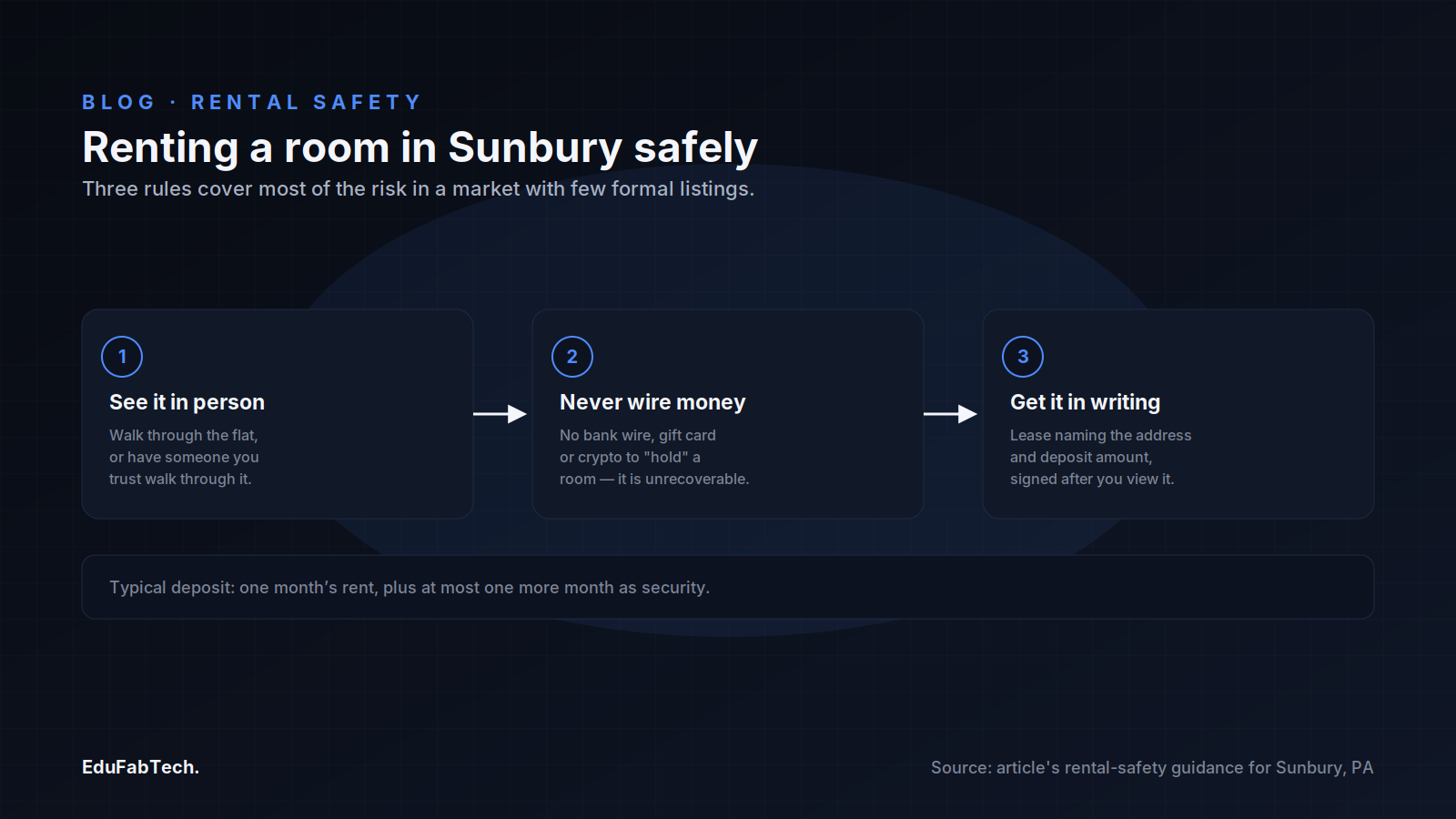
Three rules cover most of the risk. First, see the actual unit in person, or have someone you trust see it, before any money changes hands; a real Sunbury landlord can let you walk through a rowhouse flat on a weekday. Second, never send money to "hold" a room by bank wire transfer, gift card or cryptocurrency — those payments cannot be reversed, and no legitimate local landlord needs them. Pay a deposit only after you have seen the place, read the lease and have something in writing naming the address and the amount. Third, check the ordinary things while you are there: that the heating works (winters here are cold and long), that there is no damp or mould in the older brick walls, that the smoke detectors are present and that you understand who pays for heat, water and electricity. What a typical deposit should be is one month's rent plus, at most, another month as security; anything far above that, demanded in a hurry, is a warning sign.
Furnishing a room for very little
Second-hand goods are easy to find in Sunbury, and Market Street is the place to start. The Salvation Army Family Store sits on Market Street in the downtown and sells used furniture, kitchenware and clothing, with proceeds funding the charity's local services; a short walk away, other small thrift and consignment shops come and go along the same stretch. North of the centre, the American Rescue Workers run a large donation and thrift store on North Fourth Street. For a larger charity shop you may need to drive — the nearest Goodwill store is over in Lewisburg, the same town as Bucknell.
For everyday groceries and household basics, Sunbury happens to be the headquarters town of Weis Markets, the regional supermarket chain founded in the city in 1912, so a full-size store is never far. When you are kitting out a room from nothing, it is usually cheaper to gather furniture, a desk lamp and kitchen things from thrift shops and from students clearing out at the end of term than to buy new. EduFabTech carries local second-hand listings for the city — general items at /in/united-states/sunbury-pa/second-hand, furniture at /in/united-states/sunbury-pa/furniture, and things people are giving away free at /in/united-states/sunbury-pa/free-stuff.
Working while you study
If you are an international student, the rules on working are set by federal immigration law, not by the city or the university, and you should read them from the source before you take any job. The U.S. Department of Homeland Security's Study in the States site states that an F-1 student in on-campus employment "may not work more than 20 hours per week when school is in session," and that off-campus work requires prior authorisation: approval from your Designated School Official (DSO), an updated Form I-20 and, for most categories, an approved Form I-765 from USCIS — with the warning that "you cannot begin to work while the Form I-765 is pending" (studyinthestates.dhs.gov). On-campus jobs — a library desk, a dining hall, a departmental role — are the usual starting point because they need the least paperwork. This is a summary, not legal advice; your DSO at Bucknell, Susquehanna or Commonwealth University is the person to confirm what you may do. Local vacancies, including the kind of term-time work domestic students take, are listed at /in/united-states/sunbury-pa/jobs.
Libraries and places to study
Sunbury's own study option is the Degenstein Community Library on South Fifth Street, the public library for the city, with quiet reading space, computers and free internet; its opening hours are shorter than a university library's, so plan around them rather than assuming late-night access. Your main academic library will be on your campus: Bucknell students have the Ellen Clarke Bertrand Library in Lewisburg, Susquehanna students the Blough-Weis Library in Selinsgrove, and Bloomsburg-campus students the Harvey A. Andruss Library. Those are the places with the databases, study rooms and long hours; Sunbury is where you live and do the reading in between. If you want to find desks, cafés and quiet corners around the city, EduFabTech collects them at /in/united-states/sunbury-pa/study-spaces.
Getting around
Public transport in this part of the valley is run by rabbittransit, and the service most useful to a Sunbury resident is the Stop Hopper, an on-demand shuttle. According to rabbittransit, Stop Hopper operates "Monday-Friday, 6:30AM-6:30PM" across "the Selinsgrove/Sunbury and parts of Northumberland borough service area," at a fare of $2.50 cash per one-way trip, or $2.25 when paid in advance through the rabbitPAY or Stop Hopper app, with exact change required for cash (rabbittransit.org/services/stophopper). That covers the Sunbury–Selinsgrove corridor, which happens to be the direction of Susquehanna University.
What the bus does not do is make a car optional for everyone. There is no frequent, direct campus shuttle linking Sunbury to Lewisburg or Bloomsburg, the service runs only on weekday daytimes, and the distances — about six miles to Selinsgrove, eleven to Lewisburg, twenty-three to Bloomsburg — are comfortable by car but awkward without one, especially for evening classes, labs or a job that ends after 6:30pm. Most students basing themselves in Sunbury rather than on a campus end up relying on a car, a lift share or careful timetabling around the Stop Hopper. Factor the cost of running a car into your budget before you decide Sunbury's cheaper rent comes out ahead.
What is good, and what is hard
The case for Sunbury is cost and position. Rent is lower than in the campus towns, you are roughly equidistant from three universities, a full-size supermarket and the county's main services are at hand, and the riverfront and historic downtown give the city more character than its size suggests. For a student on a tight budget who already drives, it can be the cheapest sensible base in the valley.
The case against is just as plain. You will not be living in a student community — Sunbury is a working small city, not a campus town, and the social life of your university happens eleven or twenty-three miles away. The winters are genuinely cold and the housing stock is old, so heating and upkeep matter. Sunbury is a working city of modest means rather than a wealthy one, and some blocks are more cared-for than others, so viewing a place in person matters even more than usual. Above all, without reliable transport the commute can swallow the time and money you saved on rent.
A checklist for your first weeks
- Confirm which campus you are commuting to and map the real door-to-door journey — by car and, if you can, by Stop Hopper — before you sign anything.
- View any room in person, read the lease, and pay a deposit only after both; never wire money or send gift cards to hold a place.
- Register with your university's housing or off-campus office; if you are an international student, meet your DSO early and confirm the work rules from the DHS site, not from hearsay.
- Set up the rabbitPAY or Stop Hopper app if you will use the bus, and keep exact change for cash fares.
- Furnish from the Market Street thrift shops and end-of-term giveaways rather than buying new.
- Get a Degenstein Community Library card for local study space, and learn your campus library's hours for everything else.
- Budget honestly for heating and for running a car, the two costs that most often undo Sunbury's low rent. Check EduFabTech's local events to start meeting people off campus.
A quick question for readers
Do you work part-time while you study?
Many students work to pay the bills. See how common it is — and how many hours people really do.
Pick an answer, create a free account in a minute, and your vote counts. Already a member? Sign in
Comments 0
CommentNo comments yet. Members start the conversation.
Source: Bucknell University
Sources (5)
- Bucknell University. Housing Rates. Bucknell University, 2026. bucknell.edu ↗ · checked 18 Oct 2026
- Commonwealth University of Pennsylvania. Housing and Meal Plan Rates & Fees. Commonwealth University of Pennsylvania, 2026. commonwealthu.edu ↗ · checked 18 Oct 2026
- Commonwealth University of Pennsylvania. History. Commonwealth University of Pennsylvania, 2022. commonwealthu.edu ↗ · checked 18 Oct 2026
- rabbittransit. Stop Hopper. Susquehanna Regional Transportation Authority (rabbittransit), 2026. rabbittransit.org ↗ · checked 18 Oct 2026
- U.S. Department of Homeland Security. Working in the United States. Study in the States, U.S. Department of Homeland Security, 2026. studyinthestates.dhs.gov ↗ · checked 18 Oct 2026