Studying in Terre Haute: universities, housing and student life
A practical, honest guide to living and studying in Terre Haute, Indiana — two very different universities, where to find a room safely, a fare-free bus system, and what it actually costs.
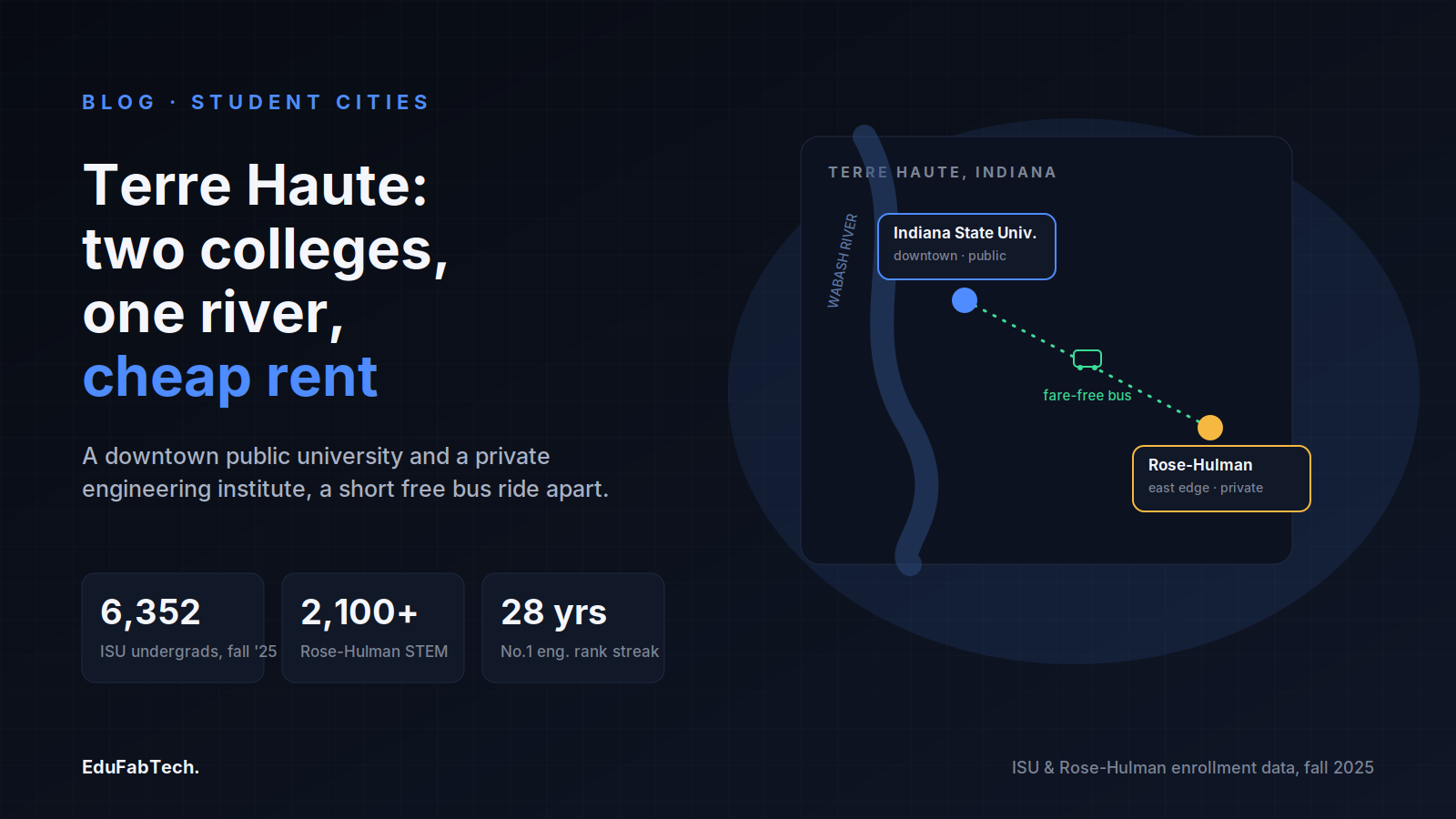
Terre Haute sits on the east bank of the Wabash River in western Indiana, close enough to the Illinois state line that you can drive to it in minutes and about 70 miles (110 km) southwest of Indianapolis along Interstate 70. The name is French for "high land," and the old downtown grid climbs gently away from the river around a nineteenth-century courthouse and Wabash Avenue, the broad street that was once part of the National Road. It is a mid-sized Midwestern city with two universities that could hardly be more different from one another — and that difference shapes almost everything about student life here, from where you look for a room to how much engineering homework is waiting for you on a Friday night.
For a student, the useful thing to understand first is the geography of those two schools. One is a large public university folded into the downtown itself; the other is a small private engineering institute on the eastern edge of town, surrounded by its own woods and lakes. They draw different crowds, sit in different neighbourhoods, and face different housing markets, even though they share the same city, the same free buses and the same winters.
This guide walks through both, then through the practical business of living here: finding a room without being cheated, furnishing it cheaply, working legally, where to study, how to get around, and what a semester honestly costs. You can browse current local listings — rooms, second-hand goods, jobs — on EduFabTech's Terre Haute page.
Two universities on the banks of the Wabash
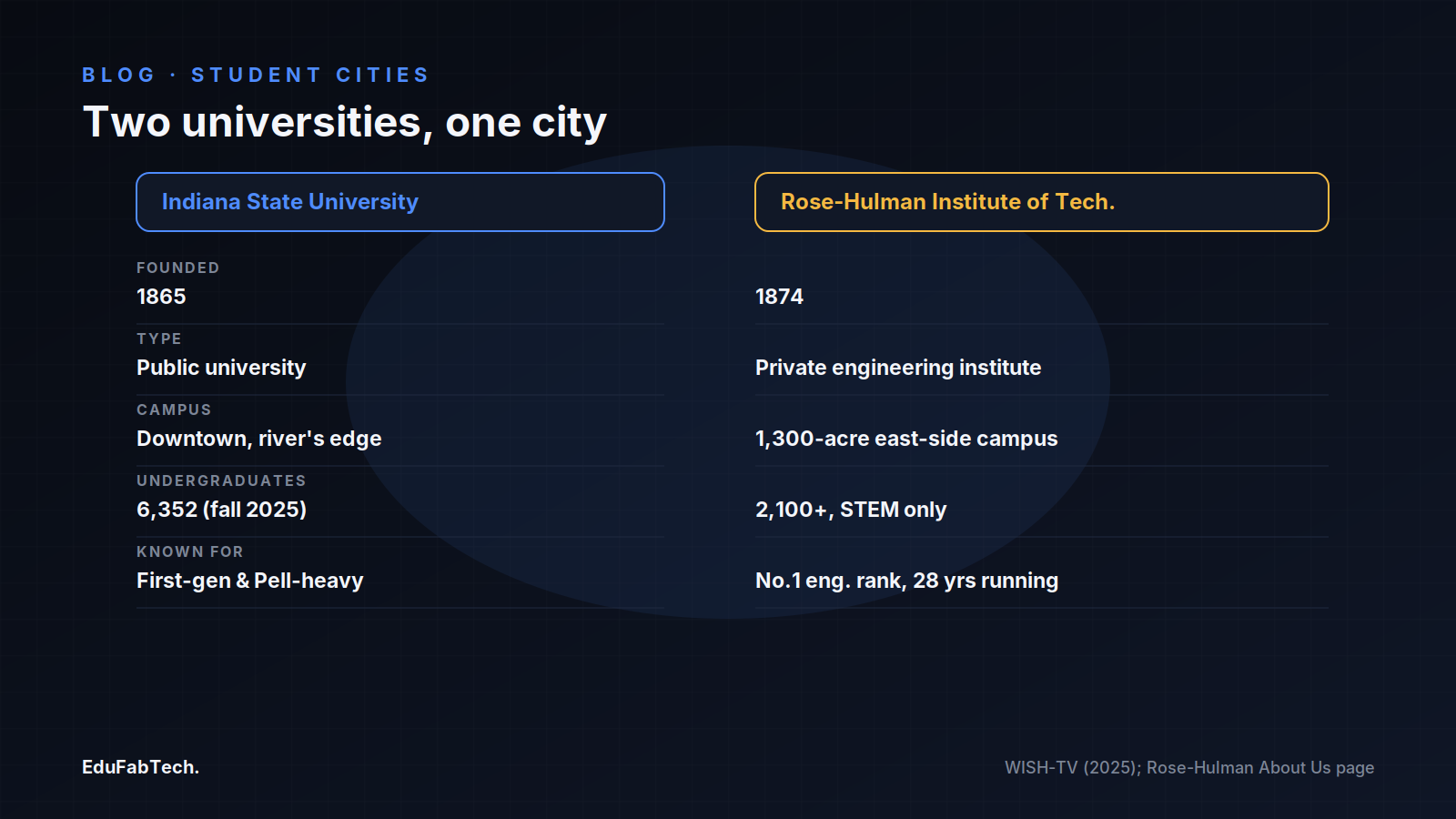
Indiana State University (ISU) is the city's public university, built into downtown Terre Haute on a campus of a few hundred acres only a short walk from the courthouse and the river. It began in 1865 as a teacher-training "normal school" and is now a comprehensive university whose sports teams are the Sycamores. It enrolled 6,352 undergraduates in autumn 2025, with an incoming class of 1,602 first-time, full-time students — about 13% larger than the year before — according to WISH-TV's 2025 report on Indiana enrolment. That same report notes that nearly half of the incoming class were first-generation students and more than half qualified for Pell grants, which tells you something true about the place: ISU is a working university that takes in a lot of students who are the first in their families to attend college, and its scale gives downtown Terre Haute its student energy.
Rose–Hulman Institute of Technology is the opposite in almost every dimension. It is a small private institute devoted to engineering, mathematics and science, founded in 1874 and set on a 1,300-acre campus at 5500 Wabash Avenue on the east side of the city, according to the institute's About Us page. The same page says Rose–Hulman enrols more than 2,100 undergraduates across its STEM programmes, and that U.S. News & World Report has ranked it the No. 1 undergraduate engineering programme — in the category for colleges whose highest engineering degree is a bachelor's or master's — for 28 straight years. Students who come to Rose–Hulman come specifically for that: a demanding, residential engineering education where almost everyone lives on or beside the campus and the workload is famously heavy.
The two schools do not really compete for the same applicant, and as a resident you will quickly learn which world you are in. An ISU student lives in a city; a Rose–Hulman student lives on a campus that happens to be in a city. You can see what is listed close to each one on EduFabTech's near Indiana State University and near Rose–Hulman pages.
Where students put down roots
Where you live depends heavily on which school you attend. Rose–Hulman is strongly residential, so most of its undergraduates live in institute housing on the eastern edge of town and the off-campus rental question barely arises until the later years. ISU students have more choice, because the campus is embedded in ordinary Terre Haute neighbourhoods and the surrounding blocks are full of older houses divided into student flats.
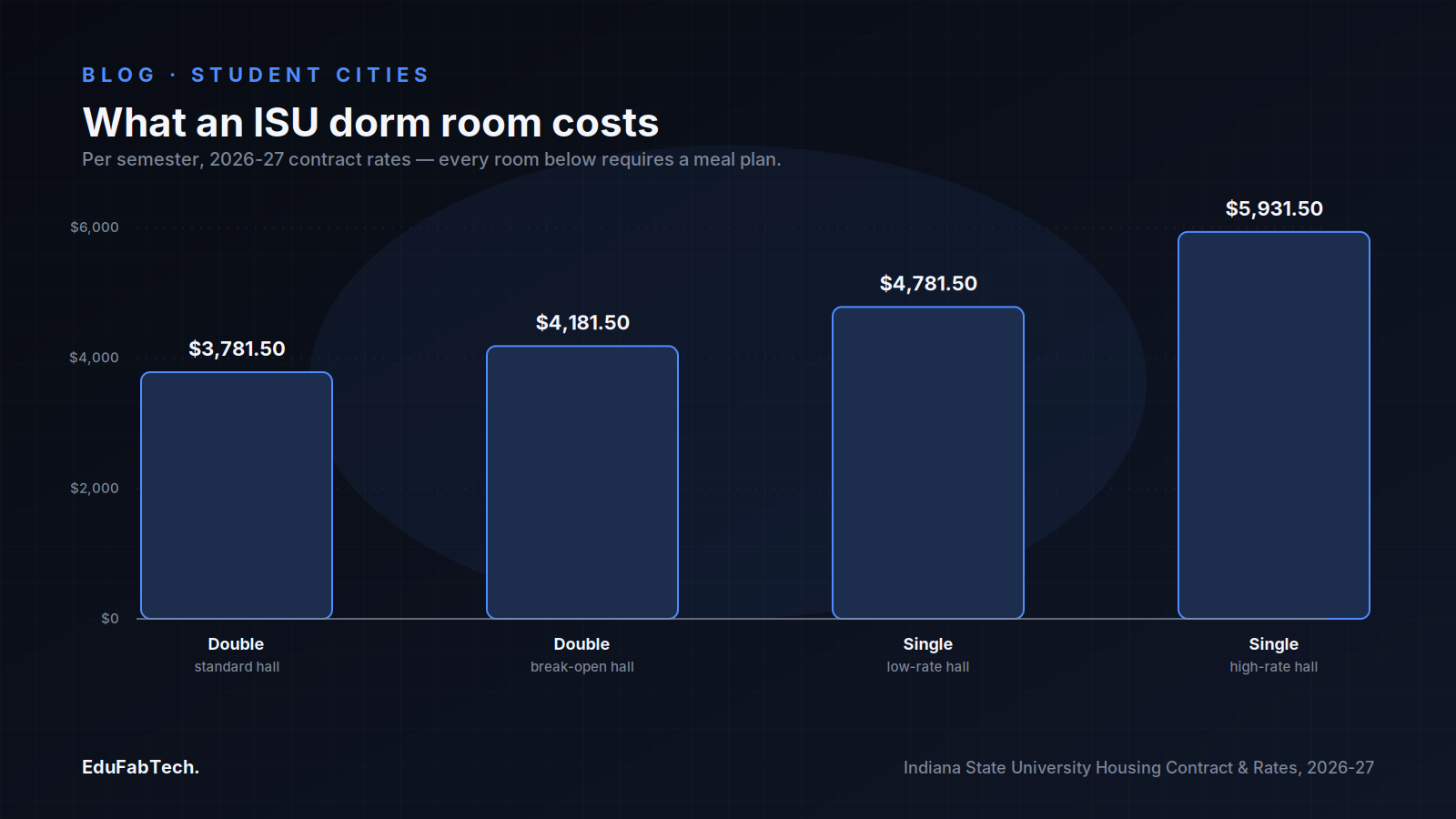
ISU runs traditional residence halls on campus. For the 2026–27 year, the university's own Housing Contract and Rates page lists a standard shared double room at $3,781.50 per semester with a meal plan required, rising to $4,181.50 per semester for a double in the halls that stay open over breaks; single rooms run higher, from $4,781.50 to $5,931.50 per semester depending on hall and room type, all with a meal plan. First-year students are the main audience for the halls, and the meal-plan requirement matters when you compare that figure with a cheaper off-campus room that comes with a kitchen instead.
Off campus, the obvious district for ISU students is the grid immediately around the university — including the historic Farrington's Grove neighbourhood just south of campus, with its late-Victorian houses, and the streets north toward the Twelve Points area. Rents in Terre Haute are low by national standards, which is one of the genuine advantages of studying here, but the housing stock is old, so the thing to check is not the rent but the condition: heating in winter, damp, the state of the kitchen and bathroom, and whether utilities are included. Browse what is currently available on the Terre Haute rooms page before you commit to anything.
On timing: if you want a specific house near ISU for the autumn, start looking in late winter or early spring, because the best-placed student houses are taken months ahead. For a dorm place, follow the dates on the university housing site rather than guessing.
Avoiding rental scams here. The scams that appear in Terre Haute look like the ones everywhere else but cluster around the cheap rooms advertised for the blocks near ISU: a listing with an unusually low rent, an "owner" who is conveniently out of town, and a request to send a deposit to "hold" the place before you have seen it. Do not do it. A normal local deposit is roughly one month's rent, paid by a traceable method once you have a signed lease — never by bank wire, gift card or cryptocurrency, none of which you can recover. Because student housing is concentrated in a few compact areas, it is easy to view a place in person, and you should: walk the actual room, meet whoever hands you the keys, and read the lease before any money changes hands.
Furnishing a room without overspending
An empty off-campus room needs a bed, a desk and a few pans, and Terre Haute is a good town for buying those cheaply. The city has indoor flea markets and antique malls — Vendors' Village on the south side inside the Honey Creek Mall, and M&J Northside Mall on Lafayette Avenue among them — where second-hand furniture, kitchenware and household goods turn over constantly, and the move-in and move-out weeks each semester flood the market with cheap or free items left behind by departing students. Thrift stores around the city carry the same sort of thing year-round.
Before you buy anything new, check EduFabTech's listings for second-hand furniture in Terre Haute. A mattress and a desk are worth buying new or barely used for hygiene reasons; almost everything else — shelves, chairs, lamps, crockery — you can find second-hand for a fraction of the price, and sell on again when you leave.
Working while you study
Part-time work is realistic in a university town, and both campuses employ students in libraries, dining halls, labs and offices. The rules depend on your status. For international students on an F-1 visa, the U.S. government's Study in the States site is the authority to read, not a message board: its Working in the United States page states that "if you participate in on-campus employment, you may not work more than 20 hours per week when school is in session." On-campus work generally does not need separate federal authorisation, but it does need you to keep valid full-time status, and other categories of work — such as off-campus training tied to your programme — go through your school's Designated School Official and have their own conditions.
This is not legal advice, and immigration rules change: confirm your own situation with your university's international-student office and the official DHS guidance before accepting any job. Domestic students face none of these limits and can find campus and city jobs through the universities' own employment listings.
Libraries and places to read
ISU's main library is Cunningham Memorial Library, on the downtown campus, which offers bookable group study rooms, open desks, a writing centre and the usual academic collections; its term-time opening hours are posted on the library's LibCal hours page, which is the one to trust because they change around exams and holidays. Rose–Hulman students have their own campus library geared to engineering and science.
Beyond the campuses, the Vigo County Public Library has its main branch downtown and is free for county residents to join; alongside books it runs the Haute Create makerspace, with 3D printers and other tools, which the library describes on its creative spaces page — useful if your coursework involves building things. Public-library study space is quieter outside term and open to everyone, a good fallback when the campus libraries fill up before exams. EduFabTech also lists local study spaces and desks in the city.
A city you can cross for free
Terre Haute's great practical convenience for students is that the city buses cost nothing. The City of Terre Haute's Transit Ride Guide states that "starting January 1st, 2025 Terre Haute Transit is fare free to all riders" — so there is no fare card to buy, no student pass to arrange, and no exact change to find; you simply board. Routes converge on a downtown transfer point, and the system connects the ISU campus and downtown with the shopping areas on the south and north sides of the city.
That said, Terre Haute is a driving town, and bus frequency and evening service are limited compared with a big city. Many students keep a bicycle or a car for anything off the main corridors, and the compactness of the ISU campus means a lot of daily life is simply walkable. If you are choosing a room, proximity to a bus route or to campus itself is worth more here than it would be in a city with dense all-day transit.
What it actually costs
The single most reliable, dated housing figure for a student is the ISU dorm rate above: $3,781.50 per semester for a standard shared double with a required meal plan in 2026–27, per the university's rates page. Off-campus rents are generally lower per person than that once you share a house and cook for yourself, which is why many ISU students move out of the halls after first year — but the published, verifiable number is the dorm figure, and off-campus prices vary too much house-to-house to quote a single trustworthy average.
The broader point is that Terre Haute is an inexpensive place to be a student by American standards: housing, food and the free buses all sit at the low end, which is a real part of why people choose it. Tuition is a separate matter and differs sharply between the public university and the private institute, and between in-state, out-of-state and international students — check each school's own cost-of-attendance pages for figures that apply to you, rather than relying on a general number.
The honest trade-offs
What is good about Terre Haute for a student is concrete: low living costs, free public transport, short commutes, a walkable downtown campus at ISU, and at Rose–Hulman one of the most respected undergraduate engineering programmes in the country. The city is small enough that you are not swallowed by it, and close enough to Indianapolis for an occasional trip.
What is hard is equally concrete. This is a small Midwestern city, not a metropolis: nightlife, international food and cultural events are limited, and students who arrive expecting a big-city scene are often disappointed. Winters are genuinely cold and grey, with snow and long dark afternoons, while summers are hot and humid. The off-campus housing stock is old, so condition and heating matter more than headline rent. And without a car, life beyond the main bus corridors can feel restricted, free fares notwithstanding. None of this is a reason to stay away — it is simply the city as it is, and worth knowing before you sign a lease.
A checklist for your first two weeks
- See any off-campus room in person before paying, and never send a "holding" deposit by wire, gift card or crypto.
- Confirm what your rent includes — heating especially, given the winters and the age of the houses.
- Sort out a bank account and, if you plan to work, a Social Security Number; international students should see their university's international office first.
- International students: read the DHS Study in the States work rules and talk to your Designated School Official before taking any job.
- Learn the bus routes from the city's free transit system — they cost nothing, so there is no reason not to use them.
- Get a Vigo County Public Library card and find your quiet spot at Cunningham Memorial Library before the exam-week crowds arrive.
- Furnish from the flea markets and second-hand listings, and watch the move-in and move-out weeks for free furniture.
- Browse EduFabTech's Terre Haute listings for rooms, jobs and second-hand goods as they come up.
A quick question for readers
Do you work part-time while you study?
Many students work to pay the bills. See how common it is — and how many hours people really do.
Pick an answer, create a free account in a minute, and your vote counts. Already a member? Sign in
Comments 0
CommentNo comments yet. Members start the conversation.
Source: Indiana State University
Sources (5)
- Indiana State University. 2026-2027 Housing Contract and Rates. Indiana State University, 2026. indianastate.edu ↗ · checked 16 Oct 2026
- Rose-Hulman Institute of Technology. About Us. Rose-Hulman Institute of Technology, 2026. rose-hulman.edu ↗ · checked 16 Oct 2026
- City of Terre Haute. Terre Haute Transit Utility Ride Guide. City of Terre Haute, 2025. terrehaute.in.gov ↗ · checked 16 Oct 2026
- U.S. Department of Homeland Security. Working in the United States (Study in the States). U.S. Department of Homeland Security, 2026. studyinthestates.dhs.gov ↗ · checked 16 Oct 2026
- WISH-TV. Indiana colleges see growth in first-year students. WISH-TV, 2025. wishtv.com ↗ · checked 16 Oct 2026