Studying in Vermillion: universities, housing and student life
A practical, sourced guide to the University of South Dakota's home town — where students live, what rooms and transit cost, where to study and work, and the honest trade-offs of a small prairie college town.
A one-university town on the Missouri River bluffs
Vermillion sits in the far southeast corner of South Dakota, on a line of bluffs that rise above the Missouri River floodplain in Clay County, roughly 40 miles northwest of Sioux City, Iowa. It is a small place: the daily rhythm, the main employer and most of the social life all run through one institution. Students who arrive expecting a city will not find one. Students who want a walkable town where the campus, the downtown and the grocery store are all a short distance apart tend to settle in quickly.
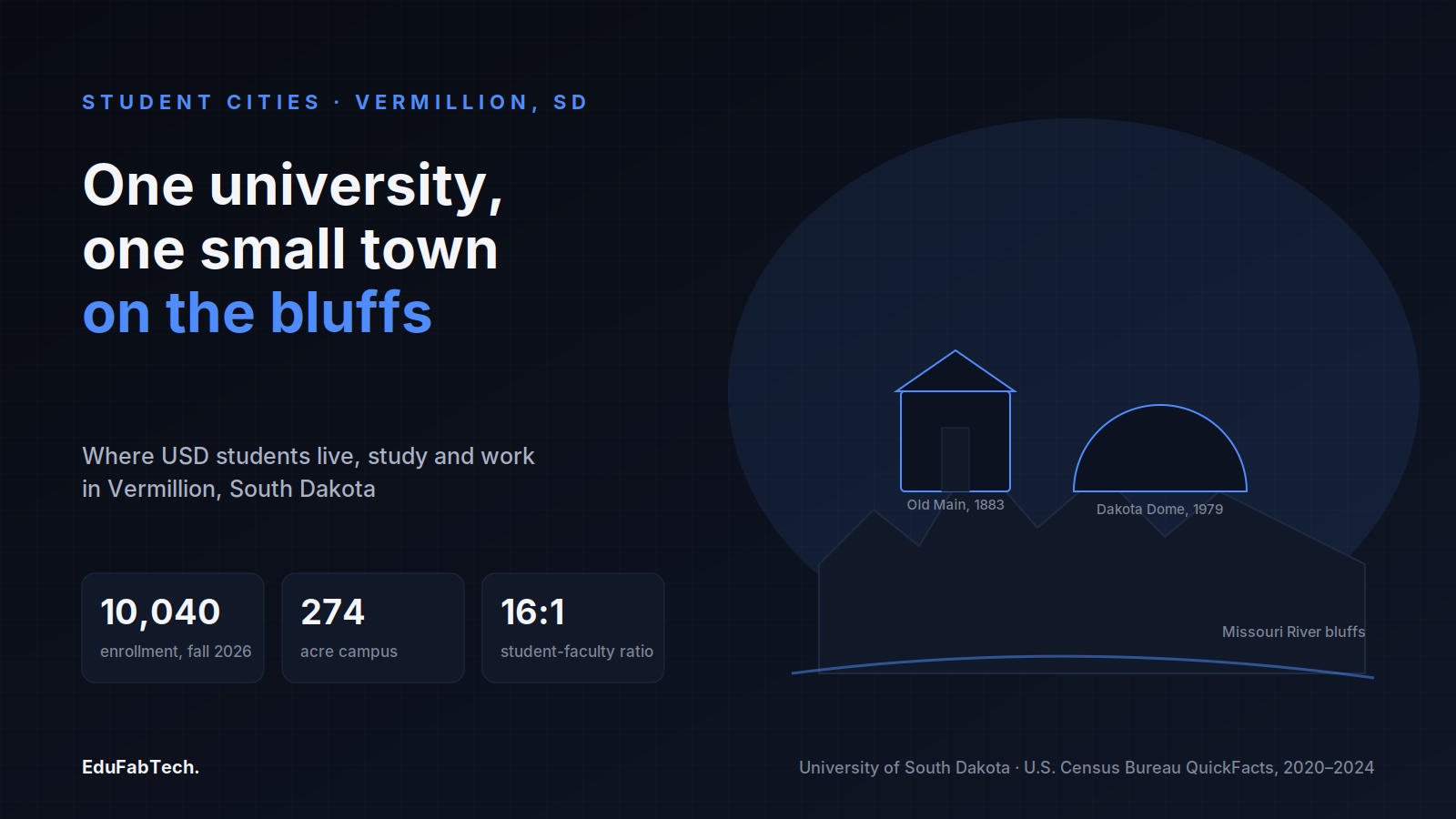
That institution is the University of South Dakota, the state's flagship and oldest university. On its At a Glance page the university reports that it was founded in 1862, occupies a 274-acre campus in Vermillion, and had a total enrollment of 10,040 students as of fall 2026, with a 16:1 student-to-faculty ratio and seven colleges and schools — Arts & Sciences, Business, Education, Fine Arts, Health Sciences, Medicine and Law. The same page lists 201 undergraduate and 93 graduate programs.
The town and the university are hard to separate. USD's Vermillion Campus and Community page states that about 5,600 USD students live, shop and eat in town, and that the university employs 1,556 Vermillion residents. On its Buildings and Facilities page, the university notes that Old Main, built in 1883, is one of its properties on the National Register of Historic Places and houses the Oscar Howe Gallery, and that the National Music Museum — known for its collection of historic instruments — occupies a 1911 Carnegie library building on campus. For a town this size, that concentration of cultural institutions is unusual.
What studying at the University of South Dakota is like
USD is a comprehensive public research university rather than a specialist school, so the range of what you can study is wide for the enrollment. Two programs give the town a professional character out of proportion to its population: the Knudson School of Law — the only law school in South Dakota — offers the Juris Doctor on the Vermillion campus, and the Sanford School of Medicine is USD's medical school. The Beacom School of Business and the College of Fine Arts, whose music program is tied to the National Music Museum on campus, are also based here. Athletics gather under the South Dakota Coyotes, who play in the Dakota Dome, the domed stadium built in 1979 that is one of the most recognisable buildings in town. Because the student body is mid-sized and spread across many programs, class sizes outside the large first-year lectures tend to be small, and the 16:1 ratio USD reports on its At a Glance page reflects that.
Where students live, and the halls that come first
USD requires most new students to live on campus. Its Housing and Dining Costs page states plainly that "first- and second-year students are required to live on campus and have a meal plan." That rule shapes the whole housing market: the off-campus rental pool is mostly third- and fourth-year undergraduates, graduate, law and medical students, and families. The traditional residence halls — named on the same page as Beede, Mickelson, Olson, Richardson, Burgess and Norton — are the default for first-years, with apartment-style options in Coyote Village and McFadden Hall for older students.
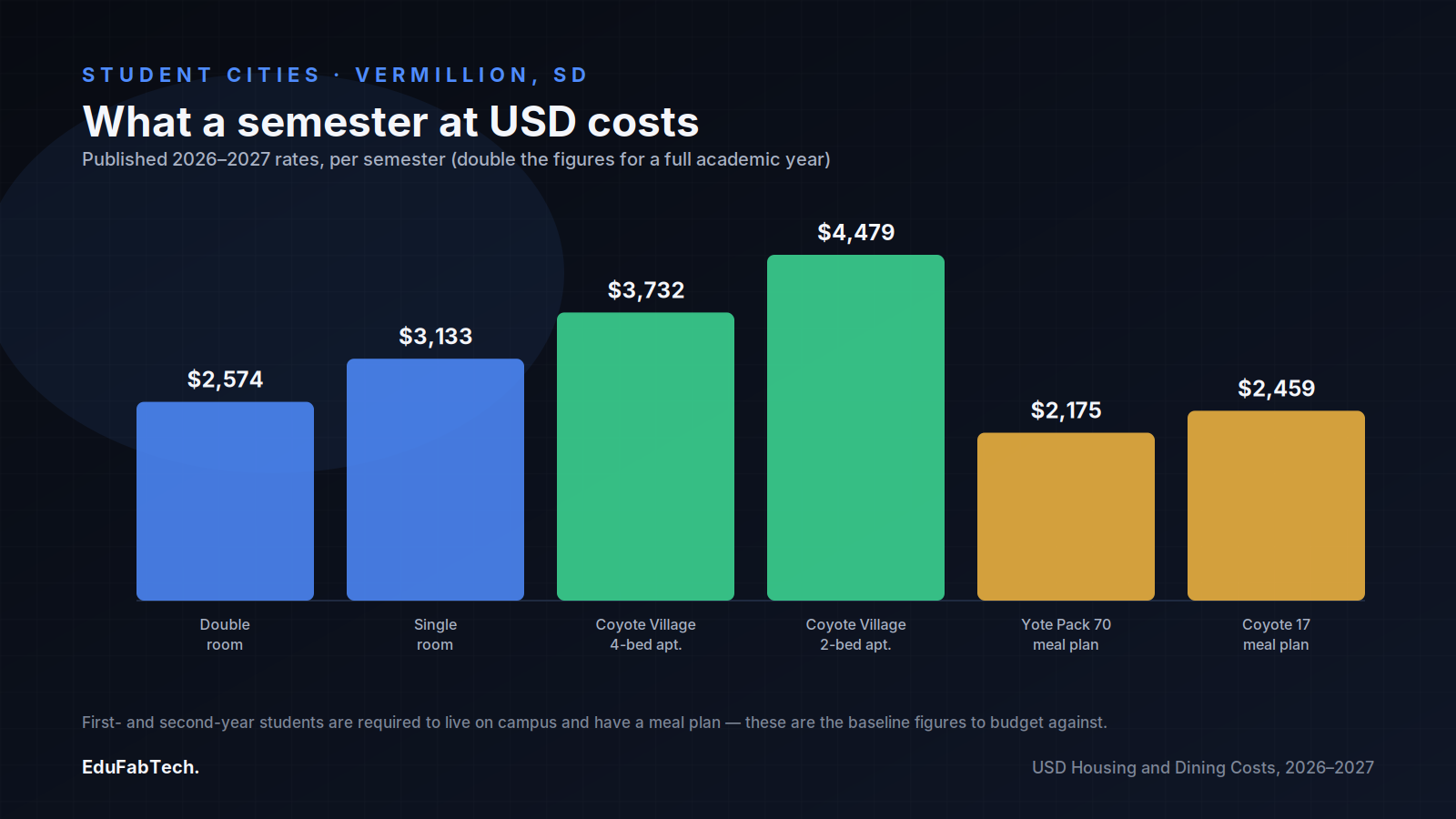
The university's published 2026–2027 rates give you firm numbers to plan against. On that Housing and Dining Costs page, a double-occupancy room in a traditional hall is listed at US$2,574 per semester and a single at US$3,133; a two-bedroom apartment in Coyote Village is listed at US$4,479 and a four-bedroom at US$3,732. The meal plans on the same page are also per semester — the default "Yote Pack 70" is US$2,175 and the Coyote 17 plan is US$2,459. These are per-semester figures, so double them for a rough academic-year total when you budget.
Off campus, the geography is simple enough to learn in a day. The historic downtown runs along Main and Market Streets, within walking distance of campus; much of the newer commercial activity — the Hy-Vee and Walmart grocery anchors, and the Goodwill store — sits on the northwest edge of town near Cherry Street and Highway 50. Rents in Vermillion are low by national standards: the U.S. Census Bureau's QuickFacts for Vermillion city report a median gross rent of US$764 a month over the 2020–2024 period, below the US$946 figure the Bureau gives for South Dakota as a whole. A median is not a quote for a specific flat, but it tells you the town is not an expensive rental market.
Renting without losing a deposit
Because the honest rental market in Vermillion is small and mostly word-of-mouth, the scams that appear here are the familiar remote ones: a "landlord" who is conveniently out of state, a listing priced below the already-low local rents, and pressure to send money before you see the unit. Vermillion is small enough that you can almost always view a room in person or send a classmate to do it; a property that cannot be shown is the clearest warning sign in a town this walkable. Never pay a holding deposit or first month by bank wire, gift card or cryptocurrency — no legitimate local landlord needs payment in a form that cannot be reversed. Ask what the deposit actually is in writing, get a signed lease naming the property, and keep receipts. South Dakota's landlord-tenant law sets the basic rules, including on deposits; read them before you sign rather than after a dispute. Current USD students list rooms, sublets and shared houses through the university and through EduFabTech's Vermillion rooms page, which is a reasonable place to start a local, in-person search.
Furnishing a room cheaply
A college town empties and refills every August and May, and Vermillion runs on that cycle. The cheapest way to furnish a room is to catch the end-of-semester turnover, when graduating students give away or sell furniture they cannot move. For second-hand goods year-round, Goodwill of the Great Plains operates a store on the northwest side of town near the Walmart and Hy-Vee, and there is a long-running nonprofit thrift shop downtown; between them they cover most of what a desk, a kitchen and a bed need. Because the town is compact, moving a second-hand couch across it is genuinely easy — a point that matters more here than in a spread-out city. EduFabTech's second-hand listings for Vermillion are worth checking against the thrift shops before buying anything new, and the free-stuff page is most active in the move-out weeks.
Working part-time, and the rules for international students
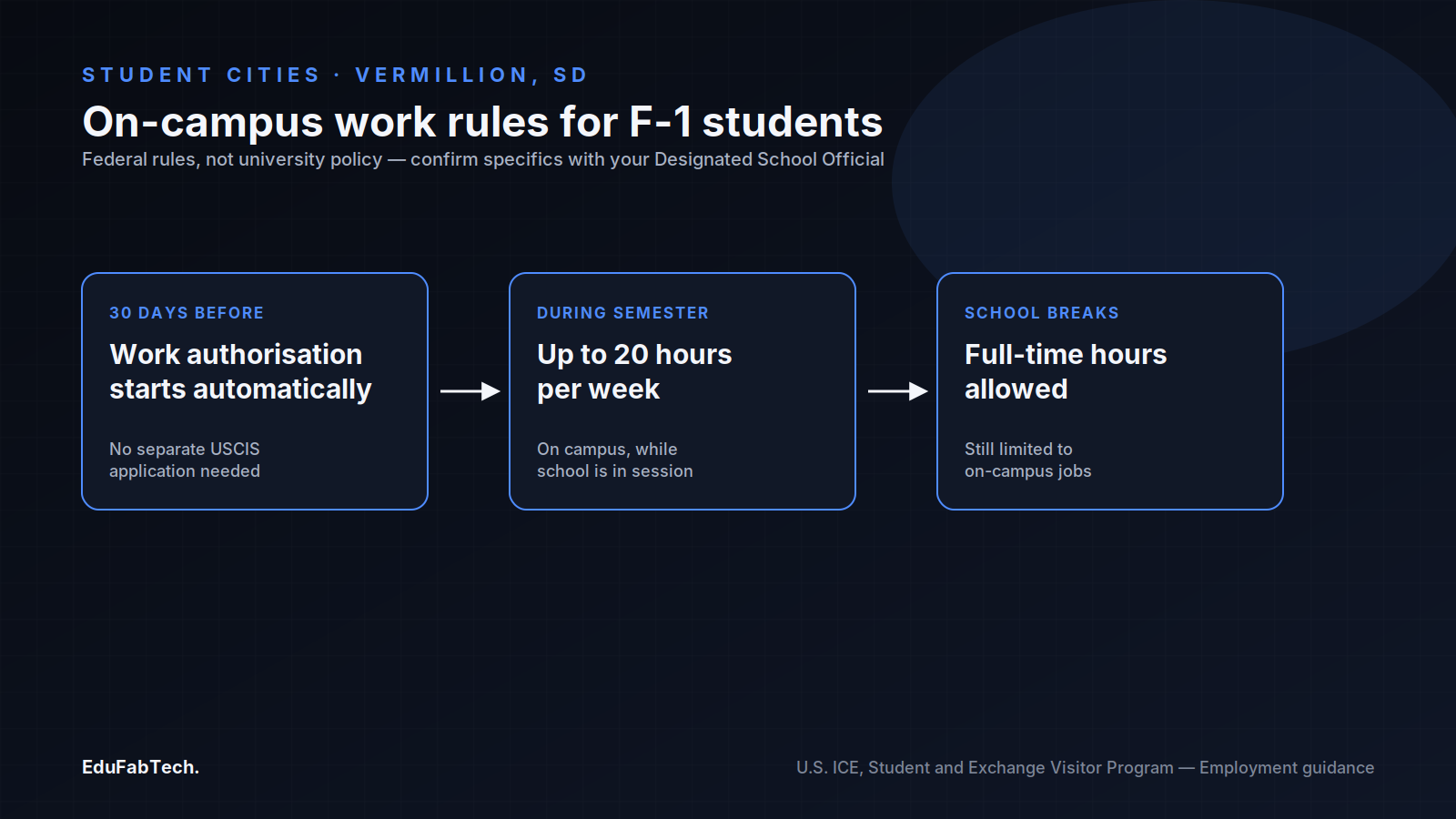
Most student jobs in Vermillion are on campus or in the small service economy around it — dining, the library, recreation, retail and the grocery anchors. If you hold an F-1 student visa, the on-campus route is the simplest and is governed by federal rules, not by the university. U.S. Immigration and Customs Enforcement's Employment guidance for the Student and Exchange Visitor Program states that F-1 students may work on campus up to 20 hours per week while school is in session and full-time during breaks, that an F-1 student automatically has permission to work on campus without a separate application to USCIS, and that work may begin as much as 30 days before the program of study starts. Off-campus work, including Curricular and Optional Practical Training, has its own conditions and must be authorised; your Designated School Official in USD's international student office is the person to ask first. Treat the ICE page and your DSO as the authorities here — this guide is not legal advice, and the rules change. EduFabTech's Vermillion jobs page collects local part-time listings.
Libraries and places to study
The main study building is the I.D. Weeks Library at 414 E. Clark Street, the university's central library in Vermillion. During the fall and spring semesters the library lists hours of 7:30 a.m. to midnight Monday through Thursday, to 10 p.m. on Friday, 10 a.m. to 10 p.m. on Saturday and 10 a.m. to midnight on Sunday — long enough to cover both early risers and late workers. It offers individual carrels and bookable group rooms; the library notes that rooms can be reserved online at least 24 hours in advance. Health sciences and law students also have specialist collections tied to their schools. When the library is full in exam weeks, the student union and departmental lounges absorb the overflow; EduFabTech's study-spaces page and the listings near the University of South Dakota point to desks and quiet rooms beyond the main library.
Getting around a town you can mostly walk
Vermillion is small enough that walking and cycling handle most trips between housing, campus and downtown, which is the honest reason there is no large city bus network. Public transit is provided by Southeast Public Transit, a demand-response (call-ahead) service that covers Vermillion and the surrounding Clay and Yankton counties. Its fare page lists a one-way trip at US$2.50 and a higher US$7.50 fare for a Vermillion same-day one-way trip, and gives Vermillion bus service hours of Monday to Friday, 7:30 a.m. to 5 p.m. Because this is a scheduled, call-ahead service rather than a fixed-route campus shuttle, build the booking lead time into your week. For travel beyond town, intercity coach service links the area to Sioux Falls and Sioux City, but there is no passenger rail and no airport in Vermillion itself; the nearest commercial airports are in Sioux Falls and Sioux City. A bicycle, and a willingness to walk in winter, cover most day-to-day trips.
What is good, and what is hard
The good is concrete. Costs are low: the Census Bureau's 2020–2024 median gross rent of US$764 and USD's own published room rates mean a student budget here stretches further than in most American college towns. The town is walkable and safe to cross on foot, the campus holds real cultural assets — the National Music Museum, the Oscar Howe Gallery, Coyote athletics in the Dakota Dome — and the small, program-spread student body makes it easy to be known by name rather than lost in a crowd. For international and out-of-state students, the on-campus residency requirement in the first two years removes the hardest housing decision at exactly the moment you know the town least.
The hard parts are the flip side of the same smallness. The rental market off campus is thin, so late arrivals have fewer choices and the best rooms go early. There is no comprehensive city bus, so life without a bicycle or a car means planning around a call-ahead van. The nearest large city and airport are an hour or more away, which makes weekend escapes and international travel a logistical exercise. And the climate is demanding: winters on the northern prairie are long and genuinely cold, with wind that the river bluffs do nothing to block, while summers are hot and humid. None of this is hidden — but it is worth knowing before you commit to four years of it.
A short checklist for the first weeks
- Confirm your housing status. If you are a first- or second-year student, USD's Housing and Dining Costs page says you must live on campus with a meal plan — sort the hall and plan before you look anywhere else.
- Never pay to "hold" a room sight-unseen. View the place or send someone you trust; refuse wire transfers, gift cards and crypto; get a signed lease that names the property.
- Set up transport early. If you will use Southeast Public Transit, note its published one-way fare of US$2.50 and the US$7.50 same-day Vermillion fare, and book ahead; otherwise buy a bicycle and winter gear before the first snow.
- Get your library and study routine going. Learn the I.D. Weeks Library hours and reserve group rooms at least 24 hours ahead during exam weeks.
- International students: see your DSO first. Before taking any job, confirm the rules against the ICE SEVP employment guidance and your Designated School Official — on-campus work is capped at 20 hours a week in term.
- Furnish in the turnover weeks. Catch the August move-in and May move-out, check the thrift shops and local listings, and you can set up a room for very little.
A quick question for readers
Do you work part-time while you study?
Many students work to pay the bills. See how common it is — and how many hours people really do.
Pick an answer, create a free account in a minute, and your vote counts. Already a member? Sign in
Comments 0
CommentNo comments yet. Members start the conversation.
Source: University of South Dakota
Sources (5)
- University of South Dakota. At a Glance. University of South Dakota, 2026. usd.edu ↗ · checked 17 Oct 2026
- University of South Dakota. 2026-2027 Housing and Dining Costs. University of South Dakota, 2026. usd.edu ↗ · checked 17 Oct 2026
- Southeast Public Transit. Bus Fares. Southeast Public Transit (managed by River Cities Public Transit), 2026. septransit.com ↗ · checked 17 Oct 2026
- U.S. Immigration and Customs Enforcement. Employment (Student and Exchange Visitor Program). ICE / SEVIS, 2026. ice.gov ↗ · checked 17 Oct 2026
- U.S. Census Bureau. QuickFacts: Vermillion city, South Dakota. U.S. Census Bureau, 2024. census.gov ↗ · checked 17 Oct 2026