Studying in Warwick, Rhode Island: universities, housing and student life
Warwick has one community-college campus of its own and sits a short drive from most of Rhode Island's universities — a commuter base where rooms cost less than College Hill but you need a plan to get around.
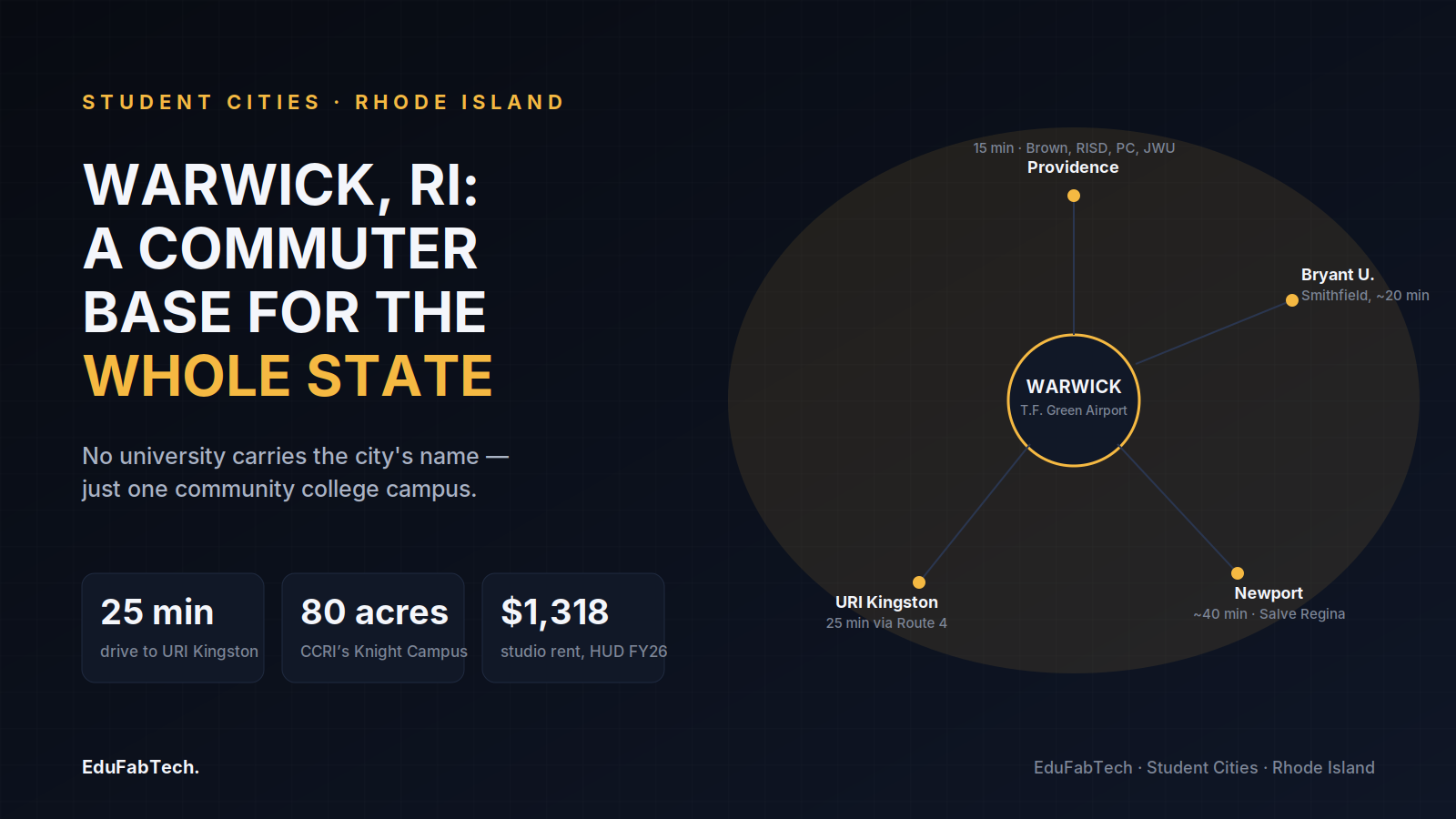
Warwick is Rhode Island's second-largest city, a sprawl of coastal villages and commercial strips wrapped around the western shore of Narragansett Bay, roughly fifteen minutes south of downtown Providence by Interstate 95. It is better known to most arriving students as the place the plane lands: Rhode Island T.F. Green International Airport sits inside the city limits, and so does the state's main out-of-town commuter rail stop. What Warwick does not have is a campus quad of its own — no four-year university carries the city's name. It is a base, not a college town, and understanding that difference is the key to living here well.
The one degree-granting campus physically in Warwick is the Knight Campus of the Community College of Rhode Island. According to CCRI's own history, the Knight Campus opened in September 1972 on 80 acres that Royal W. Knight had donated to the college, and its facilities sit under a single roof in what the college calls a megastructure, set on a wooded parcel in the city's western section near the Route 2 and Route 95/295 approaches, where associate degrees and transfer programmes are taught. Everyone else studying from Warwick is a commuter — out to Kingston, up to Providence, across to Bristol or Newport — which is why the city fills with students who want cheaper rent and a car, rather than a dorm and a dining hall.
That trade is the honest shape of student life here. Warwick is suburban and car-oriented: single-family homes, two- and three-family houses, and apartment blocks strung along Post Road, Bald Hill Road and Jefferson Boulevard. You generally pay less for space than you would on College Hill, and you pay for it in minutes behind the wheel or waiting for a bus. If you want to see every listing gathered in one place before you commit, EduFabTech keeps a Warwick city page with rooms, jobs and second-hand goods.
The ring of colleges you can reach from Warwick
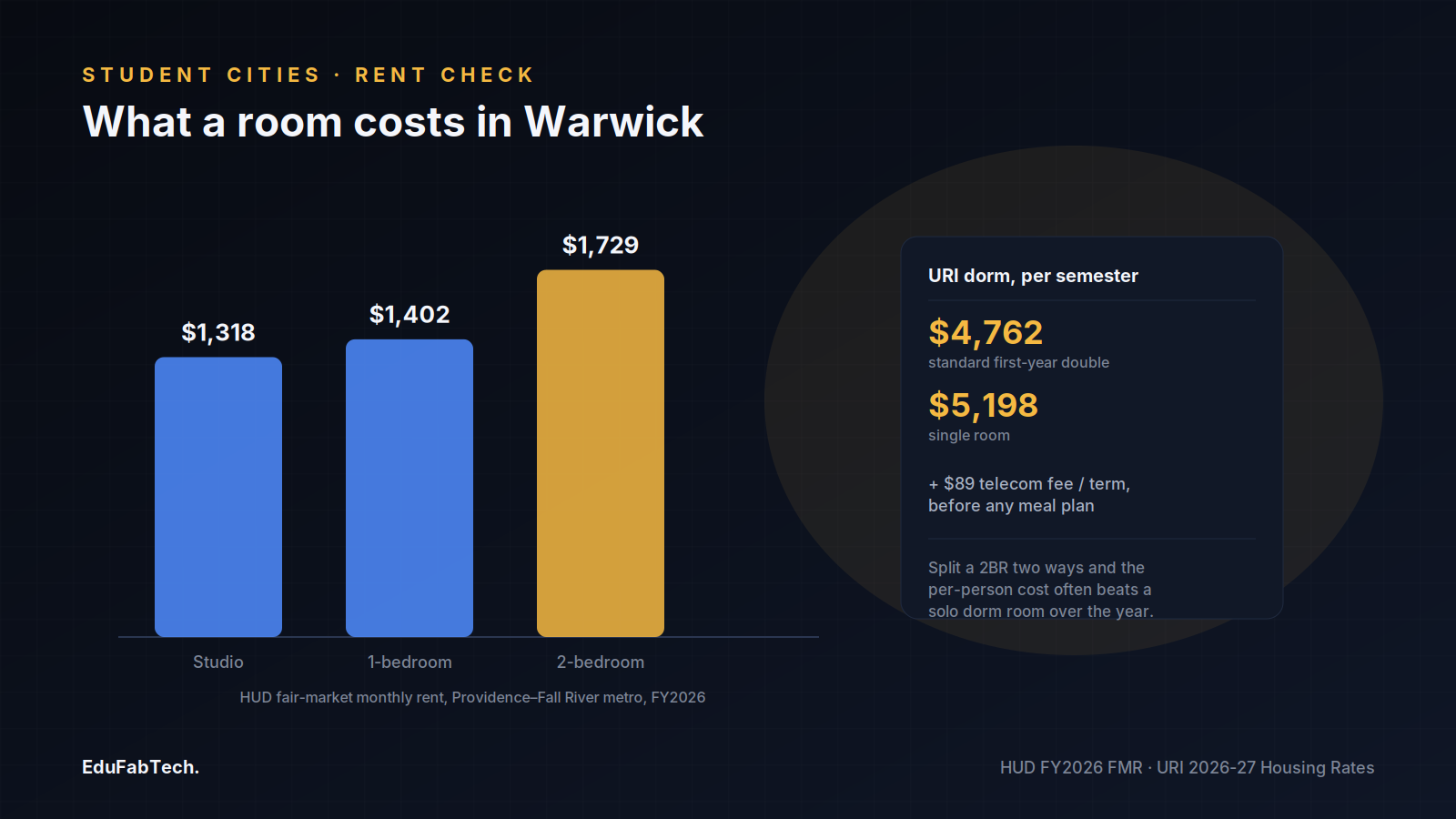
Warwick's real advantage is position: most of Rhode Island's higher education sits within a half-hour drive, and the state is small enough that "nearby" means something. The closest full university is the University of Rhode Island, whose main campus is in the village of Kingston, about 25 minutes south on Route 4 — a land-grant university strong in oceanography, pharmacy, engineering and nursing, with its Graduate School of Oceanography on the Narragansett Bay Campus. Listings clustered around that campus live on EduFabTech's near-URI page.
North toward Providence, the cluster thickens. Brown University, the Ivy League institution on College Hill, is known for its Open Curriculum and sits among the brick quadrangles and colonial streets of Providence's east side. The university's degree-granting divisions reach well beyond its undergraduate college: the Brown University Graduate School oversees its master's and doctoral programmes, and the Brown University School of Public Health, based in downtown Providence, grants its own public-health degrees. Beside the main campus, the Rhode Island School of Design runs down the same hill toward the river and is one of the best-known art and design schools in the country. Providence College, a Catholic liberal-arts college in the city's Elmhurst section, and Johnson & Wales University, Providence, long associated with culinary arts and hospitality, round out the Providence group, along with Rhode Island College, the state's public teaching-and-nursing college on the Providence–North Providence line.
The outer ring is still commutable from Warwick for the determined. Bryant University, a business-focused university, is in Smithfield to the north; Roger Williams University sits on the water in Bristol to the south-east, with architecture and law among its programmes; Salve Regina University occupies Gilded-Age mansions in Newport; and Wheaton College is a liberal-arts college just over the state line in Norton, Massachusetts. Newport also hosts the Naval War College, a graduate war college that awards master's degrees to serving military officers rather than to the general public. None of these is a quick hop, but with a car and a tolerance for bridges and bay winds, Warwick keeps all of them in range.
The villages students actually settle in
Warwick is a patchwork of old villages rather than a single downtown, and where you land changes your rent, your commute and your weekends. A few are worth knowing by name.
Apponaug is the civic centre — City Hall, the courts and a small knot of restored buildings around a historic colonial crossroads. It is as close as Warwick comes to a walkable "downtown," central for buses and roughly equidistant from the northbound and southbound highways, which makes it a sensible base if you split time between campuses.
Pawtuxet Village, straddling the Warwick–Cranston line on the Pawtuxet River, is the most genuinely pedestrian corner of the city: a historic harbour village with cafés, a Sunday farmers' market in season and a tight stock of older apartments. Rents reflect the charm, and parking is tight, but it is the one place you can live mostly on foot. Conimicut, out on the bay with its own lighthouse and point park, is quieter, more residential and generally cheaper — a longer drive to everything but close to the water.
Oakland Beach, a small bayside neighbourhood built around a public beach and a cluster of clam shacks, tends to be among the more affordable waterfront areas and draws a mix of year-round renters. Cowesett, in the city's south-west near the East Greenwich border, is leafier and pricier, with larger homes and the shortest run to URI. And the City Centre / Jefferson Boulevard corridor, around the airport and the train station, is the most apartment-dense part of Warwick — purpose-built complexes, chain retail and the best transport links, at the cost of being the least charming to walk.
Finding a room without losing a deposit
Because Warwick has no campus housing office renting to the public, most student rooms here are ordinary private rentals: a room in a three-family house, a shared apartment along Post Road, or a studio in one of the Jefferson Boulevard complexes. Start looking early for a September move — the Rhode Island rental market tightens over the summer as leases turn over, and the best-value rooms near the bus lines go first. EduFabTech's Warwick rooms page is one place to begin, alongside campus housing boards and word of mouth.
The scams here follow the pattern of any car-dependent metro: a listing priced suspiciously below the going rate, photos that look too polished, a "landlord" who is conveniently out of state and cannot show the unit, and a request to wire a holding deposit before you have seen anything. Treat those as the warning they are. See the place in person, or send someone you trust; meet whoever holds the keys; and read the lease before any money moves. Never send a deposit by bank transfer, gift card or cryptocurrency to "hold" a room — once that money is gone it does not come back, and no legitimate Warwick landlord needs it that way.
Rhode Island law gives you a concrete yardstick. Under R.I. Gen. Laws § 34-18-19, a landlord may not demand a security deposit greater than one month's rent, and must return it — with an itemised list of any deductions — within 20 days of the tenancy ending. If someone asks for two or three months up front to "secure" a place, that alone is a reason to walk away.
What a room costs
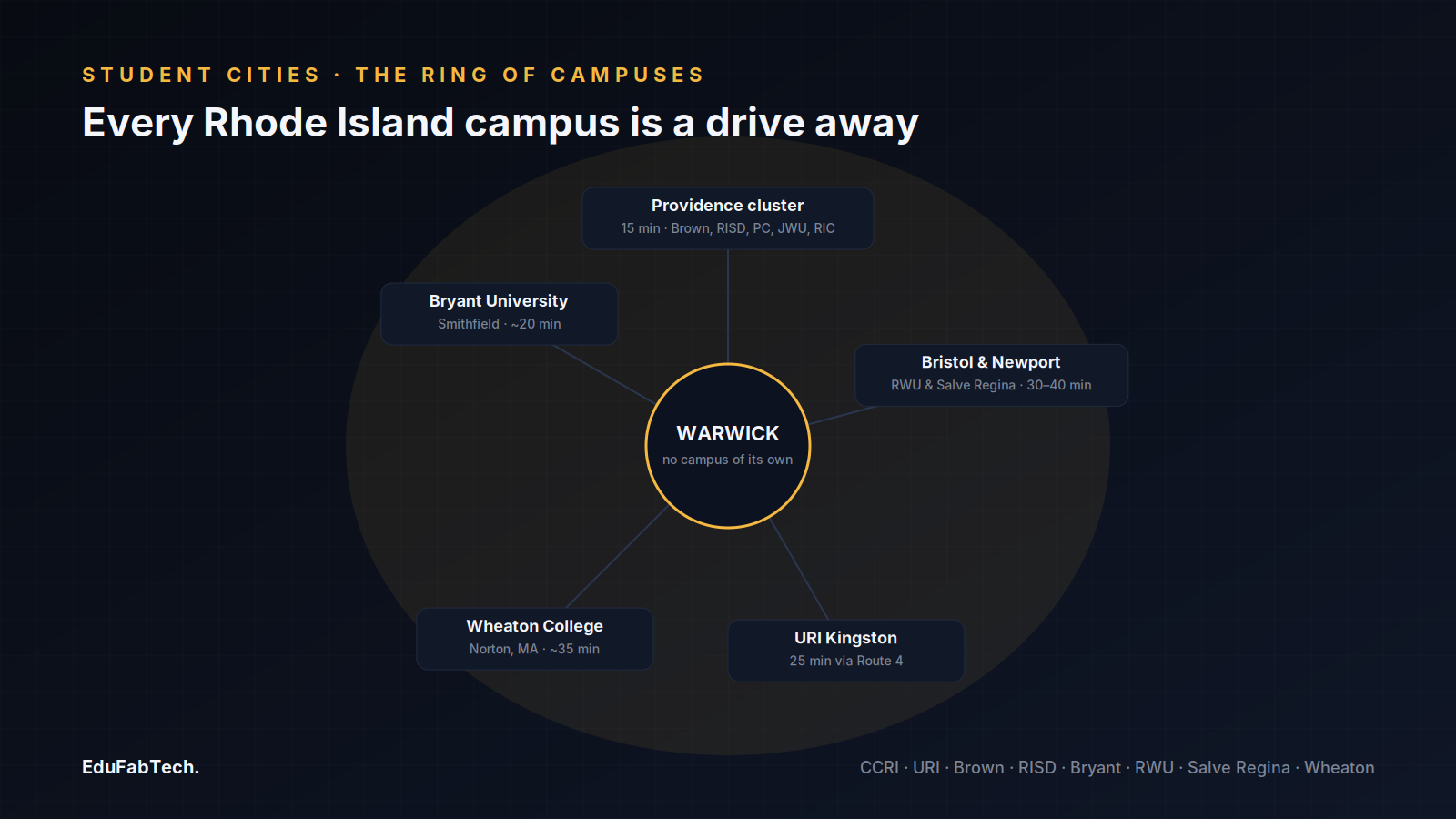
Warwick falls inside the Providence–Fall River, RI–MA metropolitan area that the U.S. Department of Housing and Urban Development uses to set its benchmark rents. HUD's fair market rents for fiscal year 2026 put a studio in that area at US$1,318 a month, a one-bedroom at US$1,402 and a two-bedroom at US$1,729. These are HUD's payment-standard figures rather than a survey of asking prices, so individual Warwick listings run both below and above them, but they are a reliable floor for a budget: splitting a two-bedroom brings the per-person cost well under a solo studio.
If you commute to URI and weigh a dorm against renting, the campus numbers are published. The University of Rhode Island's 2026-2027 housing rates list a standard first-year double room at US$4,762 per student per semester and a single at US$5,198, plus an US$89 telecommunications fee each term — before any meal plan. Set against Warwick's private rents, a shared off-campus apartment is often cheaper over a full year, which is a large part of why students choose the city in the first place.
Furnishing a room on the cheap
Warwick is a good town for second-hand furniture precisely because it is suburban: the big-box thrift stores have the floor space that downtown Providence lacks. Goodwill of Southern New England runs a large store and donation centre at 444 Quaker Lane, and there is a Savers thrift store at 24 Universal Boulevard, both in the Route 2 / Bald Hill retail belt where you can fill a room in one trip. The Salvation Army also operates thrift locations in the area. Just across the line in neighbouring West Warwick, the Old Mill Vintage Marketplace and Flea on Bridal Avenue is the closest proper flea market for odds and ends.
For the cheapest route of all, watch the turnover weeks. At the end of each semester, usable furniture appears on kerbs and in giveaway piles across the student-heavy streets. EduFabTech's second-hand furniture listings for Warwick are worth checking before you buy anything new, and a measuring tape plus a friend with a car will save you more than any single shop.
Getting around: buses, the Wave card and the train
Public transport in Rhode Island is run by the Rhode Island Public Transit Authority (RIPTA), and Warwick is one of its better-served suburbs, with routes running up Post Road and Warwick Avenue toward Providence and a hub at the airport station. RIPTA has moved to the reloadable Wave card as its main fare method; its fare page lists a standard US$2 boarding, a US$6 day pass and a US$70 monthly pass, with fares capping automatically at the day-pass price once you reach it.
Several colleges buy their students out of those fares entirely through RIPTA's U-Pass programme. The University of Rhode Island announced that, from 1 October 2026, its students, faculty and staff ride any RIPTA bus statewide for free simply by showing a valid URI ID, at any hour, according to URI's announcement; other institutions set their own terms, so check with your own campus transport office rather than assuming the same deal applies.
For leaving the state, Warwick is unusually well placed. The MBTA Commuter Rail runs from the T.F. Green Airport station at 700 Jefferson Boulevard north to Providence and on to Boston's South Station on the Providence/Stoughton Line, with the line's southern terminus a few stops further at Wickford Junction in North Kingstown. The airport itself puts direct domestic flights within a ten-minute drive of most of the city — a genuine convenience for international students flying home.
Libraries and places to study
The Warwick Public Library system gives you free, quiet study space across the city. The Central library at 600 Sandy Lane keeps the longest hours — open until 8 p.m. early in the week per the library's hours page — with smaller branches in Apponaug, Conimicut and the Norwood neighbourhood for a desk closer to home. Your campus library is still the anchor for serious work: URI, Brown and the others keep long semester hours and online databases you cannot get elsewhere, and the CCRI Knight Campus library is open to students enrolled there.
If you would rather study where you live, EduFabTech lists study spaces and desks around Warwick, which is useful in a city where cafés, not campus commons, are where a lot of reading actually gets done.
Working while you study
Part-time work rules depend on your visa, and the safest source is the government, not a forum. Students on an F-1 visa may work on-campus up to 20 hours per week while school is in session without separate approval from U.S. Citizenship and Immigration Services, provided they keep valid status and have their school's designated official sign off; off-campus work is tightly limited and usually requires authorisation. The official explanation of what counts as on-campus employment and the hour limits is on the U.S. Immigration and Customs Enforcement SEVP employment page — read it, and talk to your international-student office, before you accept any job. This is not legal advice, and the details change.
For local openings — campus jobs, retail along the Route 2 corridor, airport and hospitality work — EduFabTech's Warwick jobs page is a starting point. Whatever you find, confirm it fits your visa terms first.
What is good, and what is hard
The good is real: Warwick is cheaper than Providence's east side, it has a long bay coastline with public beaches and parks, it is central to nearly every Rhode Island campus, and it has an airport and a train station most student towns would envy. The hard part is the mirror image. Without a car you will lean heavily on RIPTA, whose suburban routes are useful but not frequent, and journeys that look short on the map can eat an hour by bus. The city is spread out and strip-mall in character away from the historic villages; winters on the bay are cold and grey; and rents, while below Providence, have been climbing with the rest of Rhode Island. Warwick rewards students who value space and a base over a walk-to-class campus life.
A checklist for your first weeks
- See any room in person — or have someone you trust see it — and read the lease before paying; never wire a holding deposit.
- Confirm the security deposit is no more than one month's rent, as Rhode Island law requires.
- Get a RIPTA Wave card, and check whether your college is in the U-Pass programme before buying a monthly pass.
- Register at the Warwick Public Library (Central, Sandy Lane) for free study space and borrowing.
- Furnish from Goodwill on Quaker Lane, Savers on Universal Boulevard and end-of-semester giveaways before buying new.
- If you are on a visa, read the official on-campus work rules and check with your international-student office before taking a job.
- Learn your route to campus by both car and bus — in Warwick the commute is the decision.
A quick question for readers
Do you work part-time while you study?
Many students work to pay the bills. See how common it is — and how many hours people really do.
Pick an answer, create a free account in a minute, and your vote counts. Already a member? Sign in
Comments 0
CommentNo comments yet. Members start the conversation.
Source: University of Rhode Island
Sources (5)
- University of Rhode Island. 2026-2027 Housing Rates. University of Rhode Island Housing & Residential Life, 2026. web.uri.edu ↗ · checked 17 Oct 2026
- U.S. Department of Housing and Urban Development. FY2026 Schedule of Metropolitan & Non-Metropolitan Fair Market Rents. HUD USER, 2026. huduser.gov ↗ · checked 17 Oct 2026
- University of Rhode Island. URI and RIPTA launch U-Pass partnership providing free bus access for students, faculty and staff. URI News, 2026. uri.edu ↗ · checked 17 Oct 2026
- Rhode Island General Assembly. R.I. Gen. Laws § 34-18-19 — Security deposits. State of Rhode Island, 2024. webserver.rilegislature.gov ↗ · checked 17 Oct 2026
- Community College of Rhode Island. Our History. CCRI, 2024. ccri.edu ↗ · checked 17 Oct 2026