2026 Antarctic Ozone Hole Ranks Seventh Largest in 48 Years, NASA and NOAA Report
A weak polar vortex pushed the hole to 9.6 million square miles on average, but agencies say declining chlorine still points to recovery by the 2070s.
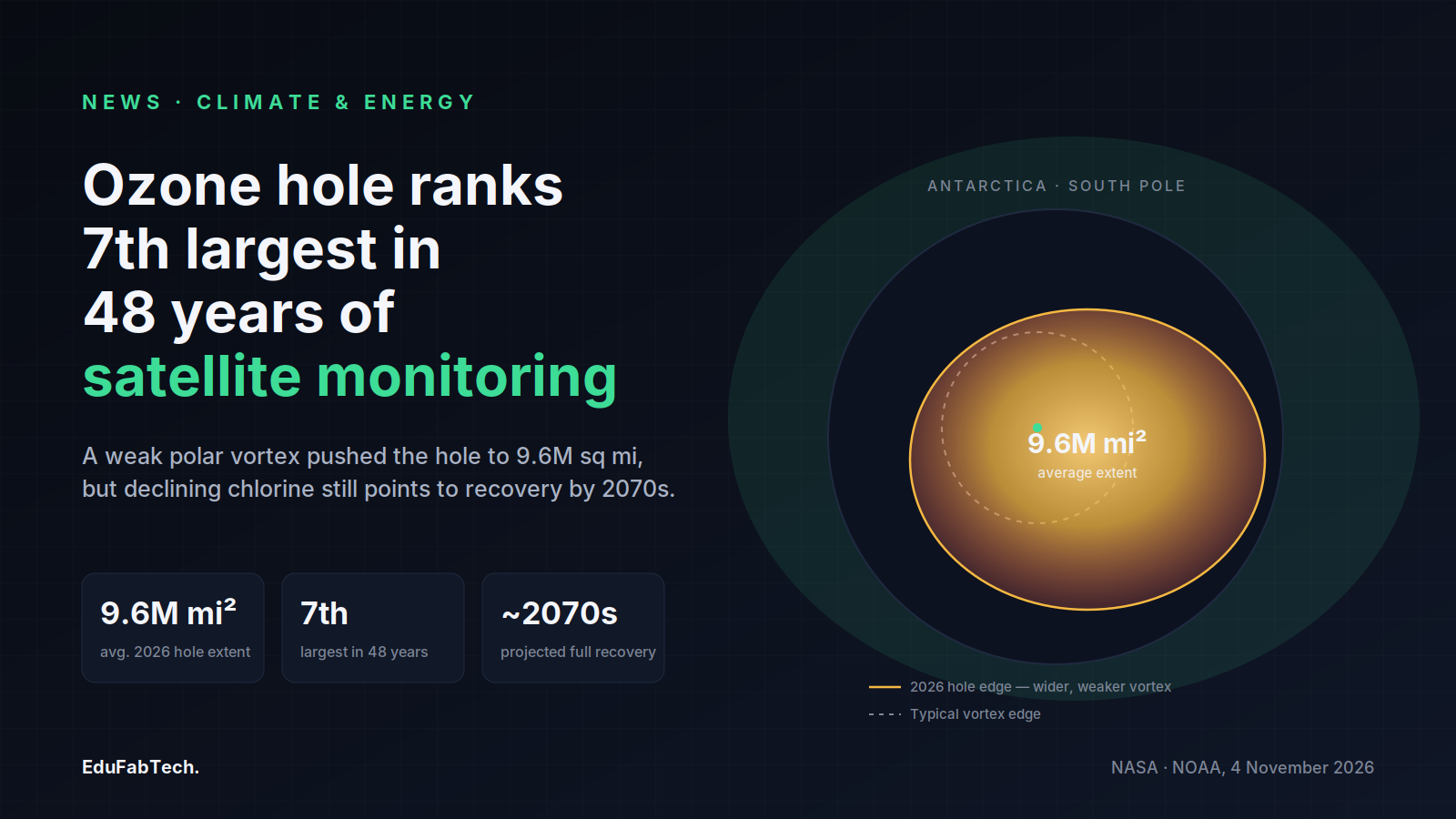
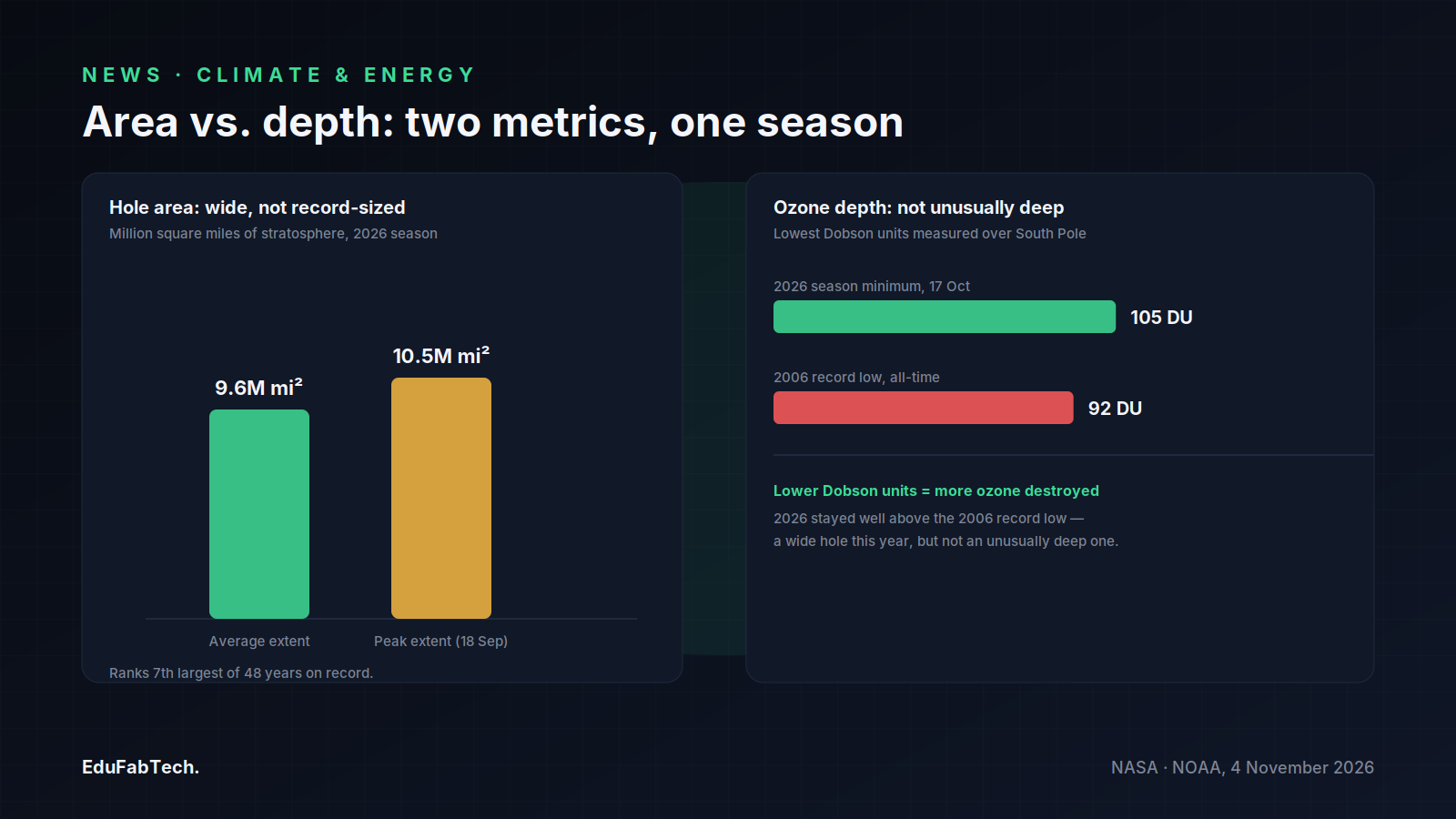
NASA and the National Oceanic and Atmospheric Administration (NOAA) reported on 4 November 2026 that the Antarctic ozone hole averaged 9.6 million square miles (25 million square kilometers) between 7 September and 13 October 2026, making it the seventh-largest since satellite and ground-based monitoring began 48 years ago, according to the agencies' joint announcement. The hole reached its peak extent of 10.5 million square miles (27.1 million square kilometers) on 18 September 2026, NASA's Earth science site states.
What the measurements show
The two agencies track the hole using ground instruments at the South Pole's Baseline Atmospheric Observatory, where scientists operate a Dobson Ozone Spectrophotometer, together with NASA's Aura satellite and NOAA's NOAA-20, NOAA-21 and Suomi NPP satellites, per the NOAA release. Ozone concentration directly over the South Pole hit its lowest reading of the year, 105 Dobson units, on 17 October 2026. That is well above the lowest value ever recorded at the station, 92 Dobson units, measured in October 2006, the release says.
Why this year's hole grew larger
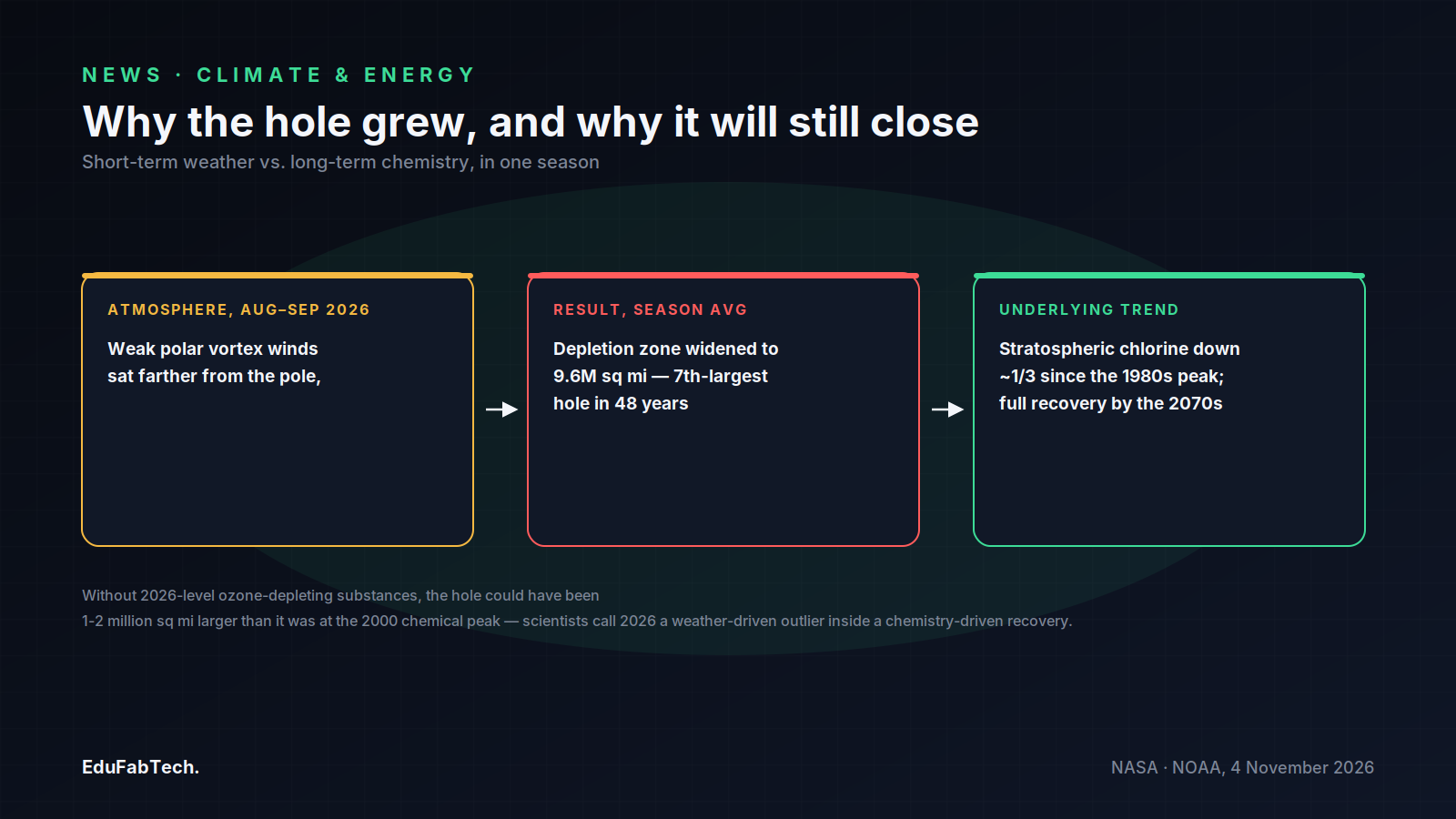
NOAA Chemical Sciences Laboratory scientist Amy Butler attributed the size to unusual atmospheric circulation rather than a reversal in the ozone layer's recovery. Weak planetary-scale weather systems over August and September, she said, "kept the strongest polar vortex winds further from the pole by several degrees of latitude, creating a larger area for conditions ideal for ozone depletion to occur," according to the NASA Science page. A stronger, more stable polar vortex isolates frigid stratospheric air over Antarctica, and that cold air is what allows chlorine and bromine compounds to destroy ozone efficiently each spring.
Paul Newman, a senior scientist at the University of Maryland, Baltimore County, who leads NASA's ozone research team at the agency's Goddard Space Flight Center, placed the 2026 season in the context of the broader recovery trend. "The annual ozone hole has been forming later in the season in recent years, which tells us the ozone layer is healing," he said, as quoted in the NOAA statement. Newman added that the hole "is large but could have been 1 to 2 million square miles (3.5 million square kilometers) larger if ozone-depleting substances were as prevalent in the atmosphere today as they were at their year 2000 peak."
The Montreal Protocol's role
Both agencies tie the longer-term trend to the Montreal Protocol, the 1987 international treaty that phased out the production of chlorofluorocarbons and other ozone-depleting substances. According to NASA's ozone hole page, chlorine levels in the Antarctic stratosphere have declined by roughly one-third from their 1980s peak as a result of the treaty. The agencies project that the ozone layer will fully recover by around the 2070s, as the legacy compounds already released into the atmosphere continue to break down.
Why this matters for research and teaching
The ozone hole is one of the longest-running, most consistently measured indicators in atmospheric science, and the 2026 figures illustrate a point relevant to anyone teaching or studying environmental trends: a single year's measurement can diverge from a long-term trajectory without contradicting it. Students comparing year-to-year ozone hole size should note that meteorology — specifically the strength and position of the polar vortex — drives short-term variability, while the underlying chemistry, governed by atmospheric chlorine and bromine concentrations, drives the multi-decade recovery curve.
For researchers working with the dataset, NOAA and NASA's monitoring record now spans 48 years, combining ground-based Dobson spectrophotometer measurements at the South Pole with continuous satellite coverage. That combination lets scientists distinguish a Dobson-unit minimum (a measure of ozone column depth directly overhead) from the hole's areal extent (a measure of how much of the stratosphere falls below a depletion threshold), two related but distinct metrics that are sometimes conflated in secondary reporting. The 2026 season's area rank of seventh-largest in 48 years and its Dobson-unit minimum of 105, well short of the 2006 record low of 92, show those two metrics did not move in lockstep this year — the hole was unusually wide without being unusually deep.
What to watch next
Both agencies frame 2026 as a weather-driven outlier within a chemistry-driven recovery. Future annual reports from NOAA and NASA will show whether the later seasonal onset Newman described continues, which the agencies treat as one of the clearer signals that atmospheric chlorine is continuing to decline on schedule under the Montreal Protocol.
A quick question for readers
How much do you spend on books and course materials per term?
Amounts in US dollars. The results help show how much course materials really cost students.
Pick an answer, create a free account in a minute, and your vote counts. Already a member? Sign in
Comments 3
Comment-
The part worth sitting with is that the hole got wider without getting deeper - Dobson minimum was 105, nowhere near the 2006 low of 92. Tha…
-
The 105 versus 92 Dobson-unit comparison is the part doing real work here, and it cuts against the headline size ranking rather than reinfor…
-
The bit worth flagging for anyone teaching this: the article's own point that area and Dobson minimum can decouple is the actual lesson here…
Join free to read the full comments and reply Comments are between members; an account takes a minute.
Source: NOAA
Sources (2)
- NOAA. NOAA, NASA release measurements of 2026 ozone hole. NOAA, 2026. noaa.gov ↗ · checked 11 Nov 2026
- Sally Younger. 2026 Ozone Hole. NASA Science, 2026. science.nasa.gov ↗ · checked 11 Nov 2026