V-Dem's 2026 Academic Freedom Index Finds Declines in 50 of 179 Countries
A decade of expert-coded data from the V-Dem Institute and Friedrich-Alexander University shows academic freedom falling since 2015 in 50 countries and territories, with the fastest institutional-autonomy drop among wealthy democracies recorded in the United States.
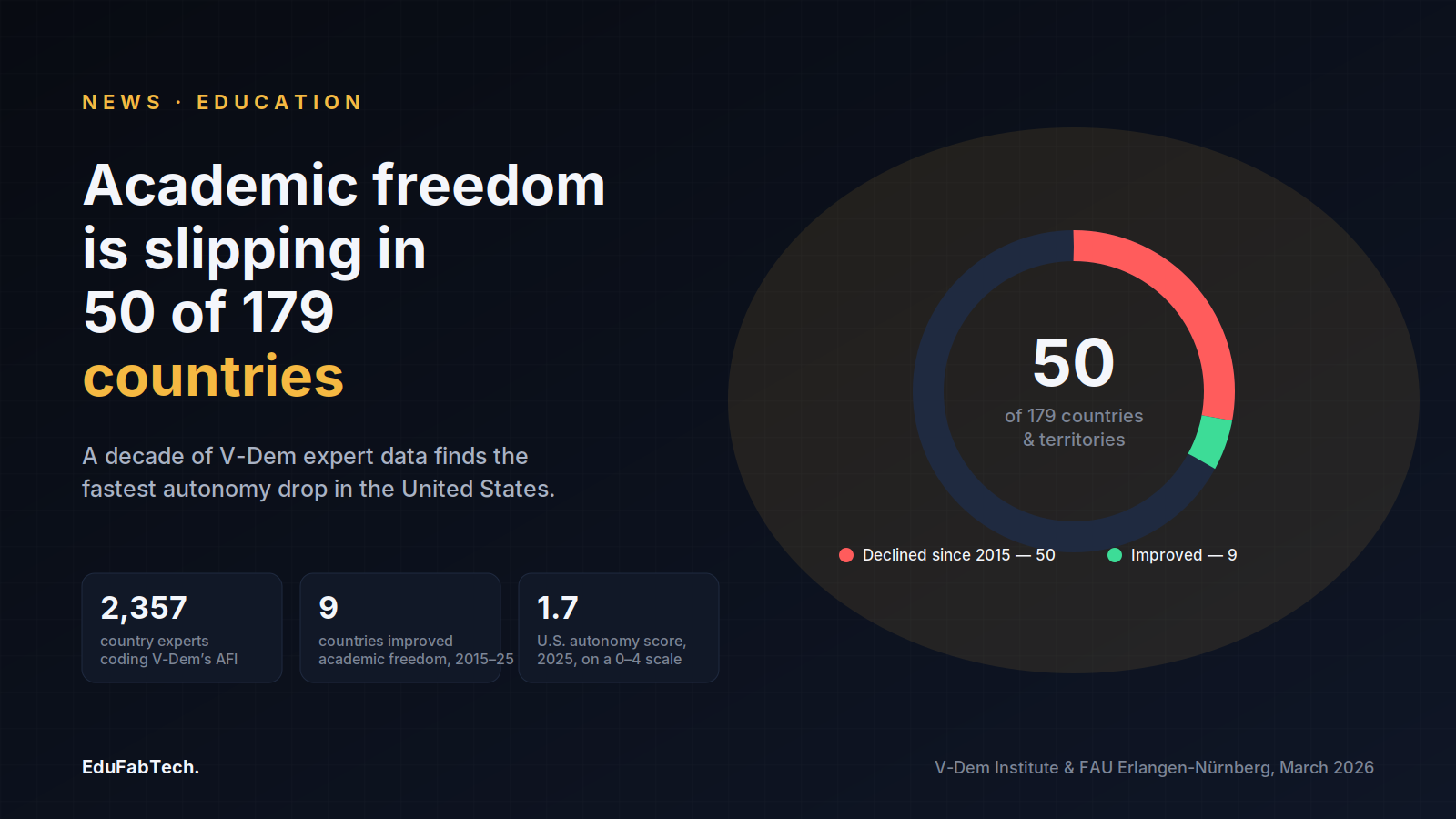
The 2026 update to the Academic Freedom Index, published in March 2026 by researchers at Friedrich-Alexander-Universität Erlangen-Nürnberg (FAU) and the V-Dem Institute at the University of Gothenburg, finds that academic freedom has declined significantly in 50 of the 179 countries and territories it covers since 2015. Only nine registered a significant improvement over the same decade, according to the official report.
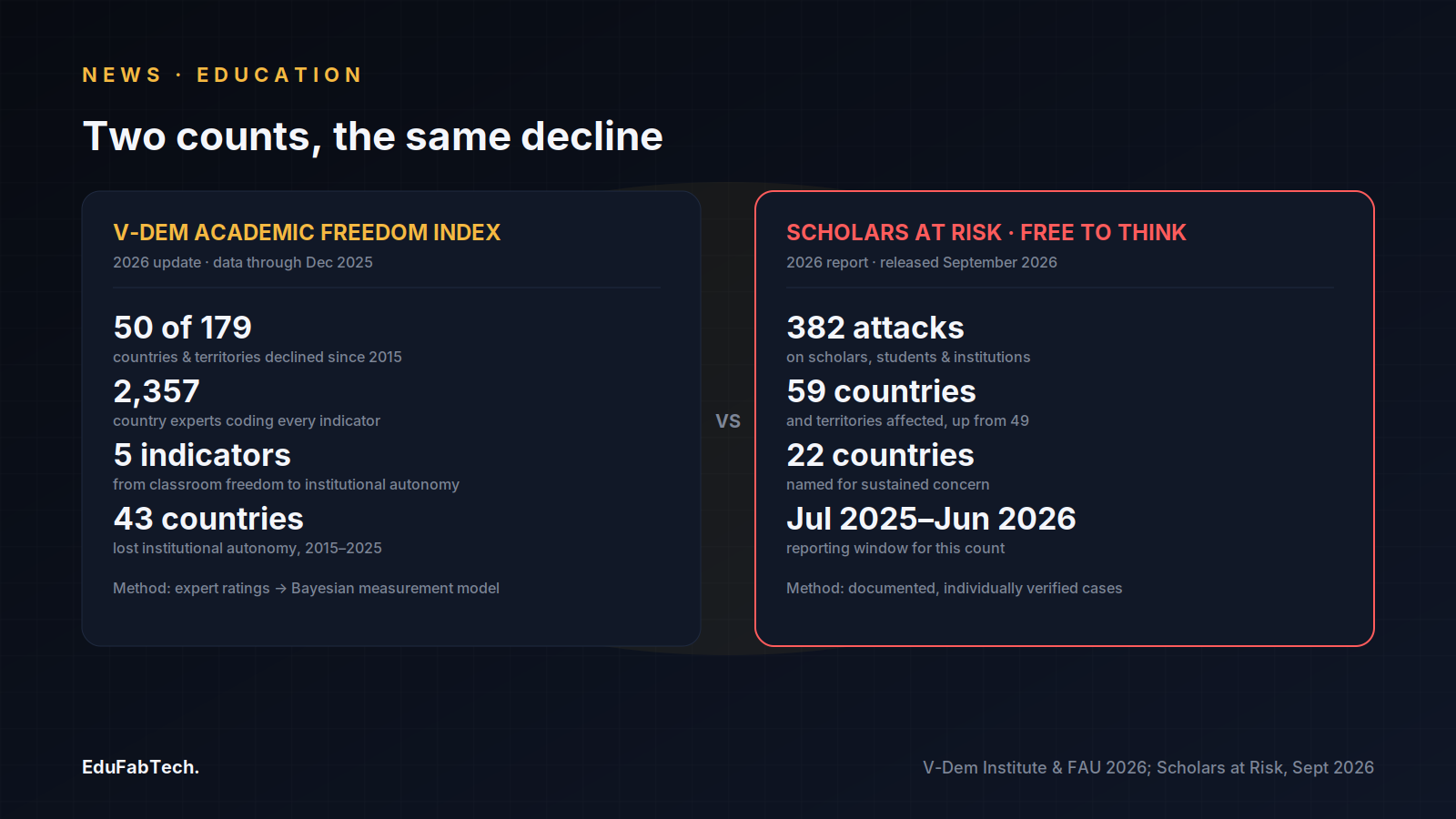
The index draws on V-Dem's version 16 dataset, built from assessments by 2,357 country experts worldwide, covering data through December 2025. Each country is scored on five indicators: freedom to research and teach, freedom of academic exchange and dissemination, institutional autonomy of universities, campus integrity, and freedom of academic and cultural expression. Experts rate each dimension independently, and a Bayesian measurement model developed by V-Dem converts those ratings into a single comparable score per country per year.
The report's central claim is that institutional autonomy, how much control governments exert over university leadership, budgets, and admissions, is the strongest predictor of whether individual scholars and students can work freely. Where autonomy is protected, the report notes, "the freedom to research and teach is also more protected." Where it erodes, individual freedoms tend to follow within a few years.
Where the declines are concentrated
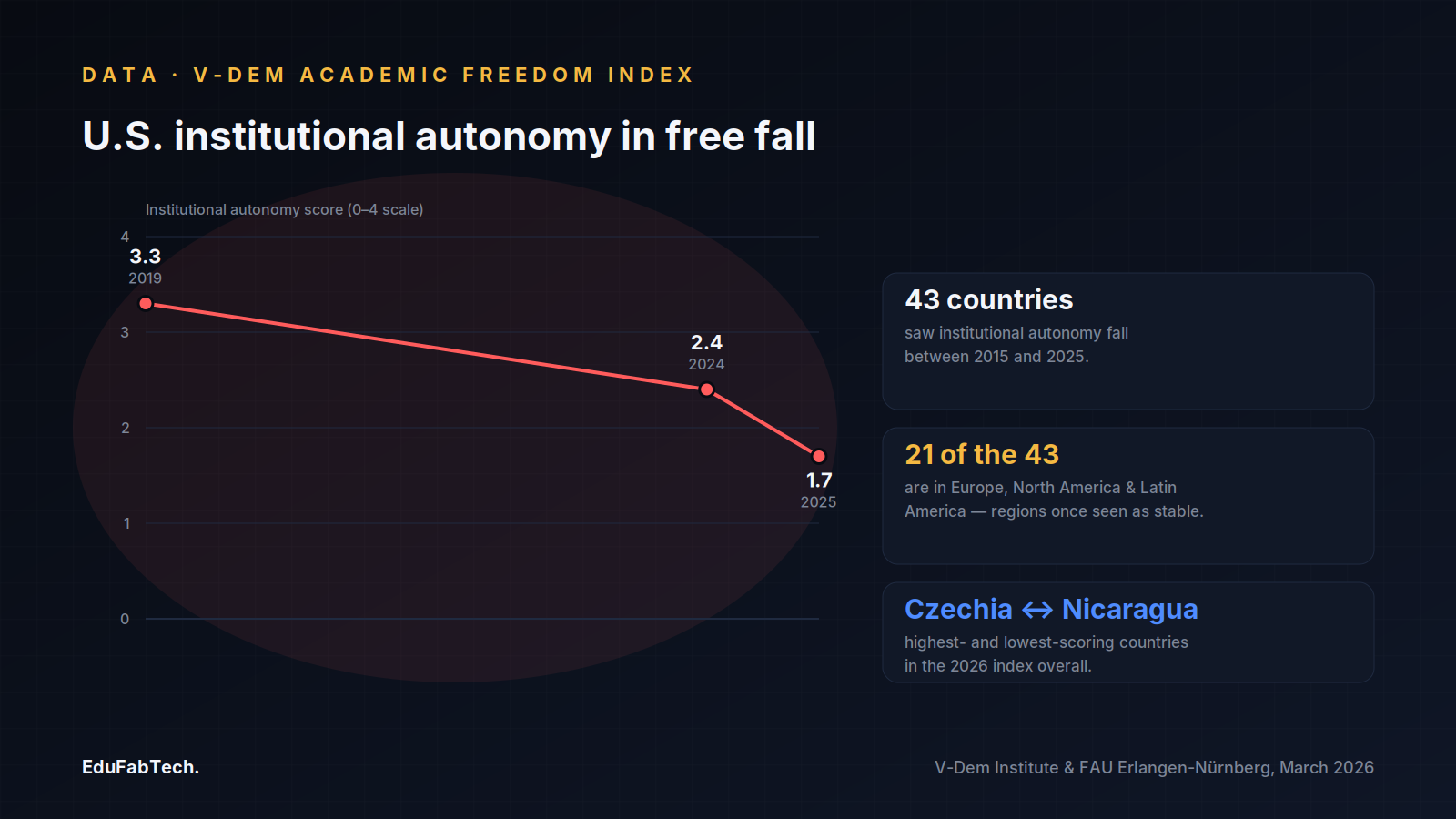
Institutional autonomy fell in 43 countries between 2015 and 2025, and 21 of those are in Europe, North America, and Latin America, regions the index's authors had previously treated as comparatively stable. The United States shows the fastest and steepest drop among wealthy democracies: its institutional-autonomy score, measured on a 0-4 scale, fell from 3.3 in 2019 to 2.4 in 2024 and 1.7 in 2025, according to FAU's summary of the update.
Other countries singled out for a decade-long downward trend include Hungary and India, alongside Türkiye, where Scientific American's coverage of the update attributes the decline in university autonomy since the mid-2010s to political attacks, legal reforms, and administrative interventions. At the other end of the scale, Czechia ranks among the highest-scoring countries for overall academic freedom protection in the 2026 update, while Nicaragua ranks lowest. Regionally, University World News reports that Southern and West Africa, together with parts of Europe, Latin America, and North America, still score higher on average than much of Asia and the MENA region, even though several of those same high-scoring regions supplied most of the decade's declines.
A second count, from a different angle
A separate monitoring project reached a consistent picture using a different method entirely. Scholars at Risk's Free to Think 2026 report, released in September 2026, documents 382 attacks on scholars, students, and institutions across 59 countries and territories between July 2025 and June 2026. That is a slight drop from 395 attacks the previous year, but the attacks spread into ten more countries and territories than the 49 covered a year earlier.
The Scholars at Risk report names 22 countries for sustained concern, among them Afghanistan, Bangladesh, China and Hong Kong, Colombia, Georgia, India, Indonesia, Iran, Nigeria, Pakistan, the Occupied Palestinian Territory, the Philippines, Russia, Senegal, Serbia, Syria, Türkiye, Ukraine, the United States, Venezuela, and Zimbabwe. Its authors note that even countries classified as democracies, including Georgia, India, and the United States, saw university autonomy "violated" by government interference during the reporting period, echoing the Academic Freedom Index's separate finding that declines are no longer confined to authoritarian states.
What the numbers do and don't show
Both projects rely on expert judgment rather than a single administrative dataset, which is a deliberate design choice: there is no global registry of university dismissals, censorship orders, or funding cuts to count directly, so the Academic Freedom Index's coders cross-check named incidents against each other before the Bayesian model smooths disagreements into a score. That makes the index useful for tracking direction and speed of change within a country over time, which is how its authors frame the US, Hungary, India, and Türkiye findings, rather than for fine-grained ranking disputes between countries that sit close together on the scale.
Taken together, the two reports describe the same decade from different vantage points: one measuring the legal and institutional conditions under which universities operate, the other counting individual cases of scholars detained, dismissed, or barred from speaking. Neither claims the trend has bottomed out. The Academic Freedom Index update covers data only through the end of 2025, and Scholars at Risk's tally runs through June 2026, so the next editions of both will show whether the declines recorded in wealthy democracies in 2025 continued into 2026 or proved to be a shorter-lived disruption.
A quick question for readers
Which study method makes things stick for you until the exam?
Research says some methods work far better than others. Vote first, then see whether students agree with the evidence.
Pick an answer, create a free account in a minute, and your vote counts. Already a member? Sign in
- Katrin Kinzelbach, Staffan I. Lindberg, Lars Lott, Angelo Vito Panaro. Academic Freedom Index Update 2026. Friedrich-Alexander-Universität Erlangen-Nürnberg / V-Dem Institute, 2026. link
- FAU Erlangen-Nürnberg Communications. Academic Freedom Index: The Autonomy of Universities in the USA Falls Far Behind Peer Group. Friedrich-Alexander-Universität Erlangen-Nürnberg, 2026. link
- Scholars at Risk. Violent Repression and Government Overreach Fuel Global Decline in Academic Freedom: Free to Think 2026. Scholars at Risk Network, 2026. link
- Yojana Sharma. Report Finds Notable Regional Divide in Academic Freedom. University World News, 2026. link
- Scientific American. See How Academic Freedom Is Changing Around the World. Scientific American, 2026. link