Two 2026 Surveys Show AI Use in Higher Education Nearly Doubling, With Guidance Lagging Behind
OECD teacher data and a 35-country student and faculty survey both show generative AI use rising fast in 2026, while training, assessment redesign and instructor confidence lag behind.
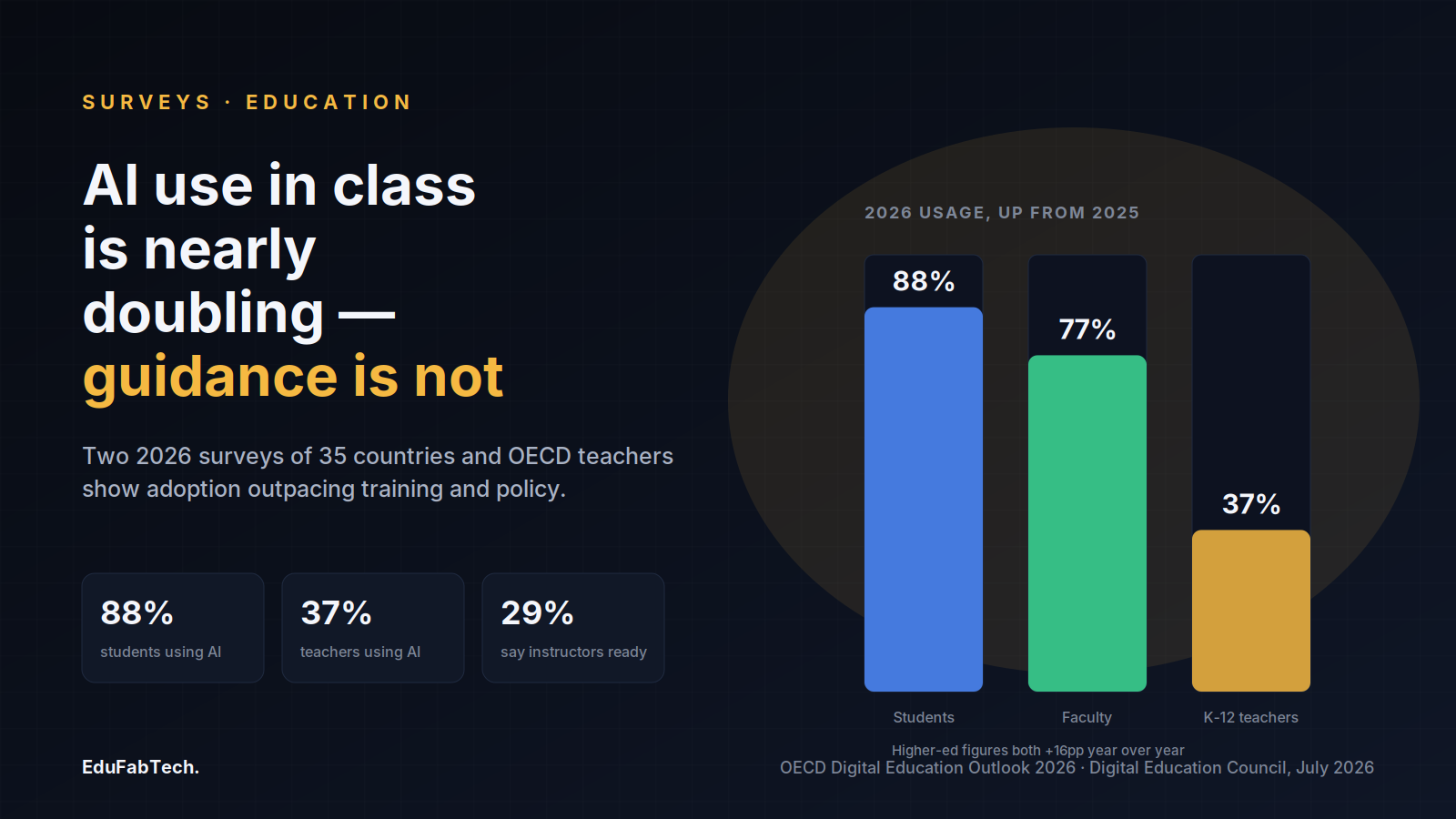
Two data releases in 2026 give the clearest picture yet of how fast generative AI has moved into classrooms and lecture halls worldwide — and how unevenly. The OECD's Digital Education Outlook 2026, published in January and built on its 2024 Teaching and Learning International Survey (TALIS), found that 37% of lower-secondary teachers across OECD countries reported using AI in their work. A separate Digital Education Council survey released in July, covering 45,398 students and faculty across 35 countries, found AI use in higher education has gone further still: 88% of students and 77% of faculty now report using it, both up 16 percentage points on the council's 2025 survey.
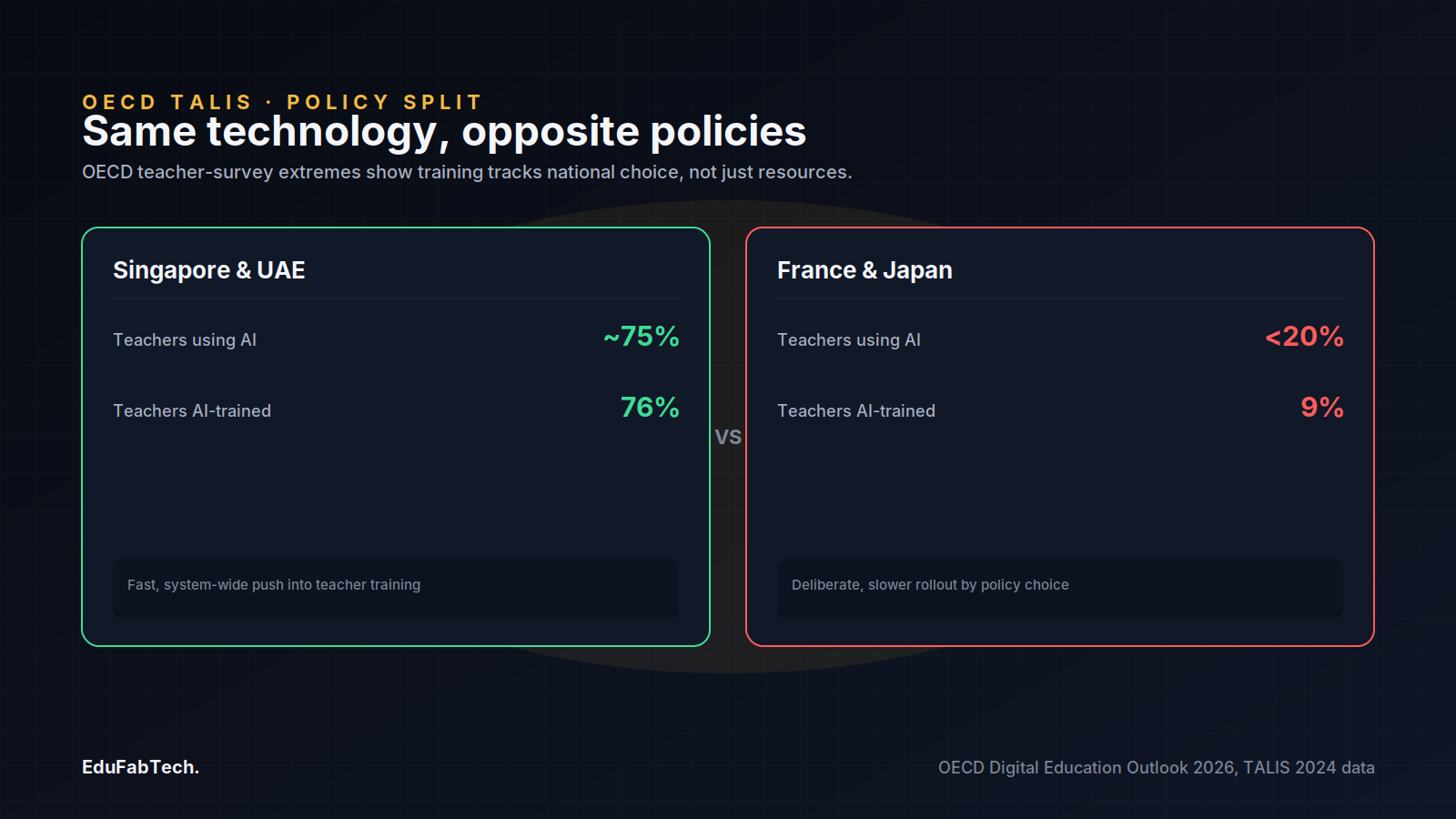
Neither figure describes a uniform global classroom. The OECD data show teacher AI use ranging from under 20% in France and Japan to roughly 75% in Singapore and the United Arab Emirates. Training shows the same spread: 76% of teachers in Singapore report AI training compared with 9% in France. The report frames this as a policy choice as much as a resource gap — some systems have pushed AI into teacher development quickly, others have deliberately held back.
What the surveys measured
The two datasets ask different questions of different populations — OECD's TALIS samples lower-secondary teachers across its member and partner countries, while the Digital Education Council surveyed students and faculty largely at the higher-education level across 35 countries, drawing on 27,284 student and 18,114 faculty responses. Read together, they show the same pattern at both ends of formal education: a steep rise in reported use, and a much slower rise in structured support for it.
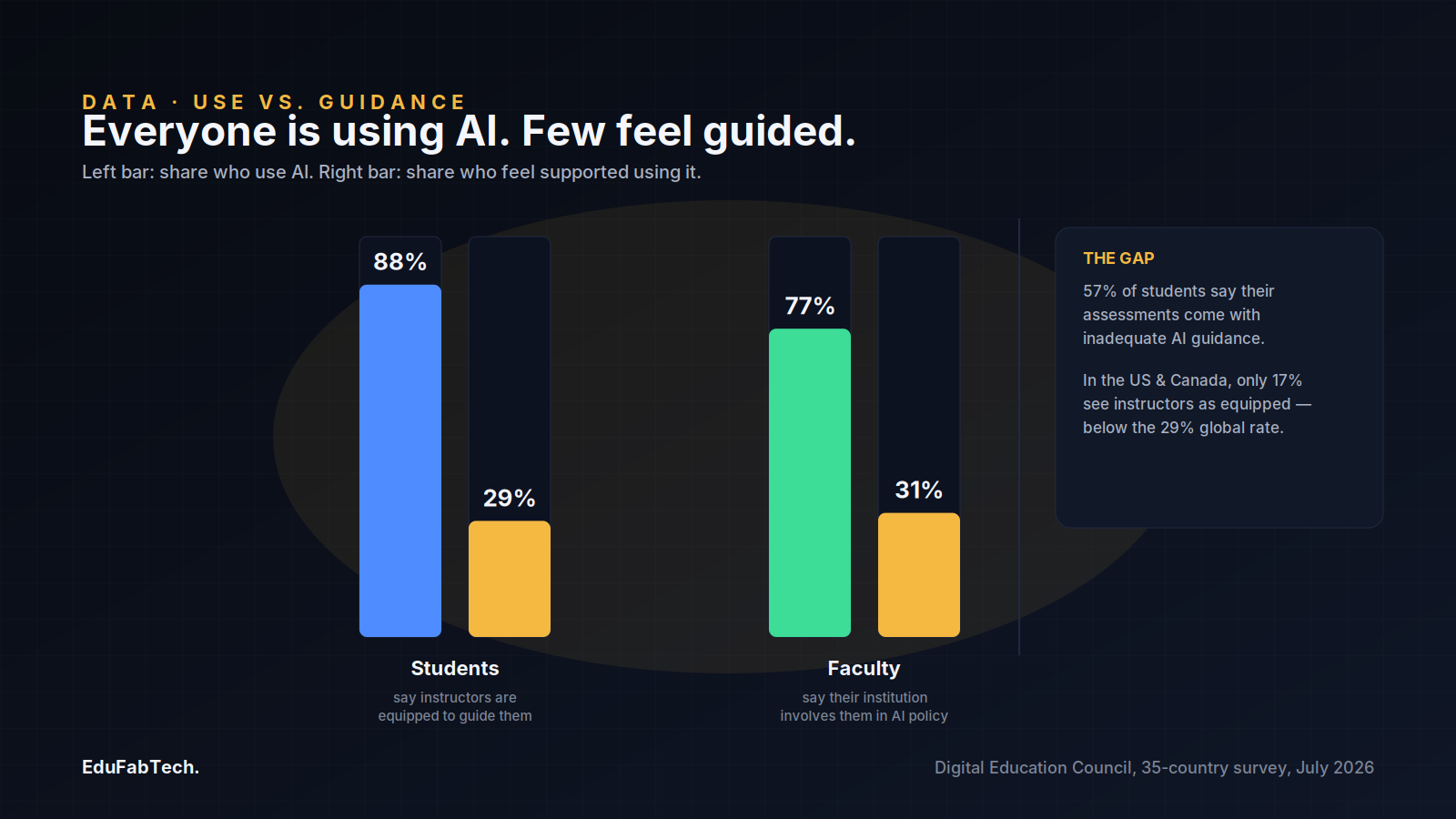
On the higher-education side, the council's survey found 57% of students say their assessments come with inadequate guidance on AI use, and only 29% believe their instructors are equipped to guide them — a figure that falls to 17% among students in the United States and Canada. Just 31% of faculty say their institution involves them meaningfully in shaping AI policy, despite nearly two in three reporting some form of AI literacy training.
The gap between using AI and learning from it
The OECD report's most specific finding concerns what happens when the tool is taken away. Citing controlled research on general-purpose AI tools in learning tasks, it reports that student performance on practice tasks improved by up to 48% with AI assistance, but fell by 17% relative to baseline once that assistance was removed — for instance, in an unassisted exam. The report describes this as a sign of "metacognitive laziness," where students bypass the diagnostic, trial-and-error work that ordinarily builds durable understanding, rather than using AI to support it.
The OECD frames its central argument around this distinction: generative AI improves learning outcomes when lessons are designed around it with explicit pedagogical purpose, and simply raises short-term performance — without lasting gains — when it is used to bypass effortful practice. Separately, TALIS found 53% of lower-secondary teachers who use AI agree it helps them write or improve lesson plans, while 72% raised concerns about its risks to academic integrity.
Where the two data sources diverge
The Digital Education Council's survey adds a regional split the OECD data don't capture at the same level of currency: faculty intent to keep using AI in teaching fell nine percentage points in the United States and Canada over the past year, from 76% to 67%, while holding roughly stable in the Asia-Pacific, Europe/Middle East/Africa and Latin America regions it also surveyed. Student unease has grown in step — 66% of students globally worry AI could make learning too shallow or discourage critical thinking, rising to 81% among students in the US and Canada.
National strategy choices help explain some of the OECD's country-level variation. Estonia has built AI adoption in schools around language: when AI tools underperform in Estonian, officials found students switch to English by default, so the country has made language quality a strategic condition of its rollout. France, by contrast, has avoided a standalone AI-in-education strategy, folding AI tools into a broader digital education policy on the grounds that the technology should not set educational goals on its own — a stance consistent with its comparatively low reported teacher AI use and training rates in the TALIS data.
What comes next
Both datasets are snapshots that will be tested against newer data soon. The OECD's next major release, Education at a Glance 2026, is due on 29 September and will focus on teacher shortages rather than AI use directly — though the two issues intersect where AI is proposed as a partial response to overstretched teaching staff. For now, the clearest conclusion both reports support is a narrow one: adoption of generative AI in education has grown faster in the past year than the training, assessment redesign or classroom guidance needed to make that adoption pay off in actual learning.
- OECD. Digital Education Outlook 2026: Guiding the Effective Use of AI in Education. OECD Publishing, 2026. doi:10.1787/062a7394-en
- Digital Education Council. AI in Higher Education Global Survey 2026. Digital Education Council, 2026. link
- Digital Education Council. Digital Education Council Global AI Faculty Survey 2025. Digital Education Council, 2025. link
- EdTech Innovation Hub. AI in higher education survey 2026: student AI use hits 88%, faculty lag. EdTech Innovation Hub, 2026. link