Nature Study Reports First Direct View of a Star Merging Inside Its Giant Companion
A star that brightened quietly for years in the Andromeda Galaxy turned out to be a companion spiraling into and merging with a giant star's core, a team reports in Nature on 18 November 2026.
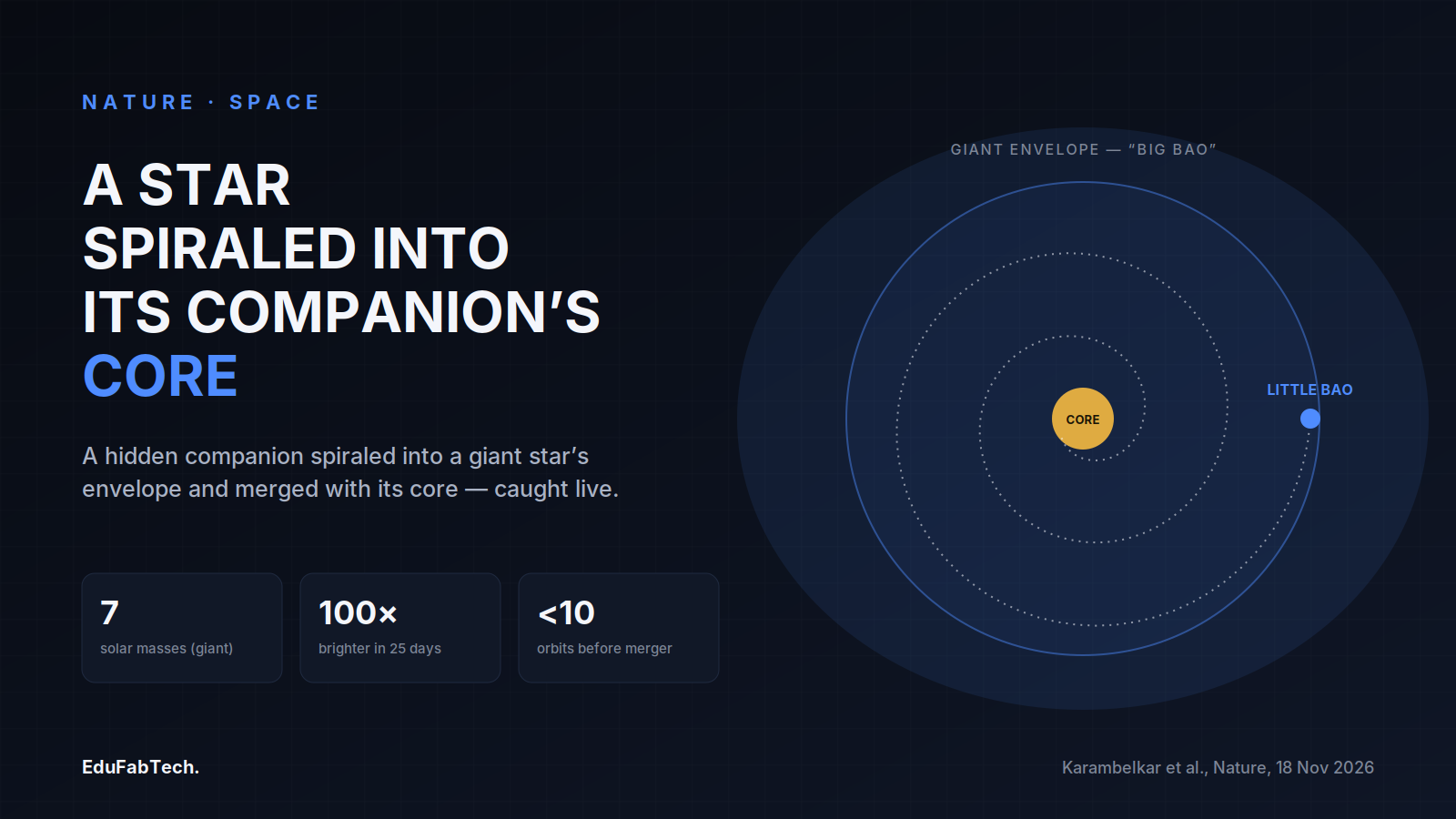
A team led by Viraj Karambelkar, a NASA Hubble Fellow at Columbia University, reported in Nature on 18 November 2026 that it had captured the first direct observations of a star spiraling inside the envelope of its giant companion and merging with its core. Co-author Kishalay De, now an assistant professor of astronomy at Columbia University, helped monitor the system. The transient, named AT 2025abao, sits in the Andromeda Galaxy, and the team had been watching it brighten for years before it finally erupted.
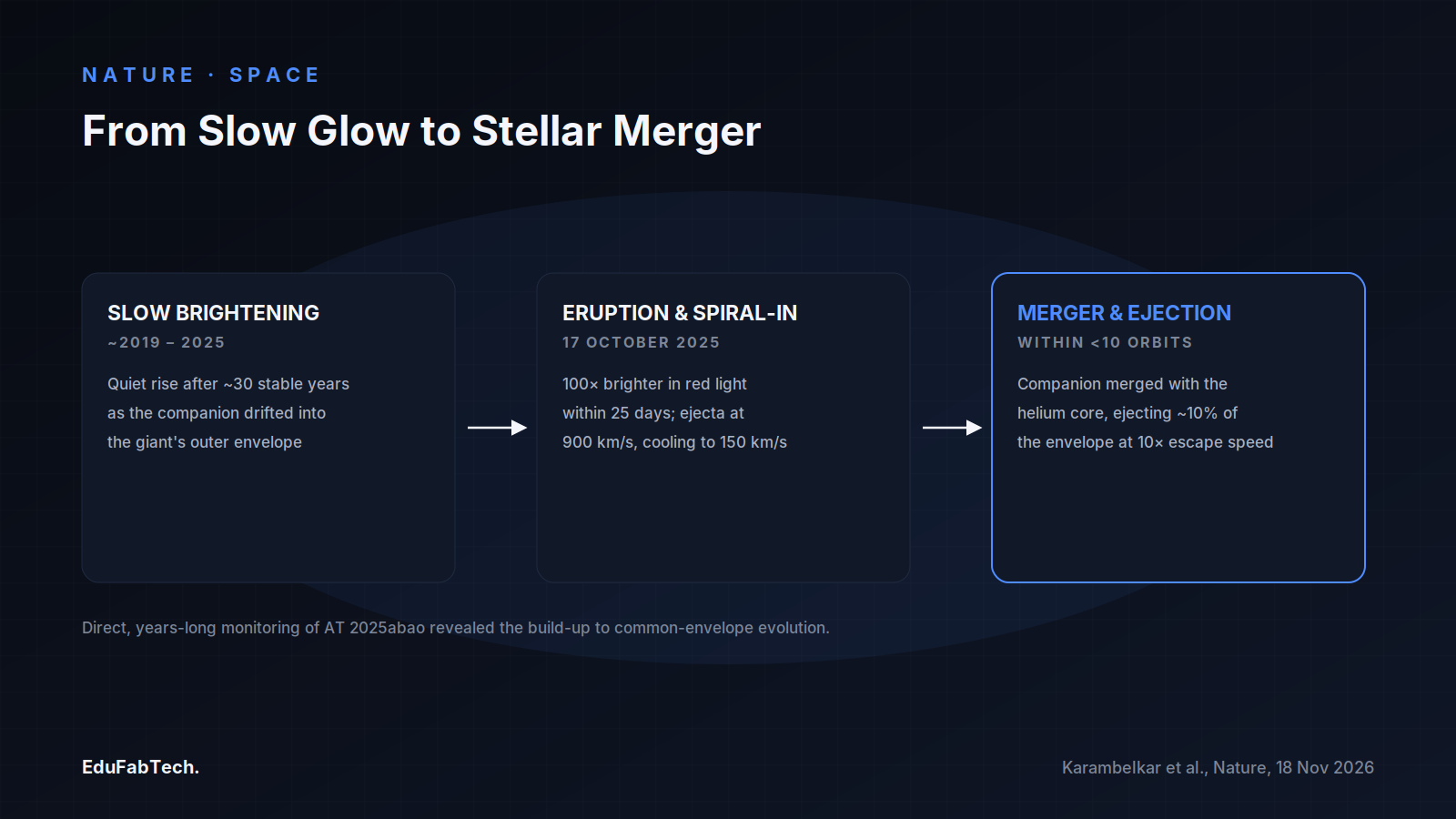
According to the Zwicky Transient Facility (ZTF) team at Caltech, the star began a slow brightening around 2019 after roughly three decades of apparent stability, and the researchers monitored it closely through 2023–2025 before it flared. That long run-up let the team catch, for the first time, the build-up to a process called common-envelope evolution — when two stars end up sharing a single loosely bound outer envelope and friction drags the smaller one inward.
The paper describes the system as a roughly 7-solar-mass asymptotic giant branch (AGB) star — nicknamed "Big Bao" by the team, according to the Caltech ZTF press release — paired with a companion of about 0.7 solar masses, or "Little Bao." The giant was about 18,000 times brighter than its companion, the press release states, which is why the smaller star stayed hidden until it began disrupting the giant's outer layers.
What the eruption looked like
The eruption itself began on 17 October 2025 and brightened roughly 100-fold in red light within 25 days, the authors report. Spectra showed gas moving at roughly 900 kilometers per second immediately after the outburst, slowing to around 150 kilometers per second as the ejected material expanded and cooled to a surface temperature of about 8,000 kelvin. The companion spiraled to the giant's helium core in fewer than ten orbits and merged with it, ejecting approximately 10% of the giant's envelope at speeds about ten times the primary star's escape velocity, according to the paper.
Observations combined ZTF and the WINTER infrared camera at Palomar Observatory with Palomar's Hale and P60 telescopes, the W. M. Keck Observatory, NASA's NEOWISE and SPHEREx missions, the James Webb Space Telescope, Gemini Observatory and NASA's Infrared Telescope Facility, per the Caltech ZTF press release.
Why the number matters for binary-star models
Astronomers have long relied on an efficiency parameter, written αCE, to estimate how much of a shrinking binary's orbital energy goes into blowing away the shared envelope — a number usually inferred indirectly from the populations of binaries that survive. The AT 2025abao data let the team constrain that parameter directly from observation for the first time, arriving at a range of roughly 0.01 to 0.4, the authors report. The paper notes that common-envelope evolution of this kind is a key step toward forming close white dwarf binaries, including the sort of compact systems that the planned Laser Interferometer Space Antenna (LISA) is designed to detect as gravitational-wave sources.
Kishalay De said in the Caltech ZTF press release: "What is unique about AT2025abao is that we have detailed observations for several years before the explosion, giving us an unprecedented glimpse of the conditions that lead to such cosmic events." Mansi Kasliwal, a professor of astronomy at Caltech and director of Palomar Observatory, said in the same release: "Combining our data with data from other global facilities helped us build a uniquely detailed picture of the AT2025abao system and confirm that a small star had crashed into the core of its larger companion."
Not everyone agrees on the companion's mass
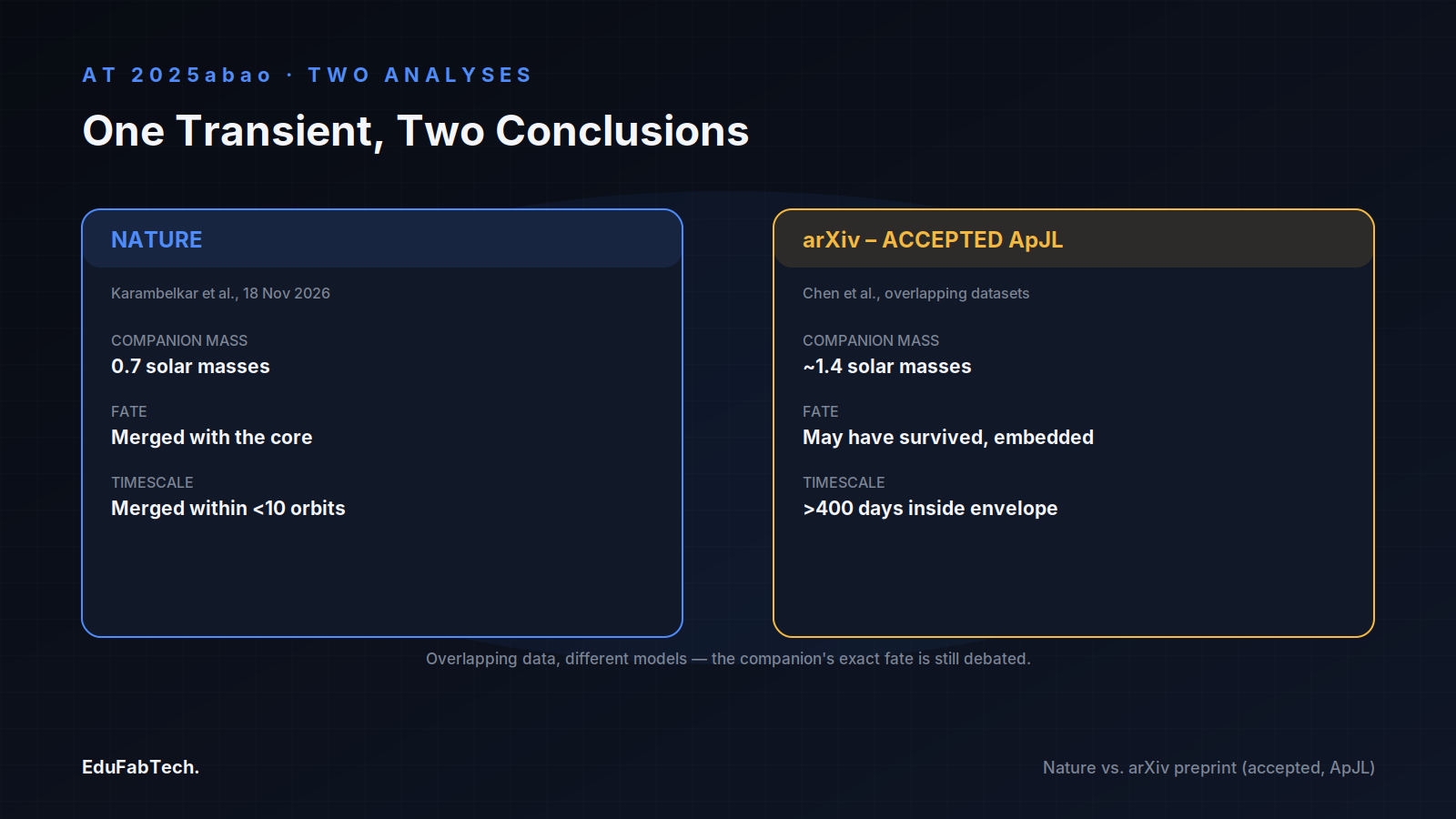
A separate analysis by Zhuo Chen and colleagues, posted to arXiv and accepted by The Astrophysical Journal Letters, argues for a heavier companion of around 1.4 solar masses and suggests it may have survived inside the envelope for more than 400 days rather than merging outright. The Karambelkar-led Nature paper and the Chen-led analysis draw on overlapping but not identical datasets, and the two groups have not reached the same conclusion on the companion's fate — a reminder that even a well-observed transient can support more than one model until further data settle the question.
What comes next
For researchers studying binary-star evolution, AT 2025abao offers a rare calibration point for models that otherwise rely on population statistics rather than a single, well-timed event. The authors note in the paper that upcoming wide-field surveys with the Vera C. Rubin Observatory and NASA's Nancy Grace Roman Space Telescope should routinely find comparable transients across roughly 100 Milky Way-like galaxies within about 15 megaparsecs, which would let astronomers test whether the efficiency range measured in this one merger holds across a broader population of giant stars and their companions.
A quick question for readers
Which study habit do you think is most overrated?
Some popular habits have little evidence behind them. Which one do you think gets too much credit?
Pick an answer, create a free account in a minute, and your vote counts. Already a member? Sign in
Comments 1
Comment-
The part that actually earns the headline is the αCE number: 0.01 to 0.4 measured directly off one event instead of inferred backward from w…
Join free to read the full comments and reply Comments are between members; an account takes a minute.
Source: Nature
Sources (3)
- Viraj Karambelkar, Kishalay De, Karel D. Temmink et al.. An inspiral of a star inside a common envelope with its giant companion. Nature, 2026. nature.com ↗ · checked 25 Nov 2026
- Zhuo Chen, Yingzhen Cui, Tianshu Wu et al.. Unravelling the Nature of AT 2025abao: From Precursor to Final Fate. The Astrophysical Journal Letters, 2026. arxiv.org ↗ · checked 25 Nov 2026
- Caltech / Zwicky Transient Facility. For the first time, astronomers witness a stellar crash from beginning to end. ZTF, Caltech, 2026. ztf.caltech.edu ↗ · checked 25 Nov 2026