Apache Fixes Critical HTTP/2 Flaw That an AI Scanner and Google Researchers Found Separately
Apache HTTP Server 2.4.71, released 11 November 2026, closes a race condition in mod_http2 that Red Hat rates 9.8 on CVSS 3.1 and says can be reliably exploited against default configurations.
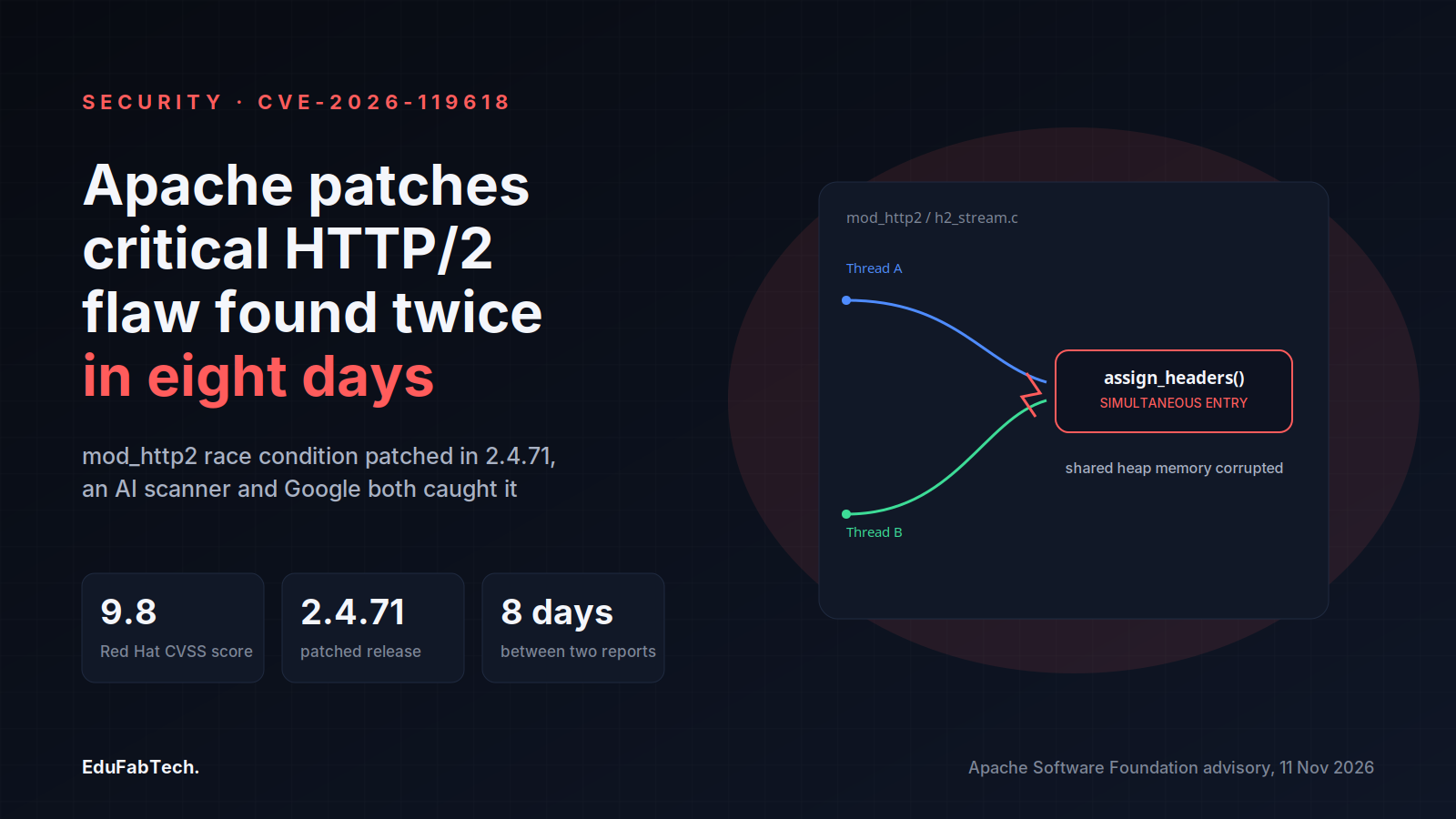
The Apache Software Foundation released Apache HTTP Server 2.4.71 on 11 November 2026, fixing a critical flaw in mod_http2, the module that handles HTTP/2 connections, that the project says can lead to remote code execution. The vulnerability, tracked as CVE-2026-119618, was reported to Apache's security team twice by two unconnected parties eight days apart, according to the Apache Software Foundation's advisory: first on 26 October 2026 by Anthropic's automated OSS Scanner, under the internal identifier ANT-2026-MAPKT6MZ, and again on 3 November 2026 by researchers Anthony Weems and Simon Scannell of Google Cloud Vulnerability Research.
Apache's advisory describes the bug as a "Concurrent Execution using Shared Resource with Improper Synchronization vulnerability in Apache HTTP Server's mod_http2 in assign_headers() [that] can lead to RCE." In practice, the function that assigns headers to an HTTP/2 stream can be entered by more than one worker thread at the same time when a server receives specially crafted, simultaneous requests, corrupting shared heap memory that the process later trusts.
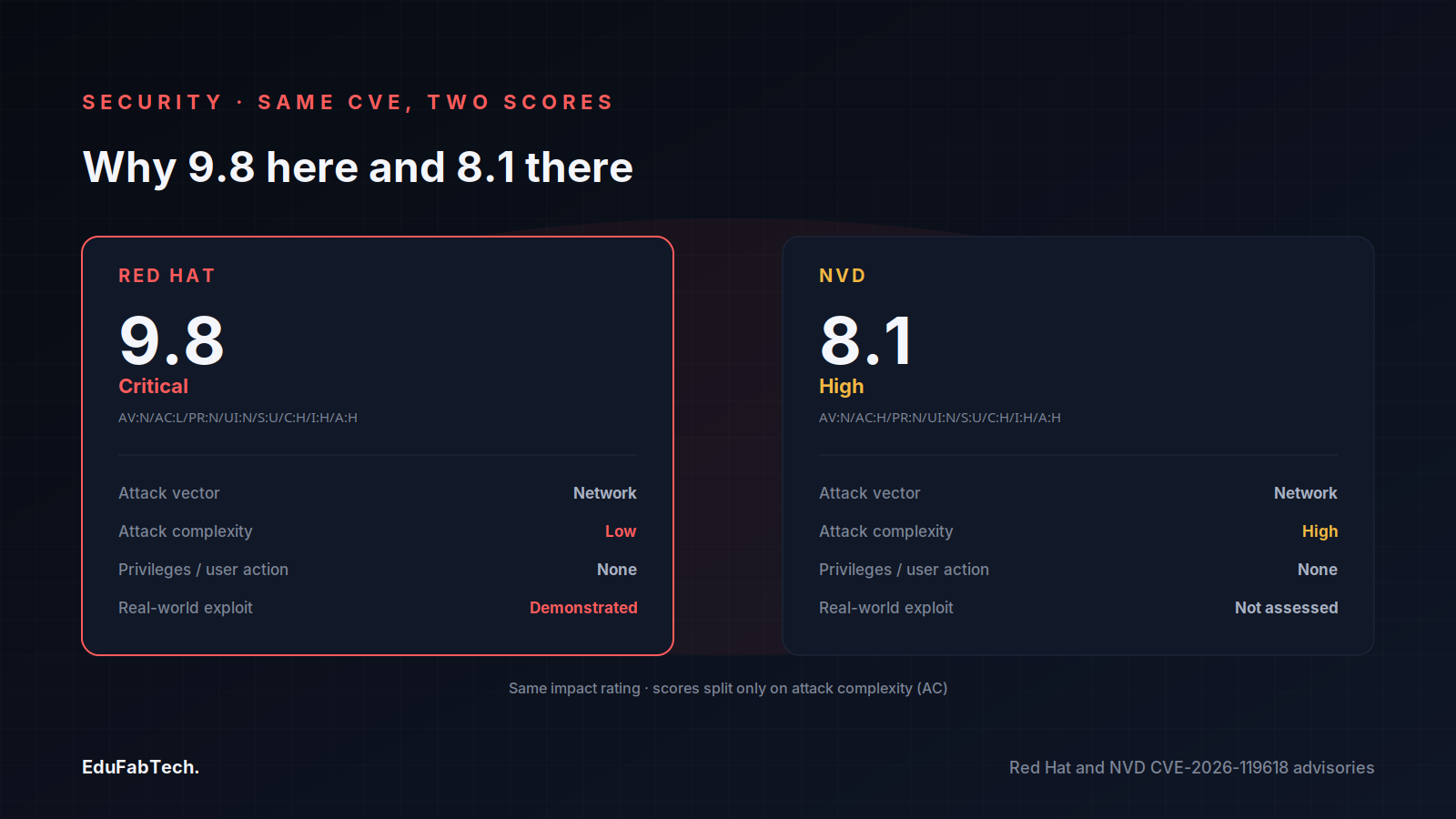
The flaw affects Apache HTTP Server versions 2.4.55 through 2.4.70, and standalone mod_h2 releases 2.0.8 through 2.0.42, as listed in the Apache advisory. Red Hat's own assessment, published on its CVE-2026-119618 page, gives it a CVSS 3.1 base score of 9.8 (AV:N/AC:L/PR:N/UI:N/S:U/C:H/I:H/A:H) — network-reachable, low complexity, no authentication or user interaction needed. NVD's own CVSS 3.1 score for the same CVE is lower, at 8.1 (AV:N/AC:H/PR:N/UI:N/S:U/C:H/I:H/A:H): the same impact rating, but attack complexity scored high rather than low, which keeps NVD's severity label at "high" rather than "critical."
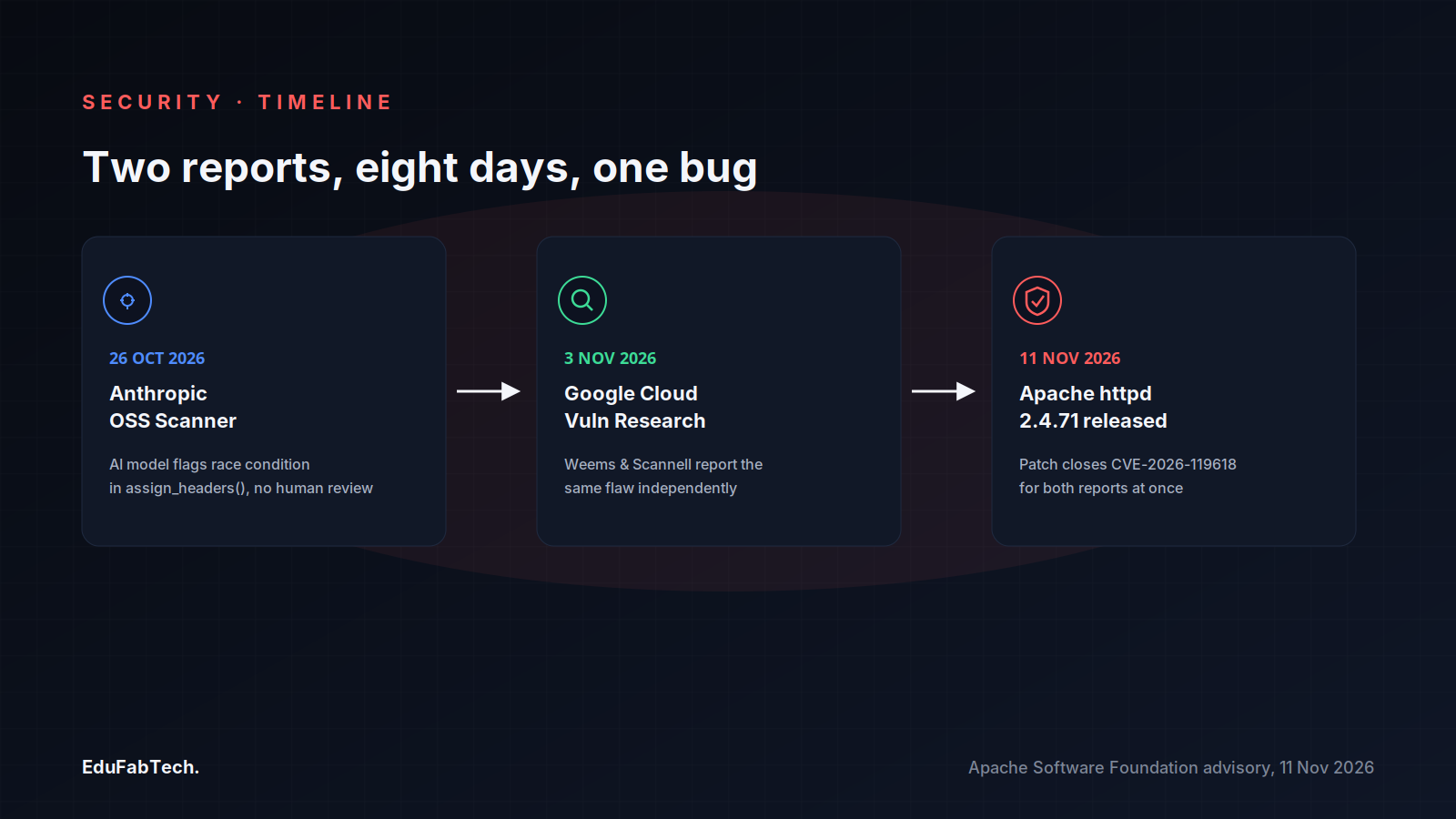
Two reports, eight days apart
The first report came from a machine. Anthropic launched OSS Scanner on 8 October 2026 as part of what it calls the Anthropic Cyber Mission, offering enrolled open-source projects free, periodic scans "from our most capable models," with each finding accompanied by a proof of concept, an explanation and, where possible, a suggested fix, according to Anthropic's announcement. The Apache Software Foundation is named among the organisations supporting the open-source infrastructure work behind the effort. Anthropic says the reports are model-generated and sent without human review, and that it aims for a true-positive rate above 90% for the programme as a whole.
The second report, filed on 3 November, came from a conventional source: two named human researchers at Google Cloud Vulnerability Research. That two independent efforts, one automated and one manual, converged on the same race condition in the same function within eight days is unusual enough that Apache's advisory records both reports and both sets of credits rather than treating the second as redundant.
Who is actually exposed
HTTP/2 support in Apache httpd is not switched on by default; it only applies to servers whose administrators have explicitly listed h2 or h2c in the Protocols directive. Servers answering only HTTP/1.1 requests are not affected by this flaw, Red Hat's advisory notes. For administrators who cannot patch immediately, removing h2 and h2c from the Protocols directive and restarting httpd is a documented workaround, though upgrading to 2.4.71 remains the fix Apache recommends.
Assessments of real-world exploitability differ. Red Hat's advisory states that public research has demonstrated a reliable exploit against a default-configured server with mod_http2 enabled, which is why it rates the issue critical on most of its own products (it rates the same flaw "Important" rather than "Critical" specifically for Red Hat Enterprise Linux 9 and 10, because those two distributions allocate each HTTP/2 stream separately, which raises the difficulty of exploitation). No security vendor has yet reported the flaw being used in attacks outside research settings.
Why it matters beyond one server
Apache HTTP Server remains one of the most widely deployed web servers behind research infrastructure, university services and open-source project sites, which is why a critical, unauthenticated RCE in one of its modules draws attention well beyond system administrators. For software engineering students and researchers, the bug is also a concrete case study in a notoriously hard class of defect: a race condition that only manifests under concurrent load, the kind of bug that unit tests rarely catch and that static analysis tools often miss.
The disclosure is also an early data point for how automated vulnerability-finding tools interact with human security research on the same codebase. Readers should note that the comparative claim here is about timing and discovery, not capability: Apache's own advisory simply records that both reports arrived independently, and neither Apache nor Red Hat has published an assessment of which report was more complete or how the two write-ups compared in technical depth.
A quick question for readers
How long can you study before checking your phone?
No judgement — just honest numbers. You might be surprised how you compare.
Pick an answer, create a free account in a minute, and your vote counts. Already a member? Sign in
Comments 3
Comment-
The part that reads like marketing dressed as news is the 90% true-positive claim. That is Anthropic's own target for the whole scanner prog…
-
The timing framing is the interesting part, but I'd push back on how it's being read. Eight days apart with the same bug in the same functio…
-
The bit I'd flag is the CVSS split, not the bug itself: Red Hat scores it 9.8 because public research showed a reliable exploit against a de…
Join free to read the full comments and reply Comments are between members; an account takes a minute.
Source: Apache Software Foundation
Sources (3)
- Apache Software Foundation. Apache HTTP Server 2.4 vulnerabilities. Apache Software Foundation, 2026. httpd.apache.org ↗ · checked 16 Nov 2026
- Red Hat Product Security. CVE-2026-119618. Red Hat, 2026. access.redhat.com ↗ · checked 16 Nov 2026
- Anthropic. Introducing the Anthropic Cyber Mission. Anthropic, 2026. anthropic.com ↗ · checked 16 Nov 2026