Apache Roller's Pre-Auth XML-RPC Flaw (CVSS 9.8) Is Under Active Exploitation
Apache confirmed on 17 November 2026 that CVE-2026-129448, an unauthenticated deserialization flaw reaching back to Roller 4.0.0, is being actively exploited; only 6.1.6 or later closes it.
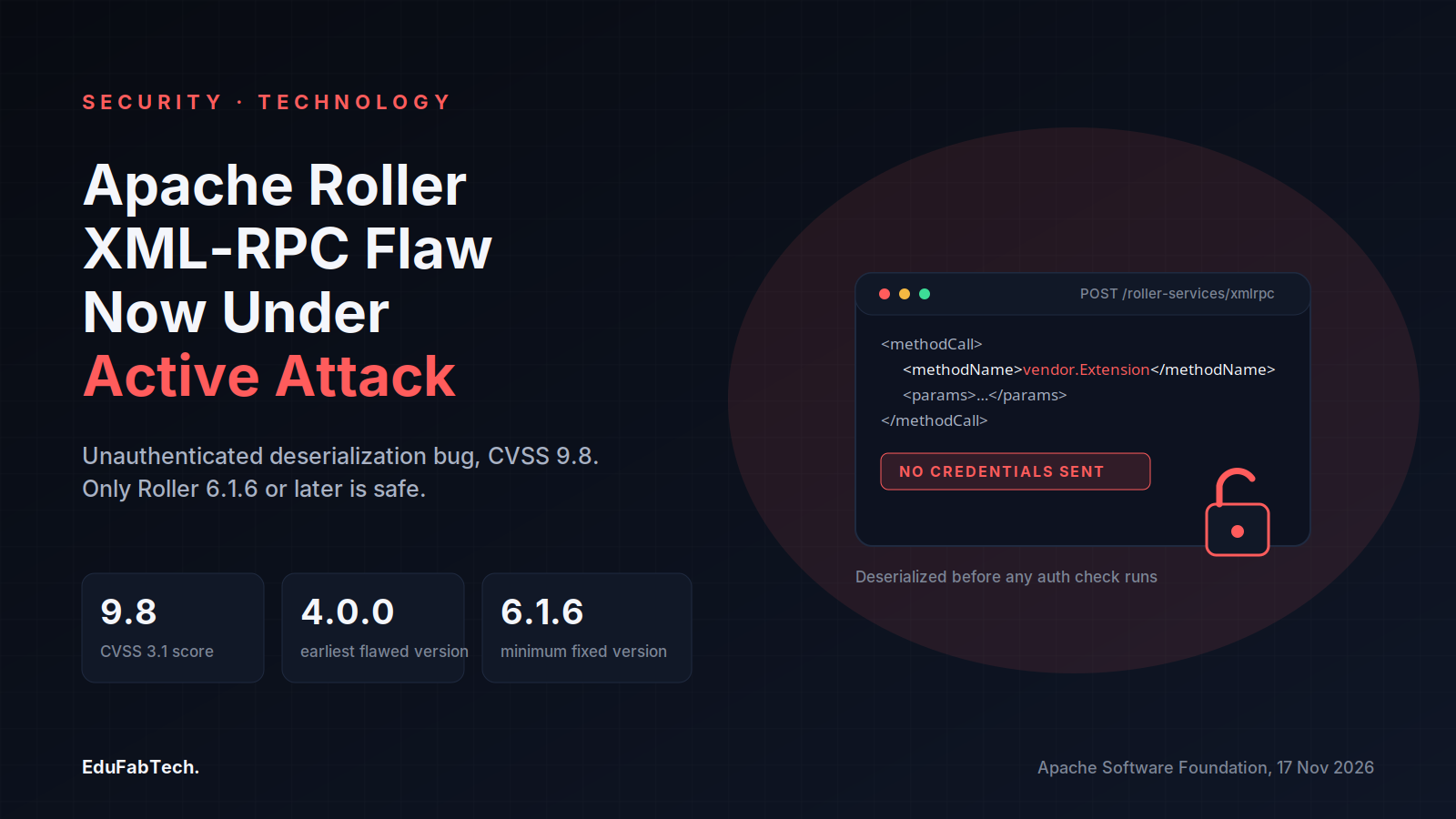
The Apache Software Foundation confirmed on 17 November 2026 that a critical flaw in Apache Roller, its open-source Java-based weblog server, is being actively exploited. The advisory, posted to the project's security mailing list, assigns the bug CVE-2026-129448 and states plainly: "This issue is being actively exploited."
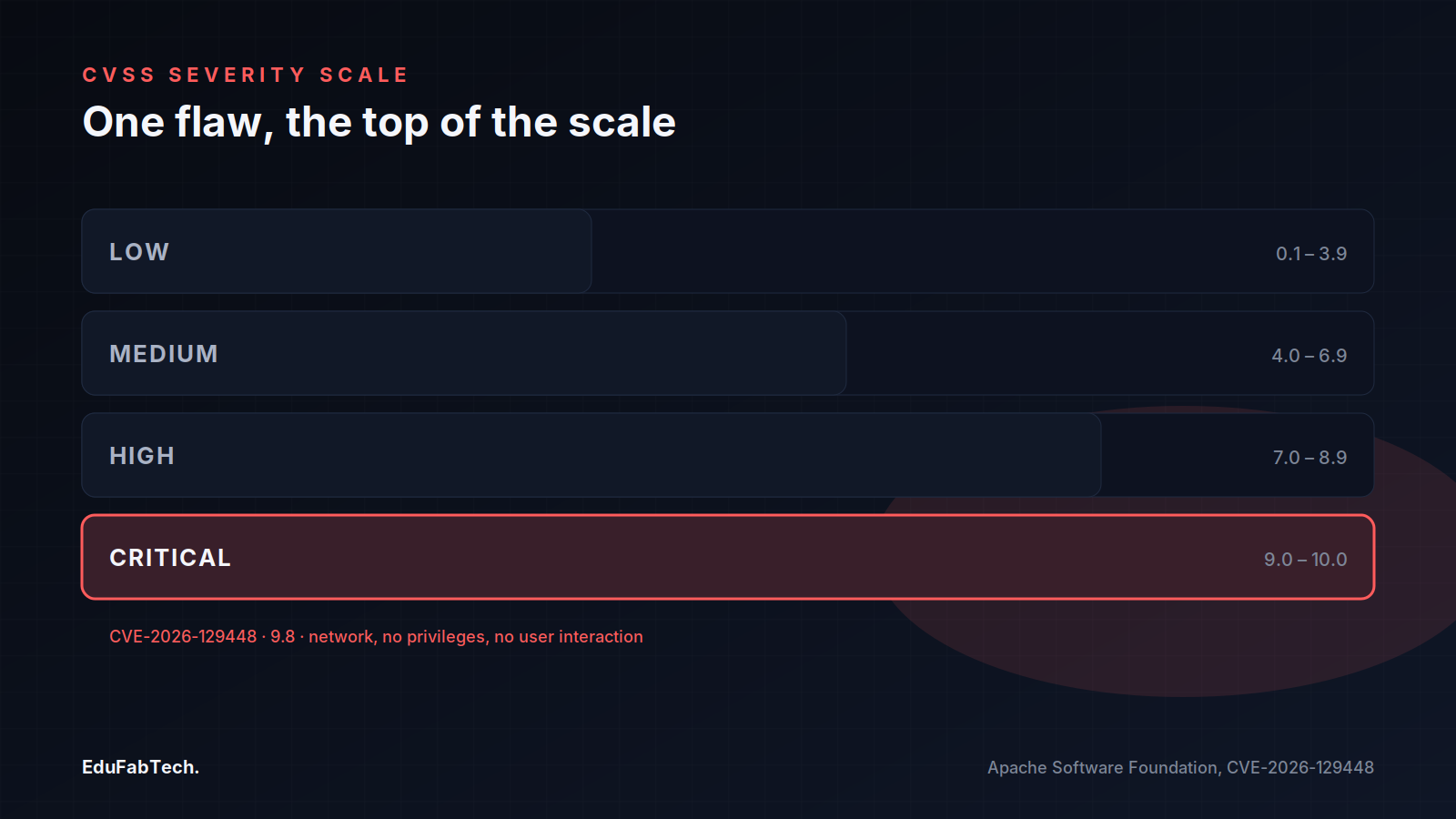
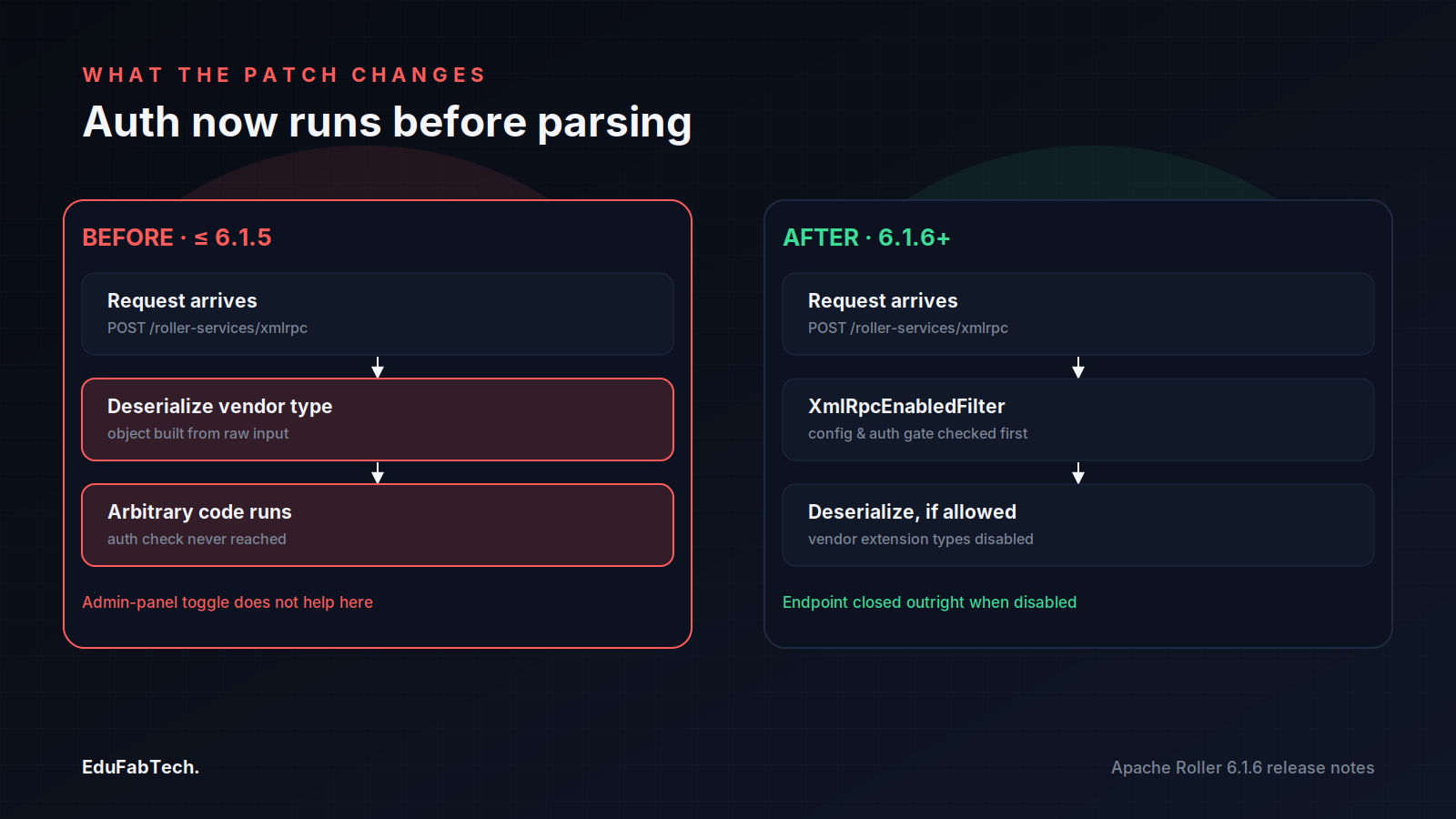
The flaw sits in Roller's XML-RPC endpoint, which accepts vendor extension types and deserializes them before checking whether the requester is authenticated at all. That ordering lets an attacker with no credentials send a crafted request and have the server execute arbitrary code during the deserialization step itself, before any login check runs. The CVE record rates it 9.8 on the CVSS 3.1 scale, with a vector showing network access, low attack complexity, no privileges and no user interaction required, and full loss of confidentiality, integrity and availability.
Apache's advisory describes CVE-2026-129448 as the same underlying vulnerability as CVE-2026-82384, which the project disclosed on 24 September 2026 and fixed in Roller 6.1.6 — but that earlier advisory listed only version 6.1.5 as affected. The November advisory widens the affected range back to version 4.0.0, meaning installations running any Roller release issued between 4.0.0 and 6.1.4 were vulnerable, not just the single release the September notice named.
What changed in the fix
Roller 6.1.6 and later close the hole by disabling the vendor extension types entirely, since Roller's own XML-RPC implementation never needed them, and by gating the XML-RPC servlet behind the existing webservices.enableXmlRpc configuration flag at the request level. The pull request that implemented the fix adds a dedicated filter, XmlRpcEnabledFilter, so the endpoint is closed outright when the feature is turned off, rather than relying on a check inside each handler that malicious input could reach before it ran.
That distinction matters for anyone trying to shield an unpatched instance in the meantime. Apache's guidance is explicit that turning off XML-RPC through Roller's own administration interface does not stop the attack on releases before 6.1.5, because those versions deserialize the incoming request before they ever consult that setting. Administrators who cannot upgrade immediately are instead told to set enabledForExtensions to false directly in WEB-INF/web.xml, or to remove the /roller-services/xmlrpc servlet mapping from that file and restart the server.
Roller 6.1.7, released on 11 November 2026, layers in a separate fix, CVE-2026-105153, for an XML external entity processing flaw in how the software parses incoming AtomPub entries — rated "Important" rather than critical. Apache's security page lists 6.1.7 as the current recommended release, with 6.1.6 as the minimum version that closes the XML-RPC deserialization path.
Reporting on the advisory by BleepingComputer notes that Apache's advisory gave no specifics on who is exploiting the flaw or which installations have been hit.
Why it matters beyond one blogging tool
Apache Roller is a multi-user weblog platform rather than a mass-market product, so its install base is smaller than something like a mail server or a web framework. But it is exactly the kind of software that ends up running, half-forgotten, on a department server at a university, a research lab or a student organization that set it up years ago and never revisited the version number — the same pattern that made the September advisory's narrow version range misleading about the real exposure.
The case is also a concrete lesson for anyone building or maintaining a deserialization-handling endpoint: an authentication check placed after the point where untrusted data is already being parsed and reconstructed into objects offers no protection at all, no matter how solid the login logic itself is. For engineers who manage Roller instances, the actionable step is unambiguous — upgrade to 6.1.6 or later, with 6.1.7 as Apache's current recommendation, rather than relying on disabling XML-RPC through the admin panel on any release before 6.1.5.
A quick question for readers
Which skill will matter most for getting a job in 2030?
Everyone has a prediction. Add yours and see what students are betting on.
Pick an answer, create a free account in a minute, and your vote counts. Already a member? Sign in
Comments 3
Comment-
The detail that matters most here isn't the 9.8 score, it's that the September advisory only named 6.1.5 and the real exposure goes back to…
-
The part that actually tells you how bad this was is the version-range correction, not the CVSS score. September's advisory said 6.1.5 only;…
-
The bit that stands out is how the September advisory undersold its own severity - narrowing the fix to 6.1.5 made it look like a one-releas…
Join free to read the full comments and reply Comments are between members; an account takes a minute.
Source: Apache Software Foundation
Sources (3)
- Apache Software Foundation. CVE-2026-129448: Apache Roller: Unauthenticated deserialization in the XML-RPC endpoint (releases before 6.1.5). ASF Mailing List Archives, 2026. lists.apache.org ↗ · checked 20 Nov 2026
- Sergiu Gatlan. Apache warns of Roller RCE vulnerability exploited in attacks. BleepingComputer, 2026. bleepingcomputer.com ↗ · checked 20 Nov 2026
- Apache Software Foundation. Apache Roller Security Advisories. roller.apache.org, 2026. roller.apache.org ↗ · checked 20 Nov 2026