Australia's Student Visa Grants to South Asia and Africa Collapse in September 2026, Home Affairs Data Show
Visa data for September 2026, reported by Times Higher Education, show approvals to Nepal, Bangladesh and Bhutan down more than 90% from a year earlier and China's grant rate above 90%, weeks before a new rule restricting onshore applications took effect on 2 October 2026.
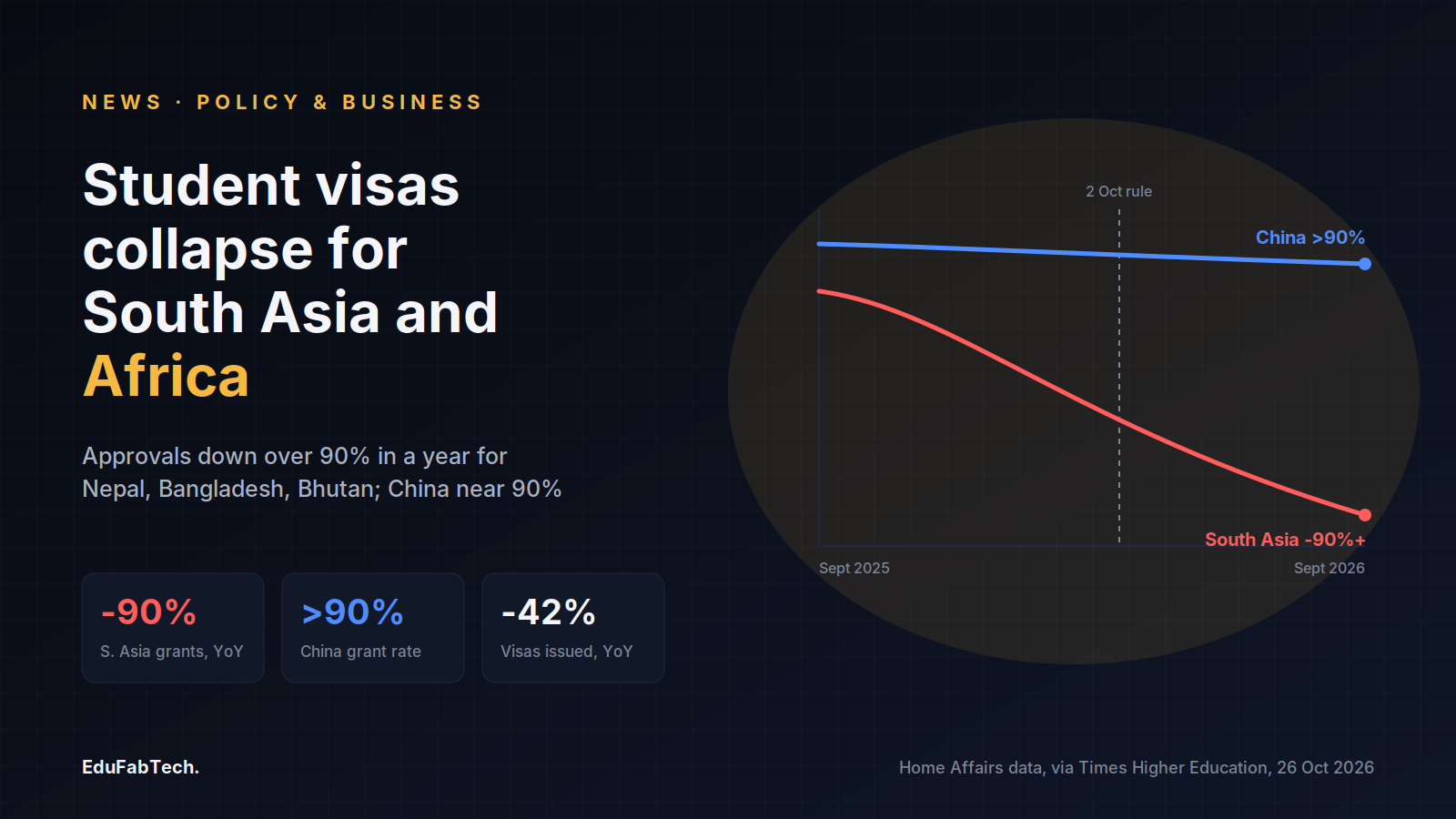
Student visa approvals issued by Australia's Department of Home Affairs to applicants from South Asia and parts of Africa fell to a small fraction of their year-earlier levels in September 2026, according to government figures reported by Times Higher Education on 26 October 2026. Grants to China held close to their previous levels over the same period, widening a gap between source countries that has grown through the year.
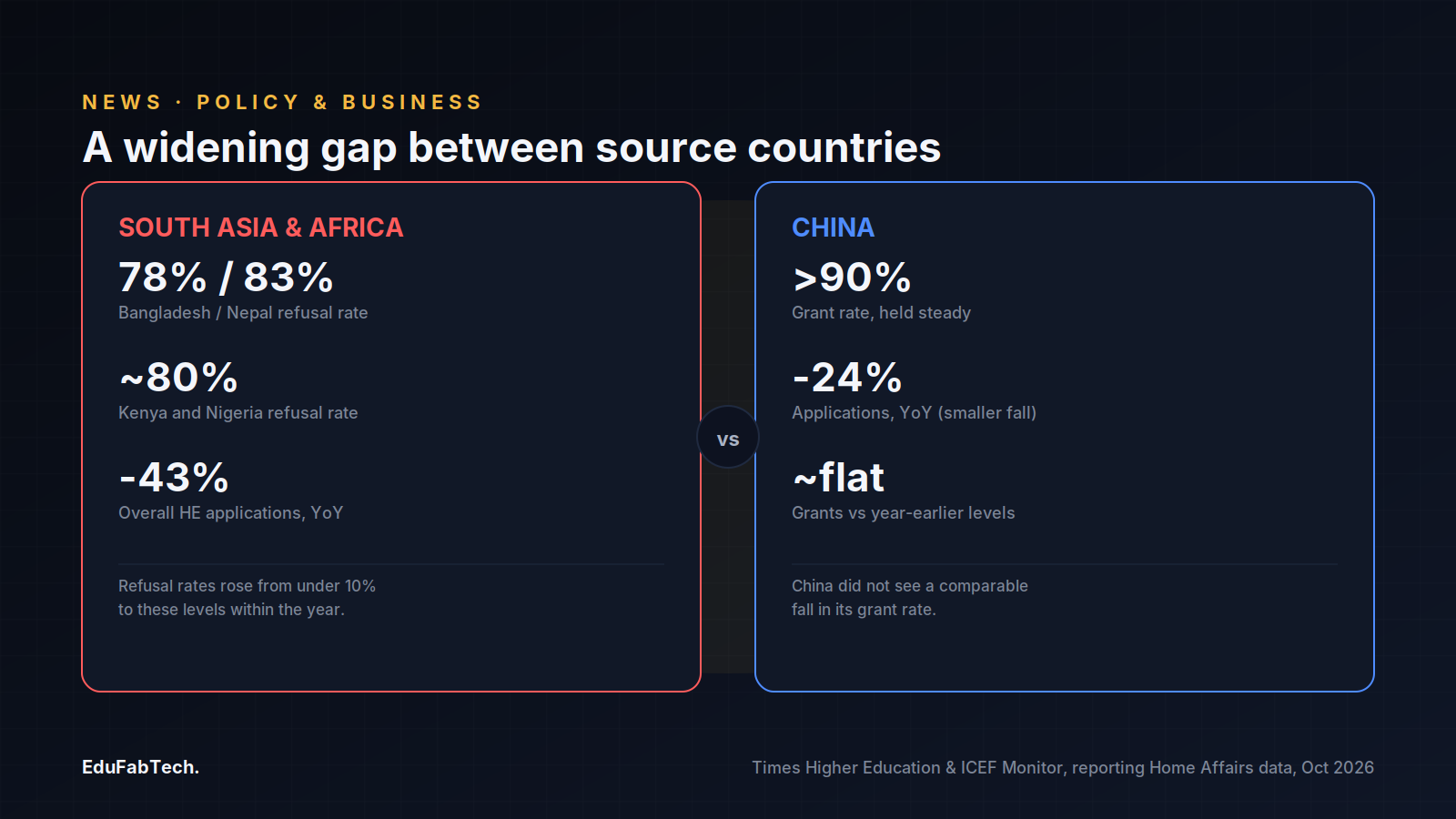
Times Higher Education reports that overall higher education visa applications in September 2026 were 43% lower than in September 2025, and visa issuances were down 42% over the same comparison. Applications from China fell 24% year on year, a far smaller drop than from several other markets, and the Chinese grant rate stayed above 90%.
The country-level falls were steeper. India received 190 visa grants in September 2026, down from 1,422 in September 2025; Nepal received 87, down from 1,074; Bangladesh received 14, down from 730; and Bhutan received 9, down from 82, Times Higher Education reports, citing Department of Home Affairs data.
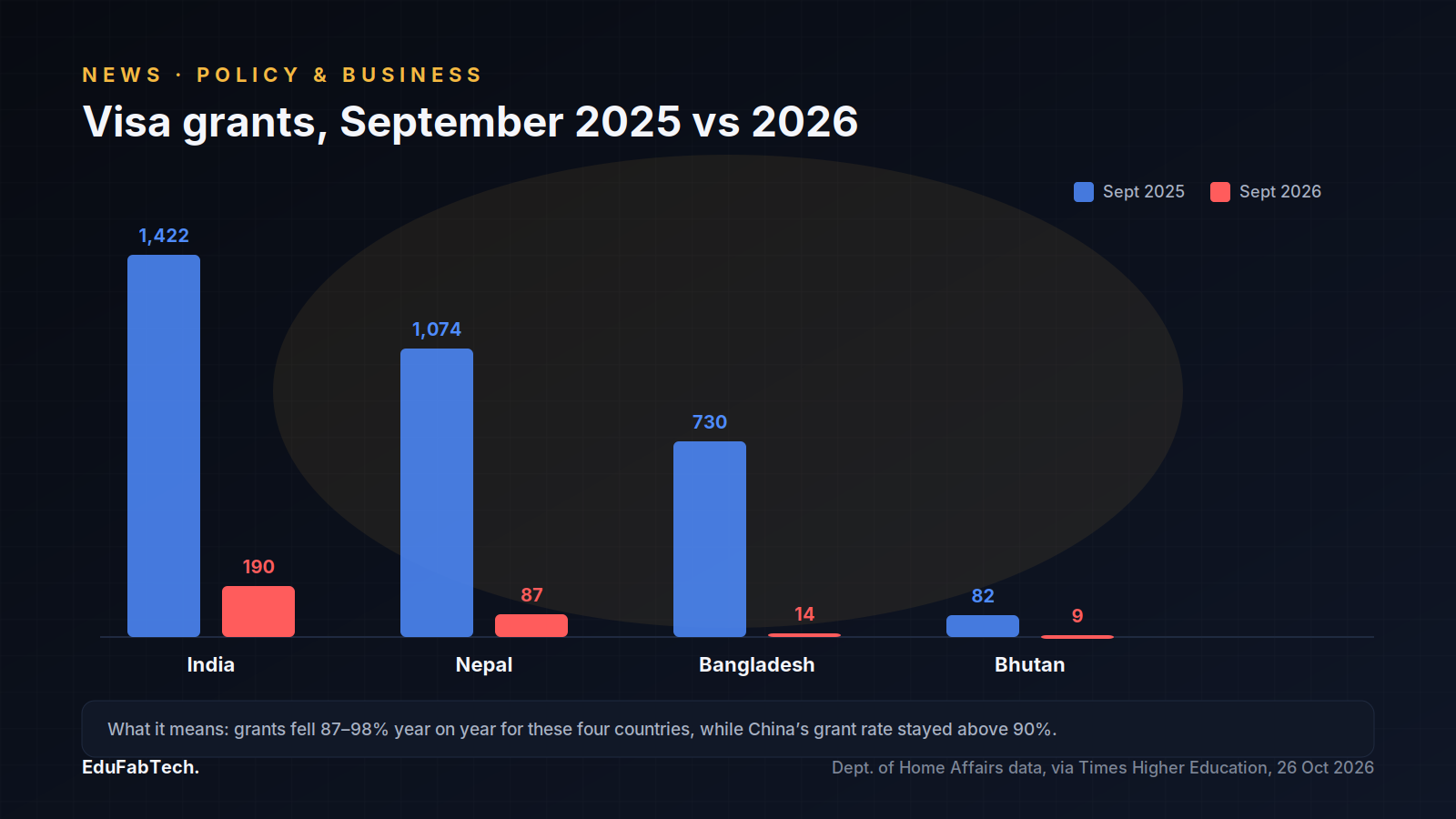
| Country | Visas granted, Sept 2026 | Visas granted, Sept 2025 |
|---|---|---|
| India | 190 | 1,422 |
| Nepal | 87 | 1,074 |
| Bangladesh | 14 | 730 |
| Bhutan | 9 | 82 |
Refusal rates rose fastest outside China
Refusal rates for several markets rose from under 10% to much higher levels within the year, Times Higher Education reports: Bangladesh's rose to 78%, Nepal's to 83%, and Kenya's and Nigeria's to roughly 80%. Phil Honeywood, chief executive of the International Education Association of Australia, is quoted in the same report calling the current settings "the most restrictive I've ever seen in more than 20 years," and saying genuine students are "voting with their feet" and applying to at least another ten countries that have kept a more welcoming visa regime than Australia's.
What changed on 2 October 2026
The September figures predate a further tightening: a rule that the Department of Home Affairs says took effect on 2 October 2026, according to Envoy Global's summary of the announcement. Under the new rules, most temporary visa holders in Australia must now be outside the country both when they lodge a Student visa (subclass 500) or Student Guardian visa (subclass 590) application and when it is granted, rather than applying onshore. Exemptions allow existing student visa holders to apply onshore if they need up to twelve months to finish a course with the same provider, are sponsored by the Department of Foreign Affairs and Trade or Defence, are enrolled in a PhD, are applying for primary or secondary schooling, or are progressing to a higher-level qualification.
Separately, under a restriction the government announced on 17 September 2026, ICEF Monitor reports that new Student visa applicants can generally no longer include a partner or dependent children, with exemptions limited to PhD students, students from Pacific or ASEAN countries, and students on overseas government scholarships. Australia's immigration minister, Tony Burke, is quoted by ICEF Monitor saying of current dependant visa holders, "the ones who are already here, that'll stay as is" ... "but we will no longer be adding to the stock of students automatically being able to bring family members over."
ICEF Monitor also reports that Australia granted about 46,000 dependant visas alongside 337,400 student visas between July 2025 and June 2026, and that South Asian countries accounted for more than 70% of dependant visas granted offshore in that period, including 10,448 from Nepal, Bangladesh, Bhutan, India and Sri Lanka combined.
What it means for students and institutions
For prospective applicants from South Asia and East Africa, the September 2026 figures reported by Times Higher Education suggest that an offer letter from an Australian institution is now far less likely to translate into a visa than it was a year earlier, even before accounting for the separate restriction, announced in September 2026, on bringing a partner or children. Students weighing a multi-year programme away from home, and the universities that recruit them, are working with approval odds that have shifted markedly within a single year rather than gradually.
For institutions that built enrolment plans and budgets around South Asian and African cohorts, the figures point to a revenue and planning risk concentrated by country of origin rather than spread evenly across international enrolments, since the Chinese market has not seen a comparable fall in its grant rate.
A quick question for readers
Rate these parts of student life this term
Rate each one from 1 (very poor) to 5 (very good). Together the results show where students struggle most.
Rate 5 things →Comments 3
Comment-
The number that should worry institutions isn't the country totals, it's the refusal rate swing: Bangladesh and Nigeria/Kenya going from und…
-
What's odd is how precise the hard numbers are next to how fuzzy the commentary is. India at 190 versus 1,422, Bhutan at 9 versus 82, refusa…
-
The number that jumps out is the gap between 'applications down 43%' and 'issuances down 42%' overall, because it means the drop isn't reall…
Join free to read the full comments and reply Comments are between members; an account takes a minute.
Source: Times Higher Education
Sources (3)
- John Ross. South Asian students go elsewhere as visa grants slow to trickle. Times Higher Education, 2026. timeshighereducation.com ↗ · checked 27 Oct 2026
- ICEF Monitor. Australia moves to reduce net migration with new restrictions on student family members and "visa hopping". ICEF Monitor, 2026. monitor.icef.com ↗ · checked 27 Oct 2026
- Envoy Global. Australia Tightens Student Visa Application Rules for Onshore Applicants. Envoy Global, 2026. envoyglobal.com ↗ · checked 27 Oct 2026