BepiColombo Enters Mercury Orbit on 21 November 2026 After an Eight-Year Cruise
The joint ESA-JAXA mission fired its thrusters in a single autonomous burn, the first of 16 maneuvers that run to April 2027 before science observations start.
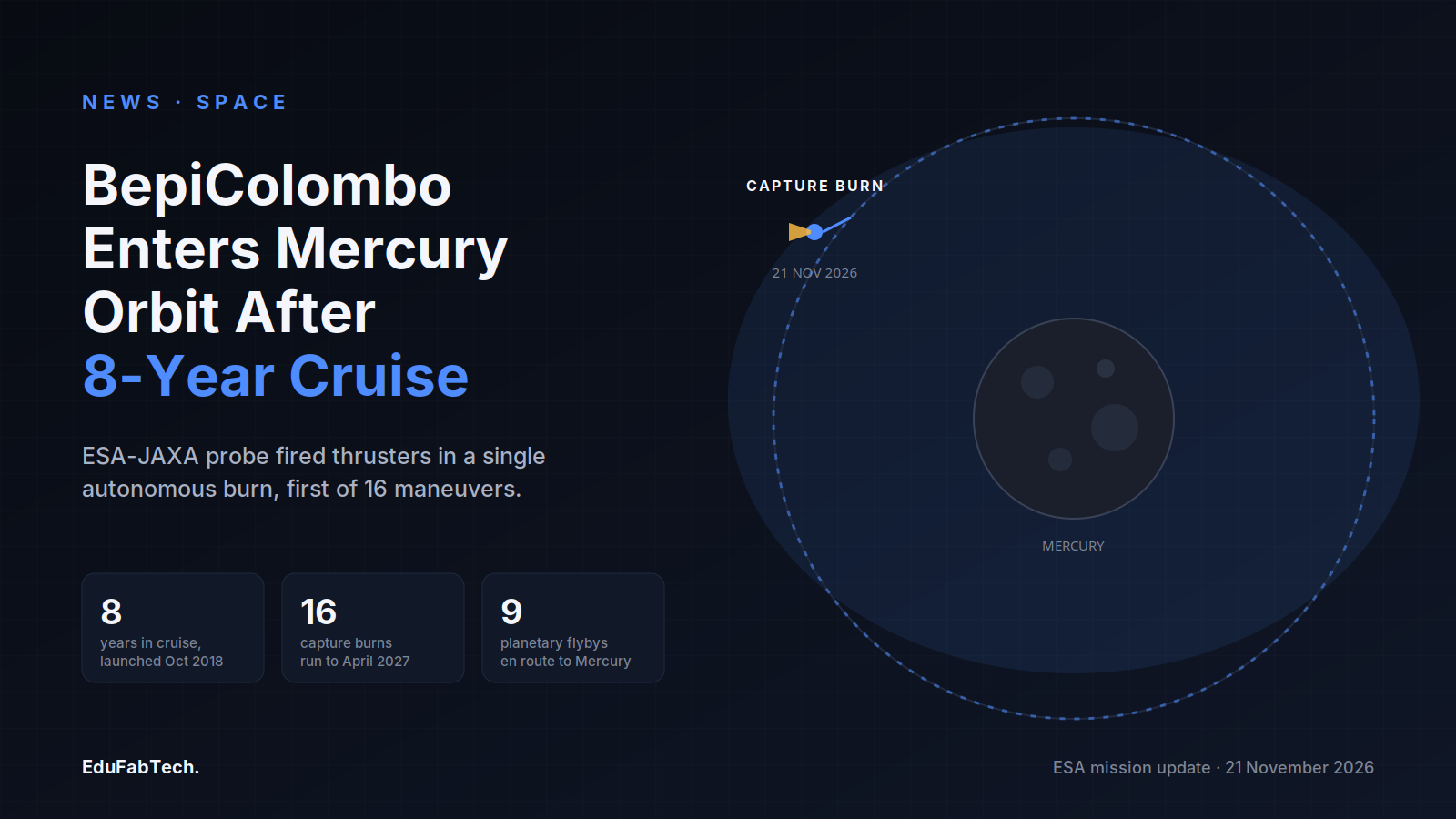
The European Space Agency and the Japan Aerospace Exploration Agency's joint BepiColombo mission fired its thrusters on 21 November 2026 to begin capture into orbit around Mercury, according to ESA's mission update page. The maneuver followed an eight-year cruise that started with launch on 20 October 2018 and included nine planetary flybys along the way — one of Earth, two of Venus and six of Mercury itself — according to ESA's BepiColombo fact sheet.
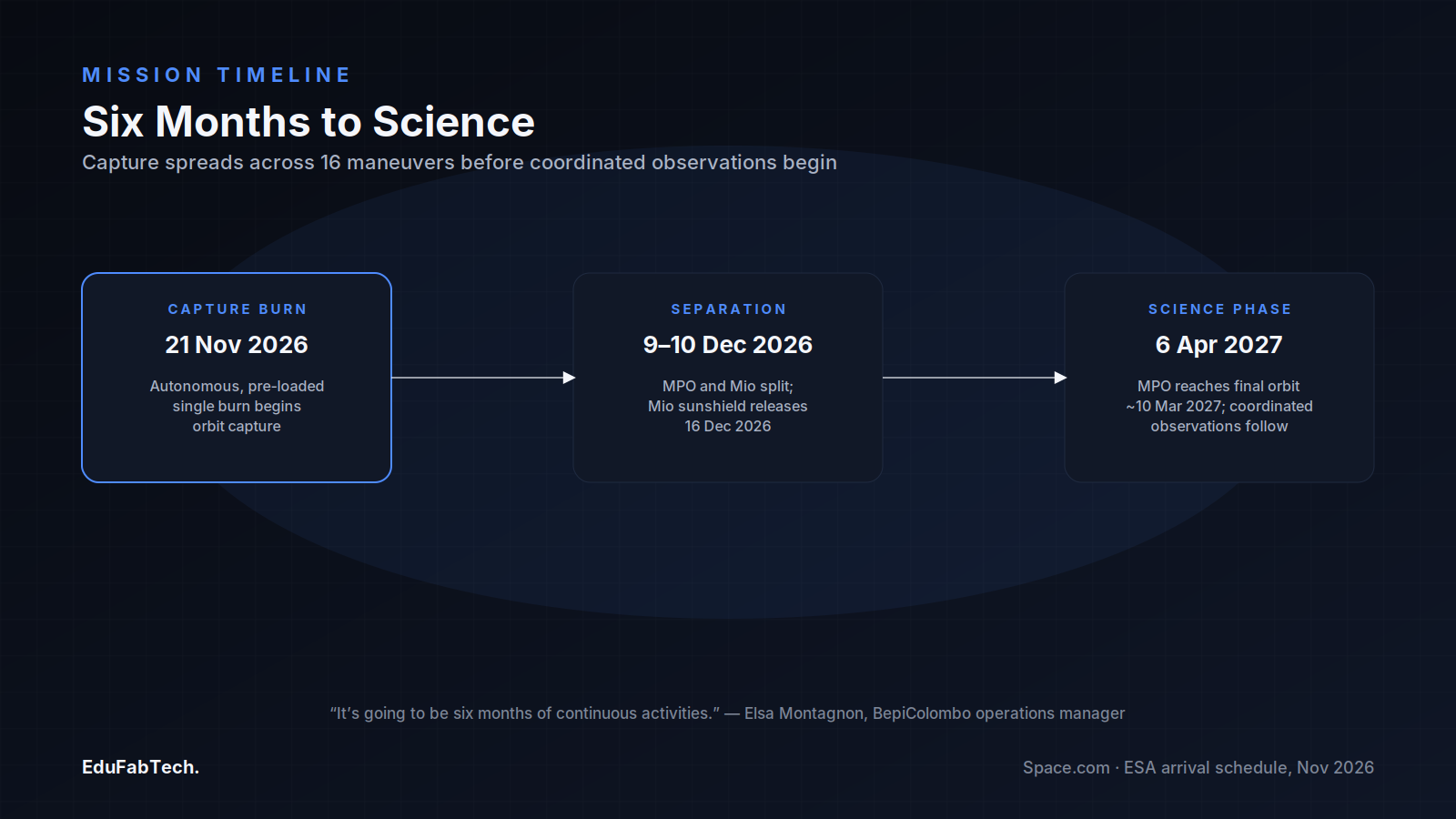
The 21 November burn is not a single pass-or-fail event. ESA describes BepiColombo's capture method as a "weak stability boundary" technique that is "more robust against failures when compared to using the more traditional 'big kick', or single-burn capture, approach," according to the agency's mission summary. BepiColombo's operations manager, Elsa Montagnon, told Space.com that the capture spreads across 16 maneuvers over roughly six months: "In our case, it's going to be six months of continuous activities." Because of Mercury's distance from Earth, the 21 November burn itself ran from a pre-loaded, autonomous sequence rather than real-time ground control. ESA's own schedule, published on its arrival-updates page, lists the next milestones as separation of the two orbiters on 9-10 December 2026, release of the Mercury Magnetospheric Orbiter's sunshield on 16 December 2026, and the start of the science phase in April 2027.
Why the mission arrived nearly a year late
BepiColombo was originally due to enter Mercury orbit in December 2025. The schedule slipped by 11 months after engineers found, in April 2024, unexpected electric currents between solar arrays on the Mercury Transfer Module and its power-conditioning and distribution unit, SpaceNews reported. The fault cut the thrust available from the transfer module's ion engines to about 90% of their original capacity — not enough to reach Mercury on the original timeline. ESA mission manager Santa Martinez said at the time that "following months of investigations, we have concluded that MTM's electric thrusters will remain operating below the minimum thrust required for an insertion into orbit around Mercury in December 2025," according to SpaceNews. Rather than attempt a repair, ESA's flight dynamics team redesigned the final approach trajectory, and the transfer module was jettisoned from the two science orbiters on 3 September 2026, ESA's mission update page states.
Two orbiters, one planet
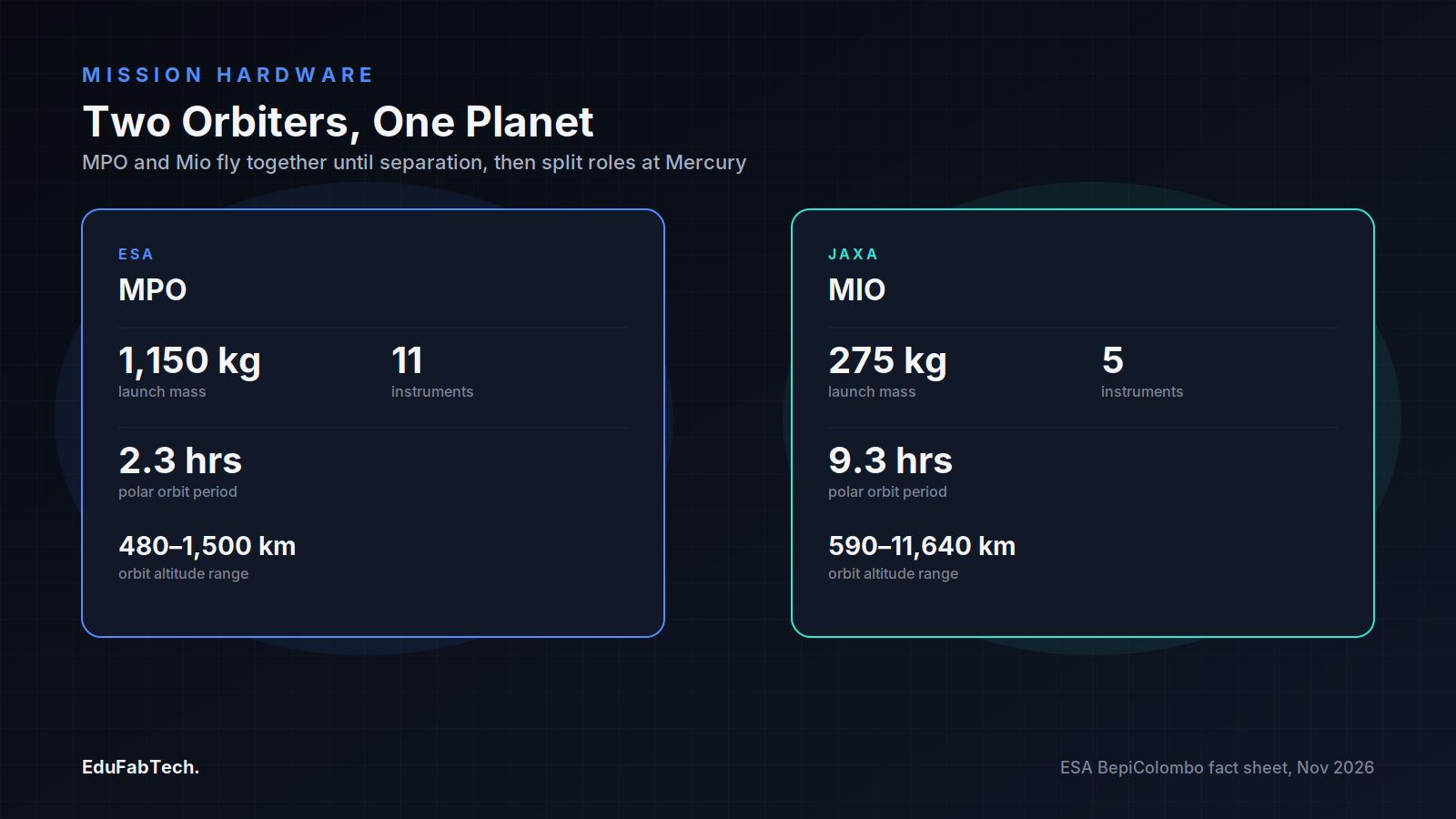
BepiColombo is built around two spacecraft flying together until next month: ESA's Mercury Planetary Orbiter (MPO) and JAXA's Mercury Magnetospheric Orbiter (Mio), according to ESA's mission fact sheet. At launch the combined stack massed 4,100 kg; the MPO alone weighs 1,150 kg and Mio weighs 275 kg. The fact sheet lists 11 instruments on MPO, including cameras, infrared, ultraviolet, X-ray, gamma-ray and neutron spectrometers, a laser altimeter, a magnetometer and particle analysers, while Mio carries five instruments built around a magnetometer, ion and electron analysers, plasma detectors and a wave analyser. Once separated, MPO is set to settle into a polar orbit with a 2.3-hour period and an altitude ranging from 480 to 1,500 km, while Mio will fly a wider polar orbit with a 9.3-hour period ranging from 590 to 11,640 km, per the same fact sheet.
What the mission is trying to answer
ESA's science-objectives page for BepiColombo frames the mission around a set of open questions about the solar system's innermost planet. Among them: "Why does such a small planet possess an intrinsic magnetic field, while Venus, Mars and the Moon do not have any?" and "Is the core of Mercury liquid or solid?" The page also asks what drives the production of Mercury's exosphere — a vestigial, constantly replenished atmosphere far thinner than Earth's — and whether permanently shadowed craters near Mercury's poles hold sulphur or water ice.
What comes next
BepiColombo is only the second mission to orbit Mercury, after NASA's MESSENGER spacecraft, which orbited the planet from 2011 to 2015. Flying two orbiters at once is intended to let MPO's surface and interior measurements be read alongside Mio's simultaneous measurements of the magnetosphere and particle environment around the planet, rather than relying on a single spacecraft's instruments at different times. For students and researchers following planetary and space physics, the relevant date now is less 21 November than the months that follow: ESA's own schedule lists orbiter separation in December 2026 and the start of the science phase in April 2027, while Space.com — citing the mission's operations team — reports MPO is expected to reach its final mapping orbit around 10 March 2027, with coordinated science observations beginning around 6 April 2027.
A quick question for readers
Which study habit do you think is most overrated?
Some popular habits have little evidence behind them. Which one do you think gets too much credit?
Pick an answer, create a free account in a minute, and your vote counts. Already a member? Sign in
Comments 3
Comment-
The part that jumps out is the thrust fix: not a repair but a redesigned trajectory, and ESA still only clawed back from 90% capacity to an…
-
The part that actually earns a comment is the thruster fault, not the arrival. A 10% thrust loss from unexpected electric currents between t…
-
The number that actually matters here isn't the 21 November date, it's the 90%. A ~10% thrust shortfall on the ion engines was enough to blo…
Join free to read the full comments and reply Comments are between members; an account takes a minute.
Source: European Space Agency
Sources (3)
- European Space Agency. Latest updates: BepiColombo's arrival at Mercury. ESA, 2026. esa.int ↗ · checked 21 Nov 2026
- European Space Agency. Fact Sheet - BepiColombo. ESA Science & Technology, 2026. sci.esa.int ↗ · checked 21 Nov 2026
- Jeff Foust. ESA delays BepiColombo orbital insertion because of thruster problem. SpaceNews, 2024. spacenews.com ↗ · checked 21 Nov 2026