Unpatched Cacti Zero-Day Lets Guest Accounts Run Code in Four HTTP Requests
Researcher ek0ms savi0r published a public proof of concept on 26 November 2026 showing unauthenticated command execution on Cacti Core 1.2.31 when guest access is enabled; Cacti has not issued a patch.
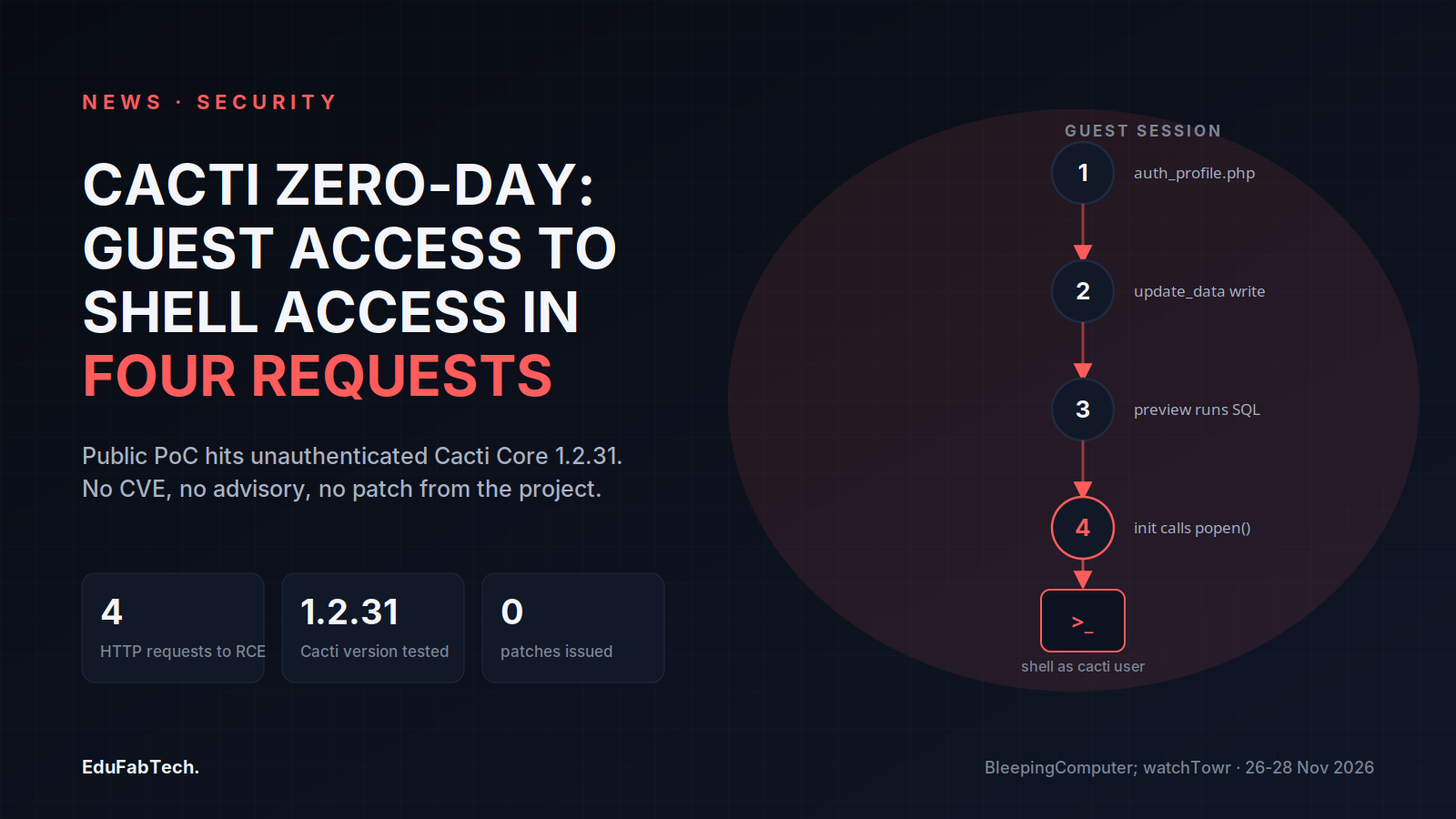
A security researcher using the alias ek0ms savi0r, who credits the disclosure to a group calling itself Church of Malware, published a working exploit chain on 26 November 2026 for Cacti, the open-source network monitoring tool, showing how an attacker with no account and no credentials can run operating-system commands on a Cacti server in four HTTP requests. The chain, published in a GitHub repository called Sad Girls 0day Club and tracked informally as 4HTTP2SHELL (also called 4HTTP2ROOT), was tested against Cacti Core 1.2.31, the version current at the time of disclosure. As of 28 November 2026, the Cacti project had issued no security advisory, no CVE identifier and no patched release for the issue.
What the exploit does
Cacti is used by network administrators to poll devices such as routers and switches and store the resulting performance data, often alongside device credentials and connection details. The flaw requires that the server's guest account be enabled — an optional setting that lets people view graphs without logging in.
According to the researcher's writeup, the chain works in four steps. First, the attacker requests auth_profile.php to obtain a valid guest session and CSRF token without logging in. Second, the attacker sends a request to auth_profile.php?action=update_data that writes an unvalidated string into the "preview_graphs_per_page" display setting, embedding a SQL payload aimed at the poller item table. Third, loading graph_view.php?action=preview causes Cacti to run that stored value as a database query, exploiting what the researcher describes as the PDO driver's acceptance of stacked SQL statements, which lets the injected text issue an UPDATE to the poller configuration. Fourth, requesting graph_realtime.php?action=init invokes Cacti's real-time poller, which reads that database-stored command and passes it to PHP's popen() function without an allowlist check, executing it as the Cacti server user.
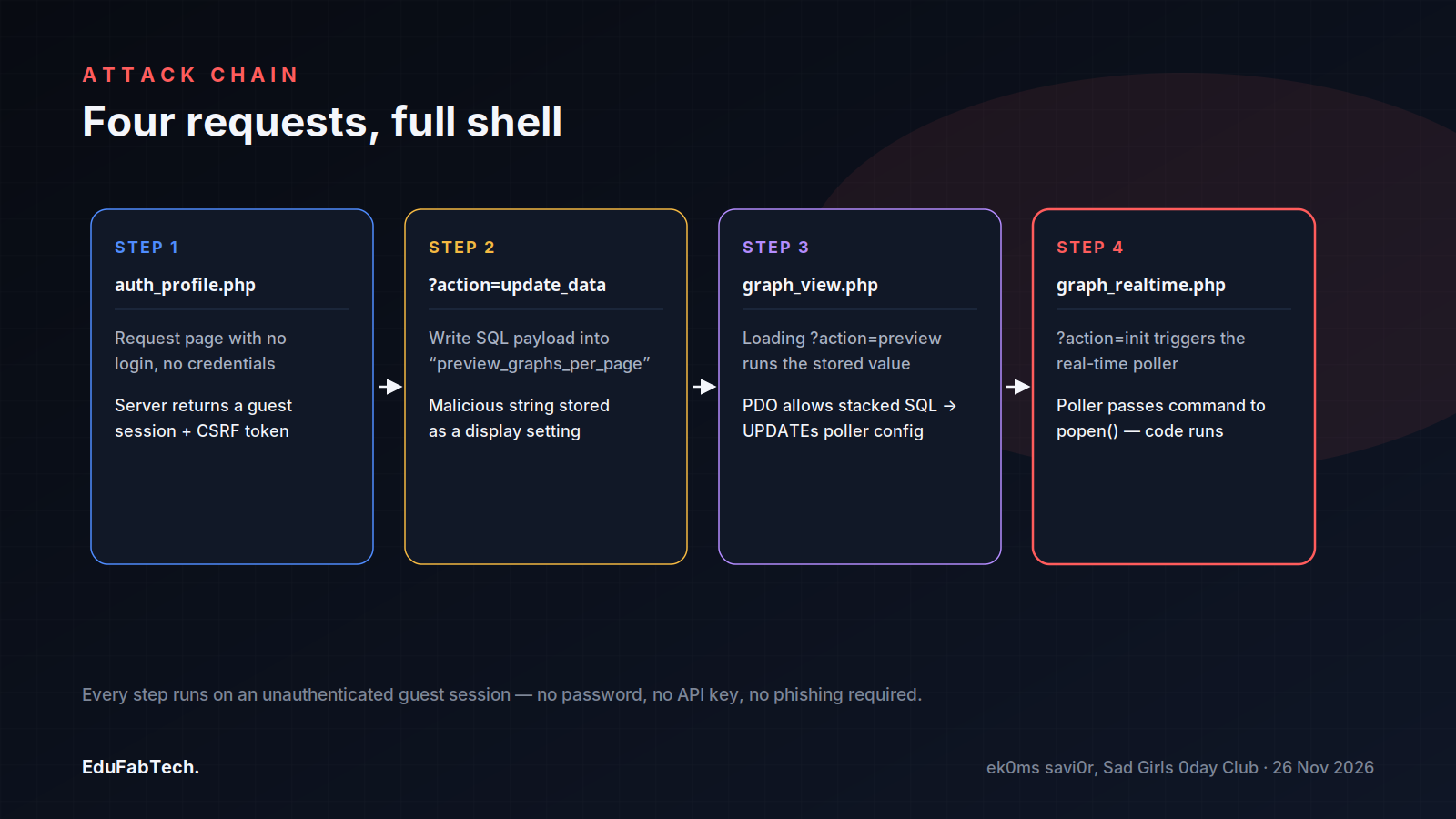
The researcher summarized the result directly: "I found a path from a fresh, unauthenticated HTTP session to command execution as the Cacti server user in four requests. No login. No valid API key. No phishing," according to the GitHub repository and reported by BleepingComputer (2026).
Why it was published without a patch
BleepingComputer (2026) reports that ek0ms savi0r disclosed the chain publicly rather than privately to the Cacti project, and that the researcher's accompanying post cited years of frustration with vulnerability reports being dismissed or closed as duplicates, expected behavior, or issues that could not be reproduced. The repository does not state that Cacti maintainers were notified before the proof of concept went public, and no CVE number has been assigned to the issue at the time of writing.
Incident-response firm watchTowr published its own technical FAQ on the issue, confirming the same four-request mechanics and adding guidance for defenders. watchTowr (2026) describes the bug as a vulnerability that lets an unauthenticated guest run commands on the Cacti server, and states that, as of 27 November 2026, it had found no evidence of exploitation in the wild. The firm says it used its "Adversary Sight" scanning and "Rapid Reaction" response process to identify exposed Cacti instances among client environments, underscoring that the flaw is already being hunted for by defenders now that a public proof of concept exists.
What administrators and researchers should check
Both BleepingComputer (2026) and watchTowr (2026) recommend the same immediate mitigation: disable the guest account under Cacti's user administration settings, which breaks the first step of the chain, and restrict the Cacti web interface to trusted internal networks rather than exposing it to the open internet. watchTowr also advises reviewing existing poller configurations for commands that administrators did not set themselves, and watching logs for unexpected non-numeric values in settings that should only ever hold numbers — a sign the injection step has already run.
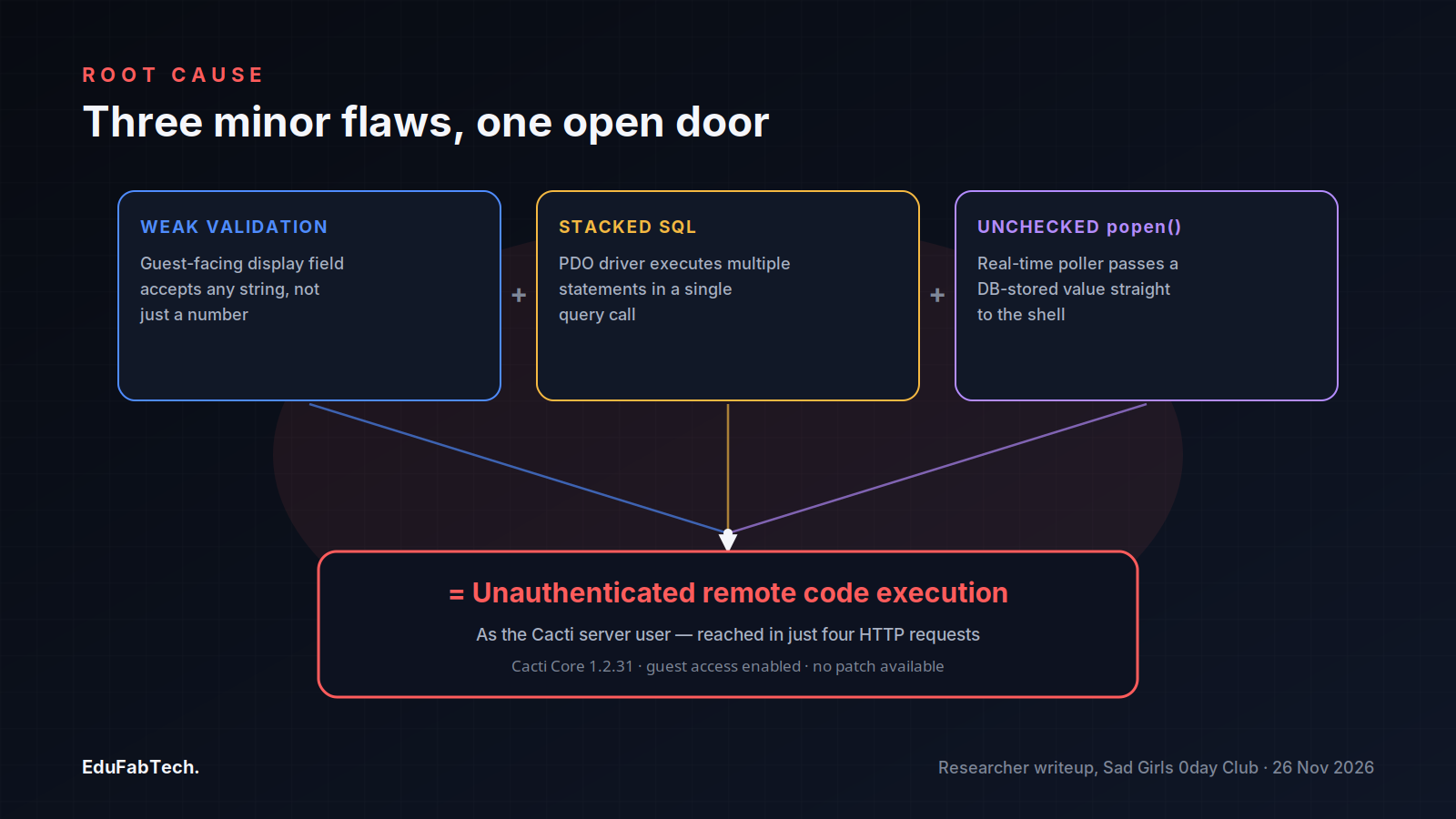
For students and engineers working with network operations or monitoring infrastructure, the case is a concrete illustration of how a low-privilege feature — a guest account meant only to let visitors view graphs — can become a full command-execution path when a single numeric-looking setting is not validated before being written to the database and later trusted by a second, unrelated component (the real-time poller). The researcher's own description of the bug as requiring weak validation at a display-settings endpoint, a database driver that permits multiple statements, and an unsanitized call to popen() shows how three separate, individually minor defects combine into unauthenticated remote code execution.
No fix is currently available from the Cacti project. Until one is issued, the only documented mitigations are disabling guest access and restricting network exposure to the management interface.
A quick question for readers
Which skill will matter most for getting a job in 2030?
Everyone has a prediction. Add yours and see what students are betting on.
Pick an answer, create a free account in a minute, and your vote counts. Already a member? Sign in
Comments 3
Comment-
What gets me is the order of events, not just the bug. The researcher went public after years of reports getting closed as duplicates or "ca…
-
Three individually boring defects stacking into unauthenticated RCE is the real lesson, not the four-request headline. Weak validation on wh…
-
The part worth sitting with is that three individually boring bugs chained into full unauthenticated RCE: a display setting that should only…
Join free to read the full comments and reply Comments are between members; an account takes a minute.
Source: ek0ms savi0r (Sad Girls 0day Club, GitHub)
Sources (3)
- ek0ms savi0r. 4http2shell: Cacti Core 1.2.31 Unauthenticated RCE via Guest Access. Sad Girls 0day Club (GitHub), 2026. github.com ↗ · checked 28 Nov 2026
- Ionut Ilascu. Unpatched Cacti zero-day with public PoC gives remote code execution. BleepingComputer, 2026. bleepingcomputer.com ↗ · checked 28 Nov 2026
- watchTowr. 4HTTP2ROOT FAQ: Cacti Zero-Day Exposure and Fix. watchTowr, 2026. watchtowr.com ↗ · checked 28 Nov 2026