Canada Holds International Student Target at Up to 150,000 a Year Through 2029
Ottawa's 2027-2029 Immigration Levels Plan, released 5 November 2026, keeps the student arrivals target unchanged from last year's plan, while sector groups say reaching even that number is the harder problem.
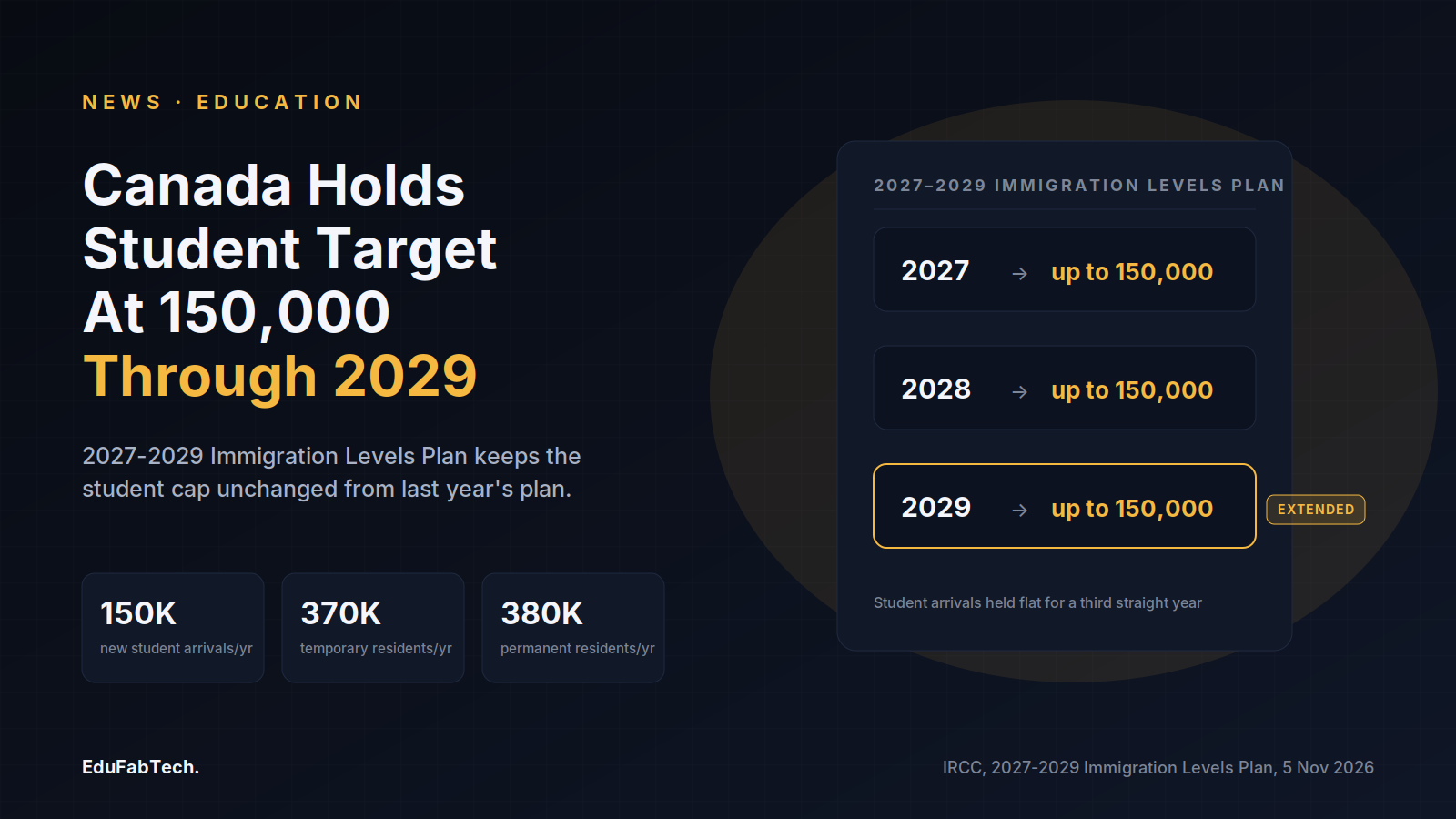
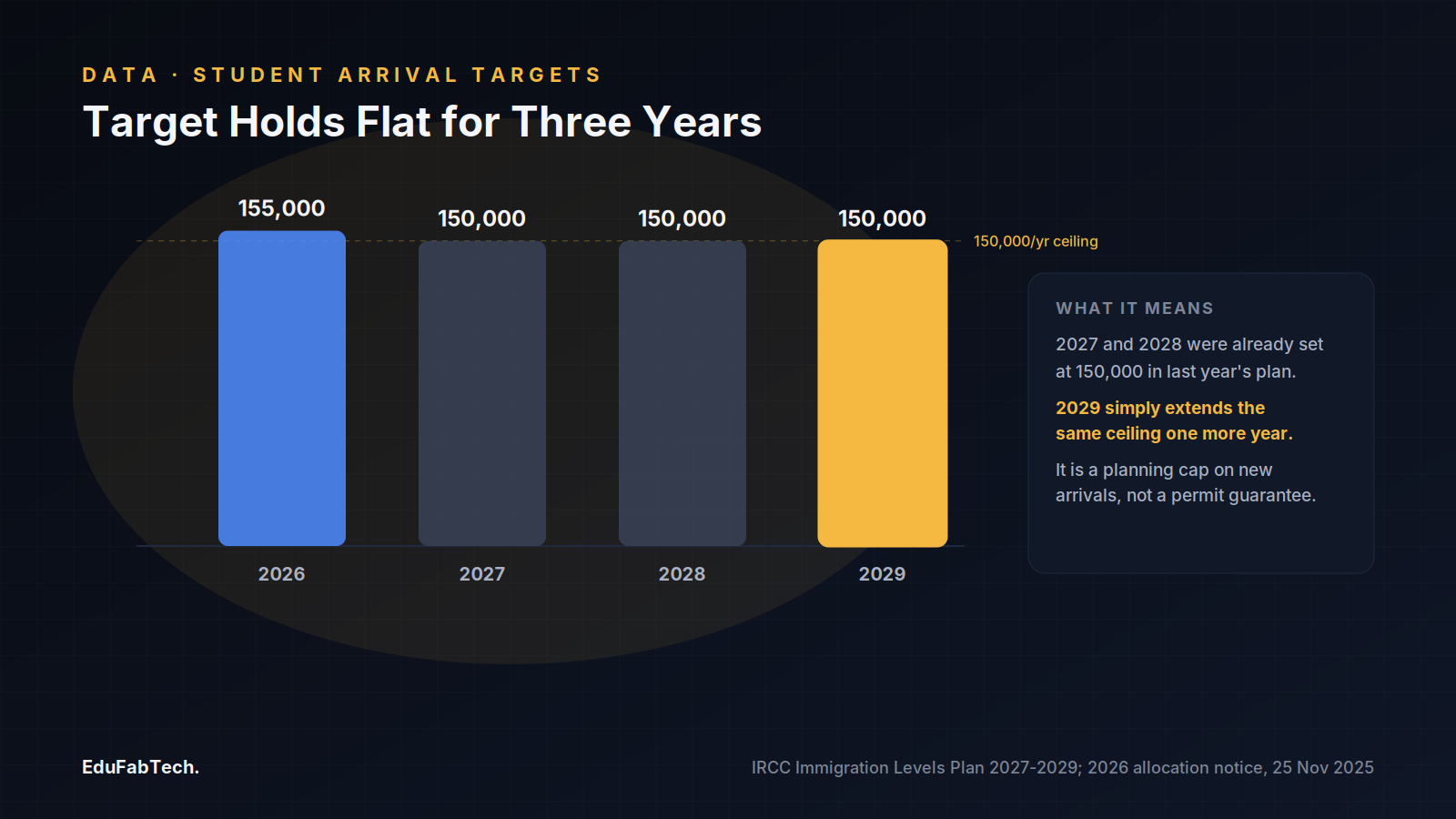
On 5 November 2026, the Government of Canada released its 2027-2029 Immigration Levels Plan, setting a target of up to 150,000 new international student arrivals for each of 2027, 2028 and 2029. The announcement, made by Minister of Immigration, Refugees and Citizenship Lena Metlege Diab, holds the student figure at the same level the previous plan had already set for 2027 and 2028, and simply extends it one further year.
The plan sets overall new temporary resident arrivals at 370,000 a year for 2027 through 2029, made up of 220,000 workers and up to 150,000 students, with permanent resident admissions stabilised at 380,000 a year over the same period. Post-graduation work permits are not counted inside the student figure: the Supplementary Information for the 2027-2029 Immigration Levels Plan states that IRCC treats them "as an extension or change of status, not new arrivals to Canada."
Canada's own immigration levels page describes the 2027 student number as "consistent with last year's plan," meaning the government is not introducing a new cut or a new increase — it is locking in the reduced level it reached after two years of sharp caps on study permits, and carrying that number forward rather than revisiting it.
How the Cuts Began
The current target is far below where Canada's international student intake stood a few years ago. An audit by the Office of the Auditor General of Canada, published 23 March 2026, found that Immigration, Refugees and Citizenship Canada reduced new study permit approvals faster than it had projected: in 2024, the department approved fewer than half the forecasted number of new study permits, and in Manitoba, Prince Edward Island, Nova Scotia and New Brunswick — where the department had projected declines of roughly 10% or less — approvals instead fell by at least 59%. The audit also found that a new letter-of-acceptance verification system confirmed 791,793 of the more than 841,000 letters it checked between December 2023 and September 2025 — about 94% — as genuine, while the department had funding to investigate only around 4,000 of the more than 153,000 potentially non-compliant students that designated learning institutions had flagged over 2023 and 2024.
For 2026, an IRCC notice on provincial and territorial allocations, published 25 November 2025, set the national target at 155,000 newly arriving international students, within a total of up to 408,000 study permits issued that year once extensions for continuing students are included. Ontario was allocated the largest share of the places requiring a provincial or territorial attestation letter, at 104,780, followed by Quebec at 93,069.
What Sector Groups Are Saying
The Canadian Bureau for International Education welcomed the extension. CBIE President and CEO Larissa Bezo said stable targets would let institutions "plan for the future, establishing recruitment strategies," but added, in comments reported by The PIE News on 6 November 2026, that "according to the most recent data from 2026, we are far from meeting our current targets" — meaning the practical constraint for many institutions is now reaching the cap, not staying under it.
Universities Canada also welcomed the plan. In the same report, its president and CEO, Gabriel Miller, said: "Canada has set ambitious goals for its economic future. Universities are helping to achieve them through the talent they develop, the research they advance and the partnerships they build with businesses and communities." He added that universities were working with the federal government to build on those strengths.
Where Canada Sits Among Host Countries
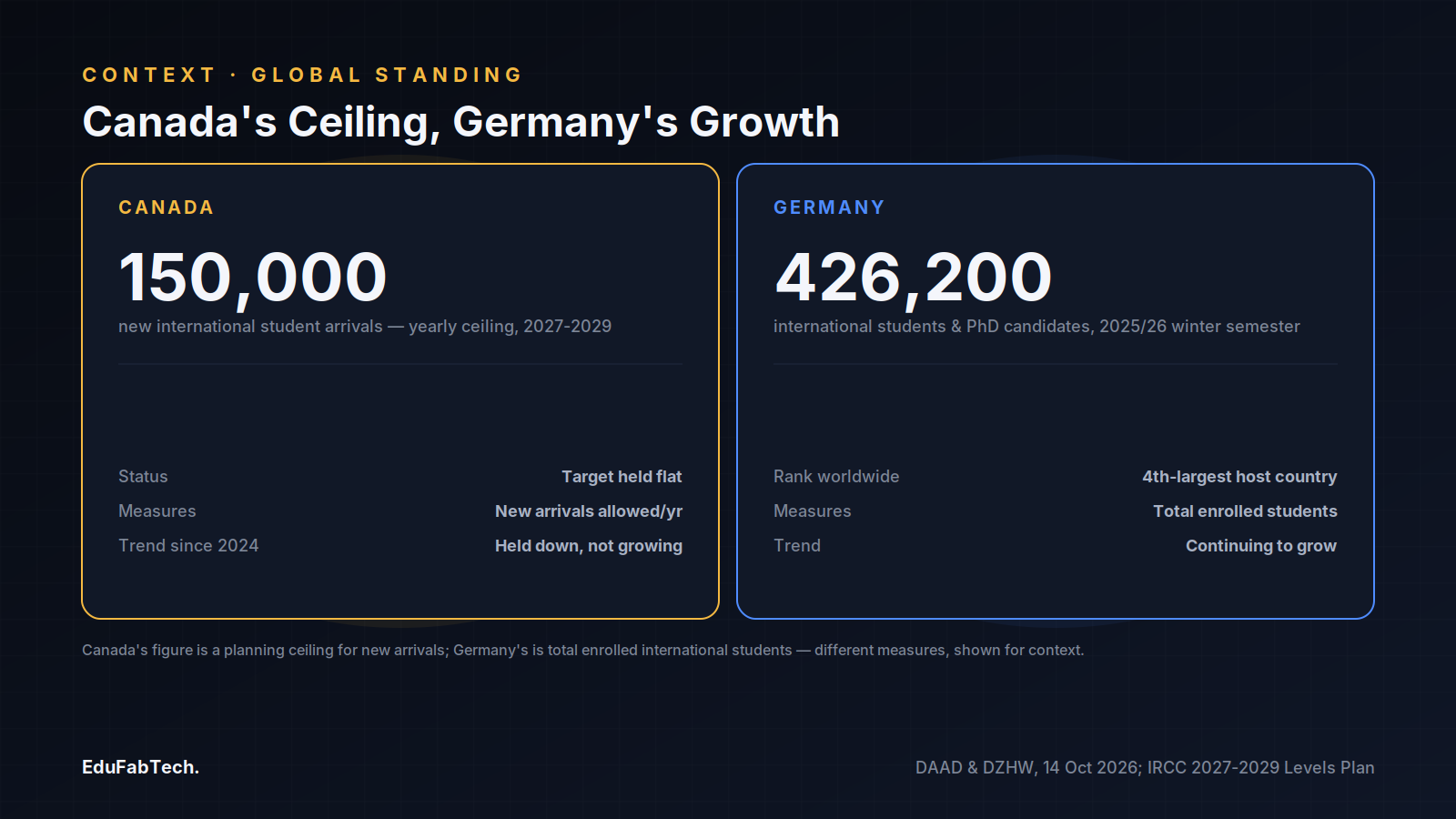
Canada's retreat from its post-pandemic highs is happening while other destinations move in different directions. The German Academic Exchange Service (DAAD) and the German Centre for Higher Education and Science Research reported on 14 October 2026 that Germany hosted around 426,200 international students and PhD candidates in the 2025/26 winter semester, placing it fourth worldwide as a host country behind the United States, the United Kingdom and Australia, and describing it as "the most important non-English-speaking host country" for international students. Canada's own target of up to 150,000 new arrivals a year is a planning ceiling rather than a count of total enrolled international students, but it signals that Ottawa intends to keep admitting far fewer new students than it did before the 2024 caps, even as competitor systems continue to grow.
What It Means for Students and Institutions
For prospective applicants, the main practical change is continuity rather than new opportunity: the number of spaces is not expanding, but it is not being cut further either, and provinces will confirm their individual allocations separately, as they did for 2026. For colleges and universities that built recruitment and campus budgets around much larger intakes before 2024, the plan removes one source of uncertainty — the risk of another mid-cycle reduction — while leaving unresolved the funding and enrolment gaps that the earlier caps already created.
Researchers and administrators tracking the policy should treat the 150,000 figure as a notional ceiling tied to Canada's wider goal, stated in the government's release, of keeping the system "well-managed, efficient and focused on our economic needs," rather than as a guarantee that any individual applicant's study permit will be approved.
A quick question for readers
Which study method makes things stick for you until the exam?
Research says some methods work far better than others. Vote first, then see whether students agree with the evidence.
Pick an answer, create a free account in a minute, and your vote counts. Already a member? Sign in
Comments 3
Comment-
The number that should get more attention is the CBIE line: we're 'far from meeting our current targets.' So the headline ceiling of 150,000…
-
The number that actually matters here isn't the 150,000 ceiling, it's the enforcement gap underneath it: IRCC had funding to investigate rou…
-
What jumps out is the gap between the headline number and the CBIE quote: the target is "up to 150,000" but Bezo is on record saying institu…
Join free to read the full comments and reply Comments are between members; an account takes a minute.
Source: Immigration, Refugees and Citizenship Canada
Sources (3)
- Immigration, Refugees and Citizenship Canada. Building a stronger Canada through a well-managed, predictable immigration system. Government of Canada, 2026. canada.ca ↗ · checked 9 Nov 2026
- The PIE News. Canada extends 150,000 international student arrivals target to 2029. The PIE News, 2026. thepienews.com ↗ · checked 9 Nov 2026
- German Academic Exchange Service (DAAD) and German Centre for Higher Education and Science Research (DZHW). Germany remains a sought-after destination worldwide for undergraduate and postgraduate study. DAAD / DZHW, 2026. daad.de ↗ · checked 9 Nov 2026