Groningen Thesis Finds Dutch Misconduct Rules Punish PhD Candidates More Than Professors
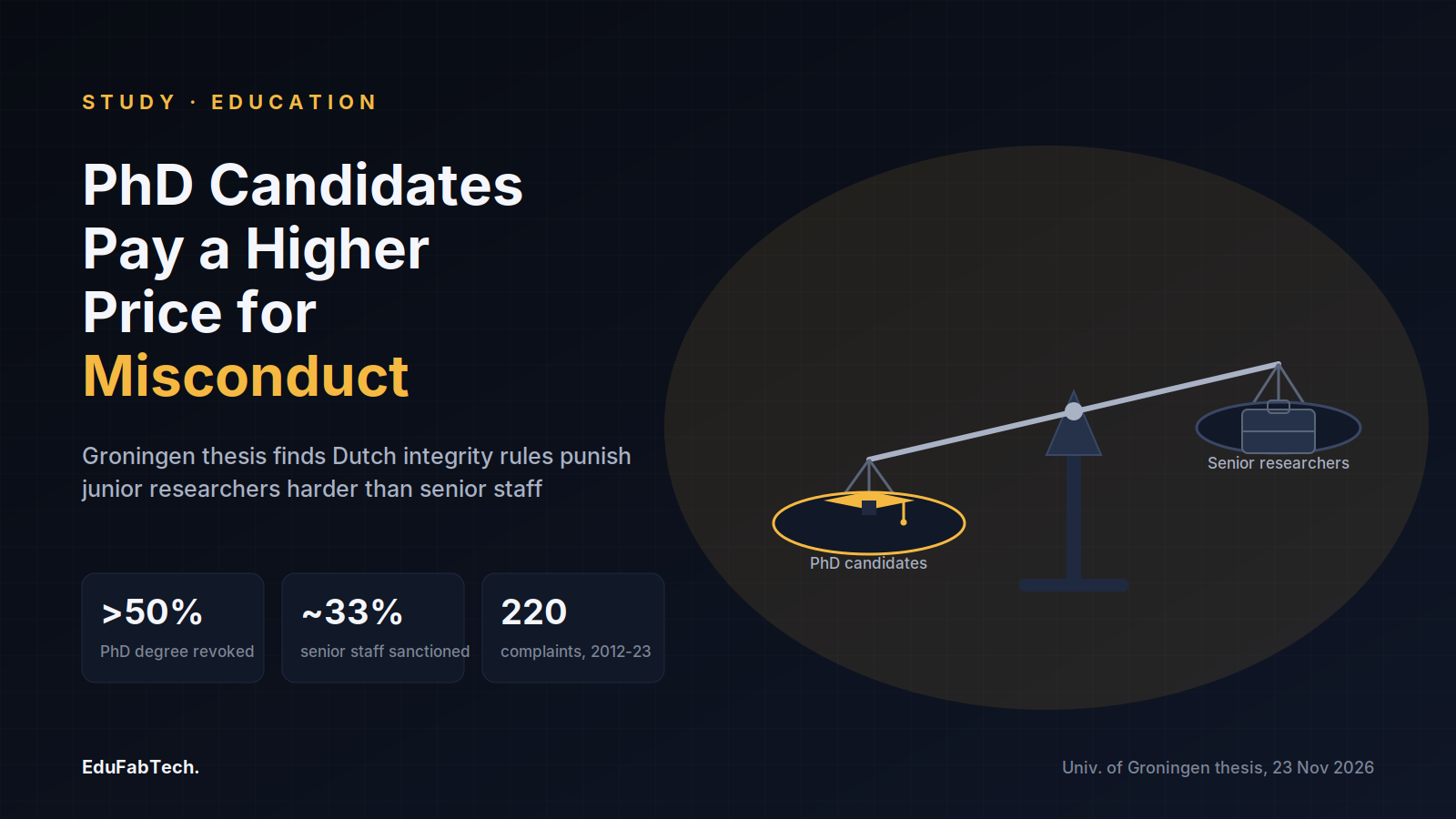
A 23 November 2026 PhD thesis at the University of Groningen found over half of PhD candidates caught plagiarising lost their doctorate, against about a third of senior researchers, between 2012 and 2023 in Dutch integrity cases.
Judith Zweistra-Immink defended her PhD thesis at the Faculty of Law of the University of Groningen on 23 November 2026, arguing that the procedure Dutch universities use to investigate suspected breaches of research integrity treats junior and senior researchers unequally and rarely ends in a sanction even when a complaint is upheld. Zweistra-Immink spent seven years as secretary of the Landelijk Orgaan Wetenschappelijke Integriteit (LOWI), the national body that gives a second opinion on integrity rulings, before turning the gap between that casework and the formal rules into her dissertation.
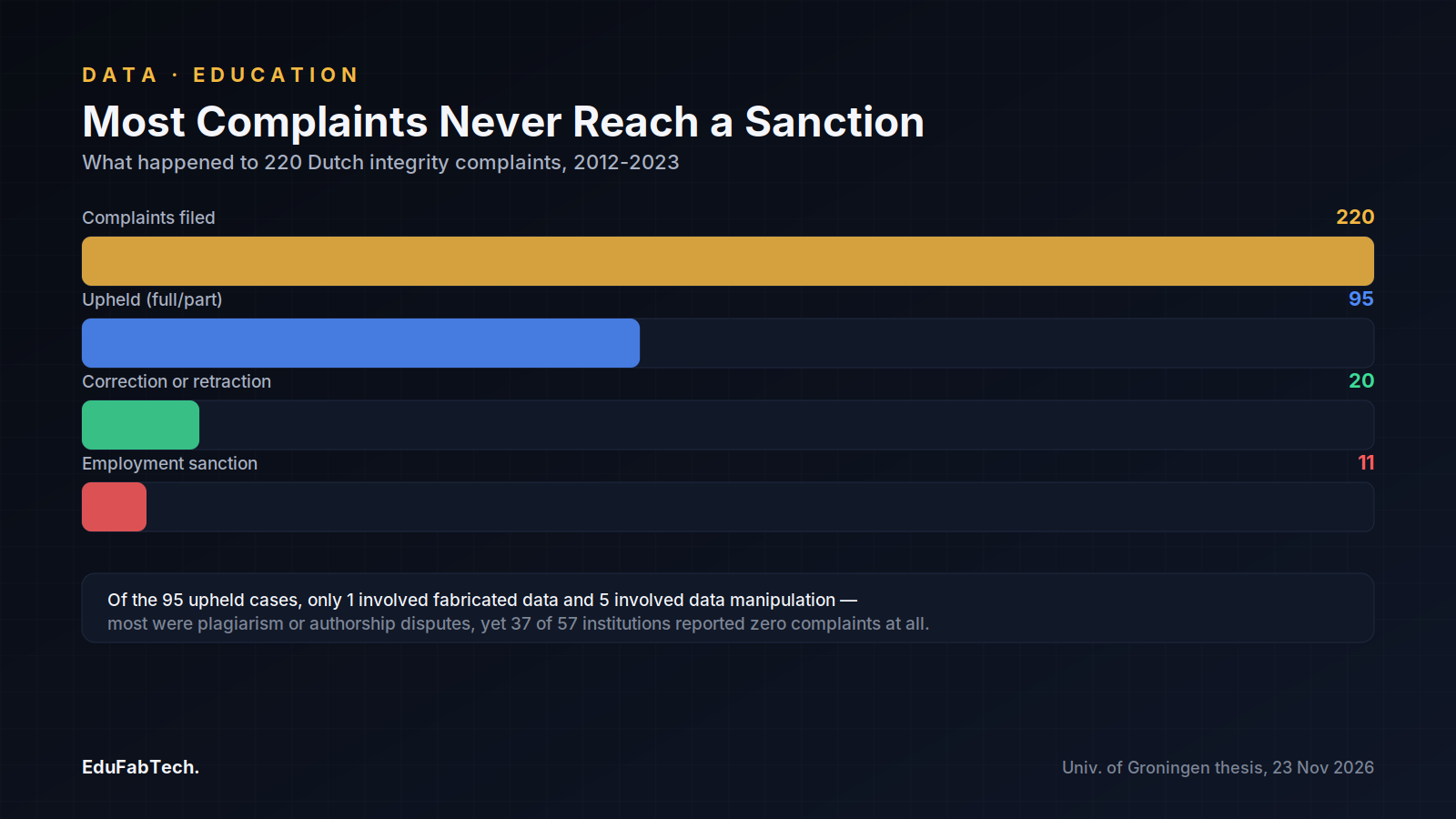
Her research covers complaints handled by 20 Dutch research institutions between January 2012 and May 2023, a period in which 220 integrity complaints were filed and 95, or 43%, were upheld in full or in part, according to Delta, TU Delft's student newspaper, which reviewed the thesis. Of those 95 upheld complaints, only one concerned fabricated data and five concerned data manipulation; most of the rest covered plagiarism, authorship disputes and other breaches. Thirty-seven of 57 surveyed organisations recorded zero complaints at all over the eleven-year span.
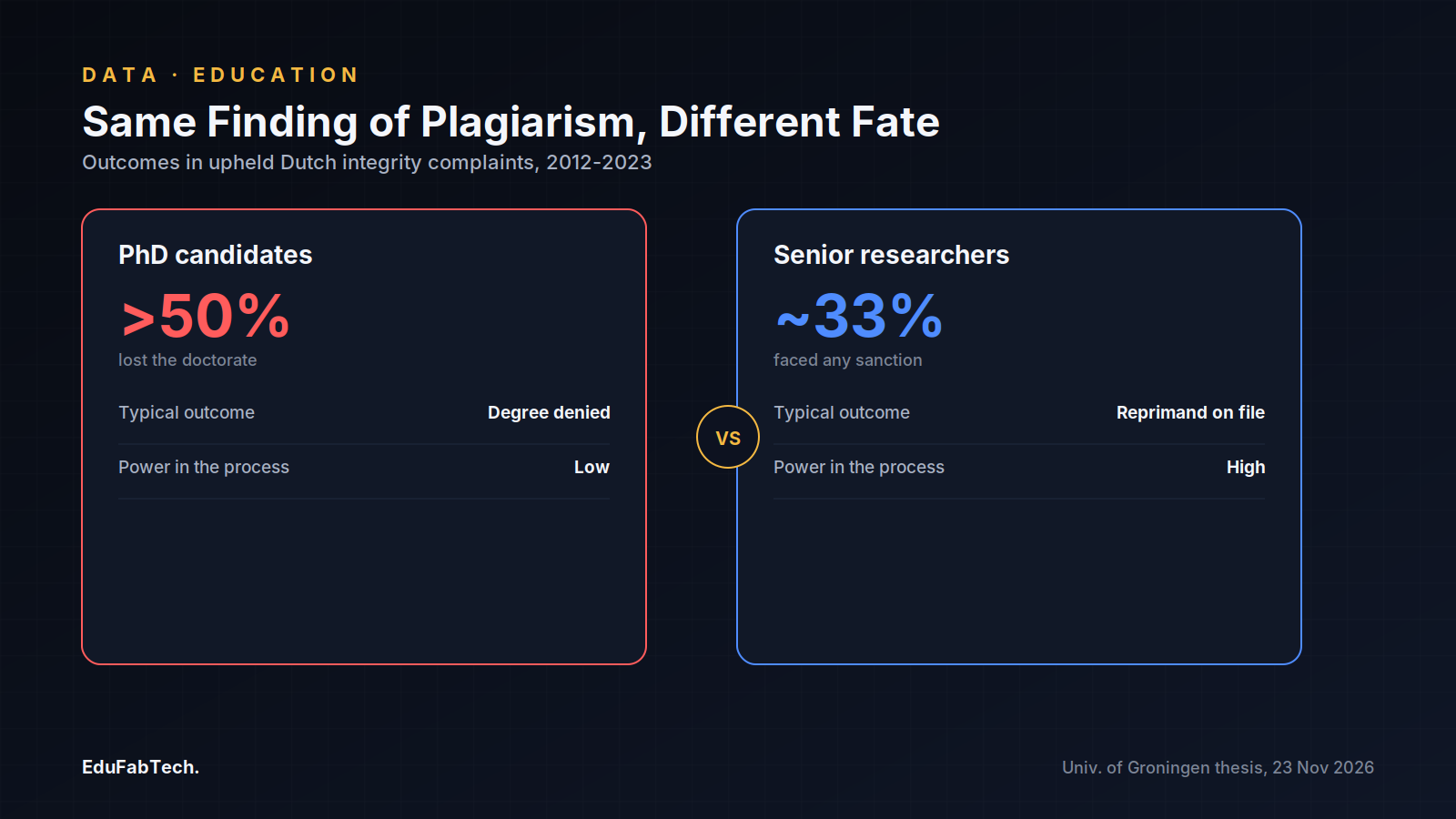
The disparity Zweistra-Immink highlights is in how those upheld cases were punished. More than half of PhD candidates found to have plagiarised were denied their doctoral degree, while roughly a third of senior researchers found to have plagiarised faced any employment-related sanction, with most senior cases ending in a formal reprimand or warning instead, according to Delta's review of the thesis. Across all upheld complaints, 20 led to a correction or retraction of a publication and 11 led to an employment sanction such as dismissal or demotion.
Why the Procedure Lets Most Cases Through Without Action
Zweistra-Immink's central finding is structural rather than individual: university boards keep final say over whether to act on a committee's advice, and in more than a third of upheld complaints no disciplinary measure followed at all. She argues this discourages people from filing complaints in the first place, since a researcher accusing a colleague or a professor has to bring the case to that same colleague's own institution, and a board weighing institutional reputation against a junior researcher's complaint has an incentive to let a finding stand without consequence.
That asymmetry, she concludes, falls hardest on the people with the least power in the relationship: PhD candidates depend on supervisors and committees for the degree itself, so a plagiarism finding against a candidate can end a doctorate outright, while the equivalent finding against a tenured researcher more often ends in a letter on file. "You would actually expect the opposite, because senior academics should know better," Zweistra-Immink told Delta after the defence.
A Known Gap Between Self-Reported Practice and Formal Findings
The low number of formal findings sits against a much larger admitted base. A national survey of 6,813 Dutch academic researchers, published in PLOS ONE in 2022 by Gowri Gopalakrishna, Gerben ter Riet, Gerko Vink, Ineke Stoop, Jelte Wicherts and Lex Bouter, found that 4.3% of respondents admitted to fabricating data and 4.2% to falsifying it at some point in their career, while 51.3% admitted frequently engaging in at least one of eleven questionable research practices over the preceding three years. Measured against that survey, the 220 complaints across 20 institutions over eleven years that Zweistra-Immink examined represent a small fraction of the behaviour researchers themselves report.
The Netherlands is not alone in this gap. The US Office of Research Integrity reported just two formal findings of research misconduct in 2025, the fewest since at least 2006 and well below its typical average of about ten findings a year, according to The Scientist's review of the agency's own case postings. The outlet linked the drop partly to staffing cuts and prolonged leadership turnover at the agency; ORI itself offered no official explanation for the 2025 figure. Neither country's low case count means misconduct is rare; both suggest that formal procedures catch a small and unevenly distributed share of it.
What Zweistra-Immink Wants Changed
The thesis proposes several specific fixes rather than a general call for more oversight. Zweistra-Immink wants LOWI's second-opinion advice made binding on university boards instead of advisory, and wants the roughly 40 separate local integrity-committee arrangements replaced with a smaller number of regional or national commissions with the authority to decide cases rather than merely recommend. She also proposes an independent institutional role to screen and file complaints, so that the reporting researcher is not left to bring a case against their own colleague or supervisor alone, and a legal mechanism allowing universities to revoke a doctoral title over misconduct discovered after the degree was awarded, something Dutch law does not currently permit outright. She stops short of recommending government oversight, arguing instead for stronger, more consistent self-regulation.
What It Means for Students and Researchers
For PhD candidates, the thesis gives empirical weight to something many have suspected anecdotally: a plagiarism finding carries a different, usually heavier, consequence for someone who has not yet been awarded a degree than for someone who already holds a permanent post. For supervisors and institutional integrity officers, the recommendation to standardise sanctions in advance, rather than deciding case by case, would remove some of the discretion that Zweistra-Immink's data suggests falls unevenly along seniority lines. For researchers outside the Netherlands, the comparison with the US figures is a reminder that a low annual count of confirmed misconduct findings — in Groningen's data as much as in Washington's — says more about how narrow the formal channel is than about how much misconduct actually occurs.
A quick question for readers
Is using AI to help write an assignment cheating?
Universities are still writing their rules. Where do students draw the line?
Pick an answer, create a free account in a minute, and your vote counts. Already a member? Sign in
Comments 2
Comment-
The breakdown of what's actually behind those 95 upheld complaints is the part that should worry people more than the sanction gap: one fabr…
-
The split that actually needs explaining is the 11 employment sanctions against 20 corrections/retractions, out of 95 upheld cases. That's a…
Join free to read the full comments and reply Comments are between members; an account takes a minute.
Source: University of Groningen
Sources (3)
- Esther van der Meer. There's work to be done: the integrity procedure in academia needs an overhaul. University of Groningen, Faculty of Law, 2026. rug.nl ↗ · checked 24 Nov 2026
- Delta editorial staff. Penalties for plagiarism are not fair, Groningen PhD thesis finds. Delta, TU Delft, 2026. delta.tudelft.nl ↗ · checked 24 Nov 2026
- Gowri Gopalakrishna, Gerben ter Riet, Gerko Vink, Ineke Stoop, Jelte M. Wicherts, Lex M. Bouter. Prevalence of questionable research practices, research misconduct and their potential explanatory factors: A survey among academic researchers in The Netherlands. PLOS ONE, 2022. journals.plos.org ↗ · checked 24 Nov 2026