Dutch Universities Enrolled 17,600 International Bachelor's Students, Above Cap of 16,766
A 10 November 2026 enrollment count shows Dutch research universities took in more international bachelor's students than the self-regulation ceiling they agreed with the minister in July.
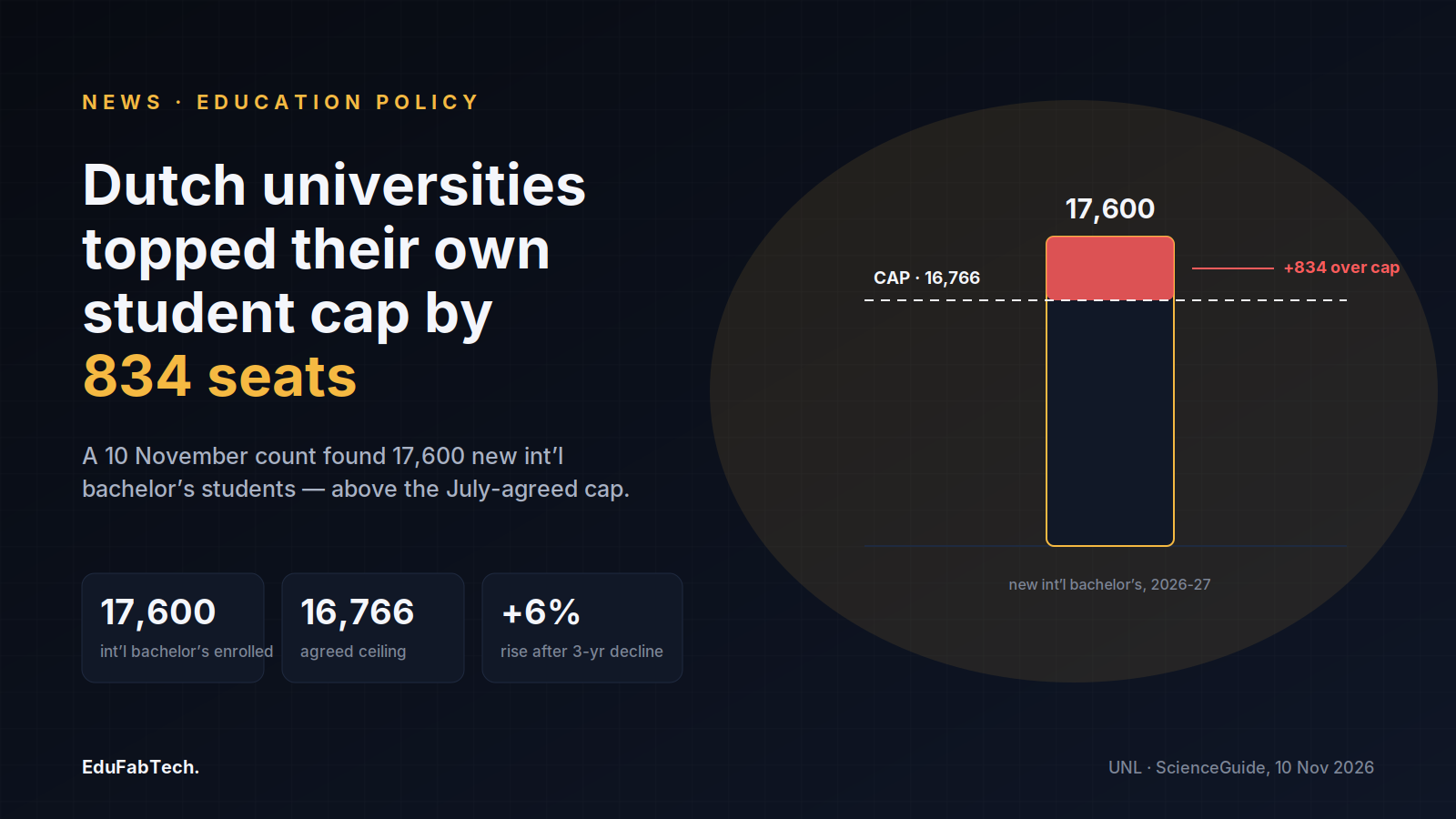
Dutch universities enrolled more new international students in the 2026-2027 academic year than they had agreed to admit, according to enrollment figures released on 10 November 2026 by Universities of the Netherlands (UNL) and the Association of Universities of Applied Sciences (Vereniging Hogescholen), reported by ScienceGuide. The thirteen research universities took in roughly 17,600 new international bachelor's students this year, above the 16,766 annual ceiling the universities had committed to under a self-regulation agreement with the minister of education.
The figures also show about 40,800 new Dutch bachelor's students at the universities, alongside the international intake, and roughly 109,300 new students across the universities of applied sciences (hbo) sector, a 1.9% increase, according to ScienceGuide's report. International bachelor's enrollment at the universities rose by about 6%, after three consecutive years of decline, ScienceGuide reported.
What the self-regulation agreement set out
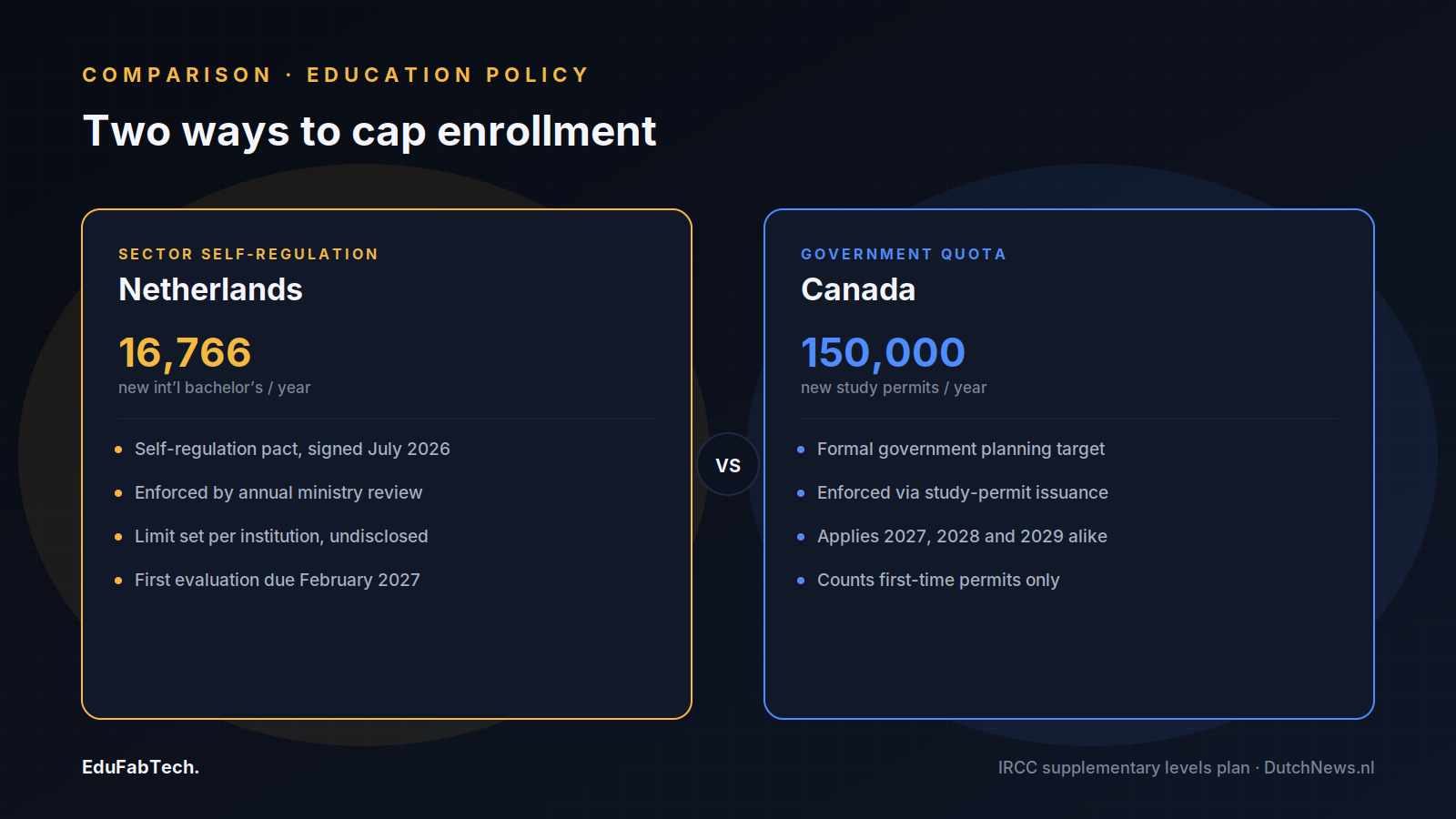
The cap stems from an administrative agreement signed in mid-July 2026 between the Minister of Education, Culture and Science, Rianne Letschert, and the two sector associations, UNL and Vereniging Hogescholen, according to the Ministry's statement, dated 15 July 2026. Under that agreement, the thirteen universities committed to admitting no more than 16,766 new international students a year, and the universities of applied sciences accepted enrollment caps limited to economics programmes, excluding hotel management, as reported by Utrecht University's DUB. No new publicly funded English-taught bachelor's programmes were to be created for now, and institutions committed to offering Dutch-language courses and labour-market preparation to help international graduates stay in the country, DUB reported.
In exchange, the minister agreed to drop a mandatory language test for programmes taught in languages other than Dutch from the pending Internationalization in Balance bill, according to the Ministry's 15 July 2026 statement. The agreement is reviewed annually, with the first evaluation set for February 2027, the Ministry said. Student unions ISO and LSVb were not party to the agreement and criticised the process; LSVb representative Evy Kras said, as quoted by DUB, that "the discussion on internationalisation is being removed from the public debate, and we are very critical of that."
Where the overshoot is concentrated
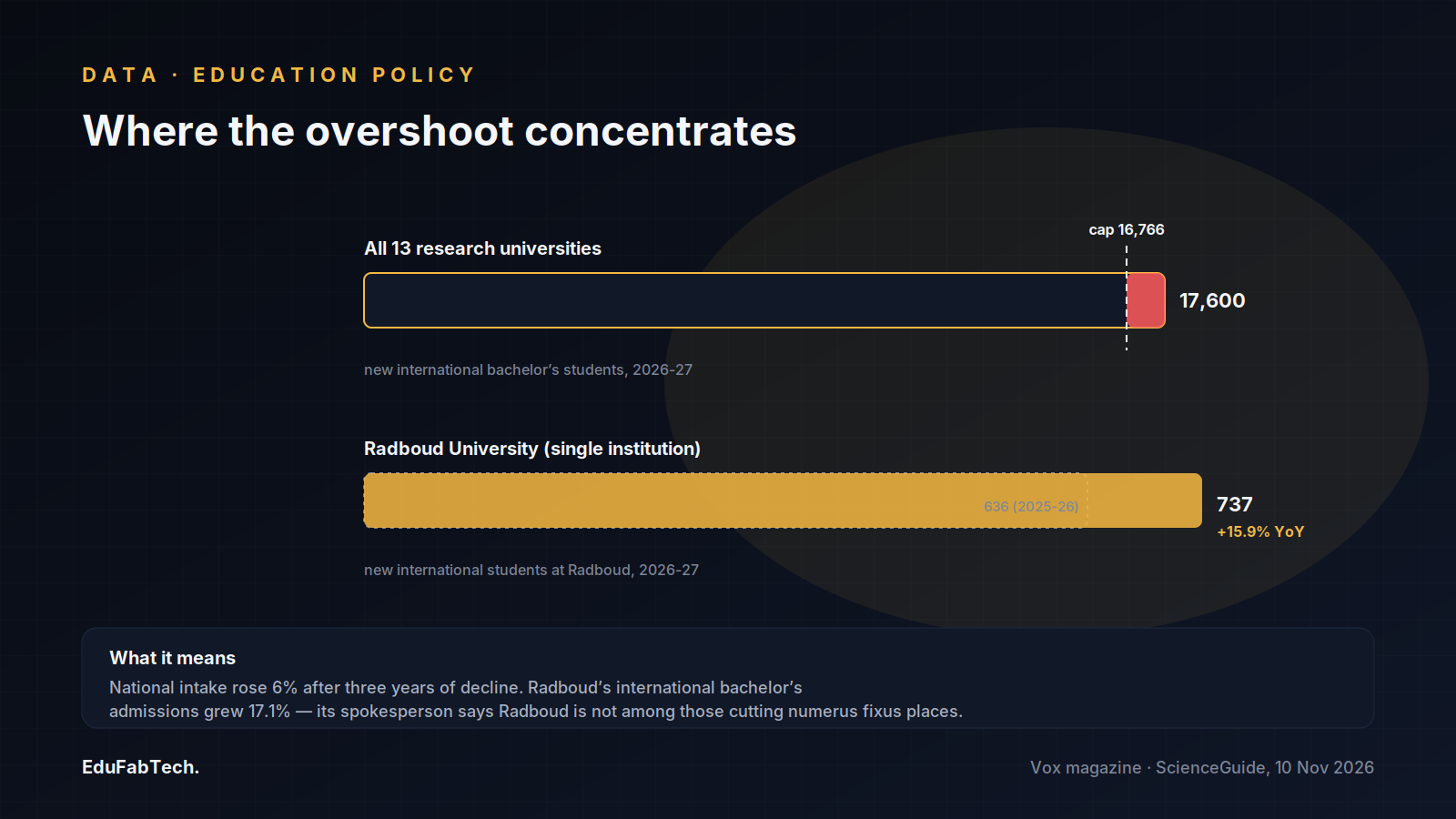
At Radboud University, 737 new international students enrolled this year, a 15.9% increase on the 636 enrolled the previous year, with international bachelor's admissions up 17.1% and master's admissions up 16.5%, according to figures reported by Vox magazine. A Radboud University spokesperson told Vox that the numerus fixus reductions other universities are making do not apply to Radboud University. UNL said, as reported by Vox, that several institutions will lower the numerus fixus for a number of English-taught programmes, including psychology, economics and business administration; ScienceGuide reported that the reduced access takes effect next year, in the 2027-2028 academic year.
UNL said international students are concentrated in technical fields where Dutch employers face staff shortages, and that applicants are increasingly choosing to study in Europe because of developments in the United States, according to DutchNews.nl. UNL president Caspar van den Berg said Dutch institutions "badly need international talent, particularly in priority sectors such as technology," DutchNews reported.
How the Dutch approach compares
The Netherlands' overshoot comes as several other countries are tightening, rather than loosening, formal limits on international student numbers. Canada's government has set a planning target of 150,000 new international student arrivals a year for 2027, 2028 and 2029, according to the Immigration, Refugees and Citizenship Canada supplementary levels plan, which counts first-time study permits only and excludes permit extensions or in-country applications. Where Canada manages that target directly through study-permit issuance, the Dutch model relies on universities self-regulating admissions by programme, with the minister monitoring compliance through an annual review rather than a visa quota.
What it means for applicants and institutions
For prospective international students, the practical effect is at the programme level rather than a national quota: numerus fixus reductions are being applied to specific English-taught bachelor's tracks in psychology, economics and business administration at some universities for 2027-2028 admission, according to the figures UNL reported to ScienceGuide and Vox, while technical and shortage-sector programmes are not described as facing the same cuts. Because the cap is enforced through a voluntary agreement rather than legislation, and because individual university targets within the 16,766 total are not public, applicants have no single published list of which programmes will restrict places next year; that detail is expected to emerge from each university's own admissions announcements ahead of the February 2027 review.
For researchers studying internationalization policy, the case is a test of whether sector self-regulation can hold a numerical ceiling without legislation. The first annual evaluation, due in February 2027, will show whether the reductions announced by individual universities bring enrollment back under the 16,766 threshold, or whether the gap between an agreed national figure and institutions' individually set, undisclosed targets reappears.
A quick question for readers
Would you choose the same field of study again?
One of the most honest questions a student can answer — and one of the most useful for those still choosing.
Pick an answer, create a free account in a minute, and your vote counts. Already a member? Sign in
Comments 3
Comment-
The number that actually breaks this scheme isn't the 17,600 versus 16,766 overshoot, it's that nobody publishes the per-university slices t…
-
The number that should embarrass this agreement isn't 17,600 vs 16,766, it's the one UNL won't publish: the individual university targets in…
-
The slippery bit is that this isn't one overshoot, it's a cap breach plus a definitional mismatch: the 16,766 ceiling was agreed by the thir…
Join free to read the full comments and reply Comments are between members; an account takes a minute.
Source: ScienceGuide
Sources (3)
- Frans van Heest. Instroom groeit in hbo en wo, universiteiten overschrijden zelfregieafspraak. ScienceGuide, 2026. scienceguide.nl ↗ · checked 15 Nov 2026
- Ministry of Education, Culture and Science. Minister OCW en onderwijskoepels verankeren afspraken over internationale studenten. Rijksoverheid.nl, 2026. rijksoverheid.nl ↗ · checked 15 Nov 2026
- Immigration, Refugees and Citizenship Canada. Supplementary Information for the 2027-2029 Immigration Levels Plan. Canada.ca, 2026. canada.ca ↗ · checked 15 Nov 2026