English Universities Need Up to £5.3bn to Fix Research Buildings, Agency Finds
A Research England survey of 72 universities found a median of a quarter of research buildings needs major repair or is unsafe, as Germany agrees shared federal-state funding that can also go toward its own, far larger renovation backlog.
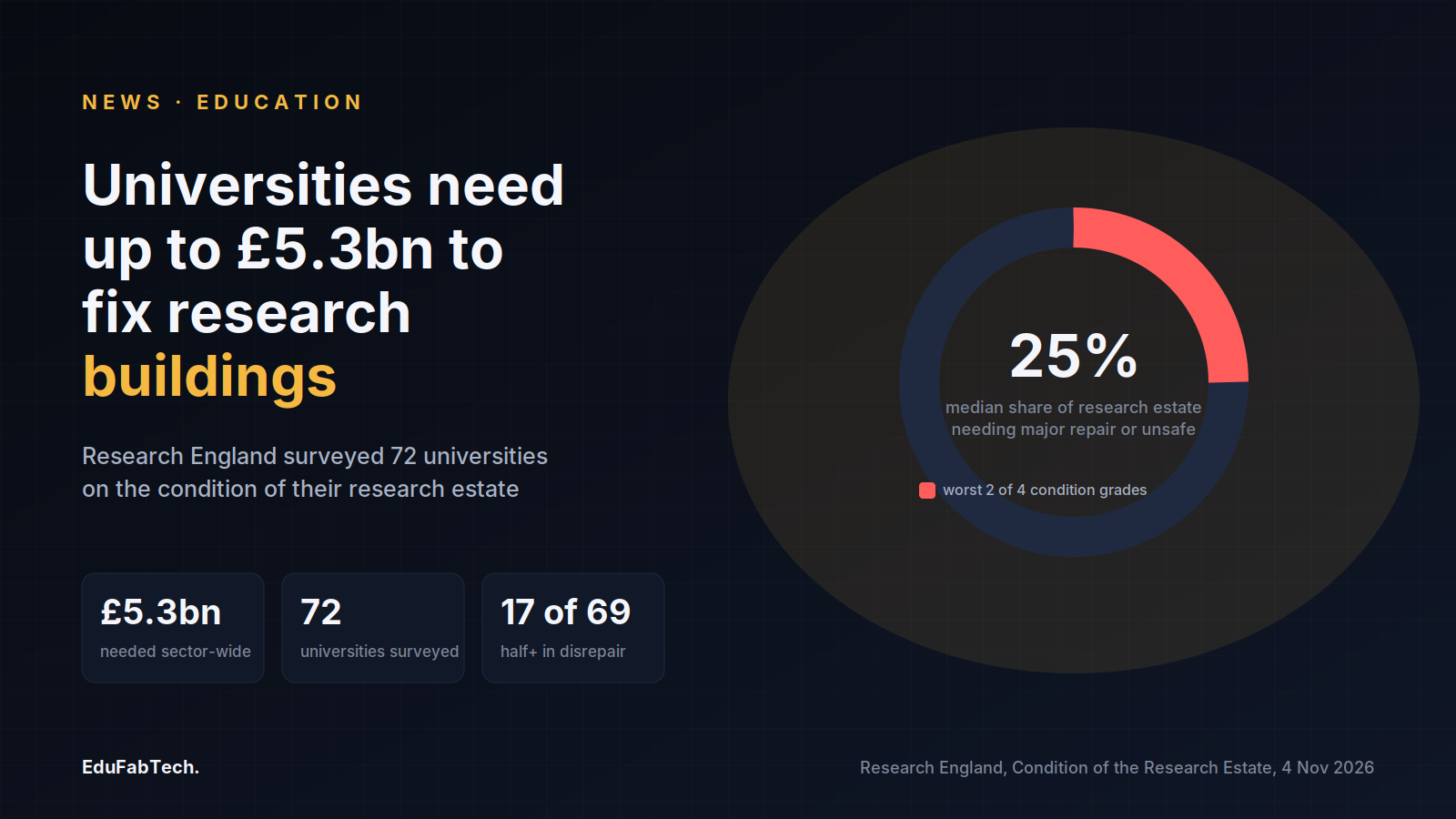
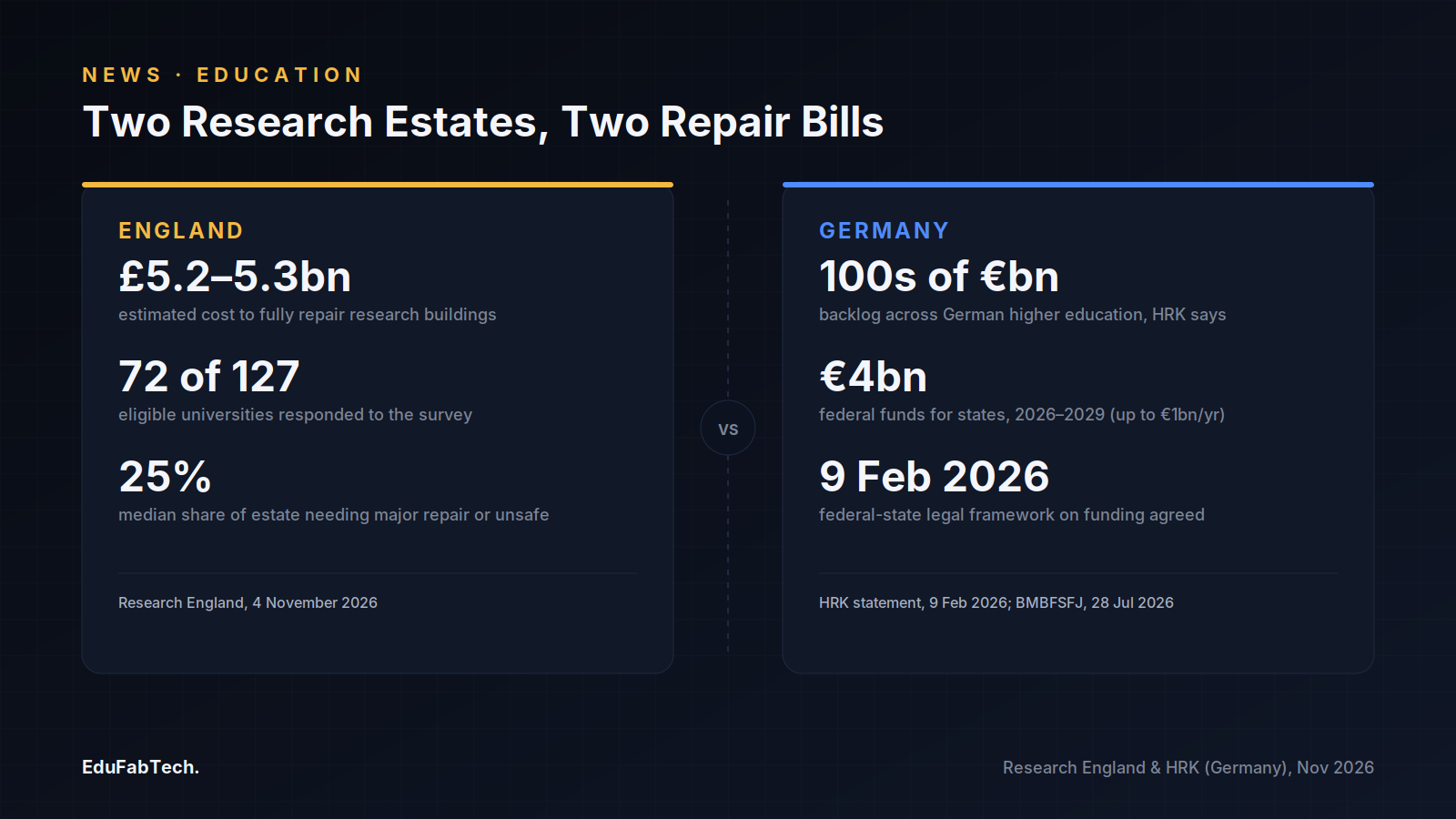
Research England, the UK Research and Innovation council responsible for funding university research in England, published a report on 4 November 2026 putting the cost of bringing university research buildings to a fully operational standard at £5.2-5.3bn. The estimate comes from the Condition of the Research Estate report, drawn from Research England's first Condition of the Estate (COTE) survey, which it sent to all 127 universities eligible for its Quality-related Research funding.
What the survey found
Seventy-two universities responded to the survey, which was open from March to November 2024 and together represented 72% of sector research income as measured by the Higher Education Statistics Agency, Research England's report states. Sixty-nine of those providers answered a question asking them to grade their research estate on a four-point scale, from "as new" to "inoperable or presenting a serious risk of major failure or breakdown." The median provider reported that a quarter of its research estate falls into the two worst categories, and 17 of the 69 reported that half or more of their research space was in that state, according to the report. Some of the universities most exposed, it notes, are among the most research-intensive in the country, facing "a need to invest urgently at levels much greater than their peers."
Spending down as costs rise
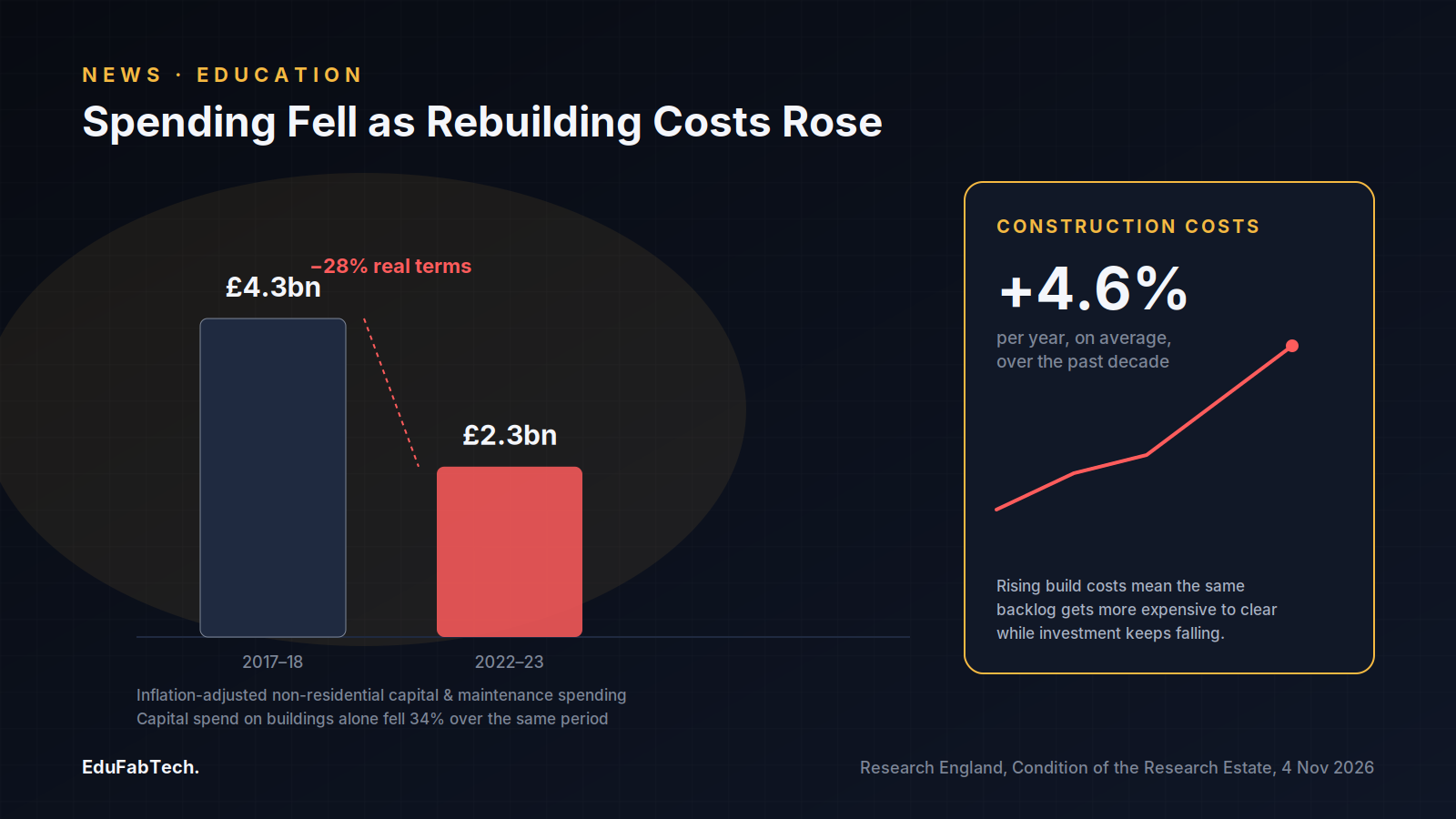
Sixty-four providers estimated the cost of restoring their own buildings to full operational condition at a combined £3.61bn; scaled to the whole sector by research income share, Research England's report puts the total need at £5.2bn to £5.3bn, depending on the scaling method used. Over the same period, spending has fallen rather than risen: inflation-adjusted non-residential capital and maintenance spending across the sector dropped 28% between 2017-18 and 2022-23, with capital expenditure on buildings alone down 34%, the report states. Sector-wide investment fell from an estimated £4.3bn in 2017-18 to £2.3bn in 2022-23. Construction costs, meanwhile, have risen by an average of 4.6% a year over the past decade, the report notes, citing industry cost forecasts.
Safety, accessibility and net zero
In interviews that followed the survey, universities told Research England of ceilings at risk of collapse, electrical faults and fire-safety problems they lack the capacity to fix immediately, with one university saying it had been pushed into reactive, emergency-only maintenance. Only 63% of responding universities said 80-100% of their research buildings were fully accessible to wheelchair users and others with access needs, and 61% said less than 40% of their research estate met their own net-zero and environmental sustainability targets. Universities linked the condition of buildings directly to their ability to recruit research staff, with some reporting that infrastructure now mattered more than salary in staying competitive. Multiple institutions already had closed or empty buildings, one said it had begun moving services abroad, and several said they had sold land or assets to manage the pressure, the report states.
A larger backlog in Germany, funded differently
England is not the only system confronting an ageing research estate. In Germany, the Hochschulrektorenkonferenz (German Rectors' Conference, HRK) said on 9 February 2026 that the federal government and the state governments had quickly agreed a legal framework that could speed up renovation projects already under way or planned at German universities, according to a statement distributed via the German science press service idw-online. Its president, Walter Rosenthal, welcomed the framework but said it would not resolve the backlog, putting the widely recognised investment need across German higher education in the "three-digit billion range" — hundreds of billions of euros.
The federal government confirmed on 28 July 2026 that it would make €4bn available to the states for 2026 to 2029, equivalent to up to €1bn a year, drawn from its special "Infrastructure and Climate Neutrality" fund and usable for investment in both childcare facilities and university and scientific infrastructure, the Federal Ministry of Education, Family Affairs, Senior Citizens, Women and Youth said. In the same announcement, federal minister Karin Prien signed the administrative agreement covering the childcare share of the programme, after all of Germany's states had signed; the ministry's statement did not say how much of the combined fund would go to university buildings specifically.
What it means for students and researchers
Neither report translates its figures directly into named buildings or departments, so students and early-career researchers choosing a lab or department cannot yet check a specific site's condition against these numbers. But both point to the same underlying pressure: ageing buildings, rising construction costs and constrained public budgets are straining at least two major research systems at once. Research England's report notes that the condition of a university's estate is increasingly tied to its ability to recruit talent and sustain research activity, and that its findings will feed into a planned reform of the Research Capital Investment Fund, the targeted grant programme universities use to maintain core research equipment and facilities.
A quick question for readers
Which study method makes things stick for you until the exam?
Research says some methods work far better than others. Vote first, then see whether students agree with the evidence.
Pick an answer, create a free account in a minute, and your vote counts. Already a member? Sign in
Comments 2
Comment-
The number that jumps out is 17 of 69 providers with half or more of their research space in the two worst categories — that's not a mainten…
-
The part that actually lands for me is the spending-vs-cost scissors: real capital and maintenance spend down 28% from 2017-18 to 2022-23, c…
Join free to read the full comments and reply Comments are between members; an account takes a minute.
Source: Research England (UK Research and Innovation)
Sources (3)
- Research England. The Condition of the Research Estate and the Financing of Its Upkeep and Renewal. UK Research and Innovation, 2026. ukri.org ↗ · checked 5 Nov 2026
- Hochschulrektorenkonferenz. Bund-Länder-Vereinbarung: "Den Sanierungsstau an Hochschulen endlich auflösen". idw-online (Informationsdienst Wissenschaft), 2026. idw-online.de ↗ · checked 5 Nov 2026
- Federal Ministry of Education, Family Affairs, Senior Citizens, Women and Youth. Bund startet milliardenschweres Investitionsprogramm. BMBFSFJ, 2026. bmbfsfj.bund.de ↗ · checked 5 Nov 2026