ESA's Euclid Telescope Releases First Major Dataset: Over 900 Million Galaxies Mapped
The DR1-Foundation release, published 12 November 2026, covers 14% of Euclid's planned six-year survey and includes the largest strong-lensing catalogue assembled so far.
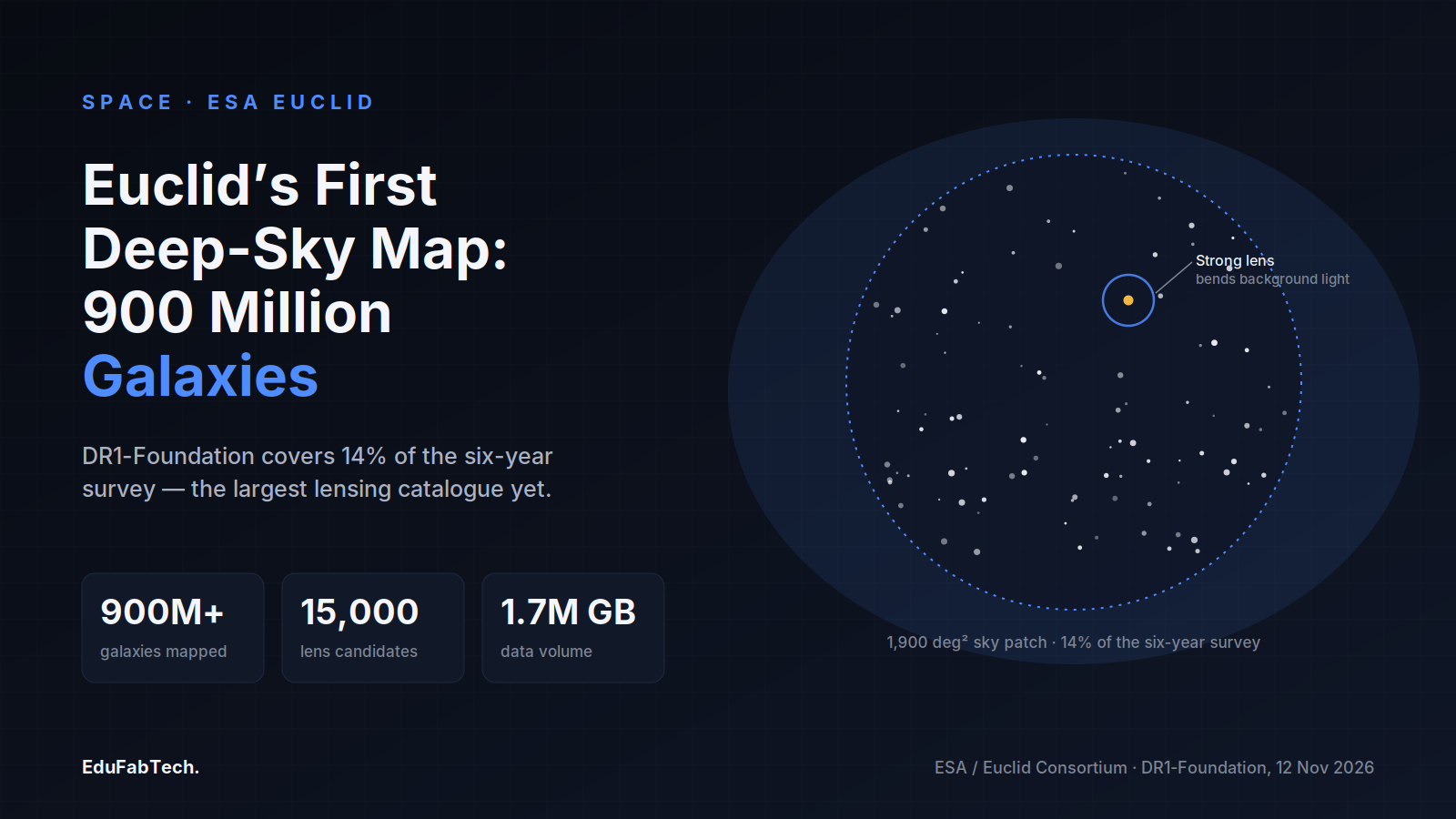
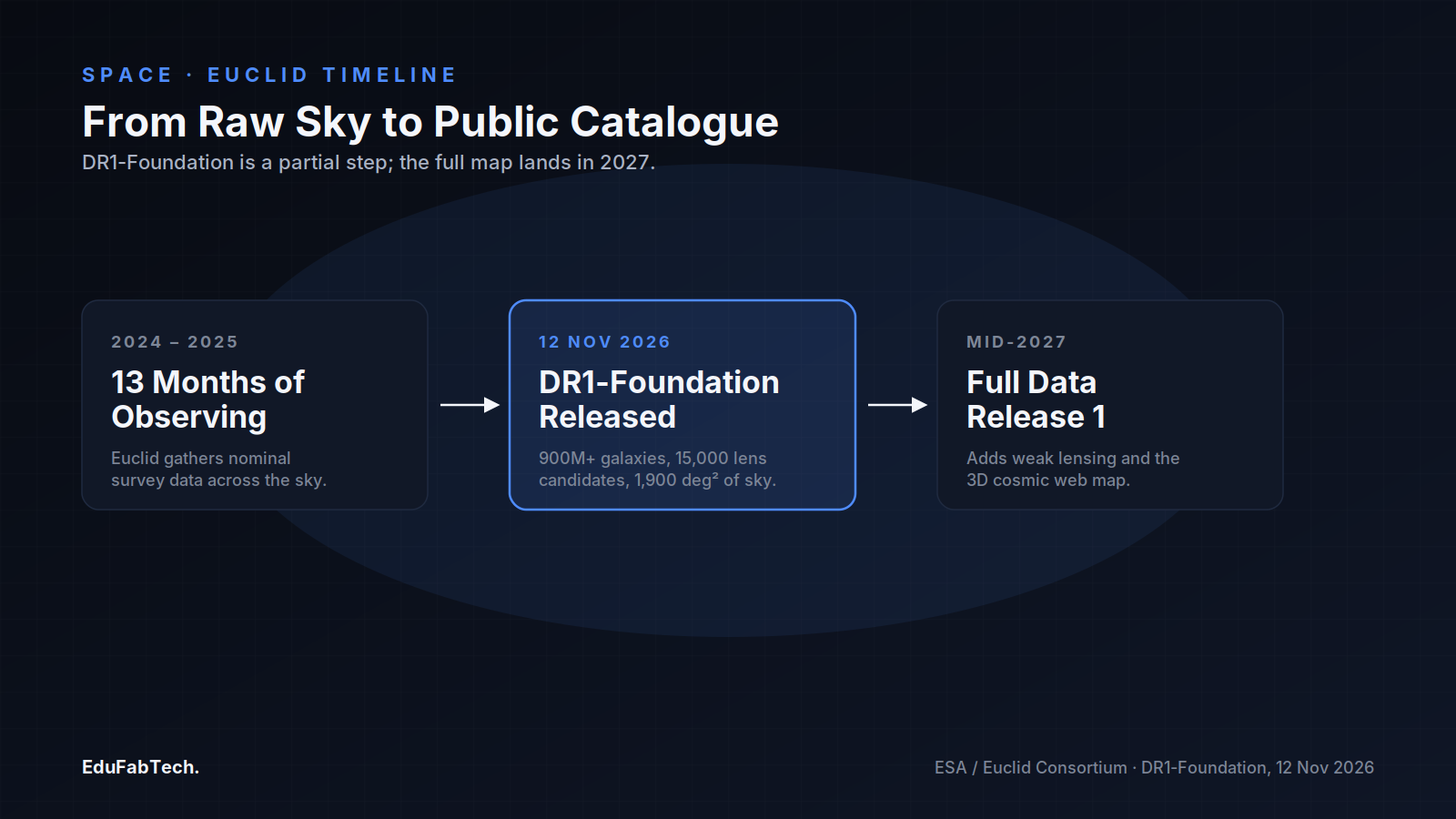
On 12 November 2026, the European Space Agency released the first major batch of data from its Euclid space telescope, called DR1-Foundation, according to ESA's announcement. The release covers roughly 13 months of observations, gathered between spring 2024 and spring 2025, and marks the first publication of nominal survey data since Euclid launched in 2023.
The dataset includes more than 900 million galaxies, around 15,000 strong gravitational lensing candidates, over 60 million quasar candidates and spectra — the "rainbows" of light astronomers use to measure distance and composition — for more than 160 million sources, ESA states on its Euclid Data Release 1 page. The total volume is 1.7 million gigabytes, covering 1,900 square degrees of sky, which ESA says represents 14% of the sky area targeted by Euclid over its six-year survey.
"These are far more than beautiful pictures; today marks a scientific milestone in our study of the cosmos. This major Euclid data release represents the largest space-based survey of its kind," said Carole Mundell, ESA's Director of Science, in the agency's announcement.
What the catalogue adds
ESA describes the strong-lensing catalogue in DR1-Foundation as "the largest strong lens catalogue ever — bigger than all previous catalogues combined," according to the same announcement. Strong gravitational lensing occurs when the mass of a foreground galaxy bends and magnifies the light of a more distant object behind it, and the effect is sensitive to the total mass of the lensing galaxy, including matter that emits no light.
"Strong lensing provides unique insight into the dark Universe, allowing us to 'weigh' individual galaxies, including their invisible dark matter, and explore how the Universe is expanding," said Natalie Lines of the University of Portsmouth, a member of the Euclid Consortium, as quoted by ESA.
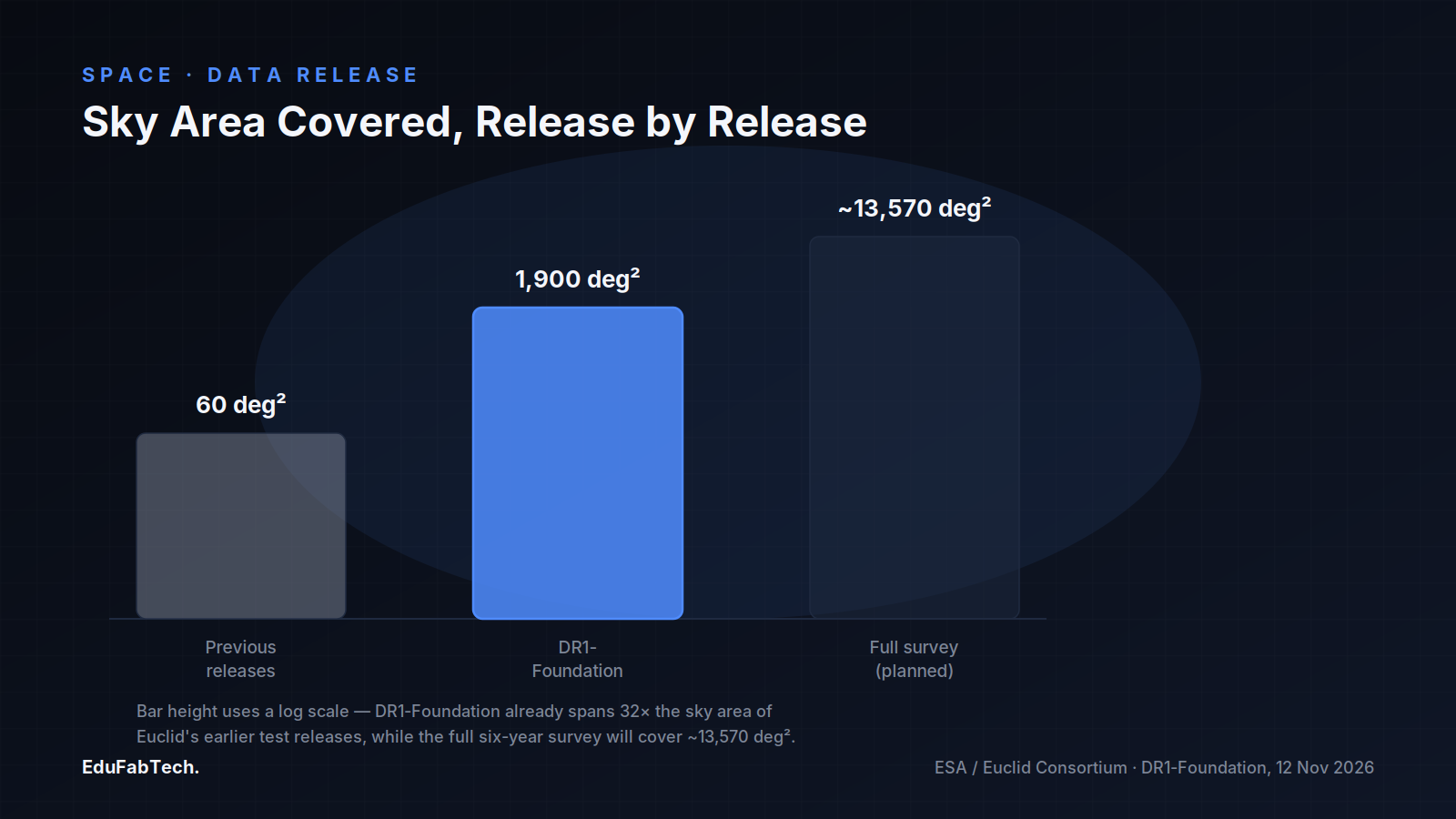
Valeria Pettorino, ESA's Euclid project scientist, said the new release marks "a change in scale from Euclid's previous releases, which included a few days of observations over around 60 deg² of sky," per ESA's statement. The jump to 1,900 square degrees in a single release is what allows the mission to start building a usable map rather than scattered test fields, according to Barbara Sartoris of the Euclid Consortium's JL Lagrange laboratory in Nice, France, who said: "Euclid doesn't just look far back in time — it does so across huge areas of sky."
Why researchers are watching this
Euclid's mission is to investigate dark energy and dark matter by tracing roughly the last 10 billion years of cosmic history, mapping how galaxies cluster and how light from distant galaxies is distorted on its way to Earth, ESA says on the same page. Independent coverage of the release, reported by Phys.org, cites Jochen Weller of LMU Munich describing the release as a step toward "understanding why the expansion of the universe is accelerating," and Frank Grupp of LMU/MPE, Euclid's German project manager, crediting the image quality to "the optics built here in Munich using the most innovative methods."
For researchers, the practical change is access: the catalogues, images and spectra are searchable through the Euclid Data Space at euclid.dataspace.esa.int, rather than held back for the Euclid Consortium alone. That makes DR1-Foundation usable immediately for work on galaxy structure, quasar demographics and lens statistics, without waiting for the mission's full data reduction.
What comes next
DR1-Foundation is a partial release. ESA says the full Data Release 1, due in mid-2027, will build on today's release by adding weak lensing measurements — the statistical distortion of many distant galaxies' shapes by foreground mass, as distinct from the strong lensing of individual objects already included in this release — along with calculations of how galaxies and galaxy clusters fit into the cosmic web. Combined with DR1-Foundation's spectra and galaxy catalogue, that later release is intended to let researchers assemble galaxies, clusters and dark matter distributions into a single three-dimensional map of cosmic structure.
Bruno Altieri, ESA's Archive Scientist at the European Space Astronomy Centre, credited the release itself to logistics as much as astrophysics: "The release was made possible by the skill, dedication, and commitment of the teams involved in the Euclid Data Space project," he said, according to ESA. At 1.7 million gigabytes for roughly one-seventh of the planned survey area, the scale of data handling is expected to grow substantially as Euclid continues observing toward its six-year target.
Students and early-career researchers outside the Euclid Consortium can already query the released catalogues directly, giving outside groups access to cosmological-scale lensing and quasar statistics without having built the instrument themselves.
A quick question for readers
Which study habit do you think is most overrated?
Some popular habits have little evidence behind them. Which one do you think gets too much credit?
Pick an answer, create a free account in a minute, and your vote counts. Already a member? Sign in
Comments 3
Comment-
The number that jumps out is 1.7 million gigabytes for 14% of the survey. If data volume scales roughly with sky area, you're looking at som…
-
15,000 strong-lensing candidates is the number worth sitting with, especially with the claim it's bigger than all previous catalogues combin…
-
The 1,900 square degrees figure is the one that matters here, not the 900 million galaxies headline. Pettorino's comparison to the previous…
Join free to read the full comments and reply Comments are between members; an account takes a minute.
Source: European Space Agency (ESA)
Sources (3)
- European Space Agency. Euclid lays the foundation for its best-ever 3D map of the Universe. ESA, 2026. esa.int ↗ · checked 13 Nov 2026
- ESA Euclid Consortium. COSMOS Euclid Data Release 1. ESA Cosmos, 2026. cosmos.esa.int ↗ · checked 13 Nov 2026
- Phys.org. Euclid offers best-ever 3D map of the universe to date. Phys.org, 2026. phys.org ↗ · checked 13 Nov 2026