Euclid Finds a Quasar at Redshift 8.13, 630 Million Years After the Big Bang
ESA announced on 24 November 2026 that its Euclid telescope found quasar J1504+6252, 40 million years older than its own previous record, with a black hole growing far below its theoretical accretion limit.
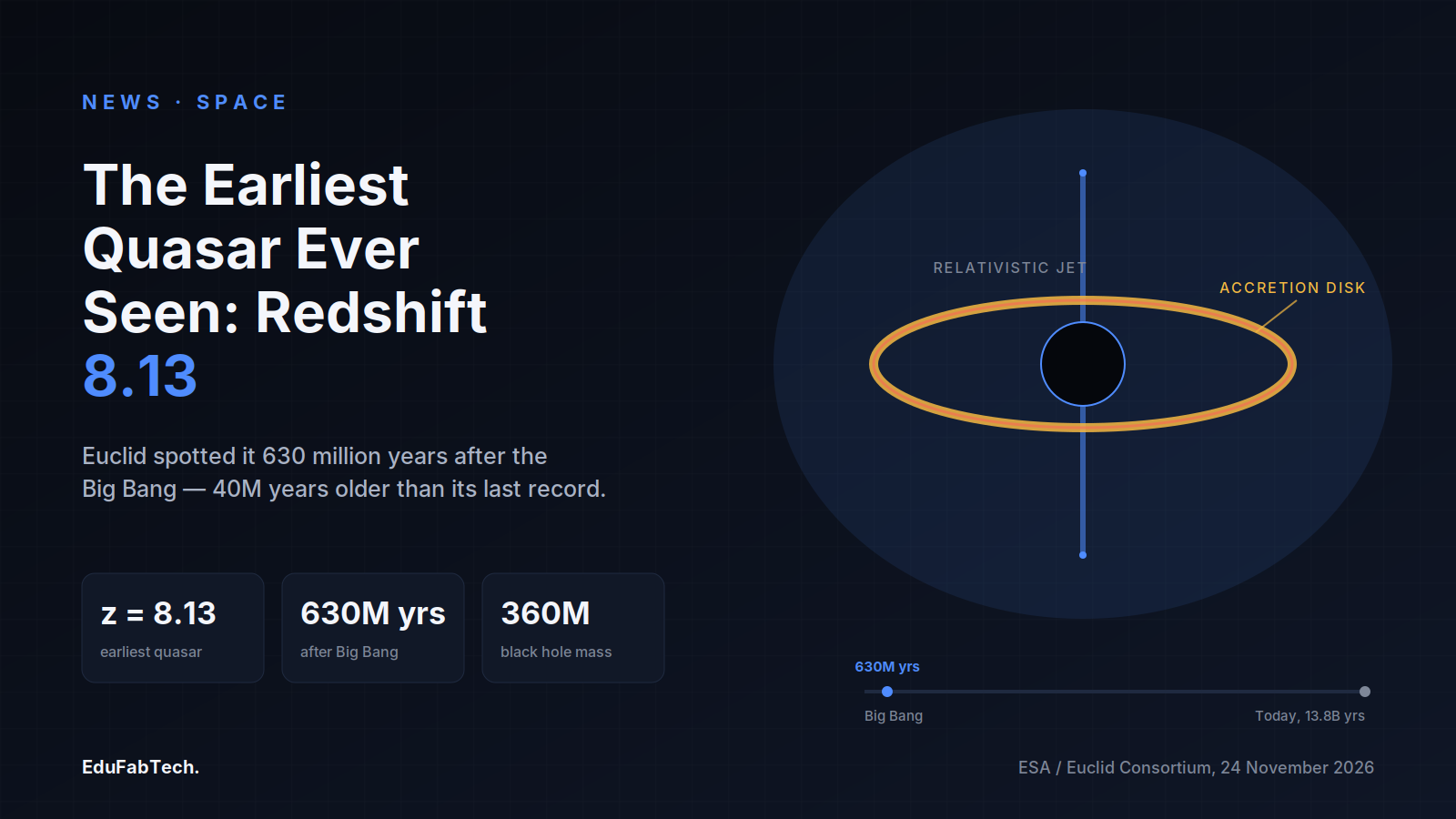
The European Space Agency announced on 24 November 2026 that its Euclid space telescope has found the most distant quasar known to date: an object cataloged as J1504+6252 and nicknamed Dún Aonghasa, seen as it was roughly 630 million years after the Big Bang. The discovery, published in Astronomy & Astrophysics by a team led by Julien Wolf that included Silvia Belladitta, makes it the first confirmed quasar at a redshift beyond 8 — specifically z = 8.13 — and pushes Euclid's own previous record back by 40 million years, a record the mission had set only months earlier, according to the ESA announcement.
A quasar is the bright core of a galaxy powered by a supermassive black hole actively pulling in surrounding gas and dust. Because that process releases enormous amounts of light, quasars can be seen across most of the observable universe, making them one of the few ways to study what black holes looked like when the cosmos was still very young. Dún Aonghasa's black hole has a mass of about 360 million Suns, according to the ESA announcement, which is modest compared with some other early quasars but still a challenge to explain for a universe that, at the time, was less than 5% of its current age.
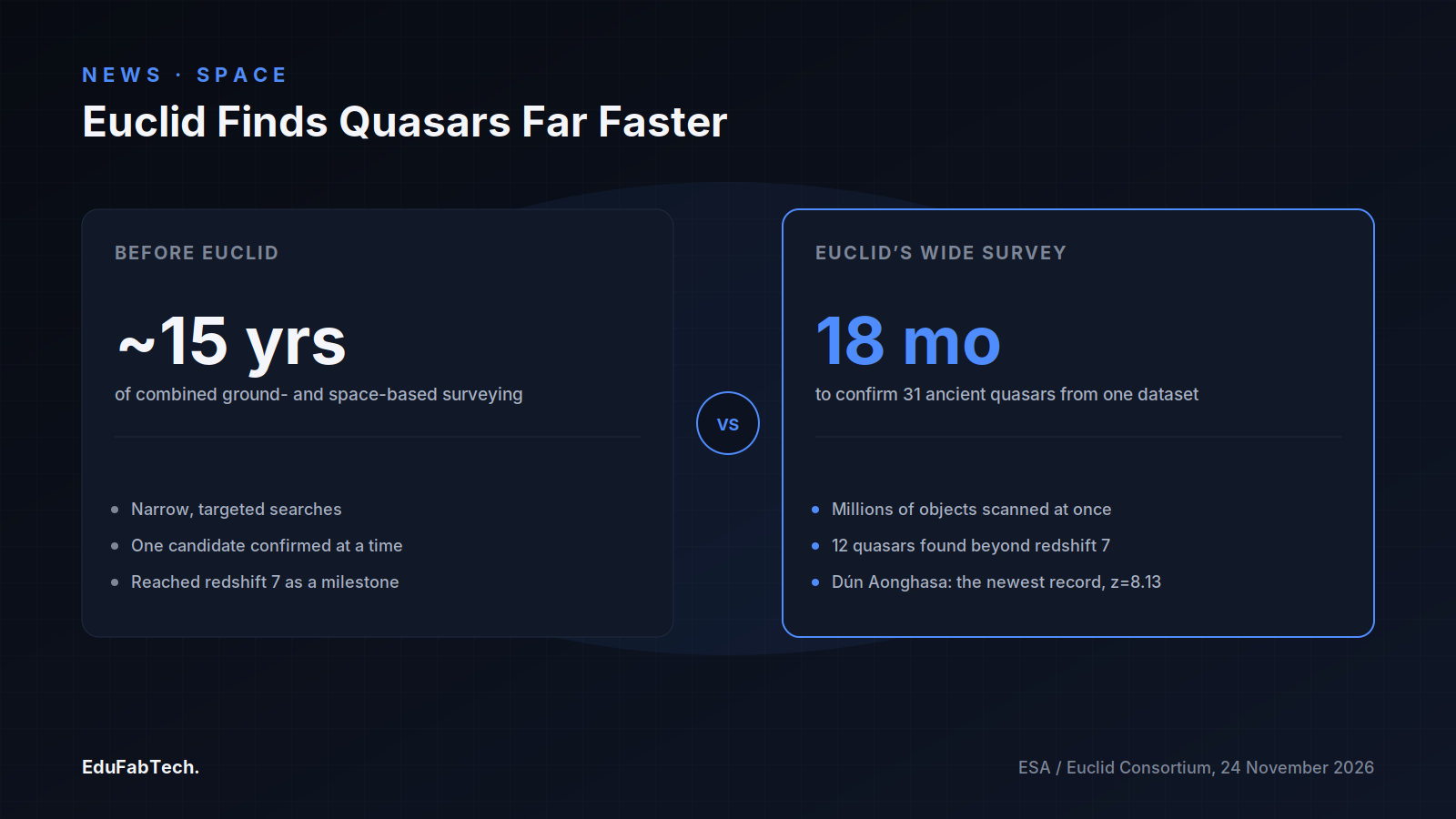
Euclid found the object within roughly 18 months of data from its Wide Survey, searching among millions of objects, per the ESA page. The candidate was then followed up and confirmed using the W. M. Keck Observatory, the Large Binocular Telescope Observatory, the Hubble Space Telescope and the James Webb Space Telescope, which showed that the black hole has a mass of approximately 360 million Suns, ESA says. Since Euclid began its science operations, the mission has announced 31 ancient quasars, 12 of them beyond redshift 7 — a threshold that previously took about 15 years of ground- and space-based surveying to reach, according to the ESA announcement.
A black hole that is growing slowly
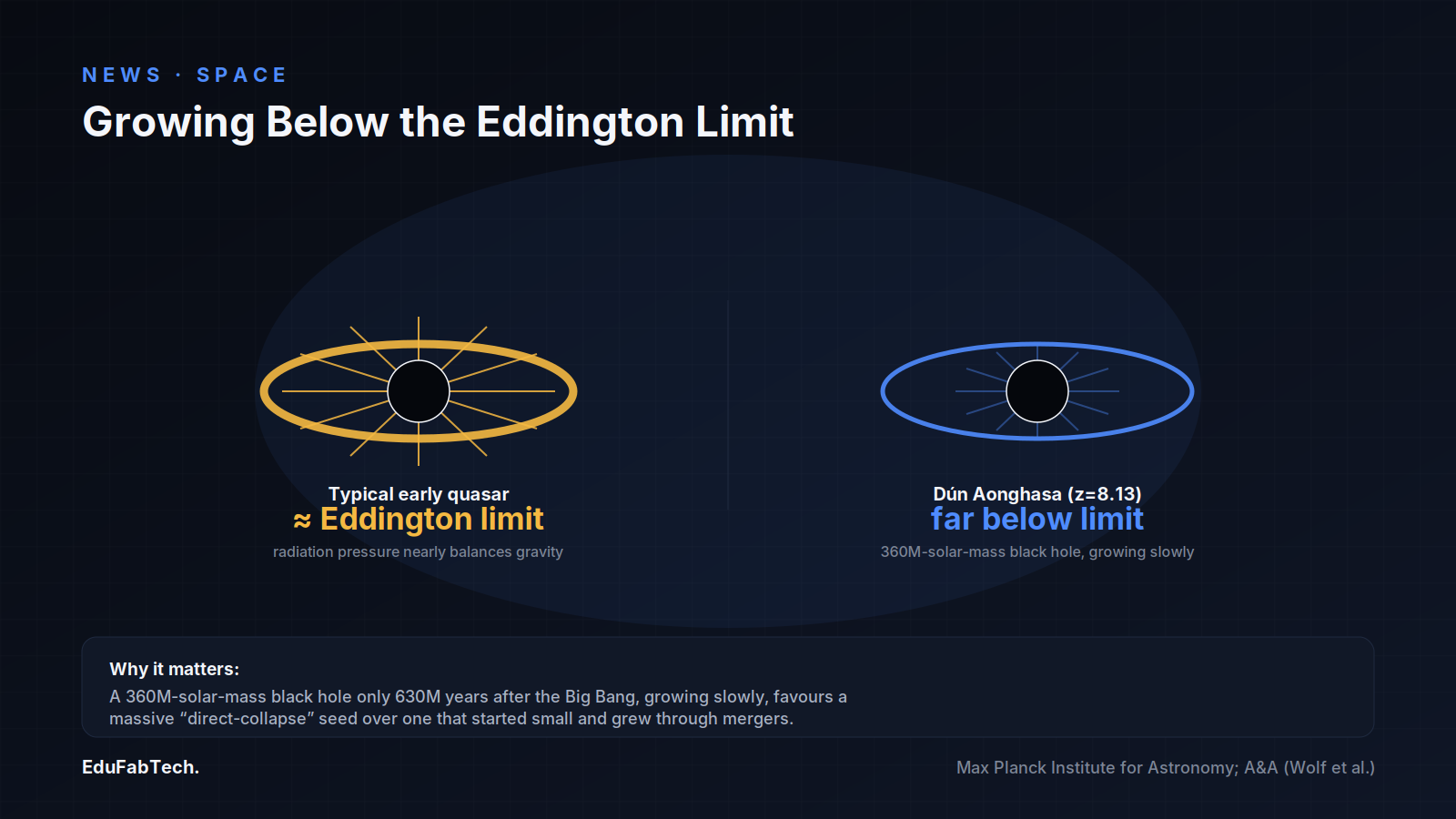
What makes Dún Aonghasa unusual is not just its distance but its behaviour. Most quasars found this early in cosmic history are feeding on surrounding material at close to their theoretical maximum rate, known as the Eddington limit — the point at which the outward pressure of radiation from infalling matter balances the black hole's inward pull of gravity. According to the Max Planck Institute for Astronomy's announcement, observational data indicate that Dún Aonghasa is growing "far below" that limit.
That is a puzzle, because a black hole of several hundred million solar masses needs either a long time or an unusually fast growth spurt to reach that size. Finding one that is now accreting slowly, so early after the Big Bang, suggests to the researchers that it either grew unusually quickly earlier in its history or started from an already massive "seed" black hole, the Max Planck Institute states. The result, the institute says, favours so-called direct-collapse scenarios for how the first black hole seeds formed, over models in which seeds start much smaller and grow gradually through mergers and accretion over longer stretches of time.
What the team says it means
Julien Wolf, who led the study and is affiliated with the Max Planck Institute for Astronomy and the European Southern Observatory, is quoted by the Max Planck Institute as saying: "Finding quasars at ever-increasing distances, at the edge of the observable universe, teaches us something about how the black holes in their centres grew." The institute also notes that if quasars continue to turn up at even higher redshifts than Dún Aonghasa, "even the direct collapse scenario may become less likely," which would push theorists toward more exotic explanations, including primordial black holes formed in the first moments after the Big Bang.
The quasar's nickname comes from a prehistoric cliff-top stone fort on Inis Mór, in Ireland's Aran Islands, which the ESA announcement describes as a place "where land gives way to a vast oceanic horizon" — an image the team applied to a quasar that currently marks the edge of what instruments can detect this early in the universe's history.
Why it matters beyond this one object
For researchers studying galaxy and black hole formation, each confirmed quasar at these redshifts adds a data point to a population that remains very small. Euclid's Wide Survey is designed to cover a large area of sky at consistent depth, which is what allowed the mission to confirm 31 ancient quasars at these distances within about a year and a half, rather than requiring the targeted, narrower searches that earlier instruments depended on, per the ESA announcement. The Astronomy & Astrophysics paper reports the discovery in detail; Dún Aonghasa is one of the twelve Euclid-identified quasars beyond redshift 7, according to the ESA announcement.
Euclid's primary mission is to study dark matter and dark energy by mapping the large-scale structure of the universe, according to ESA. Quasar discoveries such as this one are a byproduct of the same wide-field survey data, illustrating how a single astronomical program can produce results across more than one subfield. For students of cosmology, the specific numbers to track going forward are the redshift records as they fall, and whether future detections keep showing the same low accretion rates seen in Dún Aonghasa or instead show rapidly accreting black holes, which would point toward a different formation history.
A quick question for readers
Which study habit do you think is most overrated?
Some popular habits have little evidence behind them. Which one do you think gets too much credit?
Pick an answer, create a free account in a minute, and your vote counts. Already a member? Sign in
Comments 3
Comment-
The part that undersells the oddity is the accretion rate, not the redshift. A 360-million-solar-mass black hole only 630 million years in a…
-
The part that should get more scrutiny than the redshift record is the inferential leap from "accreting slowly now" to "favors direct collap…
-
The bit that's genuinely counterintuitive here: a slowly-growing black hole this early is the harder thing to explain, not the easier one. I…
Join free to read the full comments and reply Comments are between members; an account takes a minute.
Source: European Space Agency
Sources (3)
- J. Wolf, S. Belladitta et al.. Euclid: Discovery of a quasar at z = 8.13 hosting a 360-million-solar-mass black hole. Astronomy & Astrophysics, 2026. aanda.org ↗ · checked 28 Nov 2026
- European Space Agency. Euclid breaks own quasar record by 40 million years. ESA, 2026. esa.int ↗ · checked 28 Nov 2026
- Max Planck Institute for Astronomy. New quasar record tightens constraints on black hole formation scenarios. Max Planck Society, 2026. mpg.de ↗ · checked 28 Nov 2026