European Parliament Backs €47.39bn Erasmus+ Budget for 2028-2034, Above Commission's €40.8bn
MEPs voted 454-34 on 22 October 2026 to raise the next Erasmus+ programme's budget and widen access for vocational and school learners, setting up negotiations with EU governments.
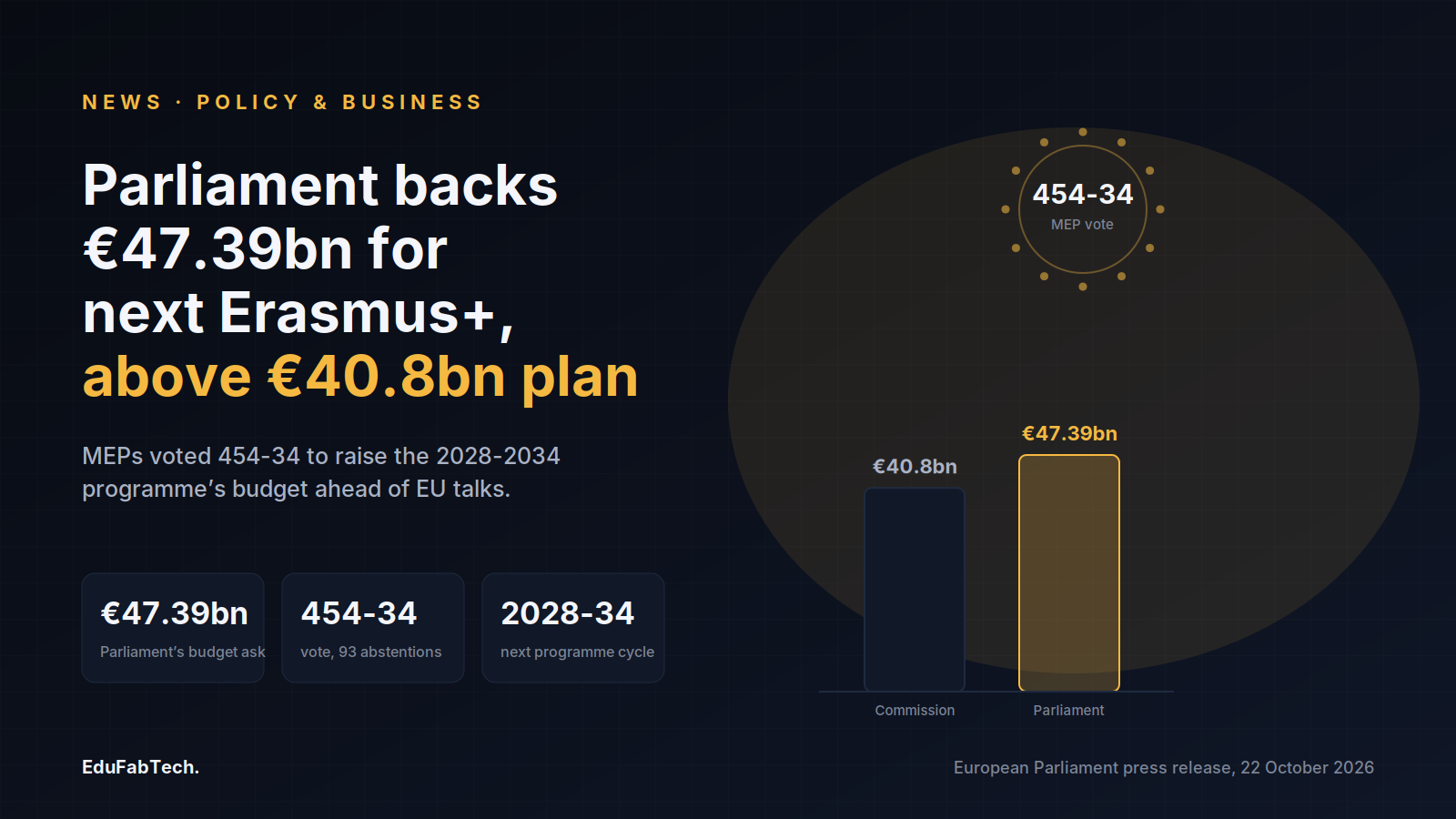
The European Parliament voted on 22 October 2026 to seek a budget of €47.39 billion for the next Erasmus+ programme, covering 2028 to 2034, exceeding the €40.8 billion the European Commission had proposed for the same period. MEPs backed the position by 454 votes to 34, with 93 abstentions, according to the European Parliament's press release on the vote.
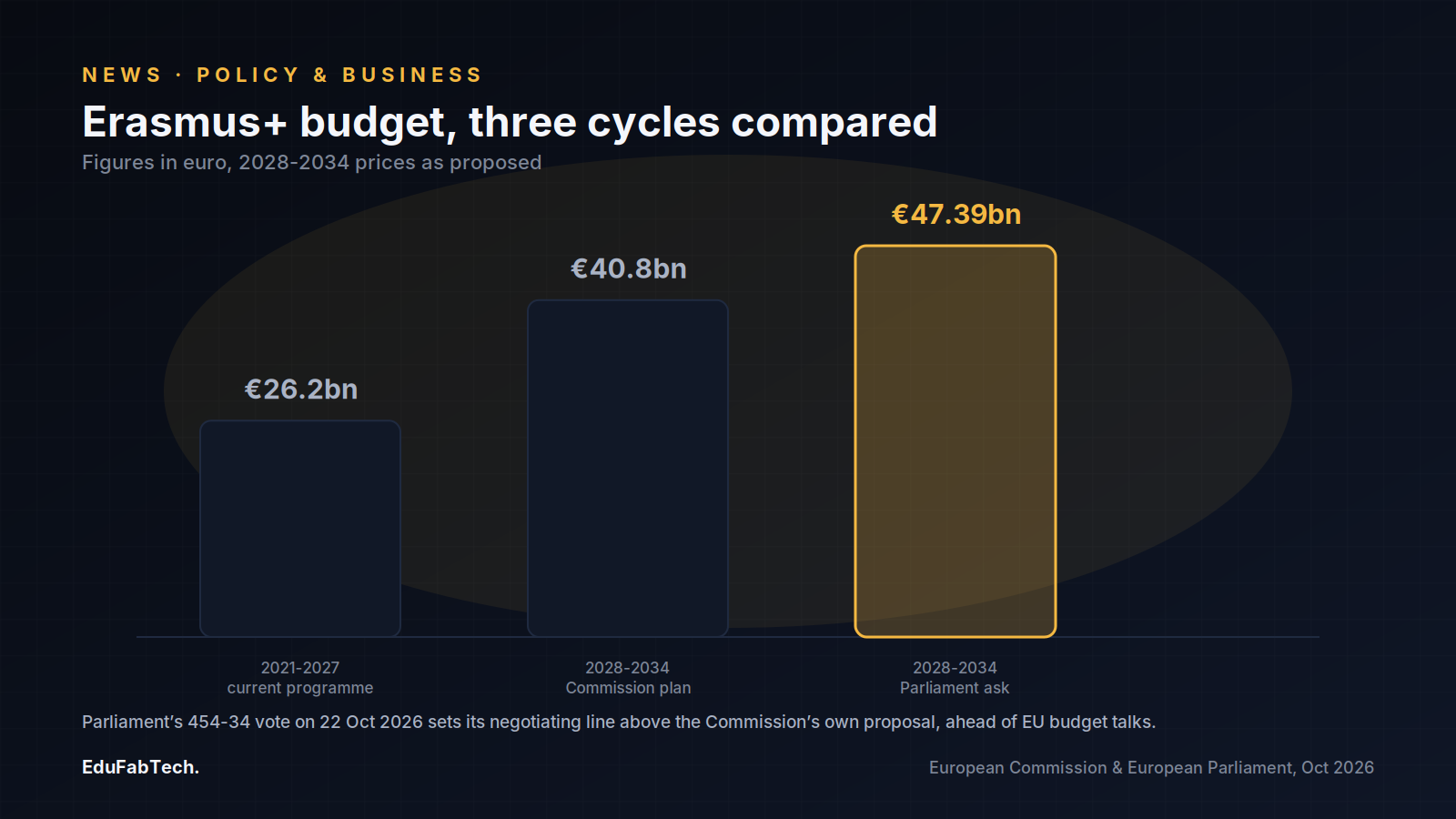
Erasmus+ funds student and staff mobility, school exchanges, vocational training placements and youth and sport activities across the European Union and partner countries. The current programme, running from 2021 to 2027, has a budget of €26.2 billion, the Commission's own proposal page states. The Commission's plan for 2028-2034 would raise that figure by more than half, to €40.8 billion in current prices; Parliament's negotiating position pushes that higher still, to €47.39 billion.
What Parliament is asking for
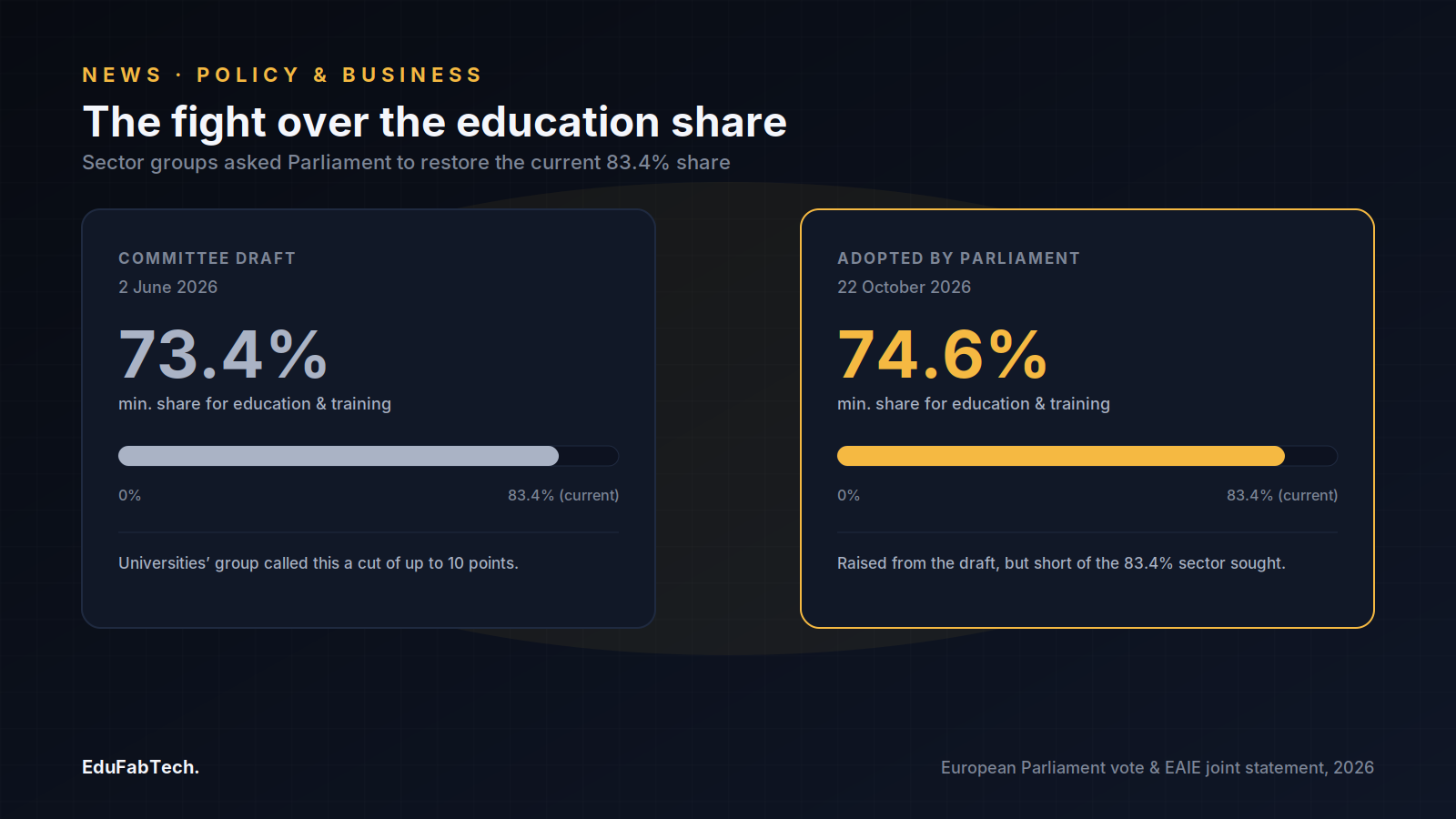
Parliament's adopted text sets minimum budget shares for different parts of the programme: 74.6% for education and training, 15% for youth and volunteering, and 4.1% for sport. Minimum shares were a change the European Association for International Education and 16 other higher education organisations had asked for in a joint statement on the Culture and Education Committee's draft report, dated 2 June 2026, arguing it would give universities, schools and training providers more certainty about what they can plan for before an exchange year begins. That statement said the committee's draft report had set the education and training share at 73.4%, a cut of up to 10 percentage points from the 83.4% share the sector holds under the current programme, and warned this would limit opportunities across the programme, reduce access to mobility and undermine the mobility targets member states have set; it called on Parliament to restore the current 83.4% share. The text MEPs adopted on 22 October lifted the figure only to 74.6%, short of what the signatory organisations had asked for.
The adopted text also asks that mobility grants be adjusted for the varying living, housing and travel costs, and for inflation, in different host countries, regions and cities, according to the European Parliament's press release, so that a student placement in a high-cost city does not carry a proportionally smaller grant than one in a cheaper location. MEPs want wider access for vocational education and training learners and trainers, and for grassroots athletes and coaches, groups that have had limited presence in the programme to date.
Parliament's text also seeks faster participation for EU candidate countries, without requiring them to complete the full association procedure first, and closer Erasmus+ links with the United Kingdom and Switzerland, the European Parliament's press release states. Neither country is yet inside Erasmus+: the UK is due to rejoin from 1 January 2027 under an agreement signed with the EU on 15 April 2026, and Switzerland signed its own EU-programmes association agreement on 10 November 2025, with Erasmus+ membership from 2027 still subject to ratification by the Swiss parliament.
Why the budget gap matters for exchange places
MEP Laurence Farreng, Renew Europe's coordinator on the Culture and Education Committee and one of the file's shadow rapporteurs, said after the vote that "learning mobility must remain at the heart of Erasmus+, strengthening European citizenship and our shared values," according to a report published by Renew Europe's political group. Parliament's position is one input into a three-way negotiation with the Council of the European Union, which represents national governments, and the Commission. The Council agreed its own position on most of the programme's rules on 11 May 2026, but left the budget figure and other provisions tied to the EU's 2028-2034 multiannual financial framework out of that mandate; the final Erasmus+ budget will be settled inside the wider MFF negotiations, not by this vote alone.
What students and teachers would notice
For students and researchers planning mobility years in advance, the practical stakes are in the gap between the Commission's and Parliament's figures: a larger overall budget, if agreed, would mean more funded exchange places and traineeships across the seven-year cycle, while a smaller one would mean the programme absorbs its new responsibilities, including the folding-in of the European Solidarity Corps volunteering scheme, without expanding the number of participants it can support. The minimum-share provision in Parliament's text is aimed specifically at predictability: an exchange office at a university or a vocational school would be able to see roughly what share of the total envelope is reserved for education and training before committing to multi-year exchange agreements, rather than having that share fluctuate year to year inside a single pooled fund.
No decision has been finalised. The Council agreed a partial position on the programme's rules in May 2026 but has not yet taken a position on the budget figure itself, which depends on the outcome of the wider 2028-2034 EU budget negotiations; trilogue talks between Parliament, the Council and the Commission on the remaining, budget-related provisions follow once the Council's full mandate is in place. Universities, school networks and training providers that currently rely on Erasmus+ funding will not know the programme's actual size, or how the money is split between higher education, schools, vocational training, youth work and sport, until that process concludes.
A quick question for readers
What is your biggest monthly expense as a student?
Knowing where the money really goes helps new students plan. Your answer helps someone budget.
Pick an answer, create a free account in a minute, and your vote counts. Already a member? Sign in
Comments 2
Comment-
Worth noticing the Council hasn't even taken a position on the budget figure yet - it punted that to the wider MFF talks. So this 454-34 vot…
-
The detail that stands out is how far Parliament's 74.6% minimum share falls short of the 83.4% the sector coalition actually asked for - th…
Join free to read the full comments and reply Comments are between members; an account takes a minute.
Source: European Parliament (Committee on Culture and Education)
Sources (3)
- European Parliament. A better equipped Erasmus+ 2028-2034 to address the EU's strategic challenges. European Parliament Press Room, 2026. europarl.europa.eu ↗ · checked 24 Oct 2026
- European Commission. Commission proposes new Erasmus+ beyond 2027. Erasmus+ EU, 2025. erasmus-plus.ec.europa.eu ↗ · checked 24 Oct 2026
- European Association for International Education and 16 other organisations. Joint statement on the European Parliament (CULT Committee) draft report on Erasmus+ 2028-2034. EAIE, 2026. eaie.org ↗ · checked 24 Oct 2026