A Hot-Spring Amoeba Pushes the Known Heat Limit for Complex Cells to 63°C
A single-celled organism isolated from a Californian geothermal stream grows at temperatures that kill every other known eukaryote, a Cell study published September 22, 2026, reports.
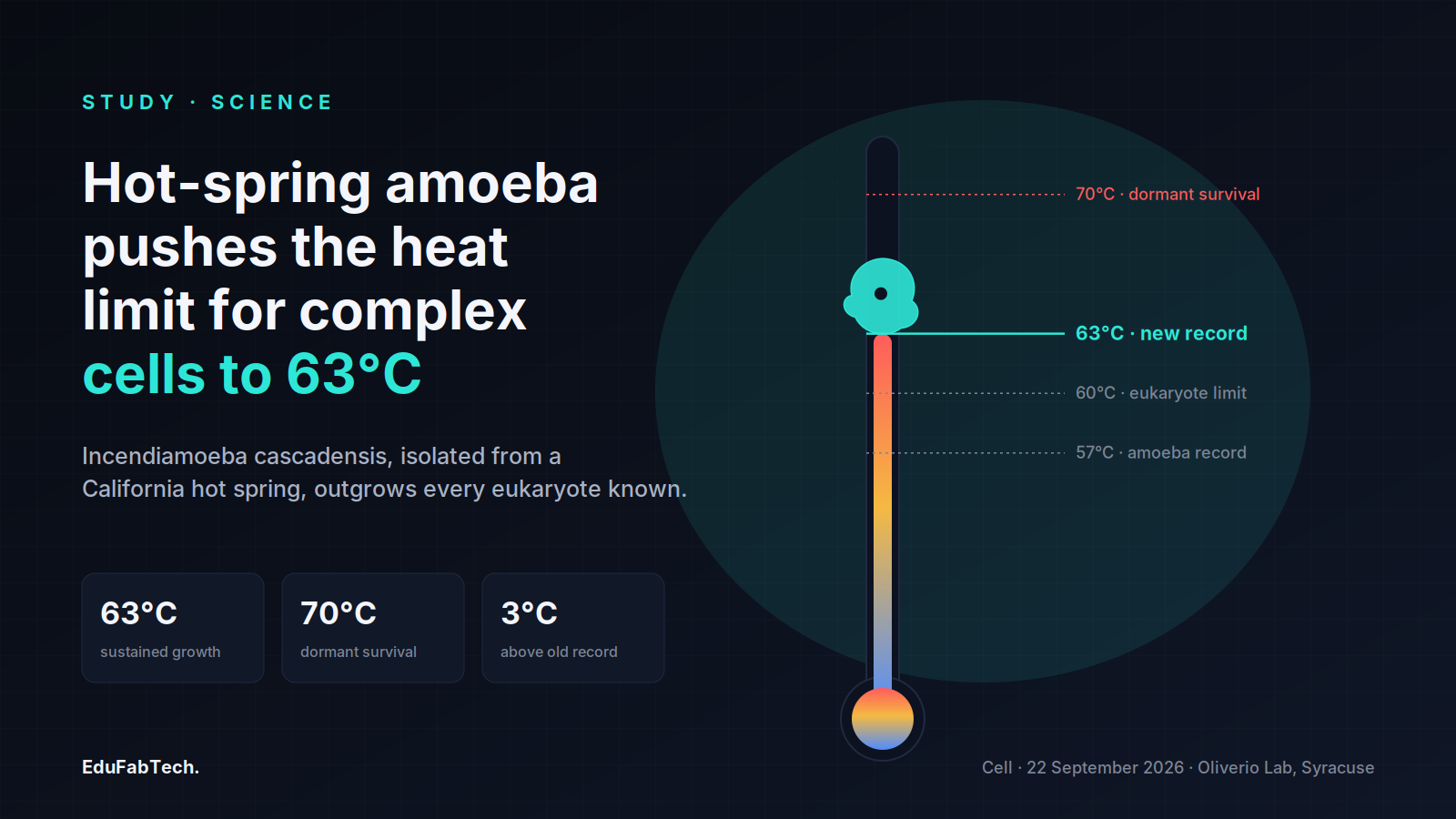
An amoeba isolated from a geothermal stream in California has become the most heat-tolerant eukaryote — a cell with a nucleus — ever documented, growing and dividing at 63°C (145°F) and surviving brief exposure to 70°C (158°F) in a dormant state. The organism, named Incendiamoeba cascadensis, is described in a study published September 22, 2026, in the journal Cell by researchers in Angela Oliverio's lab at Syracuse University in New York.
A record set three degrees higher
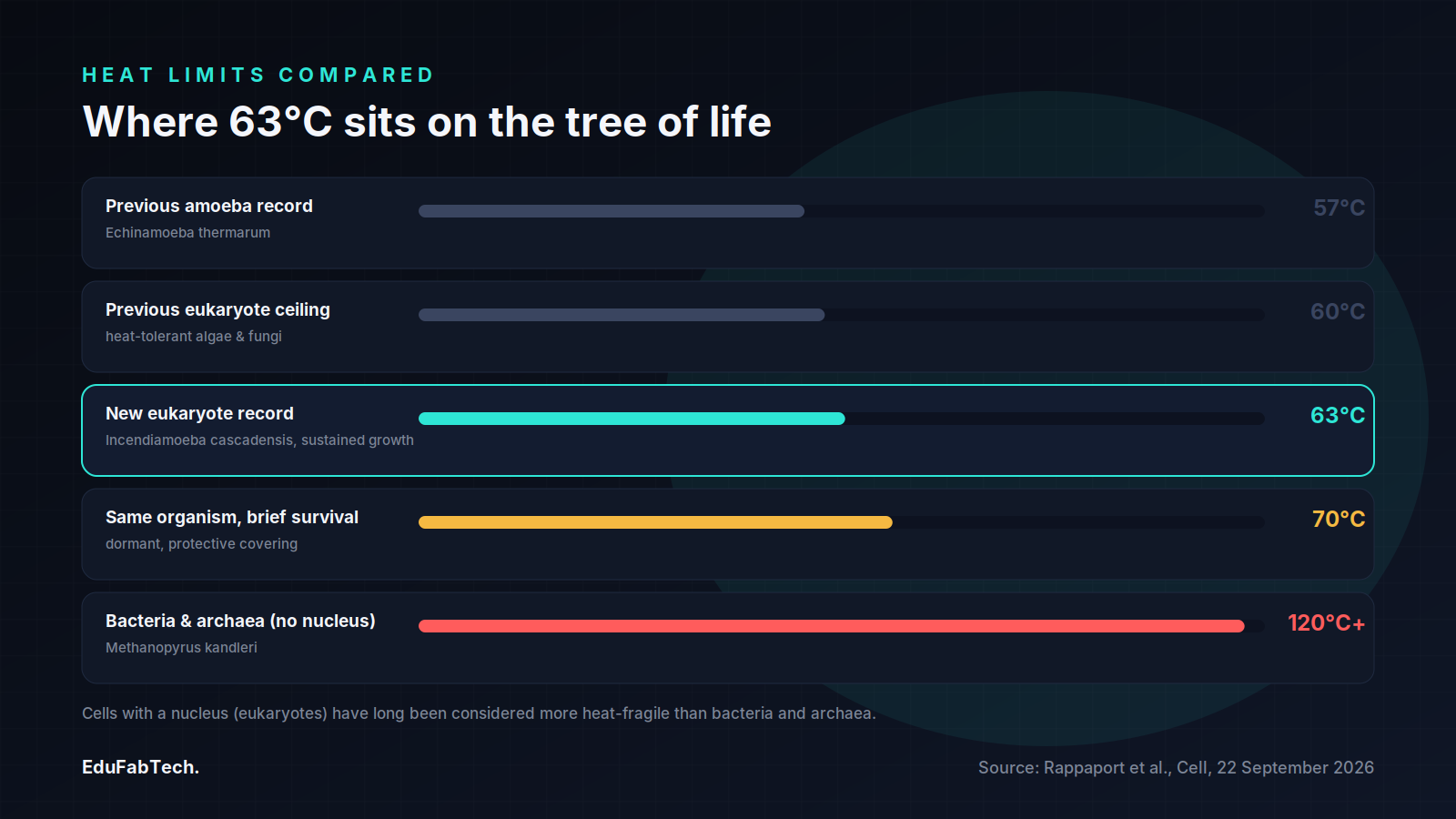
Before this discovery, the accepted upper thermal limit for eukaryotic life sat near 60°C, held by certain heat-tolerant algae and fungi. Among amoebas specifically, the previous record belonged to Echinamoeba thermarum, which tops out around 57°C. Incendiamoeba cascadensis grows and reproduces at 63°C, and can withstand short exposures up to 70°C by changing shape and forming a protective outer covering, according to reporting in Science News. Bacteria and archaea — cells without a nucleus — tolerate far higher temperatures; the archaeon Methanopyrus kandleri can grow above 120°C. The new finding narrows, but does not close, the long-standing gap between what complex cells and simple microbes can endure.
First author H. Beryl Rappaport, a doctoral student in Oliverio's lab, and colleagues collected water samples from geothermal streams in Lassen Volcanic National Park between 2023 and 2025, where temperatures in the springs ranged roughly from 47°C to 64°C. While culturing microbes from those samples at increasingly high temperatures, the team noticed one amoeba that kept growing past the point where every other isolate died off.
How a nucleated cell survives near-boiling water
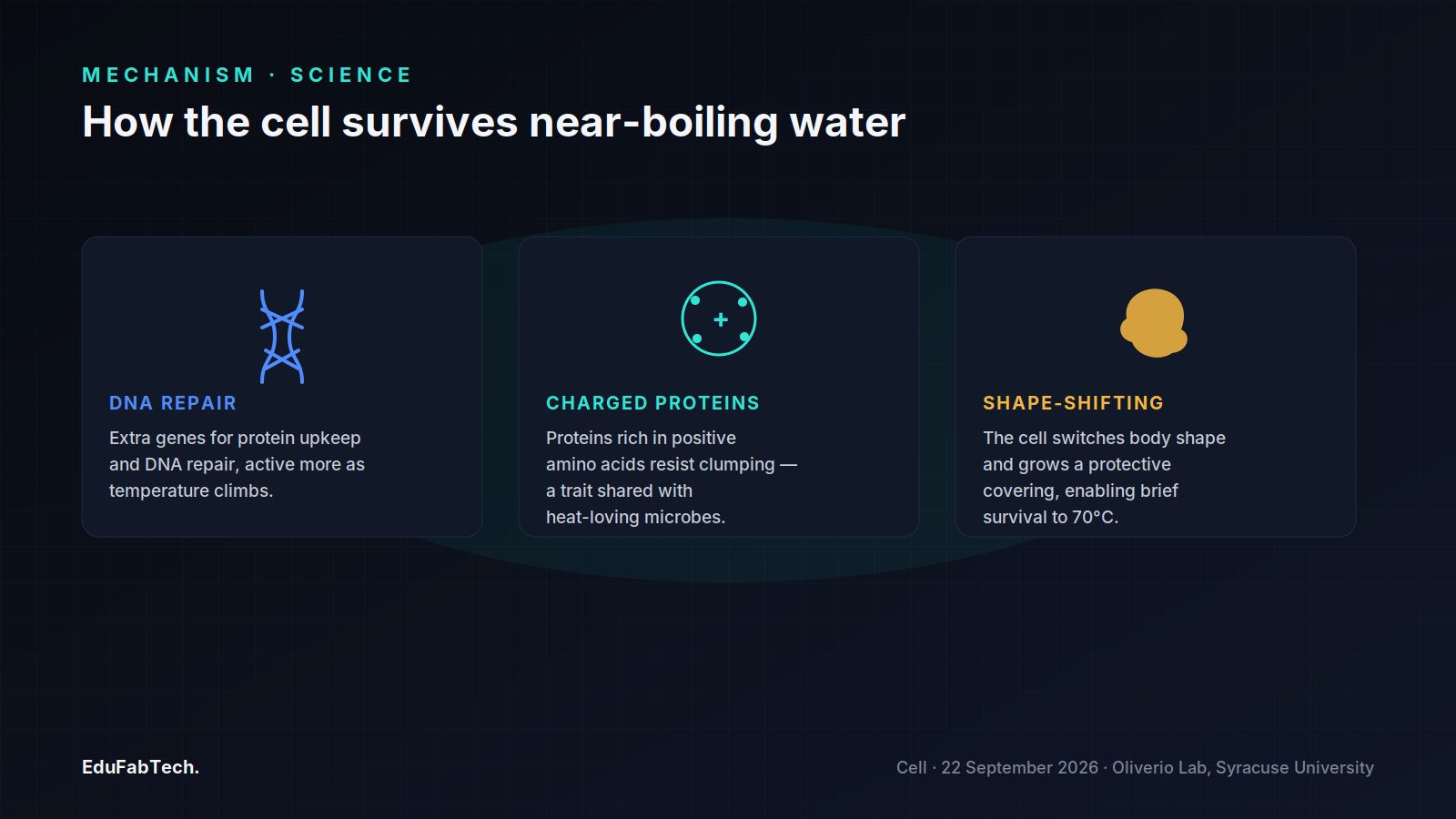
Cells with nuclei have generally been considered more heat-fragile than bacteria and archaea because their proteins, membranes and DNA-repair machinery are thought to degrade at lower temperatures. The Cell paper reports that Incendiamoeba carries extra genes associated with protein maintenance and DNA repair, and that its proteins are enriched in positively charged amino acids — a molecular signature also seen in heat-tolerant bacteria and archaea, thought to help prevent proteins from clumping and misfolding as temperatures rise.
The researchers also compared gene activity in cells grown at 48°C against cells grown at 61°C, near the low and high ends of the organism's growth range. Oliverio, quoted in coverage of the release, said several pathways tied to cellular integrity and DNA repair were upregulated at the higher temperature, suggesting the amoeba actively ramps up repair processes as conditions get more extreme rather than simply enduring the heat passively. The organism also shifts between two different body shapes depending on temperature, a behavior the researchers link to its survival strategy near its upper limit.
What the researchers are, and are not, claiming
The paper frames 63°C as the current documented ceiling for eukaryotic growth, not a hard biological boundary. "We suspect that other high-temperature eukaryotic organisms await discovery," Oliverio said. Rappaport said the team is now searching for Incendiamoeba cascadensis in other geothermal environments to establish how widely distributed it is — a question the current study, based on isolates from a single park, does not answer.
"Our hope is that this effort will inspire others to continue characterizing many of the unique microbial eukaryotic lineages that break the rules of biology."
That caution matters: the study establishes a new observed record and a plausible molecular explanation for it, but it does not establish an absolute physical limit for eukaryotic life, nor does it show how common heat-tolerant eukaryotes are in nature more broadly. The work was supported in part by NASA, the National Institute of General Medical Sciences and the Howard Hughes Medical Institute, a funding mix that reflects the finding's relevance to astrobiology as much as to cell biology — organisms that push the known limits of terrestrial life inform models of what kinds of environments elsewhere might sustain complex cellular life.
Why the distinction between simple and complex cells matters here
The finding is notable specifically because it involves a eukaryote, not because extreme heat tolerance itself is new to biology. Archaea and bacteria have been found thriving well above 100°C in hydrothermal vents and hot springs for decades, but their cells lack the nucleus, internal membrane systems and larger genomes that make eukaryotic cells — the category that includes everything from amoebas to fungi to animals — generally more heat-sensitive. A short list situates the new record:
- Bacteria/archaea (no nucleus): tolerate the most extreme heat; Methanopyrus kandleri grows above 120°C.
- Previous eukaryote ceiling: roughly 60°C, held by certain thermotolerant algae and fungi.
- Previous amoeba record: Echinamoeba thermarum, around 57°C.
- Incendiamoeba cascadensis (new record): growth at 63°C; short-term survival to 70°C.
The genus name, from the Latin for fire, reflects both the hot-spring habitat and the organism's resistance to conditions that would rapidly kill related amoebas. The species name, cascadensis, refers to the Cascade volcanic region in which Lassen Volcanic National Park sits. The researchers have not yet reported finding the organism outside that park, and the paper stops short of claiming it represents a fixed upper boundary for eukaryotic life — only the highest documented one so far.
- H. Beryl Rappaport, Angela M. Oliverio, et al.. A geothermal amoeba sets a new upper temperature limit for eukaryotes. Cell, 2026. doi:10.1016/j.cell.2026.08.043
- Erin Garcia de Jesus. Meet the 'fire amoeba,' a record-breaking survivor of extreme heat. Science News, 2026. link
- NASA Science. NASA-Funded Research Finds Complex Life Defying Record Heat. NASA, 2026. link
- Cell Press. Hot spring amoeba breaks record for heat tolerance of complex life. Phys.org, 2026. link
- Ed Cara. Say Hello to the 'Fire Amoeba.' It Just Broke a Heat Limit Scientists Thought Was Impossible. Gizmodo, 2026. link