US Employers Say AI Will Raise College-Degree Value, Gallup-Lumina Survey of 2,500 Finds
A Gallup-Lumina Foundation poll of 2,500 US hiring managers, fielded in August 2026, finds confidence in degrees intact despite AI, while a 39-country GMAC survey shows the skills employers want shifting differently abroad.
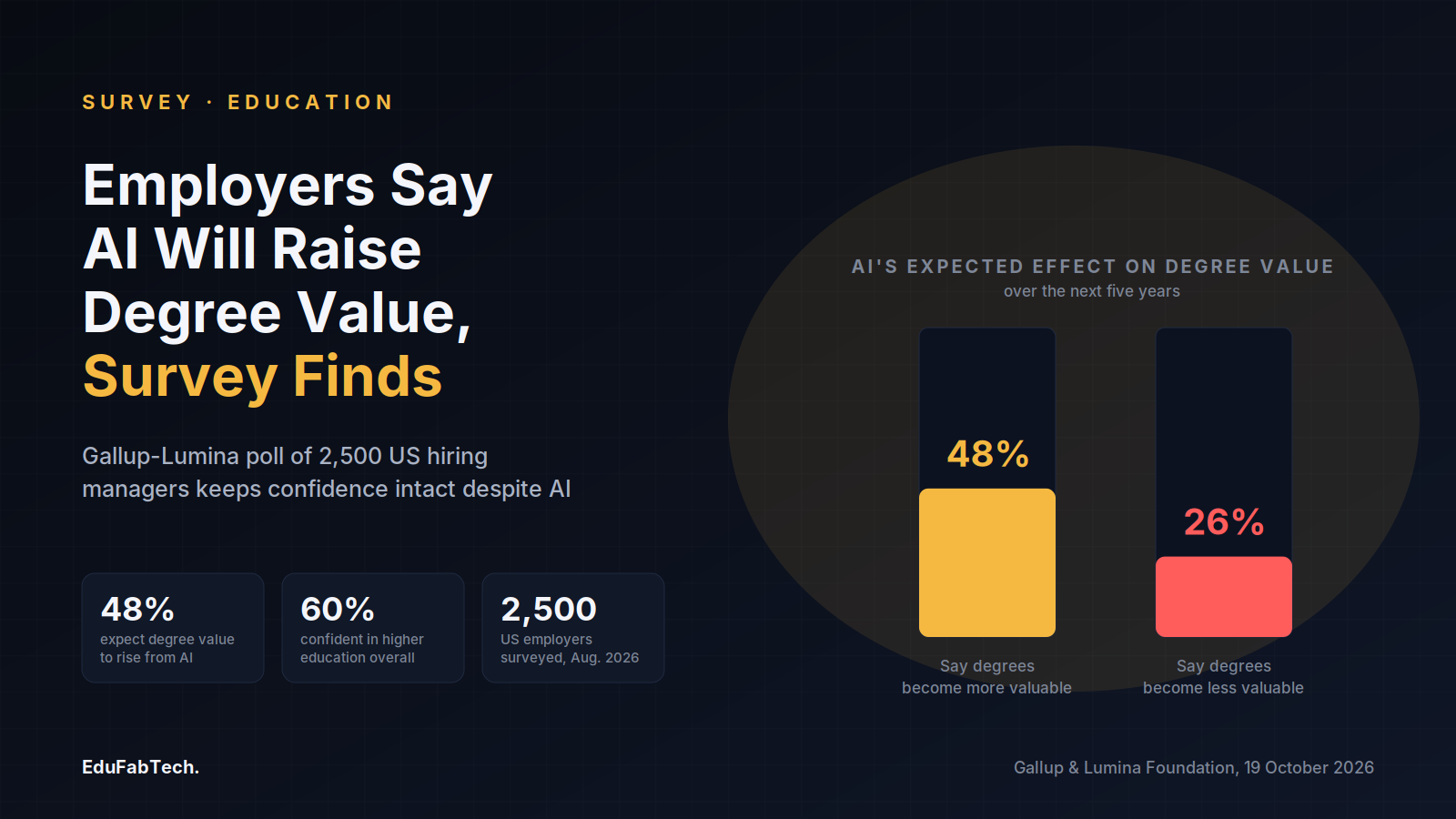
On 19 October 2026, Gallup published findings from a survey of 2,500 US employers conducted with the Lumina Foundation, reporting that 48% of hiring decision-makers expect artificial intelligence to make college degrees more important over the next five years, against 26% who expect the opposite. The survey, described by Gallup authors Stephanie Marken and Andrea Malek Ash as part of the organizations' ongoing State of Higher Education research, was fielded as an opt-in online poll from 5 to 18 August 2026.
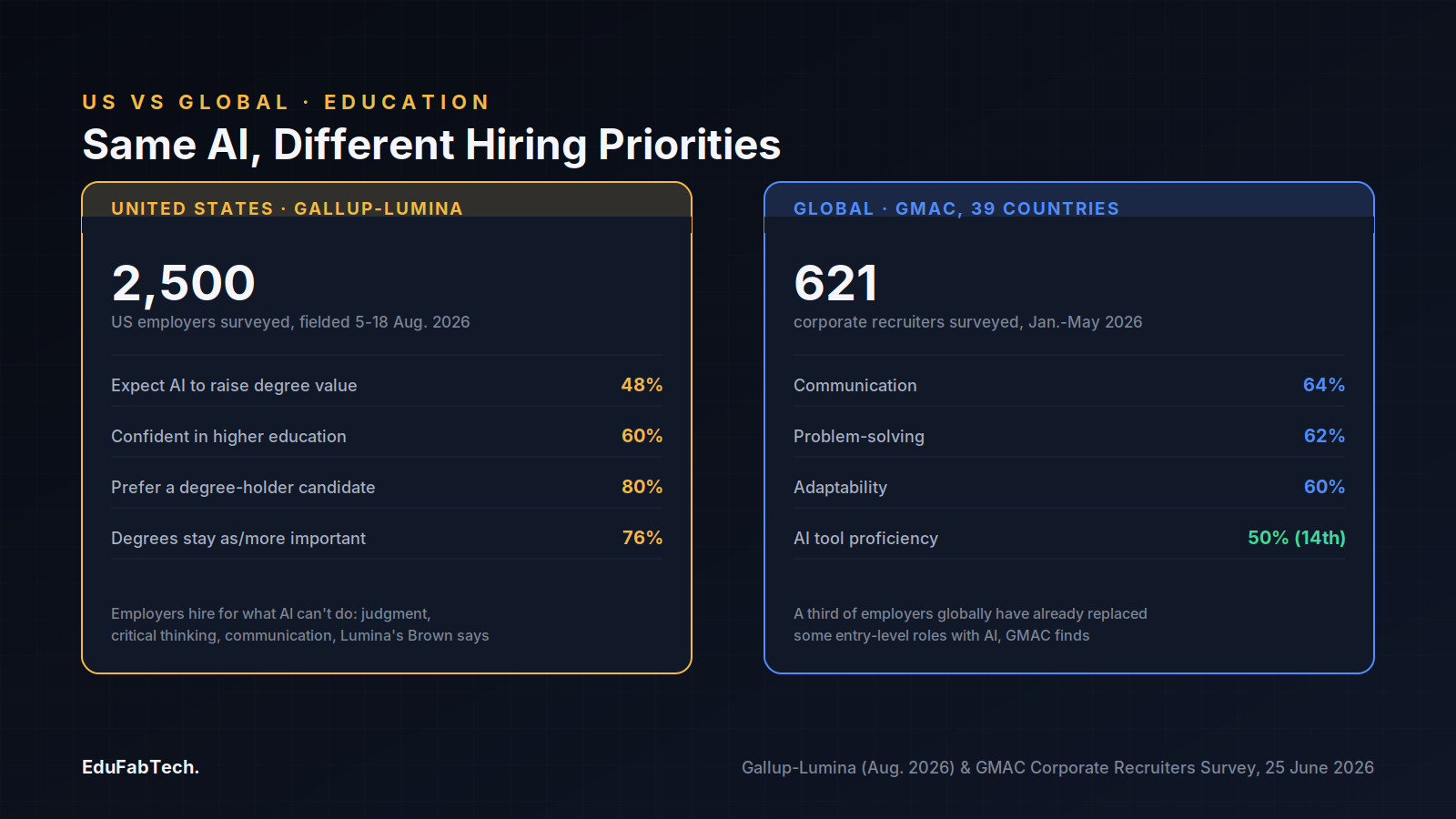
Overall, 60% of respondents said they have "a great deal" (26%) or "quite a lot" (34%) of confidence in higher education as an institution, according to the same Gallup report. Eighty percent said they would prefer a candidate with a degree even for a role that does not require one. Gallup notes that it calculated no margin of error and applied no weighting to the sample, since respondents opted in rather than being drawn at random.
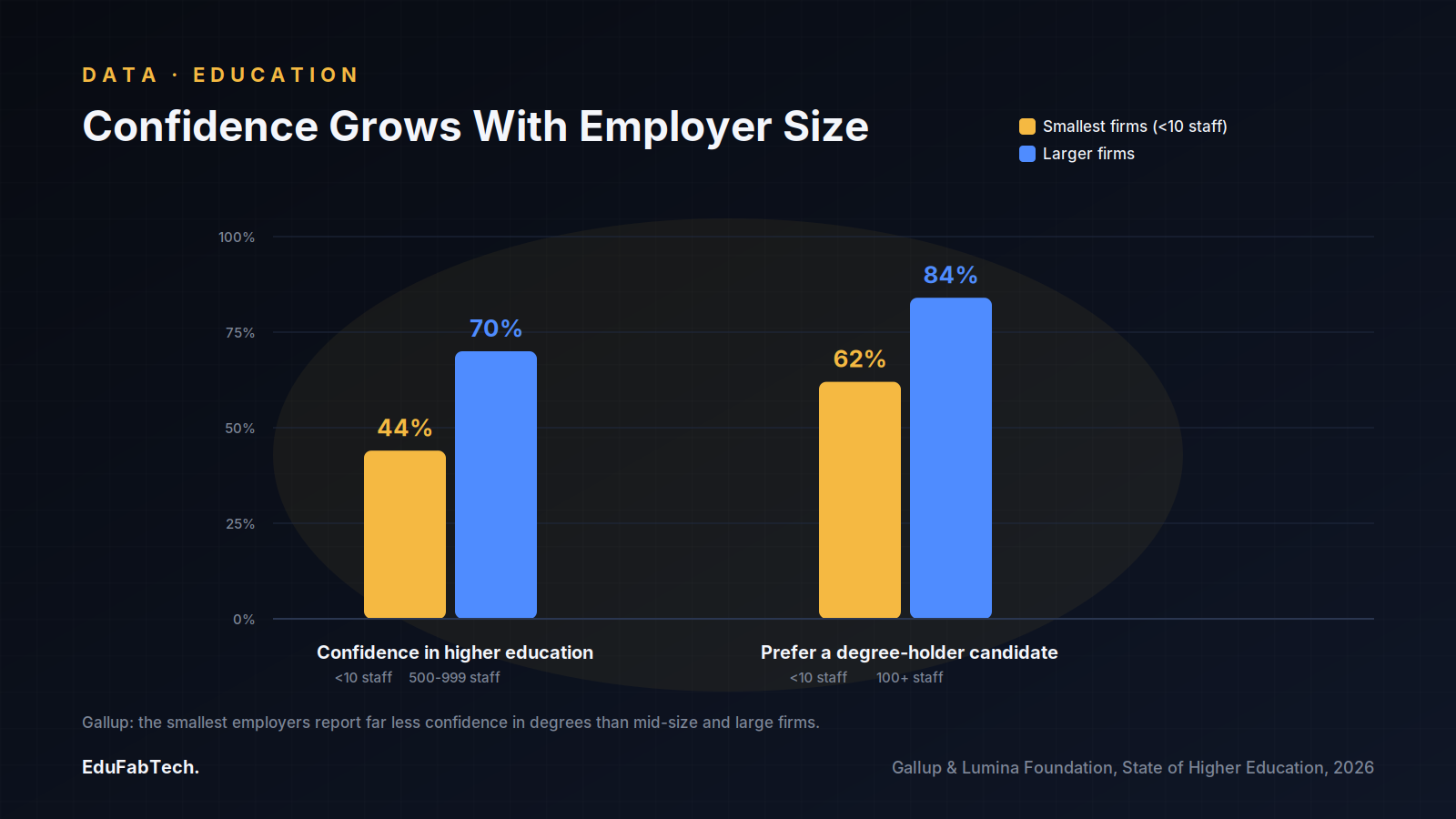
Confidence was far from uniform. By firm size, Gallup found 44% confidence among employers with fewer than 10 staff, rising to 70% at firms with 500 to 999 employees. Preference for degree-holders followed a similar pattern, from 62% at the smallest firms to 84% or higher among those with 100 or more employees, Gallup reported. By industry, confidence reached 70% in information and in education and health services, against 51% in professional and business services and 52% in leisure and hospitality.
What employers say they are hiring for
Reporting on the same data on 20 October 2026, Inside Higher Ed's Kathryn Palmer quoted Courtney Brown, the Lumina Foundation's vice president of impact and planning, saying: "Employers are hiring for the things that AI can't do. They're putting a premium on judgment, critical thinking, communication and adaptability," according to Inside Higher Ed's account of the survey. Gallup's own report states that 76% of employers expect degrees to remain as important or more important for getting a good job than they are today.
The findings sit inside a larger pattern Gallup and Lumina have tracked for several years: that employers distinguish between the credential and the capability behind it. The August 2026 employer poll is one leg of a broader annual study that Gallup says also surveys adults without a degree and recent graduates separately, though those companion results were not part of the 19 October release.
A different weighting abroad
The Gallup-Lumina sample covers only US employers, so it does not show whether confidence in degrees is moving the same way elsewhere. A separate, genuinely international survey offers a partial comparison on the skills question, if not on degree confidence itself. The Graduate Management Admission Council's 2026 Corporate Recruiters Survey, published 25 June 2026 after fielding responses from 621 corporate recruiters and hiring managers across 39 countries between January and May 2026, found that communication skills (64%), problem-solving (62%) and adaptability (60%) topped current hiring priorities, with AI tool proficiency ranked 14th among present priorities at 50% even as it was projected to top employers' five-year forecasts, according to GMAC's report. The same survey found that a third of employers globally said they had already replaced at least some entry-level roles with AI.
What it means for students and teachers
Neither survey resolves the question of whether a degree is "worth it" in the abstract. What they show, read together, is that employers in the one market surveyed by Gallup are not abandoning the degree as a signal, even as they say the skills behind it — judgment, communication, adaptability, and now AI-tool fluency — matter more than the credential alone. For students choosing programmes, the practical reading is that coursework demonstrating those named skills, not AI literacy alone, is what employers in this US sample say they struggle to find.
For teaching staff designing curricula, the GMAC data point to a specific gap: AI tool proficiency is rising fastest in employer demand yet ranks low in current priority and preparedness, a mismatch GMAC's report describes as leaving "fewer than half of employers" judging graduates well prepared in that area. Because the Gallup-Lumina employer survey covers only the United States and used an opt-in, unweighted sample, readers outside that market, or comparing confidence levels across countries, should treat its percentages as a US data point rather than a global trend.
| Measure | Smallest employers | Largest employers |
|---|---|---|
| Confidence in higher education (Gallup, 2026) | 44% (<10 staff) | 70% (500-999 staff) |
| Prefer a degree-holder (Gallup, 2026) | 62% (<10 staff) | 84%+ (100+ staff) |
A quick question for readers
What mattered most when you chose your university?
Pick up to three. Future students will use these results to decide what to weigh.
Pick up to 3 →Comments 3
Comment-
The 48% vs 26% split gets all the attention, but the methodology line is the one that should give people pause: opt-in, unweighted, no margi…
-
The number I keep snagging on is the one Gallup itself flags: no margin of error, no weighting, opt-in sample of 2,500. That doesn't make 48…
-
The gap I'd flag is the one between the two surveys, not within either one. Gallup's US employers say AI tool proficiency doesn't even featu…
Join free to read the full comments and reply Comments are between members; an account takes a minute.
Source: Gallup
Sources (3)
- Stephanie Marken, Andrea Malek Ash. Employers' Confidence in Higher Education Undaunted by AI. Gallup, 2026. news.gallup.com ↗ · checked 26 Oct 2026
- Kathryn Palmer. Employers Say AI Will Make College Degrees More Important. Inside Higher Ed, 2026. insidehighered.com ↗ · checked 26 Oct 2026
- Graduate Management Admission Council. 2026 Corporate Recruiters Survey Report. GMAC, 2026. gmac.com ↗ · checked 26 Oct 2026