Global Education Fund Raises $3.5 Billion at UN Event, Short of Its $15 Billion Target
The Global Partnership for Education's 2026–2030 replenishment drew pledges from dozens of governments, but a steep cut by one of its largest historical donors stood out against rising domestic spending in lower-income partner countries.
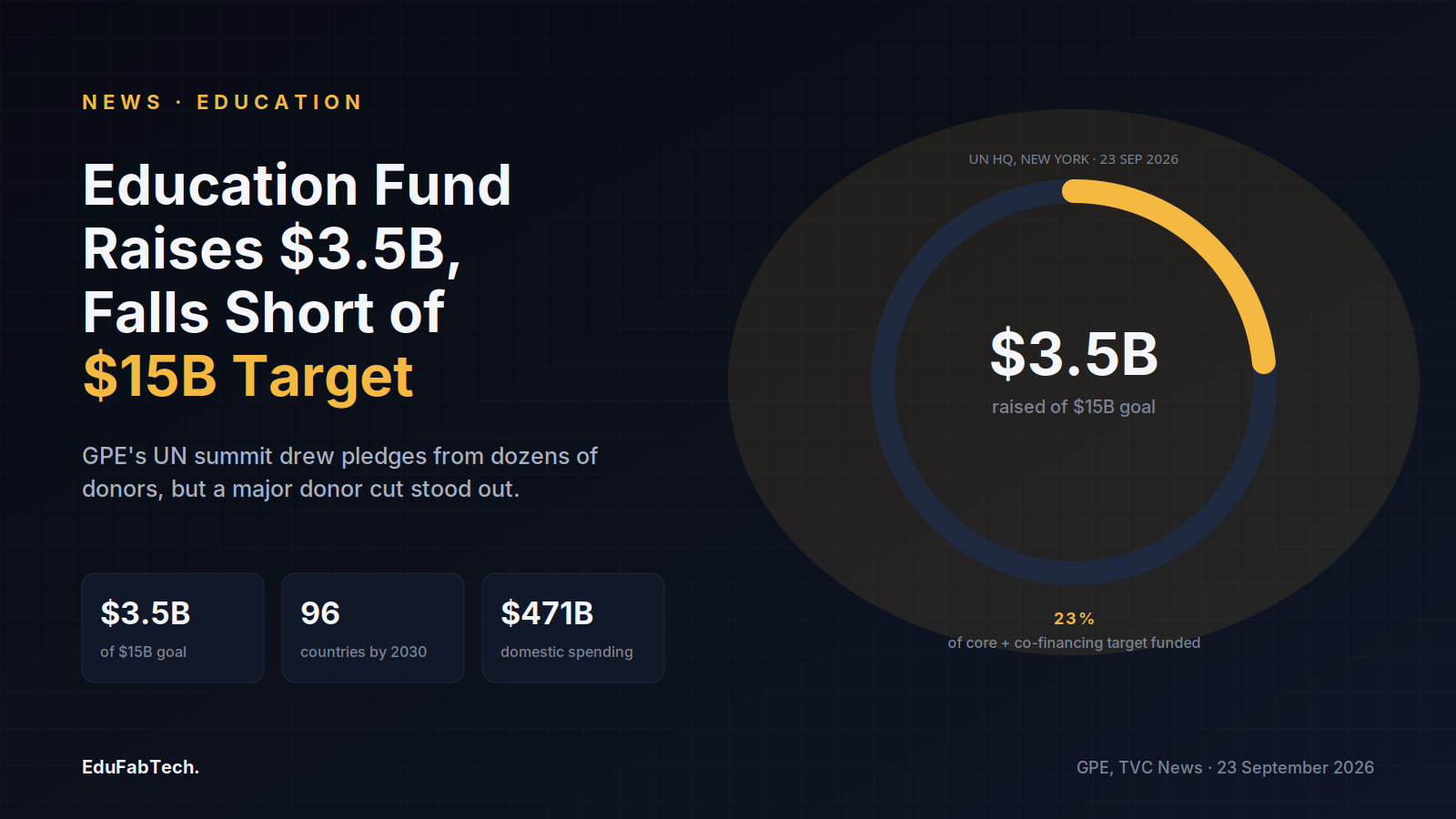
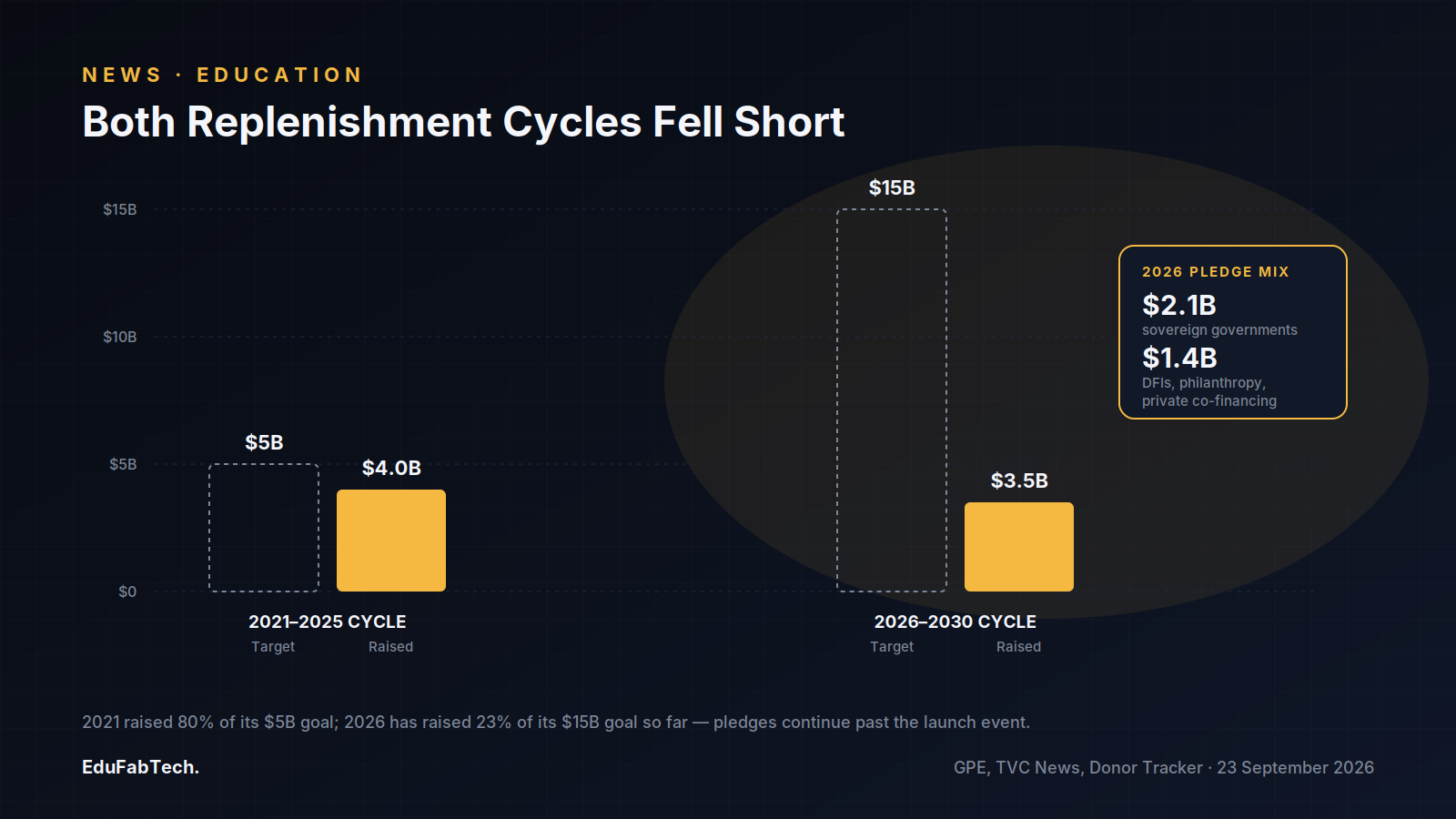
On 23 September 2026, heads of state, ministers and donor representatives gathered in the ECOSOC Chamber at UN headquarters in New York for a high-level event billed as "a new era for education financing." By the end of the day, the Global Partnership for Education (GPE) — the largest multilateral fund dedicated to education in low- and middle-income countries — had secured $3.5 billion in new commitments toward its 2026–2030 replenishment, according to TVC News reporting from the event: $2.1 billion in confirmed and anticipated pledges from sovereign donors, plus $1.4 billion in co-financing from development finance institutions, philanthropies and private-sector partners.
That leaves GPE well short of the campaign's own target. The partnership, co-hosted for this cycle by Nigeria and Italy under the name "Multiply Possibility," is seeking $5 billion for its core fund and aims to unlock a further $10 billion in co-financing, for a combined $15 billion it says would reach 750 million children across 96 countries and territories by 2030.
A donor cut and a donor increase
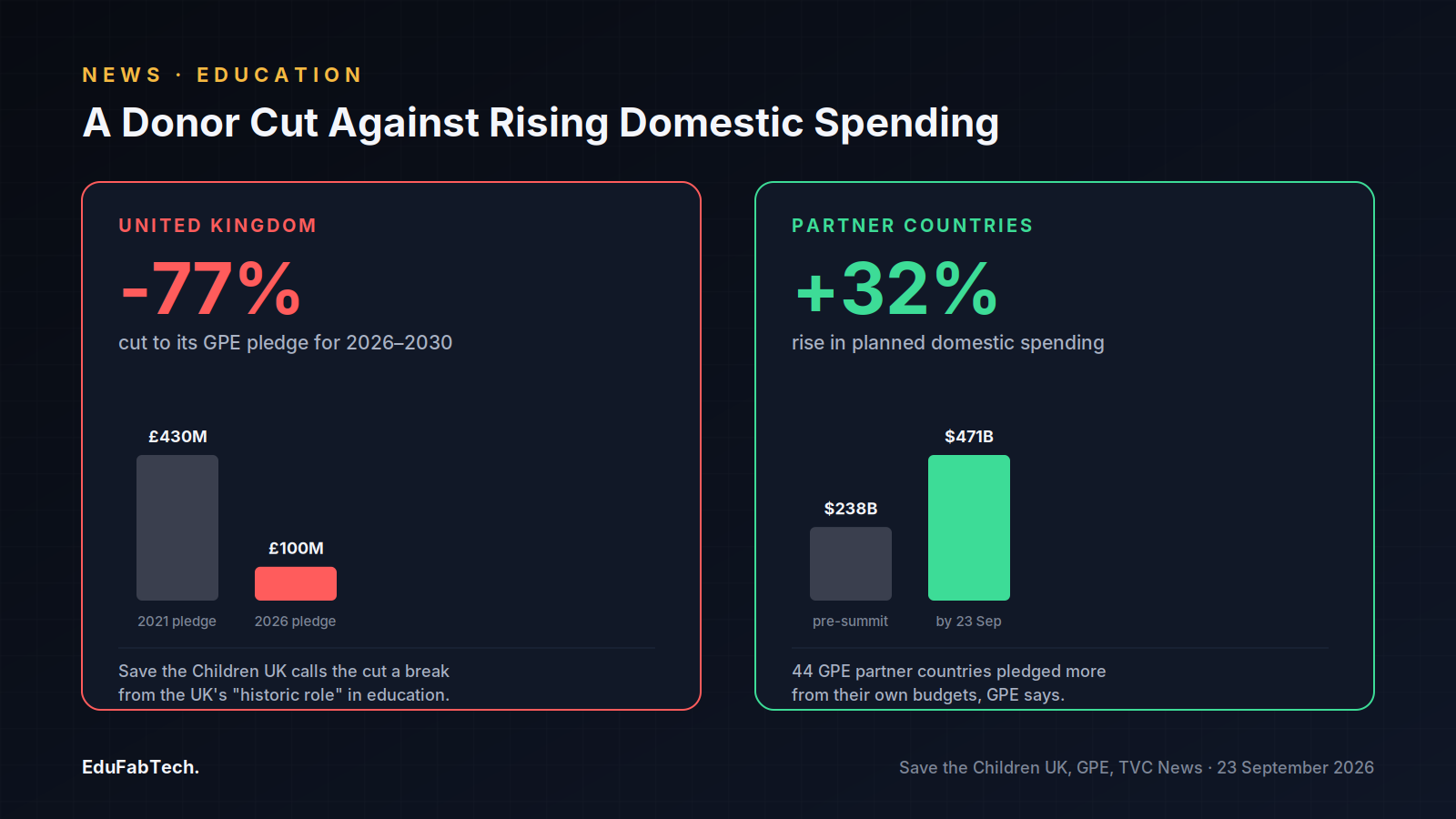
The event exposed a widening gap between how donor governments and partner governments are behaving. The United Kingdom, historically one of GPE's largest bilateral funders, pledged £100 million for 2026–2030 — a 77% reduction from the £430 million it committed in the 2021 cycle, according to Save the Children UK, which called the cut a break from the UK's "historic role as champion of education" and urged the government to add top-up funding during its current spending review period.
Other donors moved the other way. Ireland's Minister of State for International Development, Neale Richmond, announced a €40 million (US$47 million) pledge for 2026–2030 on 23 September 2026, made in Ireland's capacity as holder of the Presidency of the Council of the European Union, according to the Irish Department of Foreign Affairs. Italy, as co-host, pledged €50 million, and philanthropic and private-sector partners had already announced $400 million in commitments in the days before the summit, according to TVC News.
Partner countries are spending more, not less
The most striking contrast, however, was between donor retrenchment and the spending trajectory of the countries GPE exists to support. Ahead of the September event, 44 GPE partner countries announced they were mobilizing more than $238 billion in domestic resources for education over 2026–2030, according to the Global Partnership for Education (2026) — a figure the partnership frames as evidence of a shift away from aid dependence toward domestically financed education systems. By the day of the summit itself, cumulative domestic financing commitments announced by partner countries for 2026–2030 had risen to $471 billion, a 32% increase in planned spending by 2030, according to TVC News (2026).
Country-level measures include Guinea's 2025 decision to channel 5% of the taxes, duties and dividends it collects from the Simandou iron ore project into a dedicated budget line for education, according to the Extractive Industries Transparency Initiative (2026). Nigeria, as co-host, highlighted its own HOPE-EDU programme, which officials say is intended to reach approximately 29 million children and 500,000 teachers — though the $552 million programme is itself co-financed by the World Bank and GPE, not funded solely through domestic channels, according to CNBC Africa (2026).
Why the comparison matters
GPE's pitch to remaining donors rests on this donor-partner balance: the partnership says its funding is designed to concentrate resources in low-income and lower-middle-income countries and to leverage — rather than substitute for — the domestic spending increases partner governments are already making, according to the Global Partnership for Education (2026).
What happens next
The $3.5 billion mobilized on 23 September is not final. GPE's replenishment campaigns typically continue collecting pledges for months after a flagship event; the previous cycle, launched at a 2021 summit, ultimately raised $4.0 billion against its own $5 billion target — a shortfall of the same kind now facing the 2026–2030 campaign, according to Donor Tracker (SEEK Development, 2021). Whether the current shortfall against the $5 billion core-fund goal narrows over the coming months will depend heavily on whether donors that have not yet announced 2026–2030 pledges — including some of GPE's other traditionally large bilateral funders — commit new money, and whether the UK revisits the reduced pledge Save the Children UK has publicly challenged.
For the 96 countries and territories GPE works with, the immediate significance of the September event is less the headline dollar figure than the balance of who is paying for what: donor governments are, in aggregate, pledging less than the fund is asking for, while the governments actually running the school systems are, by GPE's own accounting, committing hundreds of billions more from their own budgets than international donors are providing through this or any comparable multilateral channel.
- Global Partnership for Education. GPE partner countries scale up domestic education financing by $238 billion ahead of critical high-level event. Global Partnership for Education, 2026. link
- Global Partnership for Education. Replenishment: Multiply Possibility 2026-2030. Global Partnership for Education, 2026. link
- Save the Children UK. UN General Assembly: Slashing Global Partnership for Education funding 'shatters UK's historic role as champion of education'. Save the Children UK, 2026. link
- TVC News. Global Leaders Mobilise $3.5bn For Education As Nigeria Reaffirms Commitment. TVC News, 2026. link
- Government of Ireland, Department of Foreign Affairs. Minister Richmond announces new funding for Global Partnership for Education at UN High-Level Week. Government of Ireland, 2026. link
- Extractive Industries Transparency Initiative. Simandou's development promise: Turning mining revenues into lasting benefits for Guinea. EITI, 2026. link
- CNBC Africa. Nigeria launches $552 million education drive backed by World Bank, GPE. CNBC Africa, 2026. link
- Donor Tracker (SEEK Development). GPE replenishment concludes: US$4.0 billion of US$5.0 billion funding target raised for Global Partnership for Education. Donor Tracker, 2021. link