Google DeepMind Previews Genie 4, a World Model With Native Audio and Live Editing
Genie 4, released 27 October 2026 as a limited research preview, generates interactive scenes with built-in sound and lets testers edit them in real time, but Google says object drift and audio accuracy are still unresolved.
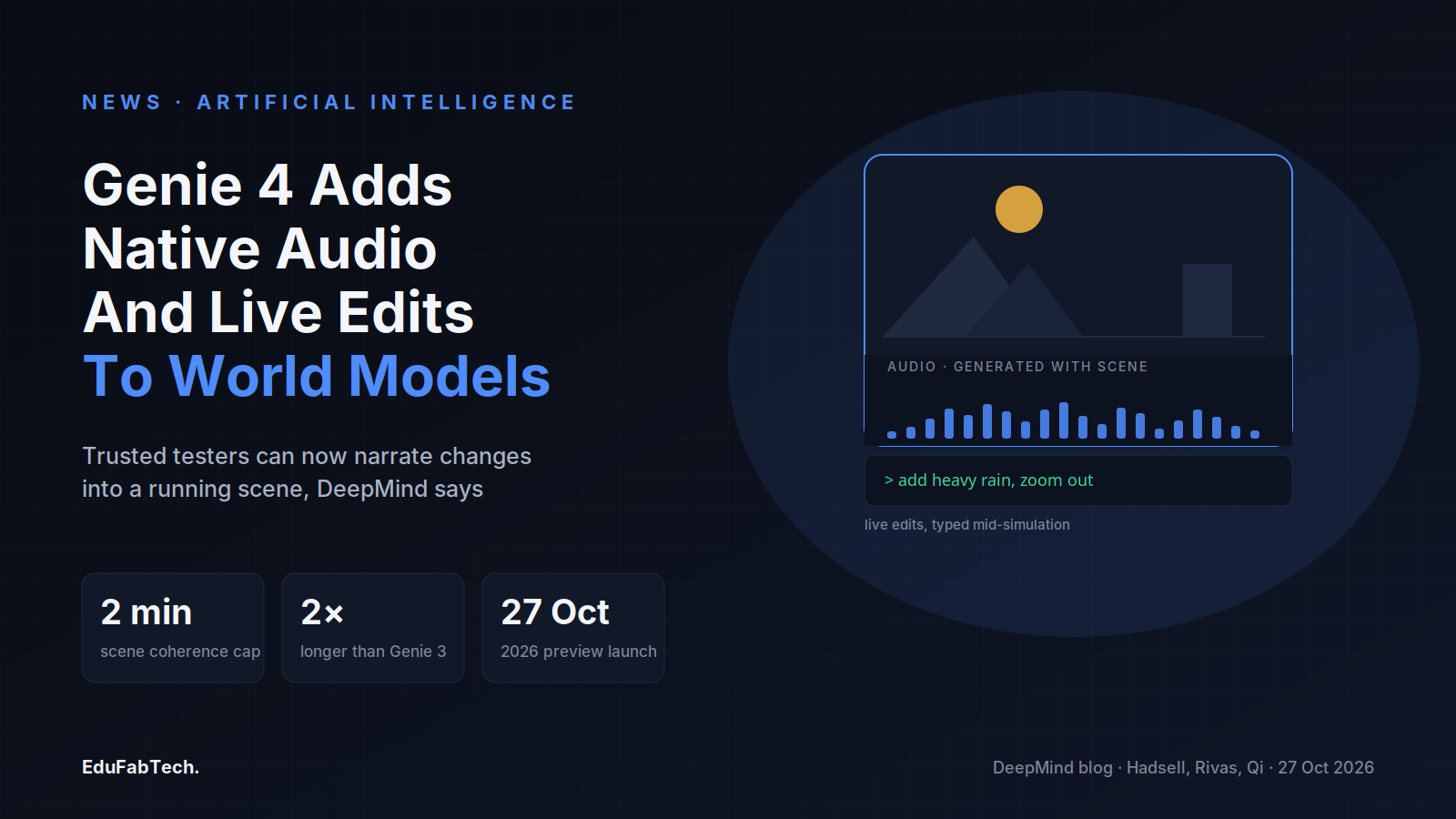
Google DeepMind released Genie 4 on 27 October 2026 as a research preview to a limited group of "trusted testers," according to the announcement on the DeepMind blog, signed by Raia Hadsell, Diego Rivas and Hang Qi. Genie 4 generates interactive, navigable simulated environments from a prompt and, unlike earlier models in the Genie line, produces audio — ambient sound, music and dialogue — in the same generation process as the visuals, rather than adding it afterward.
Google says wider access is coming "soon" to Google AI Ultra subscribers through a feature called Project Genie, and to early access partners through the Gemini API and Google AI Studio. For now, the model is not publicly testable, and no independent benchmark of its output has been published.
What testers can do inside a Genie 4 scene
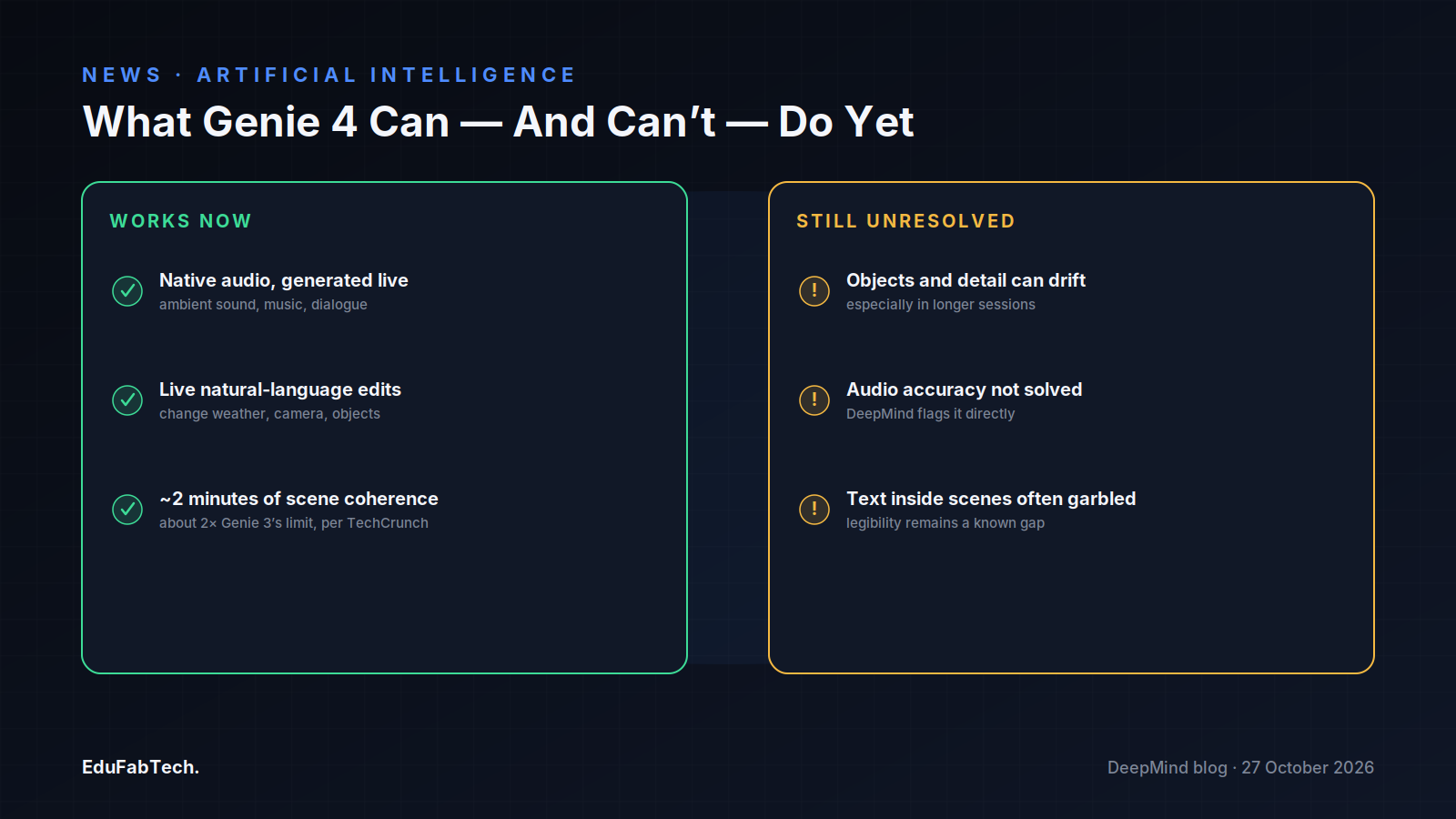
Genie 4 lets a user set an event in motion and then use natural language to modify the simulation while it runs, DeepMind's announcement says. In practice, that means typing an instruction to change the weather, move the camera, or introduce a new character or object into a scene that is already running, without restarting the simulation. DeepMind calls Genie 4 "our first real-time world model to generate audio natively," producing music, ambient noise and interactive dialogue "simultaneously generated with the world."
According to reporting on a Google briefing by TechCrunch, Genie 4 can hold a scene together — keeping objects, layout and characters consistent — for up to two minutes, double the roughly one-minute limit of Genie 3, the prior version in the line. Google's own blog post does not state this figure directly; DeepMind's published text instead describes the model's coherence qualitatively, saying it "can maintain coherent environments over short sessions."
How it is built
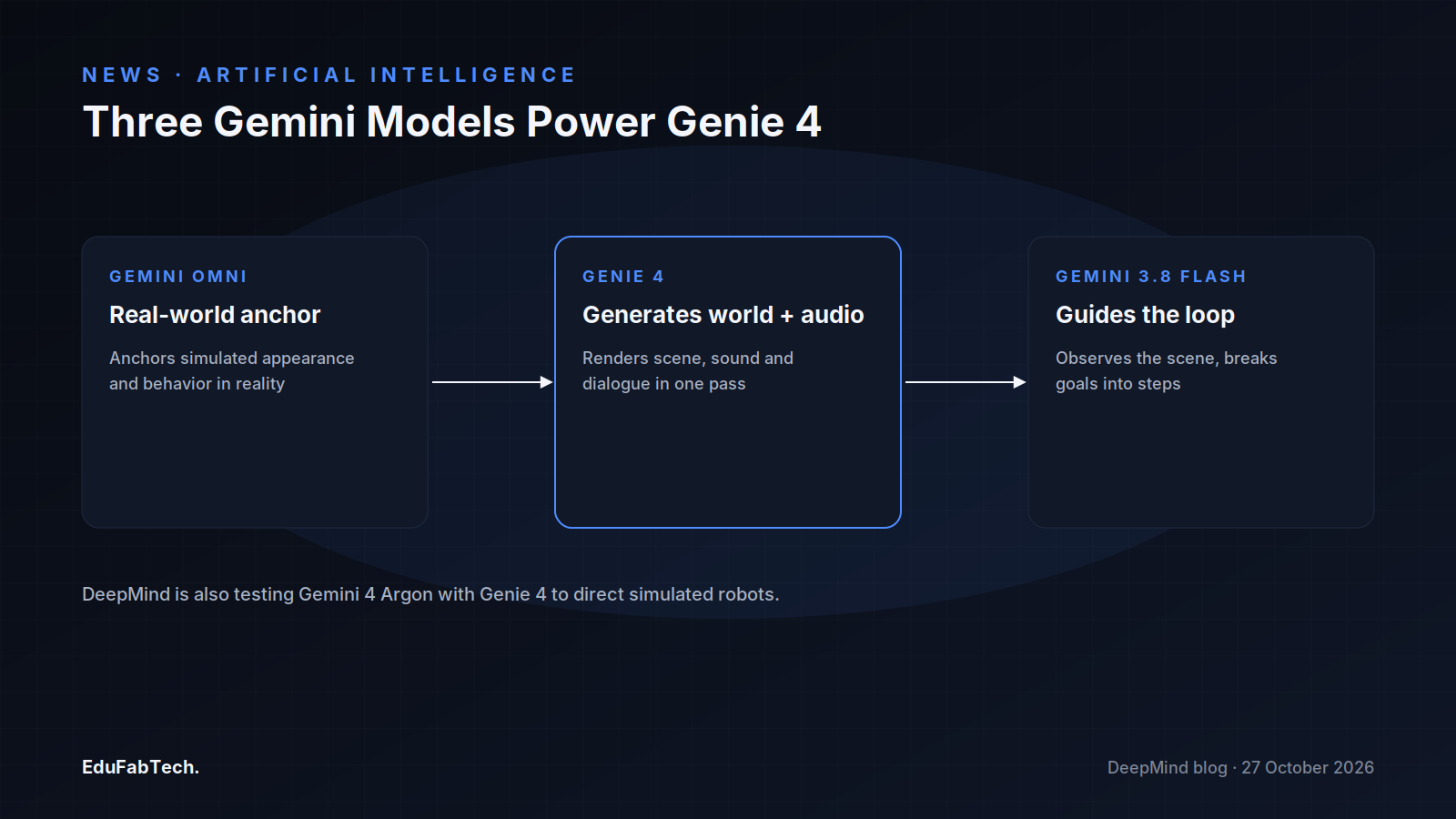
DeepMind's post says Genie 4 "incorporates and builds on capabilities from the Gemini family: Gemini Omni anchors the simulations in real-world appearance and behavior, while other Gemini models provide the complex reasoning needed to help maintain a simulation's coherence and continuity." One of those models, Gemini 3.8 Flash, runs as what DeepMind calls a guiding agent inside the loop: "as Genie 4 generates a world in real-time, Gemini continuously observes the scene, breaks down goals into a sequence of steps." DeepMind also describes early experiments that combine Gemini 4 Argon and Genie 4 with its Gemini Robotics models — in one example, Argon breaks a task into steps for a simulated humanoid robot while Genie 4 renders the scene.
Tejas Kulkarni, a research director at Google, described the intended direction during the briefing reported by TechCrunch's Rebecca Bellan: "What we'll increasingly see in the future are these hybrid world models, where you have a combination of Gemini writing code and text, and Genie ingesting that in real time and simulating reality at different levels of abstraction."
What DeepMind says still does not work well
The announcement is specific about where Genie 4 falls short. DeepMind writes that "visual details and object permanence can still shift or drift over time — especially as a simulation runs longer, after multiple complex prompt edits, or when navigating throughout the scene." It also lists audio accuracy and text legibility inside generated scenes as unresolved problems. Outputs carry Google's SynthID watermark to flag them as AI-generated.
Why it matters for students and researchers
Genie 4 sits in a research area — interactive "world models" meant to simulate physical environments rather than just generate a fixed video clip — that DeepMind frames as a step toward "developing training environments for robots and agents." For robotics and reinforcement-learning researchers, a model that can hold a navigable, physically plausible scene together for up to two minutes while responding to live instructions is a different kind of training substrate than a pre-rendered simulator: it can be edited mid-run to test an agent against new obstacles or conditions.
For now, the practical use is limited. Access is restricted to DeepMind's trusted-tester group, so the two-minute duration figure, the physics quality and the audio accuracy all rest on Google's own account and the briefing TechCrunch attended, not on outside testing. Researchers who want to evaluate Genie 4 against other interactive world models, such as Runway's GWM Worlds 2, released a couple of months earlier, will have to wait for the broader Project Genie and Gemini API rollout DeepMind has promised, or for Google to publish technical detail — such as resolution, frame rate or a formal evaluation — beyond the qualitative description in its blog post.
A quick question for readers
Which skill will matter most for getting a job in 2030?
Everyone has a prediction. Add yours and see what students are betting on.
Pick an answer, create a free account in a minute, and your vote counts. Already a member? Sign in
Comments 3
Comment-
The paragraph that matters is the one about how this evaluates: the two-minute coherence figure comes from a TechCrunch briefing, not DeepMi…
-
The part worth flagging is the two-minute coherence figure — that's from TechCrunch's write-up of the briefing, not DeepMind's own blog post…
-
The bit that'd make me poke at this in a lab, not just read it: the two-minute coherence figure is TechCrunch's number from a briefing, not…
Join free to read the full comments and reply Comments are between members; an account takes a minute.
Source: Google DeepMind
Sources (3)
- Raia Hadsell, Diego Rivas, Hang Qi. Genie 4: A new generation of world simulation. Google DeepMind, 2026. deepmind.google ↗ · checked 29 Oct 2026
- Rebecca Bellan. Google's Genie 4 world model adds audio, more realistic worlds, and real-time steering. TechCrunch, 2026. techcrunch.com ↗ · checked 29 Oct 2026
- Google. Introducing Genie 4. Google (The Keyword), 2026. blog.google ↗ · checked 29 Oct 2026