Google Ships Gemini 4 Neon; Independent Index Puts It at 61 on Xhigh, 6th of 95 Models
Released on 18 November 2026, the mid-tier Gemini 4 model targets coding and enterprise agents, with Google citing a 90.5% score on its own SEC-bench Pro vulnerability test.
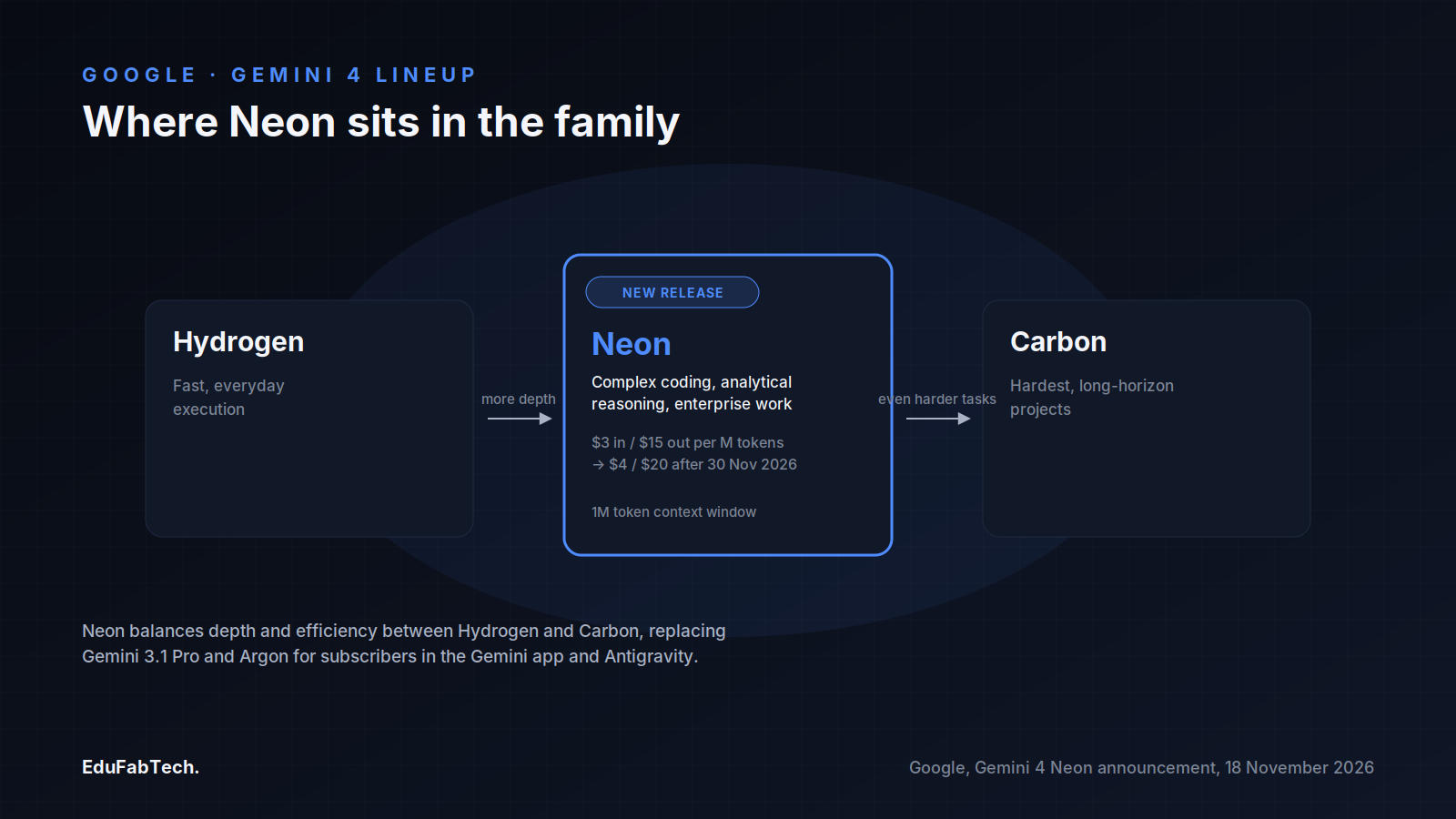
Google released Gemini 4 Neon on 18 November 2026, adding a fourth model to the Gemini 4 line it has rolled out since late September. Neon sits between Gemini 4 Carbon, built for the hardest long-horizon projects, and Gemini 4 Hydrogen, built for fast everyday execution. In its own announcement, Google describes Neon as built "for complex coding, analytical reasoning, and production-grade enterprise workflows," positioned to balance "depth and efficiency" between the other two models, according to the Google blog post announcing the release.
The model is priced at $3 per million input tokens and $15 per million output tokens, with cached input tokens billed at $0.15 per million, and it carries a 1 million token context window, per Google's announcement. Google reports that Neon will move to $4 per million input tokens and $20 per million output tokens after 30 November 2026, a rate the company says is still 25% cheaper than Carbon, according to reporting by 9to5Google.
Neon is available now to developers through the Gemini API paid tier in Google AI Studio and Android Studio, to enterprises through Gemini for Business, and to consumers through the Gemini app and Google Antigravity for Google AI Pro and Ultra subscribers, Google states in its announcement. In the Gemini app and in Antigravity, Neon replaces the earlier Gemini 3.1 Pro and Argon models for subscribers, according to 9to5Google's coverage of the rollout.
What the independent index shows
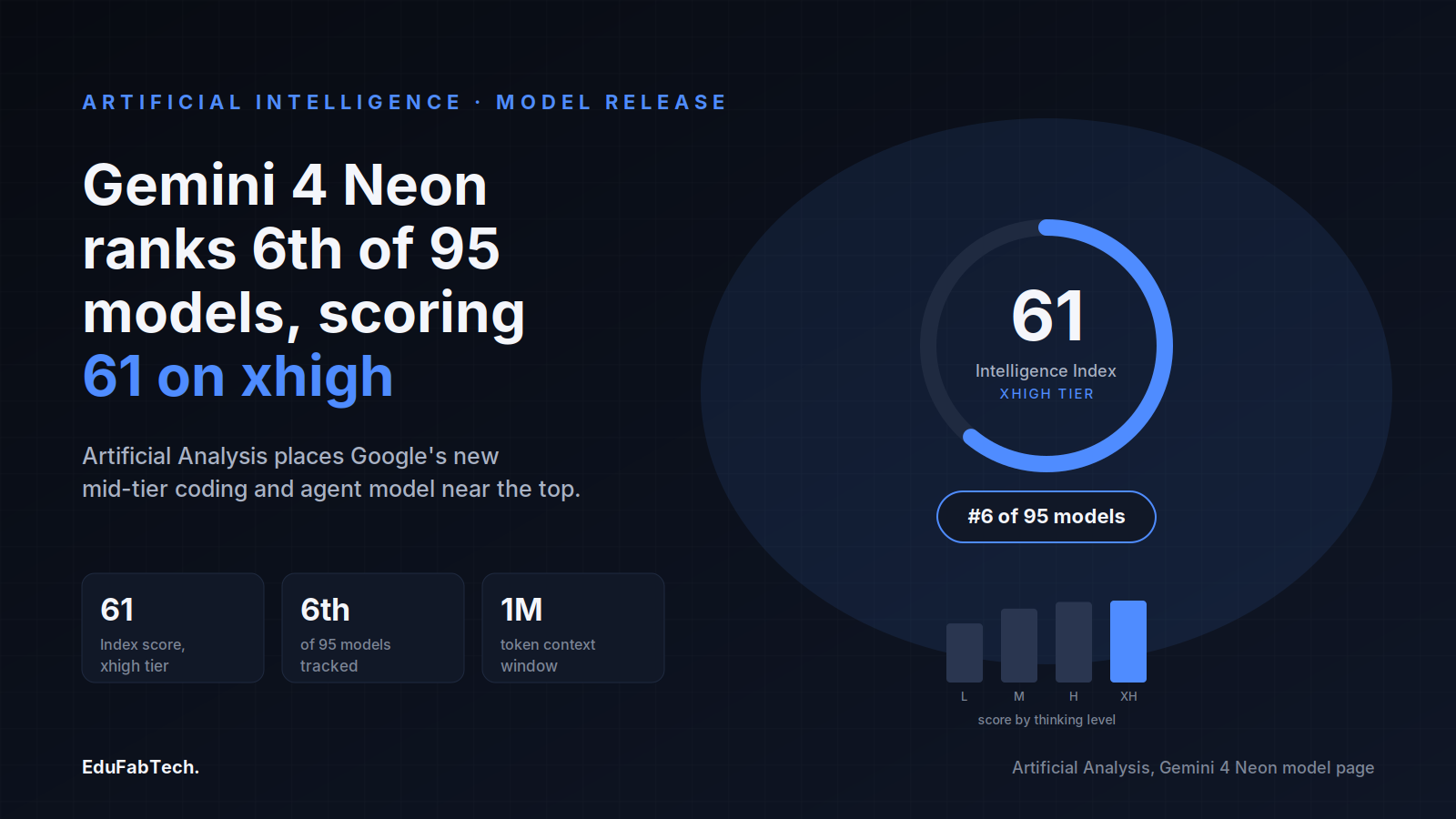
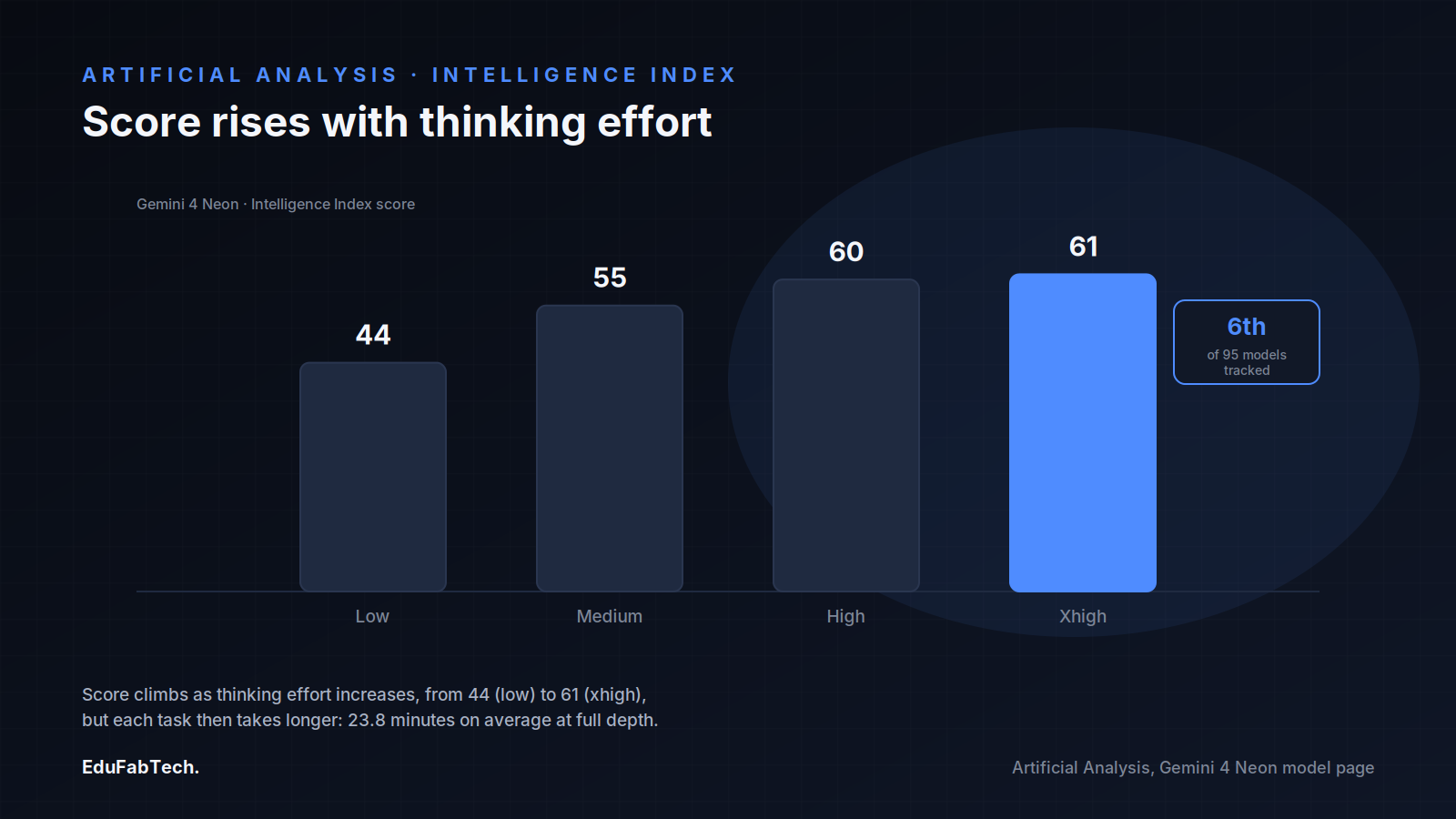
Artificial Analysis, a firm that runs its own standardized test suite across language models, lists Gemini 4 Neon at its "xhigh" thinking level with a score of 61 on the Artificial Analysis Intelligence Index, ranking it 6th among the 95 models the firm tracks on that index, according to Artificial Analysis's Gemini 4 Neon model page. The same page records lower scores at reduced thinking effort: 60 at "high," 55 at "medium" and 44 at "low," reflecting a tradeoff between reasoning depth and response time that Google exposes to users as a selectable setting.
Artificial Analysis also measured an output speed of 99 tokens per second and a time-to-first-answer-token of 58.32 seconds for Neon, with each Intelligence Index task taking an average of 23.8 minutes to complete, per the same model page. Google's own figures for the model's business pricing broadly match what Artificial Analysis records, though the independent page lists a blended per-token rate of $2.21 per million tokens based on the firm's own usage-weighted calculation rather than Google's separate input and output prices.
A cybersecurity benchmark still awaiting independent testing
Google's announcement separately claims that Neon "achieves state-of-the-art performance on SEC-bench Pro (90.5%), while costing roughly half as much per challenge," a benchmark the company says measures vulnerability-finding ability, according to the Google blog post. That figure comes from Google's own announcement; no independent organization's test of Neon against SEC-bench Pro was found at the time of writing. Google is also offering "Gemini 4 Neon for cyber" to vetted security teams through what it calls its Fairwind Program, access to which it says interested Google Cloud customers can request through their account team, per the same announcement.
Why this matters for developers and researchers
For developers building coding agents or research tooling, the practical signal is less about any single leaderboard position and more about the tradeoffs Neon makes explicit: a 1 million token context window, four selectable thinking levels that trade latency for accuracy, and a per-task cost that Artificial Analysis can now compare directly against other frontier models using its own fixed test suite. Because Neon is reachable through the standard Gemini API and through Google Antigravity, teams already building on Gemini 3.1 Pro or Gemini 4 Argon can test Neon as a drop-in replacement without new infrastructure.
Researchers evaluating agentic systems should treat Google's SEC-bench Pro figure as a vendor-reported number until an outside lab publishes its own run, while treating the Artificial Analysis Intelligence Index score as the more load-bearing figure for cross-model comparison, since it comes from a party with no stake in Neon's result and applies the same methodology across the 95 models it tracks. The scheduled price increase on 30 November 2026 is also worth noting for anyone budgeting a multi-month evaluation or production pilot around the model's current rate.
A quick question for readers
Which skill will matter most for getting a job in 2030?
Everyone has a prediction. Add yours and see what students are betting on.
Pick an answer, create a free account in a minute, and your vote counts. Already a member? Sign in
Comments 3
Comment-
The number that jumps out at me is buried mid-article: 58.32 seconds to first answer token. That's not what I'd call balancing "depth and ef…
-
The number I keep staring at is the 58.32 second time-to-first-answer-token. That's not a quibble, that's a real latency figure sitting righ…
-
58.32 seconds just to get the first answer token back is the bit that would make me pause before handing this to students as their coding as…
Join free to read the full comments and reply Comments are between members; an account takes a minute.
Source: Google
Sources (3)
- Google. Introducing Gemini 4 Neon. Google Blog, 2026. blog.google ↗ · checked 23 Nov 2026
- Artificial Analysis. Gemini 4 Neon Models - Intelligence, Performance & Price Comparison. Artificial Analysis, 2026. artificialanalysis.ai ↗ · checked 23 Nov 2026
- Abner Li. Google launches Gemini 4 Neon with Carbon quality at Flash speeds, live for AI Pro. 9to5Google, 2026. 9to5google.com ↗ · checked 23 Nov 2026