Government R&D Budgets Fall in Real Terms as Funding Tilts Toward Defence, OECD and EU Data Show
New OECD and Eurostat figures for 2024–2026 show public research budgets shrinking or barely growing in real terms, with defence gaining ground and energy and environment research losing it.
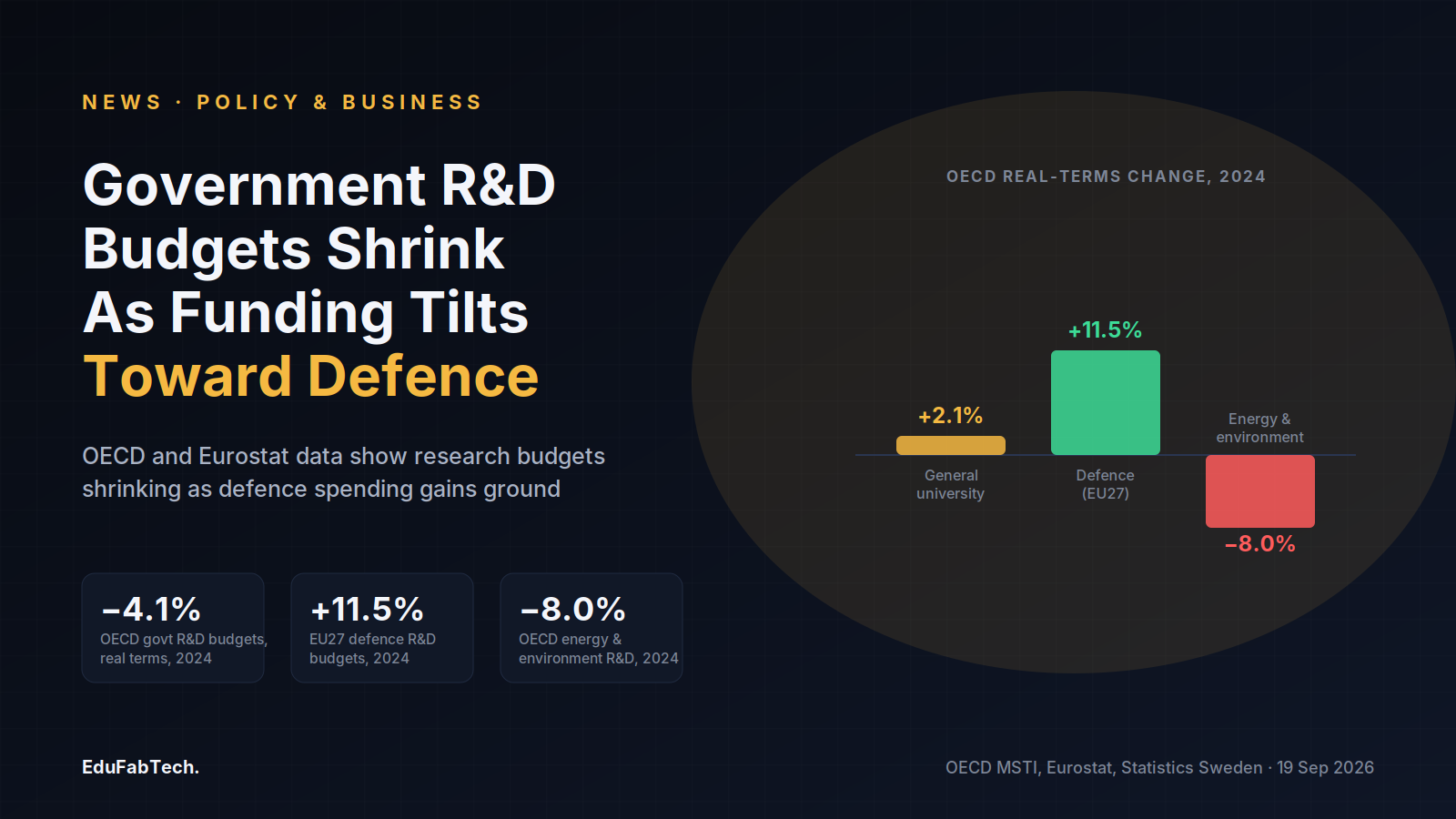
Public research budgets are still growing almost everywhere, but the growth has slowed and its composition has changed. Government budget allocations for research and development across the OECD area fell 4.1% in inflation-adjusted terms in 2024, according to the OECD's Main Science and Technology Indicators release published on 31 March 2026, reversing a 0.7% increase recorded in 2023. Within that shrinking total, defence research gained ground while funding tied to energy and the environment lost it.
The decline sits specifically in government budgets, not research spending overall. Total gross domestic expenditure on R&D across the OECD area kept growing at 2.6% in 2024, the same pace as 2023, because businesses now fund 73% of it, up from 67% in 2010. Government-performed research grew by just over 3% and higher education research by close to 2%, but the money governments set aside and direct through their own budgets is a smaller, more politically exposed slice of the total, and that is the slice that fell.
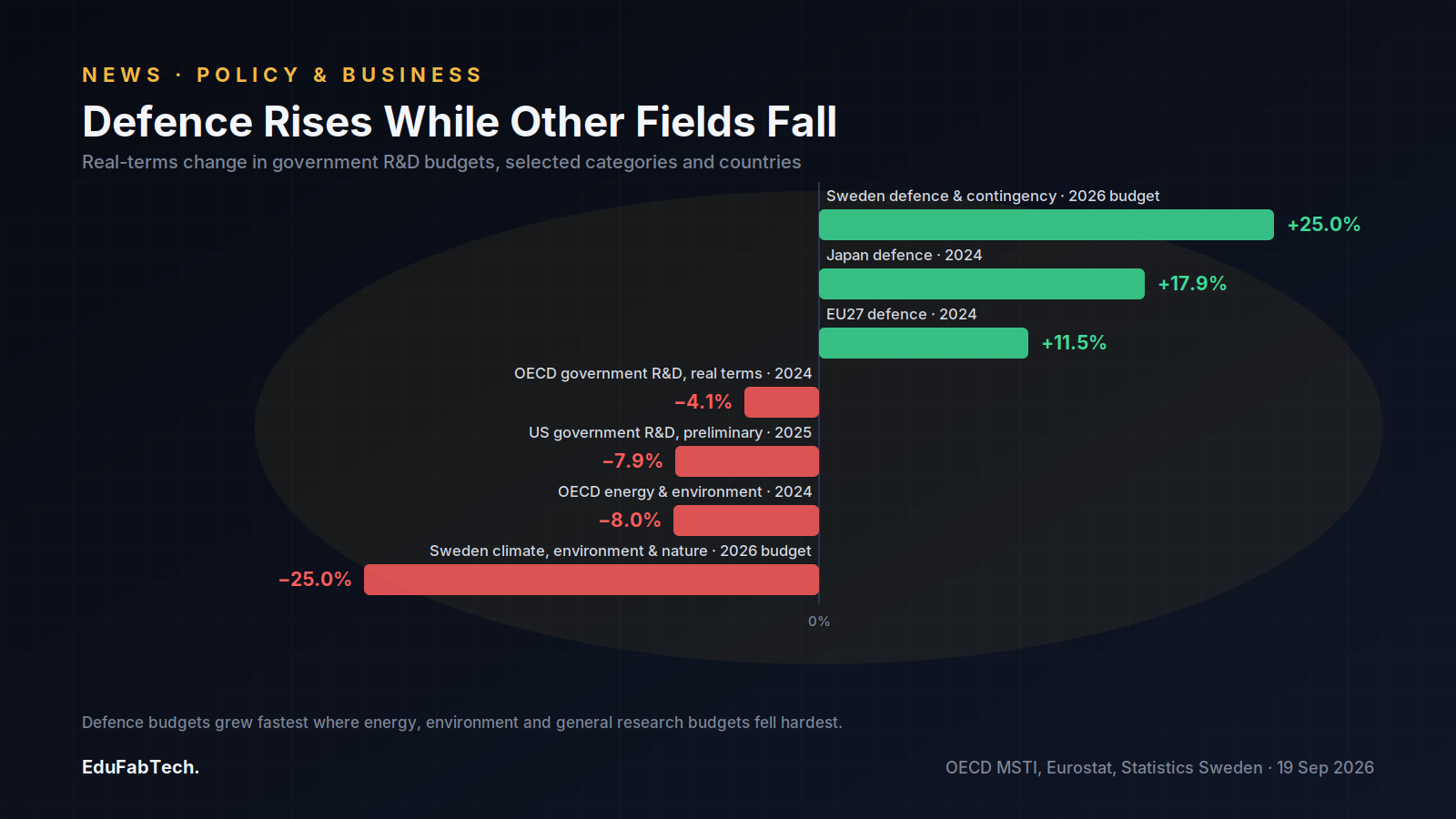
Inside the 2024 OECD figures, defence research and development budgets rose 1.2% on average, with the increase concentrated in the European Union's 27 members (+11.5%) and Japan (+17.9%). General university funding, the block grants that underwrite basic research at universities, grew 2.1%. Energy and environment-related budgets fell 8.0%, after several years of increases tied to earlier climate and energy-security commitments. Preliminary 2025 data from the nine countries that had reported by March 2026 point to a further real-terms decline of more than 5%, including a 7.9% drop in the United States.
Sweden's budget as a case study
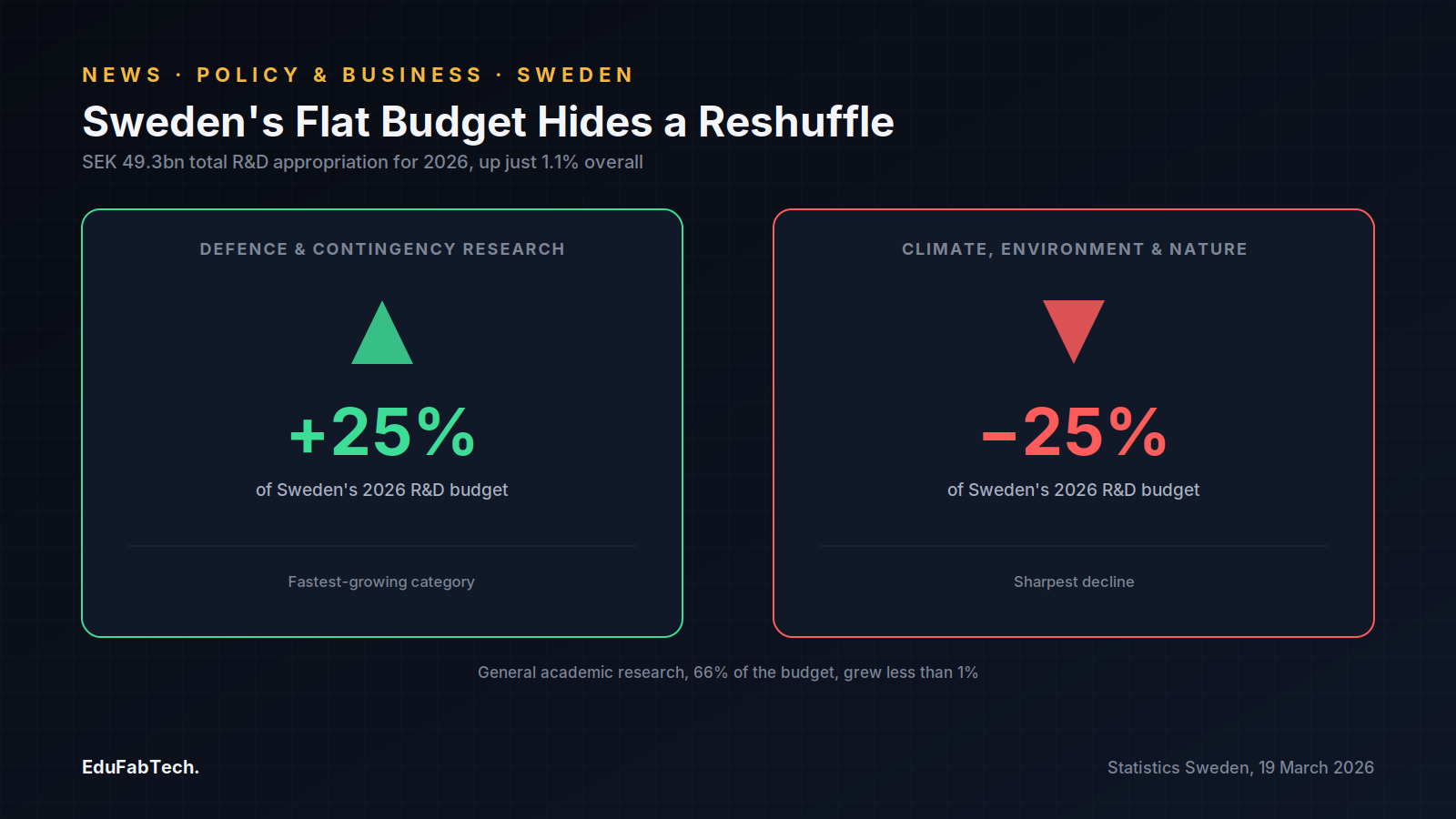
National budgets show the same reallocation in more granular form. Statistics Sweden reported on 19 March 2026 that the country's 2026 R&D appropriation, SEK 49.3 billion, grew just 1.1% over 2025, the smallest annual increase in ten years, taking research's share of the total government budget to 3.2%, its lowest since 2008. Within that near-flat total, defence and contingency research rose 25%, while funding for climate, environment and nature research fell 25% and energy research fell 7.3%. General academic research, the largest single category at 66% of the total, grew less than 1%.
The European aggregate, and the exceptions inside it
Across the European Union as a whole, the picture looks less austere. Eurostat reported on 7 August 2026 that EU governments allocated an estimated €130,200 million to R&D in 2025, 0.69% of GDP and a 60.5% increase on 2015 levels; defence accounted for 5.8% of that total. Per person, allocations ranged from €917 in Luxembourg and €627 in Denmark down to €19 in Romania and €57 in Hungary. Over the 2015–2025 decade, Bulgaria's allocation grew 495.5%, the largest increase in the bloc, while Romania's was the only one to fall, down 9.6%; Sweden's 14.7% rise was the smallest increase among EU states.
| Reporting body | Measure | Change | Year |
|---|---|---|---|
| OECD area | Government R&D budgets, real terms | −4.1% | 2024 |
| EU27 | Defence R&D budgets | +11.5% | 2024 |
| Japan | Defence R&D budgets | +17.9% | 2024 |
| OECD area | Energy and environment R&D budgets | −8.0% | 2024 |
| Sweden | Climate, environment and nature R&D | −25% | 2026 budget |
| United States | Government R&D budget, preliminary | −7.9% | 2025 |
The United States enacted a softer version
The pattern is not universal in its severity. The White House's initial FY2026 budget request proposed deep cuts across non-defence science agencies, the American Institute of Physics's policy tracking service reported on 9 January 2026, but Congress finalized considerably smaller reductions. The National Science Foundation absorbed a 3.4% cut to $8.75 billion with its core research account flat-funded, NASA's Science Mission Directorate fell 1.1% against a 1.6% cut to the agency's overall budget, and NIST rose 2.3%. The Department of Energy's Office of Science, which funds much of the country's basic physical-sciences and energy research, was increased 1.9% to $8.4 billion. The direction of the request matched the OECD-wide trend; the enacted outcome did not fully follow it.
Why the composition matters
For researchers and institutions, the total budget figure matters less than what it is earmarked for. A university physics or environmental-science department depends on the general and energy/environment lines that fell in 2024 and 2025; a defence-adjacent engineering lab depends on the lines that grew. Multi-year grants, PhD funding and instrument procurement are all sensitive to which category a budget sits in, not just its size. The OECD's next comparable cross-country snapshot, drawing on final rather than provisional national submissions, is scheduled for release in March 2027, which will show whether the 2025 preliminary declines held or were revised once more countries reported.
- OECD. OECD overall R&D growth stable; government R&D budgets decline and reorient towards defence. OECD Statistical Releases, 2026. link
- Eurostat. EU R&D government allocations up by 61% in 10 years. Eurostat News, 2026. link
- Statistics Sweden (SCB). Smaller increase in the appropriations for R&D – but focus on defence in the government budget 2026. Statistics Sweden, 2026. link
- American Institute of Physics (AIP) FYI. Congress Set to Finalize Science Budgets Rejecting Trump Cuts. AIP FYI, 2026. link