A New UN Indicator Finds Climate Content Is Still Thin in Most National School Curricula
Analysing curriculum frameworks from 131 countries and climate pledges from 166, a UNESCO-backed indicator finds general environmental content is common but climate change and biodiversity teaching remains rare, and education is barely mentioned in national climate plans.
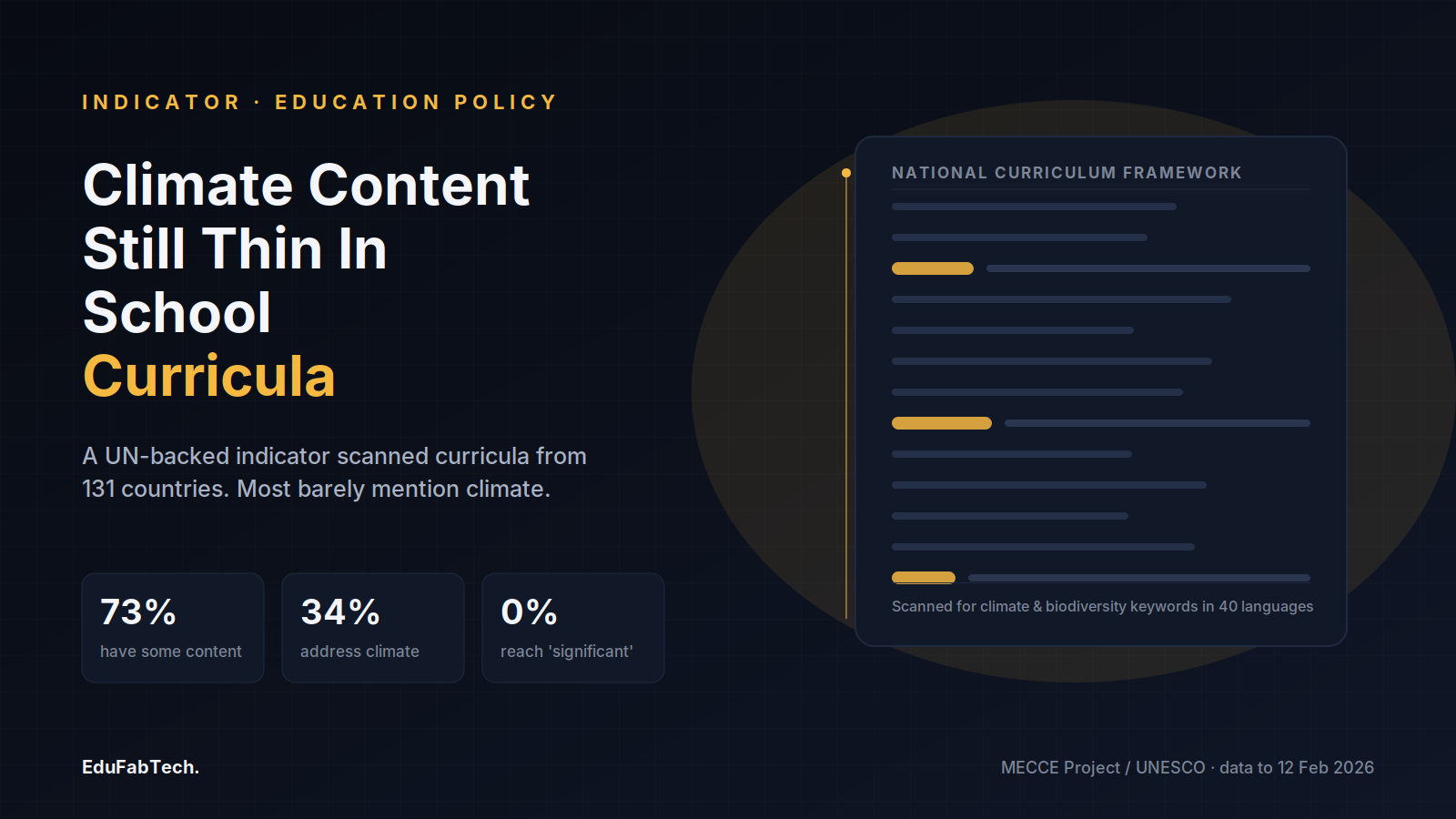
For three years, countries have had a formal commitment to "green" their school curricula — to teach environment, climate change and biodiversity content across subjects, not as an afterthought. There was no reliable way to measure whether they were doing it: the existing indicator relied on countries self-reporting. That changed with the Greening Curriculum Indicator, built by the MECCE Project — a research partnership led by the University of Saskatchewan with the University at Albany-SUNY and the University of Melbourne — by scanning the actual text of official curriculum documents for keywords in 40 languages.
The indicator now has an official status. At the 15th meeting of the Inter-Agency and Expert Group on SDG Indicators in Oslo on 21–23 October 2024, member states voted to adopt it as a second measure of SDG Global Indicator 4.7.1, the marker used to track whether countries are mainstreaming sustainable development and global citizenship into national education policies, curricula, teacher education and student assessment.
The latest results, published by the MECCE Project and updated in 2026 with data current to 12 February 2026, cover National Curriculum Frameworks from 131 countries and the climate pledges — Nationally Determined Contributions, or NDCs — of 166 countries plus the European Union's joint submission.
Curricula mention the environment. Fewer mention climate change.
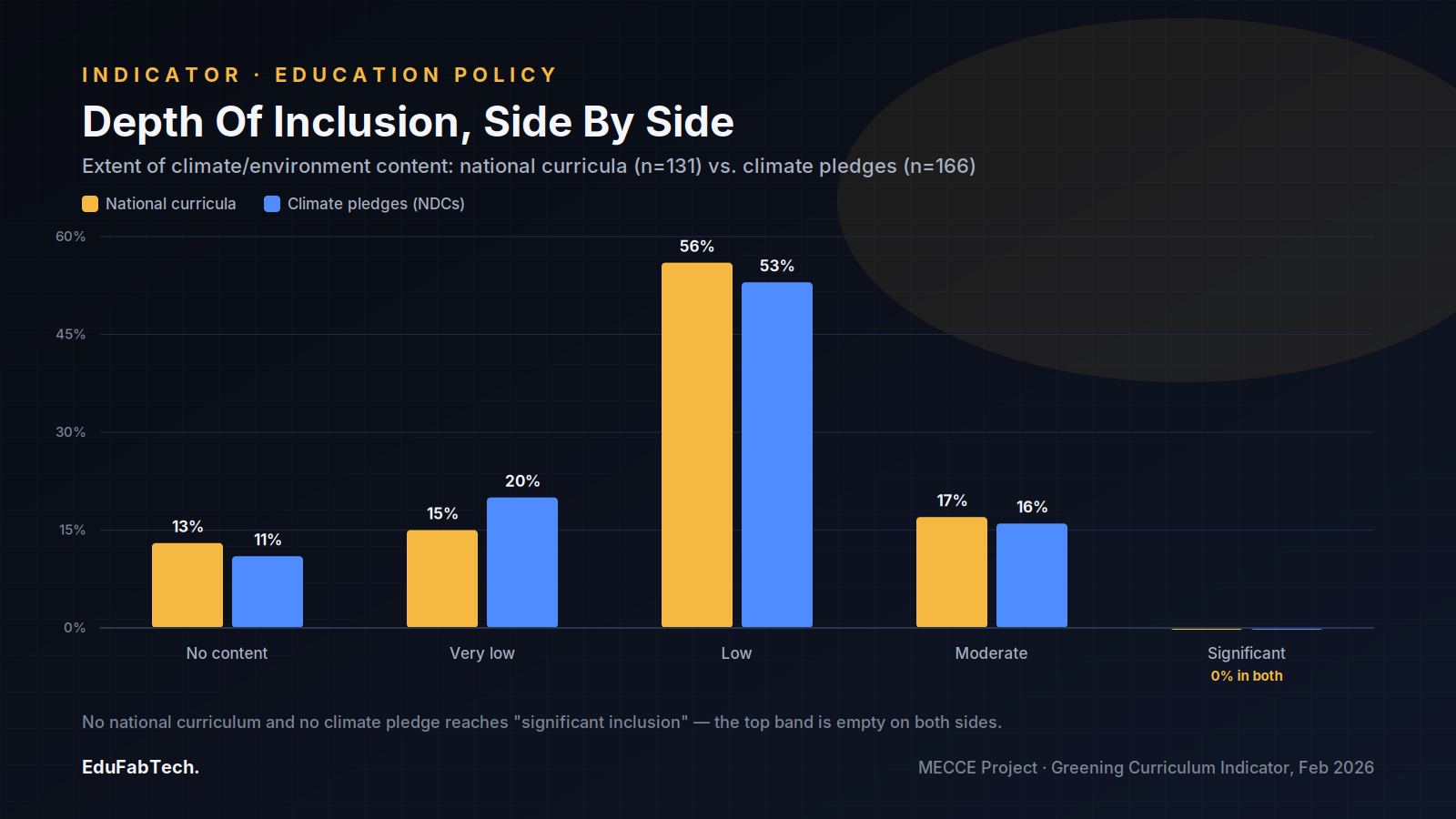
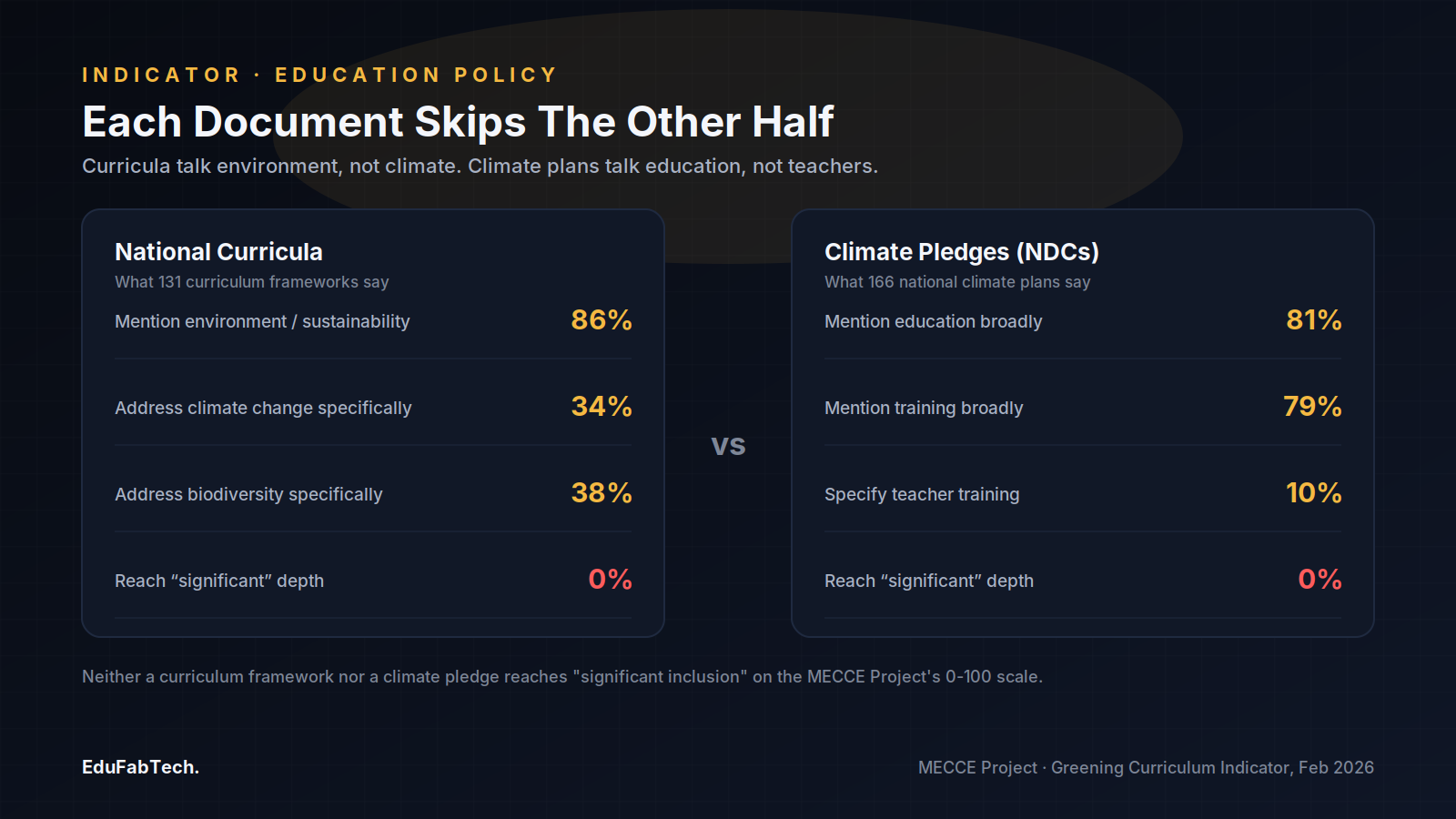
Of the 131 countries analysed, 73% have at least some low-level greening content in their national curriculum framework, but the depth is limited: 56% fall into the "low inclusion" band, and none reach the "significant inclusion" threshold the MECCE Project set at 75 or above on its 0–100 scale. The content that does exist skews general. 86% of the 131 countries have some content on environment or sustainability broadly, but only 34% have content specifically addressing climate change, and only 38% address biodiversity specifically.
Looking at intensity rather than mere presence, 12% of countries reach "significant" inclusion of general environment/sustainability content and 51% reach "moderate" inclusion. No country reaches "significant" inclusion for climate change or biodiversity specifically; for climate change content, 66% of curricula have none at all. The 15 countries with significant environment/sustainability content span every income group and region — Afghanistan, Australia, Austria, Costa Rica, Fiji, Indonesia, Liechtenstein, Lesotho, Norway, South Africa, South Sudan, Sri Lanka, Syrian Arab Republic, The Gambia and Tuvalu — which the MECCE Project's underlying methodology document notes is typical: countries that score well tend to do so on one theme, not across the board.
| Extent of inclusion | National curricula (n=131) | Climate pledges / NDCs (n=166) |
|---|---|---|
| No content | 13% | 11% |
| Very low | 15% | 20% |
| Low | 56% | 53% |
| Moderate | 17% | 16% |
| Significant | 0% | 0% |
An earlier round of the indicator, covering 110 countries as of the UNESCO Institute for Statistics' February 2025 data release, found similar regional patterns using its 0–100 composite score: countries in Central and Southern Asia averaged the highest overall score (47.8), while North Africa and West Asia averaged the lowest (29.0). Coverage itself was uneven too — 75% of Eastern and Southeastern Asian countries had enough documentation to be scored, against 38% in Oceania.
Climate pledges say even less about education
The pattern reverses when the MECCE Project looked the other direction: at what climate policy says about education, rather than what curricula say about climate. Of 166 countries' Nationally Determined Contributions — the national climate plans submitted under the Paris Agreement — 69% mention education or training at some level, but 53% only at "low" inclusion, and 11% do not mention it at all. No country's NDC reaches "significant" inclusion, and the European Union's joint submission itself sits in the "low inclusion" band.
Where education does appear in a climate pledge, it is usually as a general reference rather than a specific plan: 81% of countries mention education broadly and 79% mention training broadly, but only 34% specify anything about technical and vocational education, and just 10% mention teacher training at all — despite teachers being the people who would actually have to deliver any greened curriculum in the classroom.
What the numbers are measuring against
Both findings sit against a target set by UNESCO's Greening Education Partnership, launched alongside the 2022 UN Transforming Education Summit: that 90% of countries integrate climate change into their curricula by 2030. As of UNESCO's report at COP30 in November 2025, 97 countries had joined the partnership and 96,000 schools across 93 countries had adopted its recommended green-school practices, against a stated goal of half of schools in each member country being "green" by 2030.
The Greening Curriculum Indicator does not settle whether any of this changes what happens in classrooms — a curriculum document is a policy input, not a record of what a teacher actually teaches. What it gives, for the first time on a comparable basis across regions and income levels, is a baseline: a way to check in two, four or six years whether the gap between the stated 2030 target and the documented reality of national curricula is closing or not.
- MECCE Project. Aligning Policy Action on Education and Climate Change: An Analysis of National Curriculum Frameworks and Nationally Determined Contributions. MECCE Project (University of Saskatchewan), 2026. link
- UNESCO Institute for Statistics / MECCE Project. SDG Target 4.7 and a Greening Curriculum Indicator: Methods of Data Collection and Analysis. UNESCO Institute for Statistics (EDSC/11/3.4), 2025. link
- UNESCO. SDG Indicator Metadata 4.7.1. United Nations Statistics Division (SDG Indicators metadata repository), 2026. link
- UNESCO. COP30: UNESCO calls for urgent action to accelerate green schools. UNESCO, 2025. link