SpaceXAI's Grok 4.7 Posts Real Coding Gains, but Independent Tests Show the Harness Matters as Much as the Model
Grok 4.7 launched September 21, 2026 with large agentic-coding benchmark jumps, but outside evaluators found the gains depend heavily on which orchestration environment runs the model.
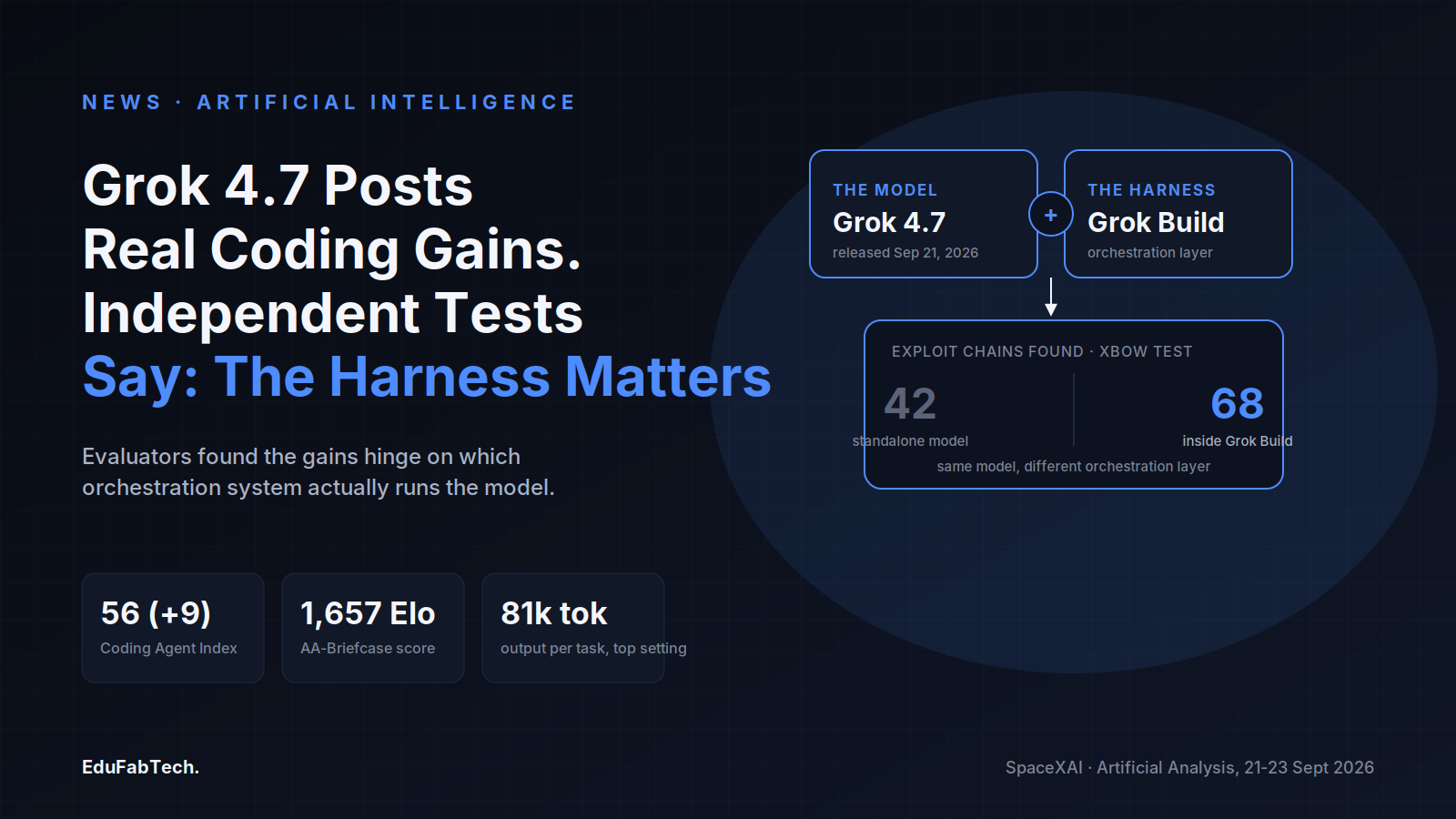
SpaceXAI, the company formed when xAI merged into SpaceX earlier this year, released Grok 4.7 on September 21, 2026, describing it as its most capable model yet for coding and long-running knowledge work. The model is live now in the Grok app, in the Grok Build coding environment, through the SpaceXAI API, and inside the Cursor editor.
The launch itself is routine for a field that now ships frontier models every few weeks. What makes it worth reading closely is what happened in the two days after: independent evaluators ran Grok 4.7 through their own harnesses and reached a more specific conclusion than SpaceXAI's own release notes did. The coding gains are real, but they are concentrated in ways that depend on which orchestration system runs the model, and they come at a meaningfully higher token cost per task.
According to SpaceXAI's announcement, Grok 4.7 was trained with "a longer reinforcement learning run on a harder mix of tasks, weighted toward problems that take many hours to complete," alongside improved self-verification and long-context handling. Pricing is unchanged from the previous model, Grok 4.6, at $2 per million input tokens and $6 per million output tokens.
What the independent numbers show
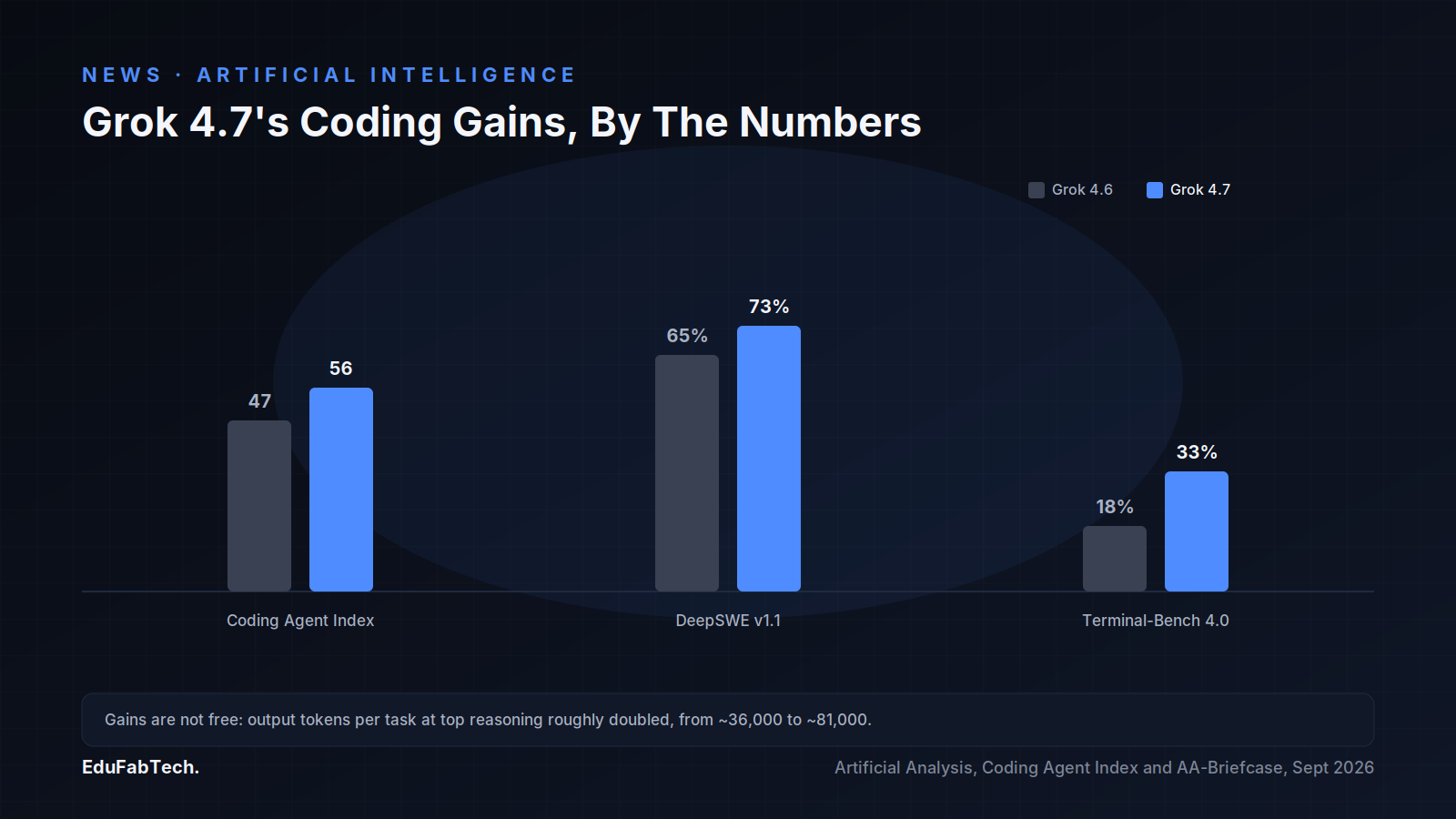
Artificial Analysis, a third-party model evaluation group, put Grok 4.7 at 46 on its Intelligence Index, up two points from Grok 4.6 and enough, in its assessment, to place SpaceXAI among the top four AI labs it tracks. On its Coding Agent Index, which runs models inside their native coding harnesses, Grok 4.7 paired with the Grok Build environment scored 56, up nine points from Grok 4.6's 47.
The largest single jump was on agentic knowledge work. Artificial Analysis measured a 111-point gain on its AA-Briefcase benchmark, a private test of long-horizon agentic tasks, with Grok 4.7 reaching 1,657 Elo — just behind Claude Opus 5 and Claude Fable 5.1. On coding-specific tests run inside Grok Build, Artificial Analysis recorded DeepSWE v1.1 rising from 65% to 73% and Terminal-Bench 4.0 climbing from 18% to 33%.
Those gains were not free. Artificial Analysis found Grok 4.7 at its highest reasoning setting used roughly 81,000 output tokens per Intelligence Index task, more than double the roughly 36,000 tokens Grok 4.6 used for the same tasks. Because per-token pricing did not change, the practical cost of running Grok 4.7 at full reasoning effort is substantially higher than the headline price suggests, even though the listed rate is identical to its predecessor.
A security evaluator's more pointed finding
The most concrete illustration of why orchestration matters came from XBOW, a firm that evaluates AI models for offensive security capability. Tested standalone under a fixed iteration budget, Grok 4.7 performed slightly worse than Grok 4.6 at crafting exploits, while producing shorter, cheaper completions. Tested inside SpaceXAI's own Grok Build orchestration environment, however, the same model produced 68 correct exploit-chain findings against 42 for Grok 4.6 under identical conditions — a substantial gain that the standalone test alone would have missed entirely.
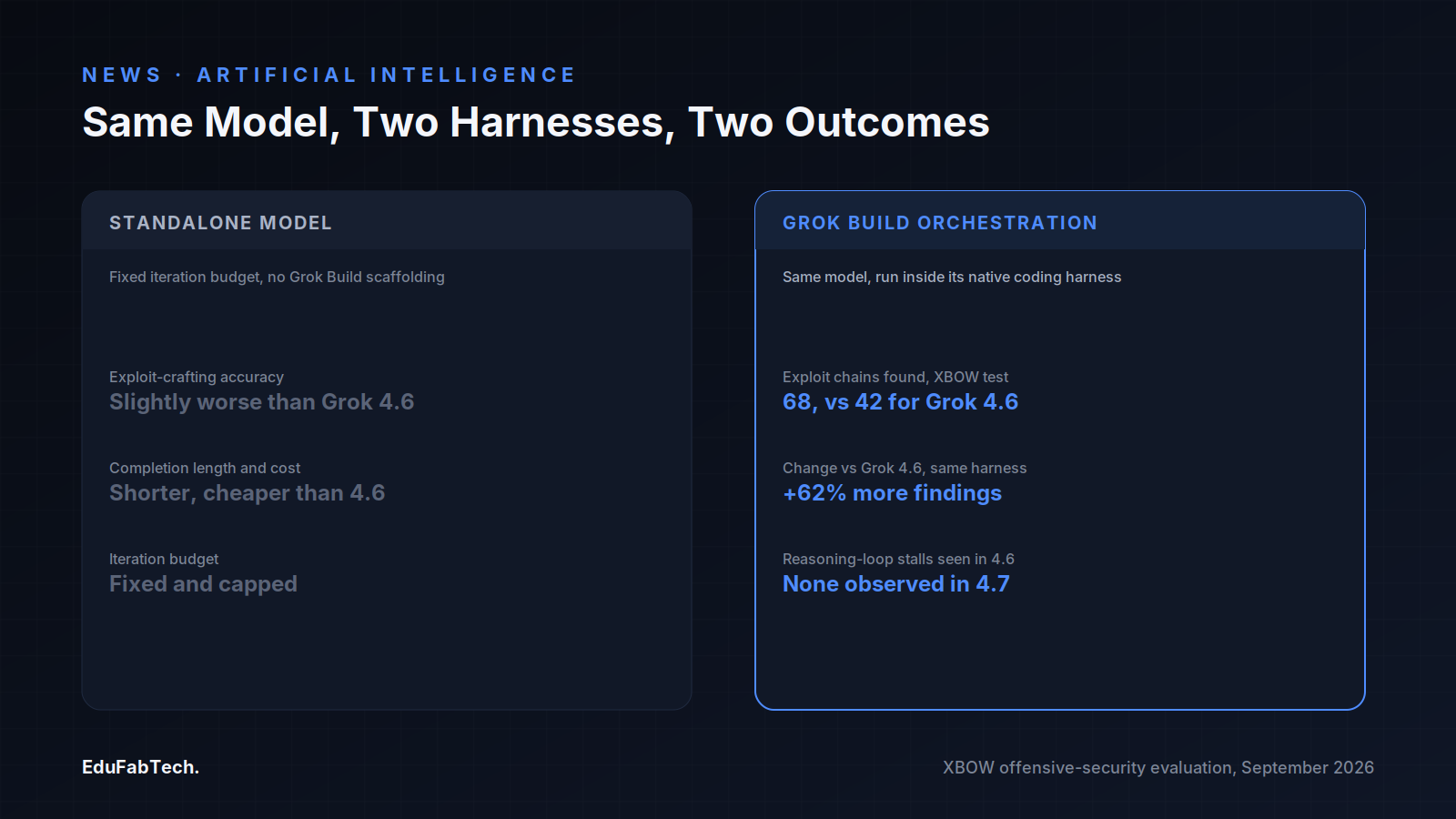
XBOW also reported that a failure mode present in Grok 4.6 — excessive reasoning loops that stalled roughly 0.85% of runs — was absent entirely in Grok 4.7's Build-orchestrated runs. Its stated conclusion is that "the orchestration layer itself increasingly needs to fit the model," meaning a benchmark score attached to a bare model, without specifying its harness, is now an incomplete description of what that model can do.
Why this matters beyond one release
For engineering teams evaluating which model to route coding or security tasks through, the practical lesson from these two independent checks is not "Grok 4.7 is better" in isolation. It is that comparing models on leaderboard scores alone, without accounting for the orchestration layer and the token budget each configuration consumes, increasingly produces the wrong answer. A model that looks unchanged or slightly worse in a standalone test can perform far better once matched with the scaffolding it was tuned against — and a model that gains benchmark points can simultaneously become more expensive to run at the settings that produced those points.
SpaceXAI's own model card, published alongside the release, reports Grok 4.7 as its strongest model to date on refusal quality and jailbreak resistance, citing a 3.3% pass-through rate for risky prompts on its internal HackerBench v0.3 evaluation and a 62.4% score on LatchBio's biosafety benchmark. Those figures come from SpaceXAI itself; XBOW's exploit-finding numbers are the only fully independent, reproducible check published so far on the model's dual-use capability, and they arrive with the caveat that the result flips depending on which system runs the model.