ESA's Hera Probe Images Didymos and Dimorphos as Separate Objects for the First Time
On 18 October 2026 the spacecraft resolved the two asteroids from 1,280 km away, its first look at the pair NASA's DART mission struck in 2022.
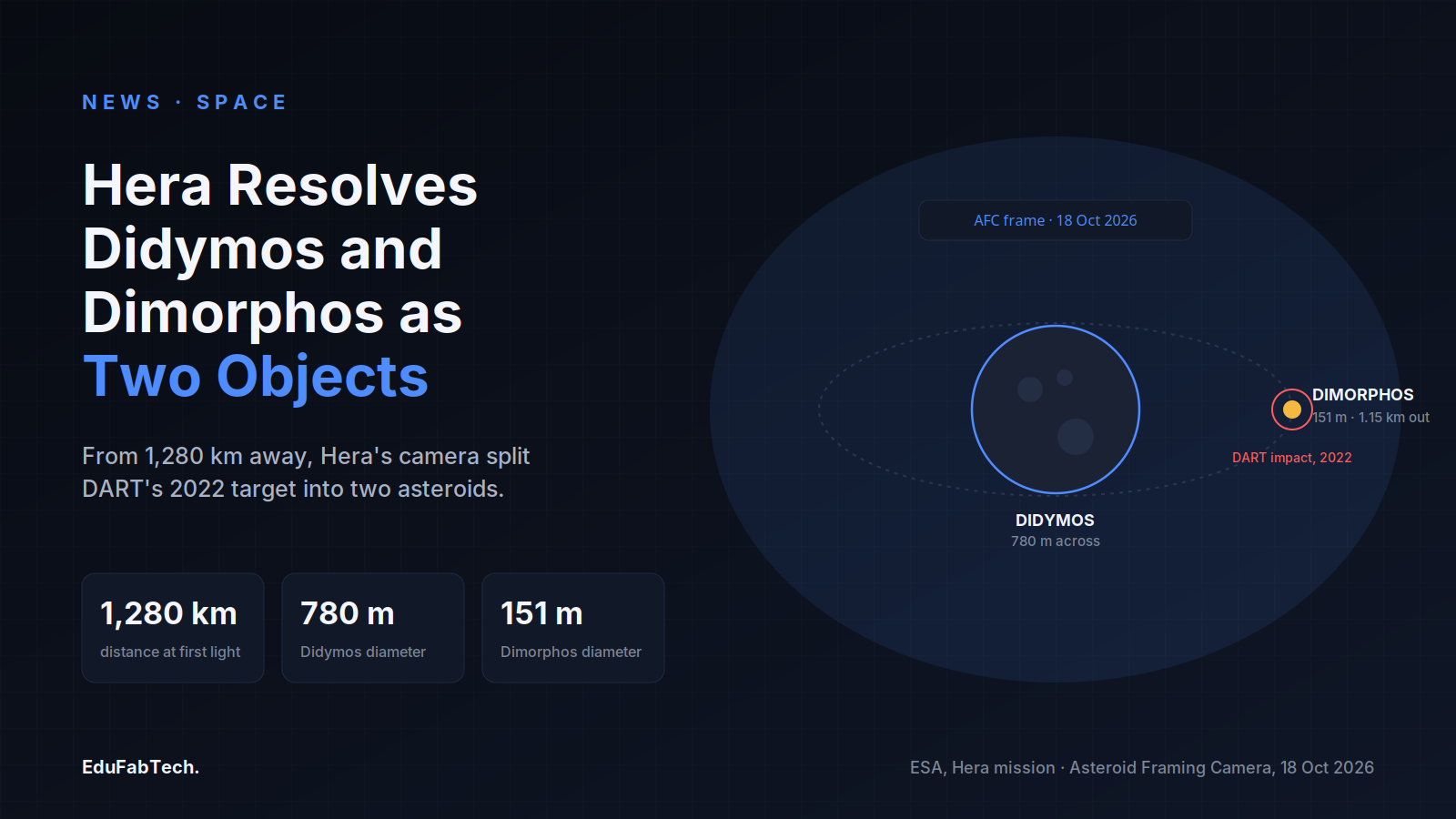
The European Space Agency said on 27 October 2026 that its Hera spacecraft has taken its first image resolving the asteroid Didymos and its small moon Dimorphos as two separate objects, four years after NASA's DART mission deliberately struck Dimorphos to test whether a spacecraft impact can change an asteroid's path. ESA's announcement says the image was captured on the evening of 18 October 2026, when Hera was about 1,280 kilometres from the pair.
Until that image, Hera's camera had only ever seen Didymos and Dimorphos as a single point of light. In the new frame, taken with the spacecraft's Asteroid Framing Camera, Dimorphos appears as roughly one pixel next to the much larger Didymos. "With this image the smaller Dimorphos asteroid becomes visible for the first time," Michael Kueppers is quoted as saying in the ESA release. Hera's mission manager, Ian Carnelli, added: "For the very first time we are seeing through Hera's own eyes the very double asteroid system that the mission was designed and built for."
Didymos measures about 780 metres across, and Dimorphos, which orbits it at an average distance of 1.15 kilometres, is about 151 metres across, according to ESA's release. The two bodies became the subject of the first real-world test of planetary defense on 26 September 2022, when NASA's DART spacecraft struck Dimorphos at 6.1 kilometres per second. ESA's release says the impact slowed Dimorphos's orbit by around 33 minutes. NASA, which ran the DART mission, had set a minimum success threshold of 73 seconds before the impact and confirmed in October 2022 that the measured change of 32 minutes exceeded that threshold more than 25-fold.
Slowing down for a rendezvous
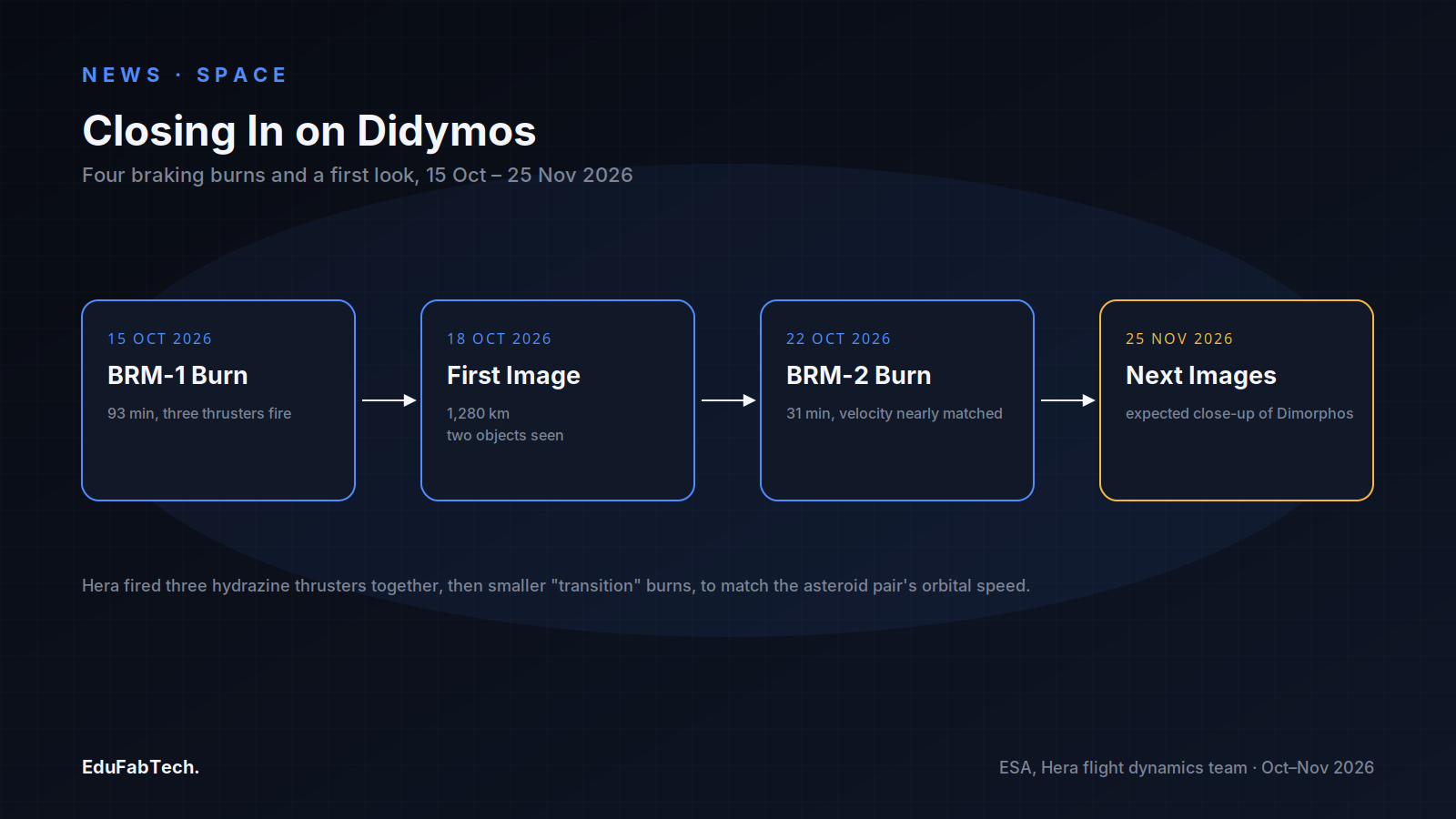
Hera, launched on 7 October 2024 from Cape Canaveral Space Force Station, spent much of October 2026 shedding speed to match the asteroid pair's orbit around the Sun. According to ESA's braking-manoeuvre release, published 7 October 2026, the spacecraft fired three hydrazine-based Orbit Control Thrusters together for 93 continuous minutes on 15 October 2026 in a manoeuvre designated BRM-1, cutting its velocity relative to the Didymos system by several hundred metres per second. A second manoeuvre, BRM-2, followed on the morning of 22 October 2026, lasting about 31 minutes and completing most of the remaining velocity change needed to match the asteroids' path. ESA flight dynamics engineer Francesco Castellini said the team would use Hera's guidance, navigation and control sensor readings, together with ranging and Doppler data in the spacecraft's radio signal, to check that the direction and size of each burn matched the planned change in velocity.
A further set of smaller "transition" manoeuvres later in October brought Hera's relative velocity with the asteroid pair down to near zero, clearing the way for the camera to start resolving the two bodies individually rather than as a single blurred point.
What researchers and students can watch for next
ESA's release states that Hera's team expects to release the first detailed images of Dimorphos on 25 November 2026, once the spacecraft has closed in further. Over the following months, the spacecraft is expected to carry out a close-up survey with its full instrument suite and to release two CubeSats, Milani and Juventas, which Universe Today reports are designed respectively to analyse the mineral composition of the impact site and to probe up to 100 metres beneath Dimorphos's surface with ground-penetrating radar, to establish whether the moonlet's interior is solid rock or a loose rubble pile.
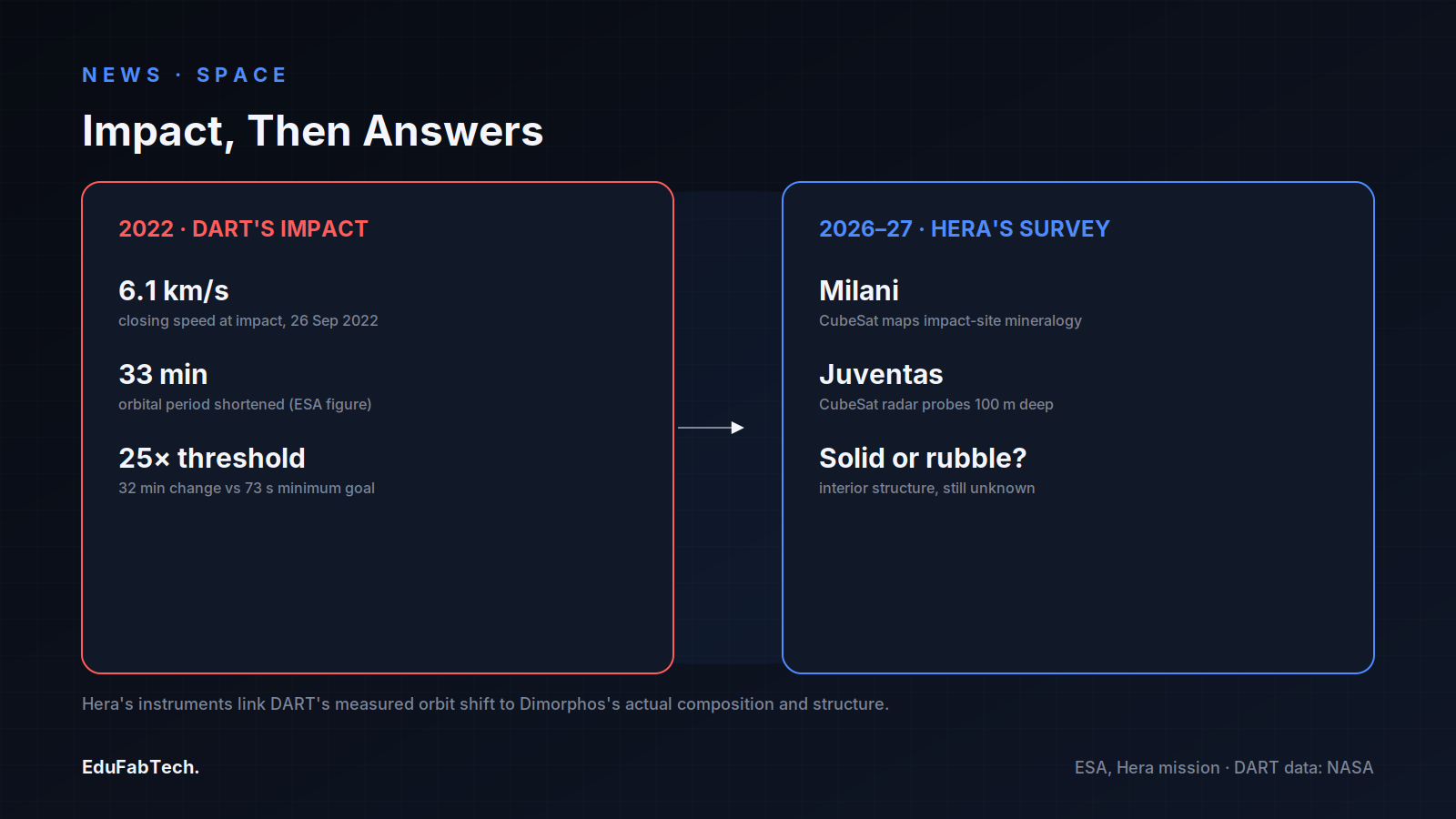
For planetary-defense researchers, the open question is how much Dimorphos's interior structure affected the way it absorbed DART's impact, since that relationship determines how reliably a future kinetic-impact deflection could be modelled for a different asteroid. Hera's survey is designed to supply the physical measurements — mass, shape, surface composition and internal structure — that modellers need to connect DART's observed orbital shift to the asteroid's actual material properties, rather than to assumptions about them.
For students following the mission, the sequence from the 15 and 22 October braking burns to the 18 October first-light image is a documented, public example of how a spacecraft actually closes the final distance to a target it has been travelling toward for two years: not a single arrival, but a scheduled series of thruster firings, each checked against tracking data before the next is approved.
A quick question for readers
Which study habit do you think is most overrated?
Some popular habits have little evidence behind them. Which one do you think gets too much credit?
Pick an answer, create a free account in a minute, and your vote counts. Already a member? Sign in
Comments 3
Comment-
The part worth questioning isn't the imaging, it's the leap from a 33-minute orbital shift to "we now know how to model kinetic deflection."…
-
The part that actually matters for the planetary defense case gets buried at the end: Hera's whole job is to pin down whether Dimorphos is s…
-
The part worth sitting with is the 1,280 km shot where Dimorphos is literally one pixel - that's not a resolved moon, that's barely a detect…
Join free to read the full comments and reply Comments are between members; an account takes a minute.
Source: European Space Agency
Sources (3)
- European Space Agency. First light: Hera resolves two asteroids instead of one. ESA, 2026. esa.int ↗ · checked 3 Nov 2026
- NASA. NASA Confirms DART Mission Impact Changed Asteroid's Motion in Space. NASA, 2022. nasa.gov ↗ · checked 3 Nov 2026
- Laurence Tognetti. Hera Probe Sees Asteroid Pair Separately for First Time. Universe Today, 2026. universetoday.com ↗ · checked 3 Nov 2026