IEEE Retracts 1,417 Conference Papers in a Single Day Over Paper-Mill Sales
On 23 October 2026 IEEE withdrew 1,417 conference papers tied to a market selling authorship slots, the largest single bulk retraction by any scholarly publisher, Nature and a new study report.
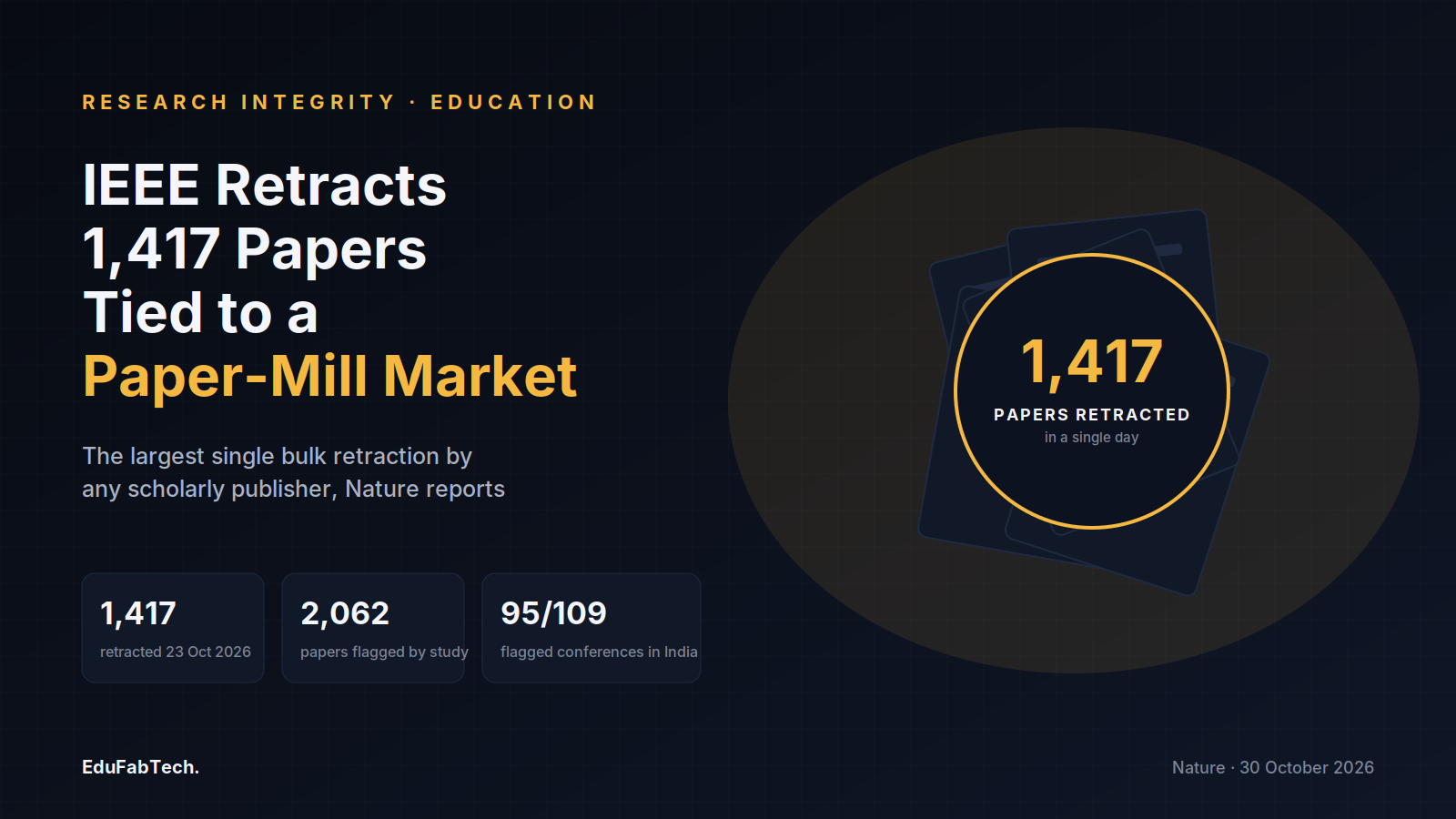
IEEE, the Institute of Electrical and Electronics Engineers, withdrew 1,417 conference papers in a single action on 23 October 2026, a move reported by Nature on 30 October 2026. Research-integrity specialists cited in that report called it the largest single bulk retraction issued by any scholarly publisher. The retraction notices attached to the withdrawn papers state that the articles "may have been offered for sale," linking them to an online market in which authorship slots on conference papers are advertised and bought.
Mapping the Paper-Mill Market
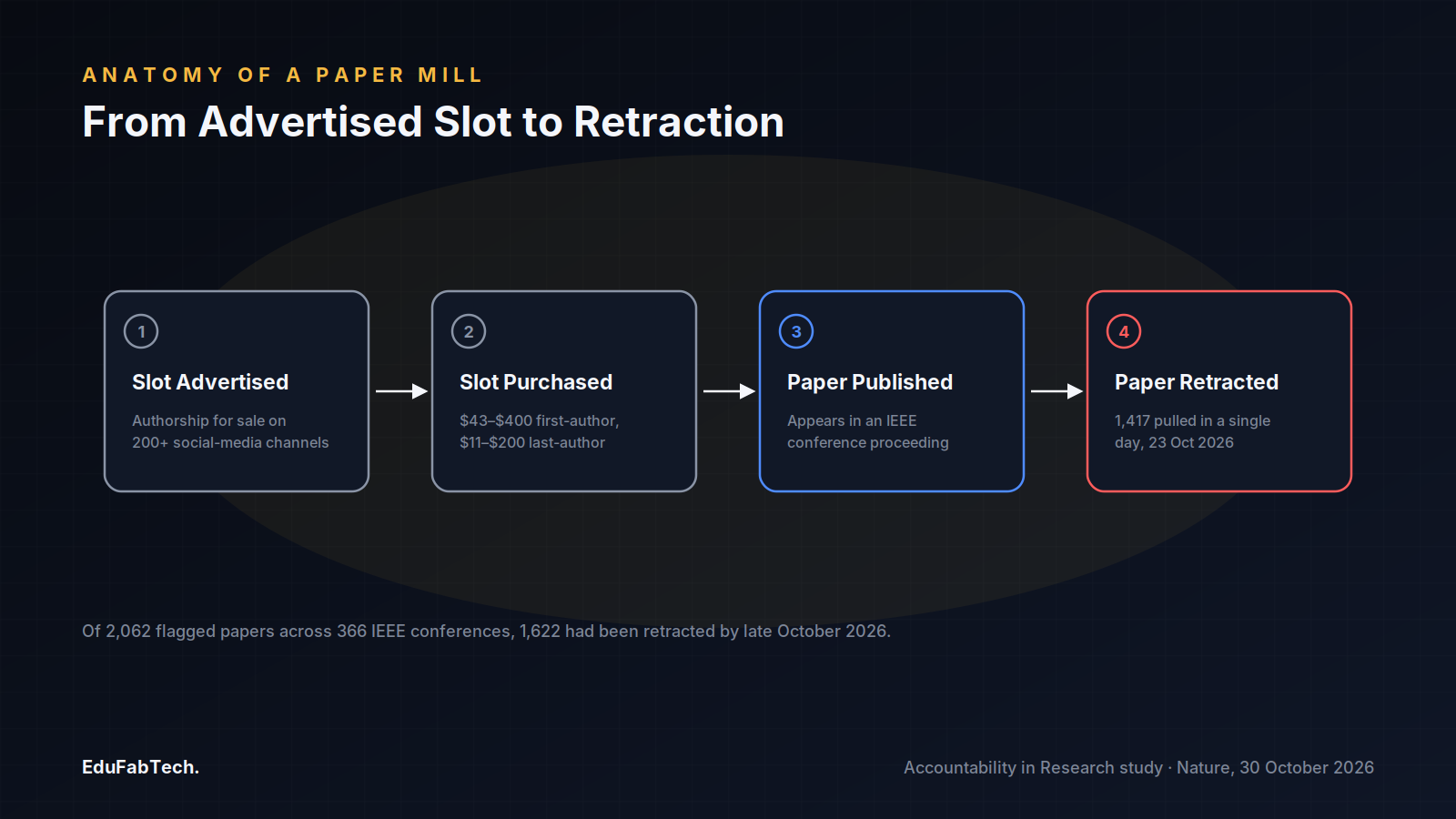
The retractions follow a study, "Opening Pandora's Box: Paper Mills in Conference Proceedings," published in the journal Accountability in Research by Anna Abalkina of the Free University of Berlin, Marie Kunešová of the University of West Bohemia, and co-authors Yagmur Ozturk and Solal Pirelli. The team collected more than 4,000 unique paper titles or topics advertised for sale across upward of 200 social-media channels, then matched them against published work. They identified 2,062 papers carrying signs of a match, spread across 366 IEEE conference proceedings published between 2021 and 2026.
According to the study, advertised authorship slots sold for between $43 and $400 for a first-author position and between $11 and $200 for a last-author position. The flagged papers carried more than 7,500 named researchers from upward of 4,000 institutional affiliations across 56 countries, and in at least one individual conference, up to 23.51% of papers presented matched a paper-mill advertisement.
A Concentration in One Country
Nature's report on the retraction, drawing on the same dataset, found the problem was not evenly spread geographically. Of 109 IEEE-sponsored conferences that published five or more papers matching a paper-mill advertisement, 95 were held in India. That concentration gives department heads, funders and conference co-sponsors outside India a specific place to look, rather than treating the problem as diffuse background noise across the field.
How This Compares With Earlier Bulk Retractions
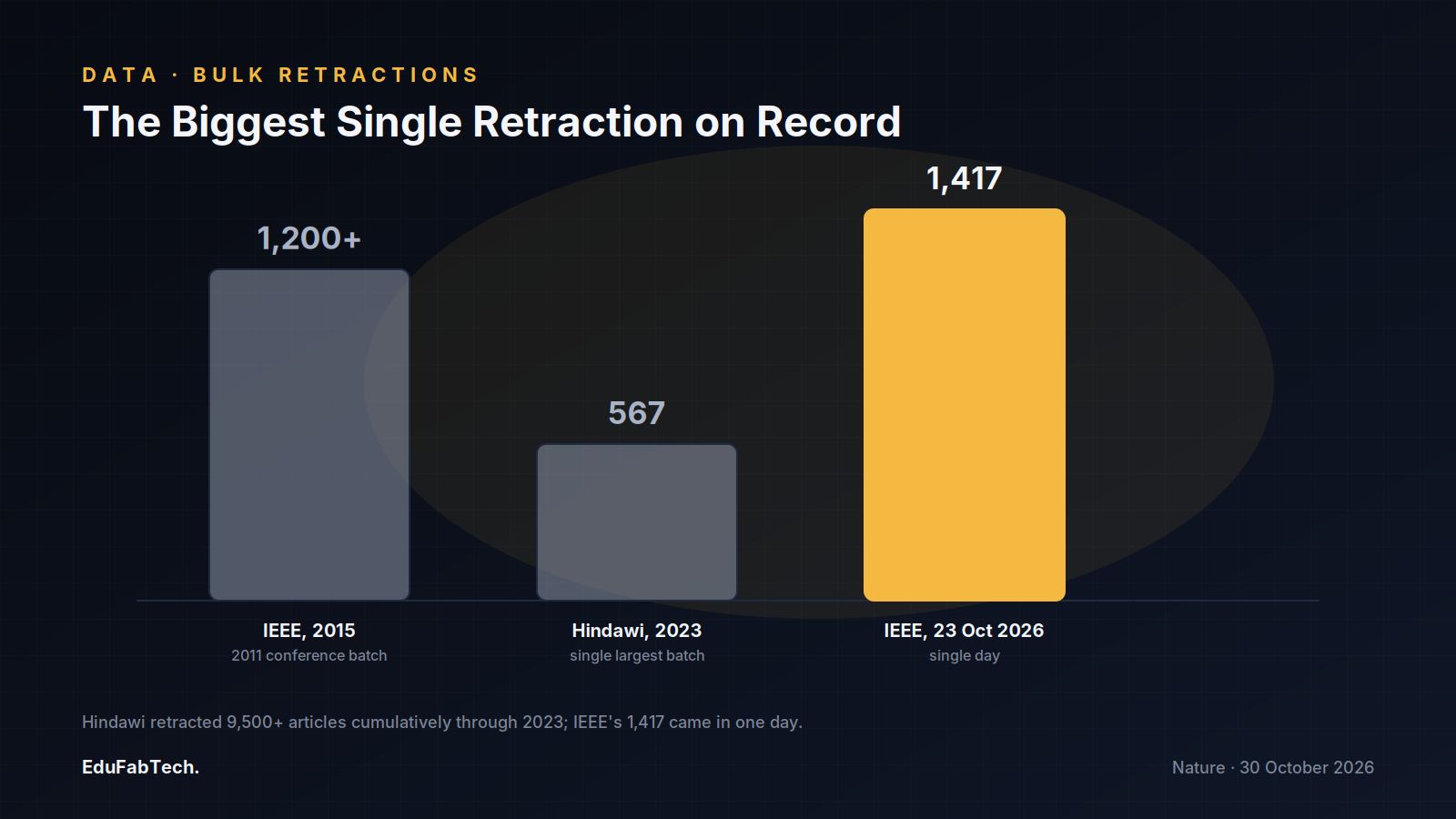
Nature's report gives two earlier reference points for scale: IEEE itself retracted more than 1,200 papers and abstracts from a single 2011 conference in 2015, and the publisher Hindawi, a now-defunct London-based subsidiary of Wiley, retracted more than 9,500 articles by the end of 2023, including 567 in one batch. The October 2026 action pulled more papers in a single day — 1,417 — than either of those earlier batches, which is why research-integrity specialists describe it to Nature as the largest single bulk retraction on record.
What IEEE and the Study's Authors Say
IEEE's statement, as reported by Nature, puts the withdrawn articles at less than 0.06% of its conference output over the six-year period the study covered; the organisation publishes more than 350,000 conference papers a year. Of the 2,062 papers originally flagged, 1,622 had been retracted by the time of Nature's report, including the 1,417 pulled in the 23 October batch, and IEEE has retracted close to 3,000 papers in total so far in 2026.
Anna Abalkina told Nature she was surprised by how quickly IEEE acted: "It is unbelievable. They're so fast." Marie Kunešová said IEEE should "implement more oversight over the different sections" that organise and vet its conferences, pointing to uneven scrutiny across the more than 2,000 conferences the organisation sponsors each year.
IEEE's Existing Screening Effort
IEEE had already been expanding its own detection work before this batch. An IEEE Spectrum article published 30 July 2026 says an ad hoc ethics committee reviewed and recommended retraction of more than 1,700 "problematic" conference articles in 2025, and that IEEE has built in an automated tool called the Clear Skies Papermill Alarm to flag potentially fraudulent manuscripts at the point of submission.
What It Means for Students and Early-Career Researchers
For students and early-career engineers, the episode is a reminder that a line on a CV or a citation in a literature review is only as reliable as the venue that published it. Conference proceedings typically move faster and carry lighter review than journals, which is part of why they attract paper mills selling guaranteed authorship. Anyone assembling a reading list, or listing publications on a PhD or job application, can check whether a specific IEEE conference paper has since been withdrawn through IEEE Xplore's own retraction notices or the Retraction Watch Database before relying on it.
For admissions committees and hiring panels reviewing applicants with IEEE conference papers on record — particularly from the conferences the Abalkina team singled out — the retraction argues for checking a paper's current status directly rather than counting conference publications at face value. The same caution applies to literature reviews: a paper matched to a paper-mill advertisement in the study's dataset may still be awaiting IEEE's review even if it has not yet been formally retracted.
A quick question for readers
Which study method makes things stick for you until the exam?
Research says some methods work far better than others. Vote first, then see whether students agree with the evidence.
Pick an answer, create a free account in a minute, and your vote counts. Already a member? Sign in
Comments 3
Comment-
The 95-out-of-109 concentration in India is the detail worth sitting with, but the piece doesn't ask the obvious follow-up: concentrated whe…
-
The number that actually tells you something here is the 95-out-of-109 concentration: once you restrict to IEEE conferences with five or mor…
-
The number worth sitting with is 95 of 109 flagged conferences being held in India - that's not a diffuse integrity problem, that's a specif…
Join free to read the full comments and reply Comments are between members; an account takes a minute.
Source: Nature
Sources (3)
- Anna Abalkina, Marie Kunešová, Yagmur Ozturk, Solal Pirelli. Opening Pandora's Box: Paper Mills in Conference Proceedings. Accountability in Research, 2026. tandfonline.com ↗ · checked 31 Oct 2026
- Miryam Naddaf. Record-breaking retraction: scholarly publisher pulls 1,400 conference papers on one day. Nature, 2026. nature.com ↗ · checked 31 Oct 2026
- IEEE Spectrum. IEEE Publishing Ethics Team Upholds Research Integrity. IEEE Spectrum, 2026. spectrum.ieee.org ↗ · checked 31 Oct 2026