AI Tools Built by Instructors, Not Vendors, Lifted Exam Scores in 19-University Trial
A randomized trial spanning the US, Hong Kong, mainland China and India found AI activities designed by each course's own instructor raised scores on proctored exams, while other 2026 trials of generic AI tools found mixed or negative results.
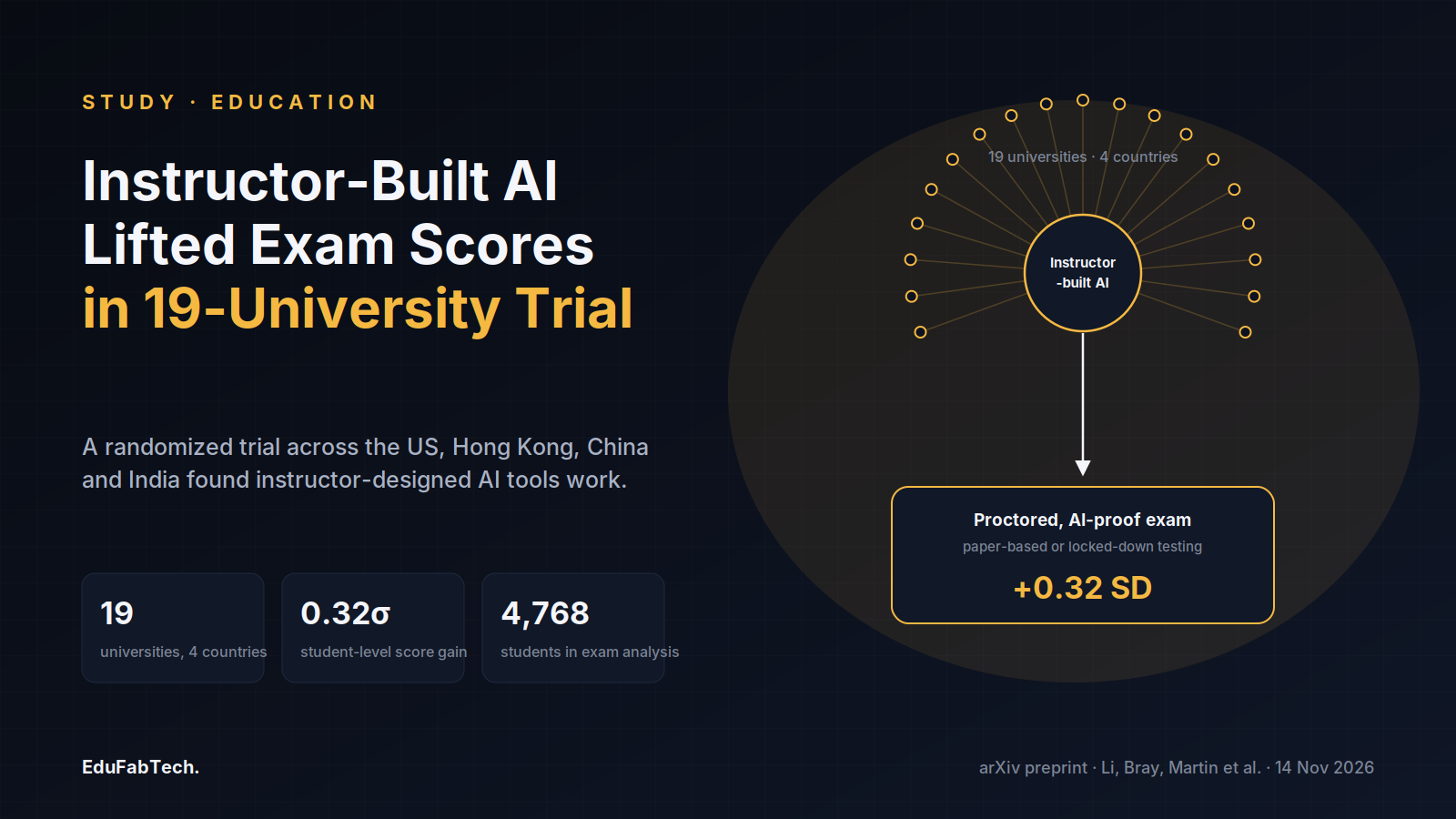
A randomized trial spanning 19 universities in the United States, Hong Kong, mainland China and India has found that AI tools designed by the instructors who teach each course raised exam scores, in contrast with other recent studies of generic AI tutoring that found no benefit or a negative one. The preprint, posted to arXiv on 14 November 2026 by Jun Li of the University of Michigan, Robert Bray, Sébastien Martin and more than 40 co-authors, describes a pre-registered trial run across three semesters, from spring 2025 to spring 2026.
What the trial measured
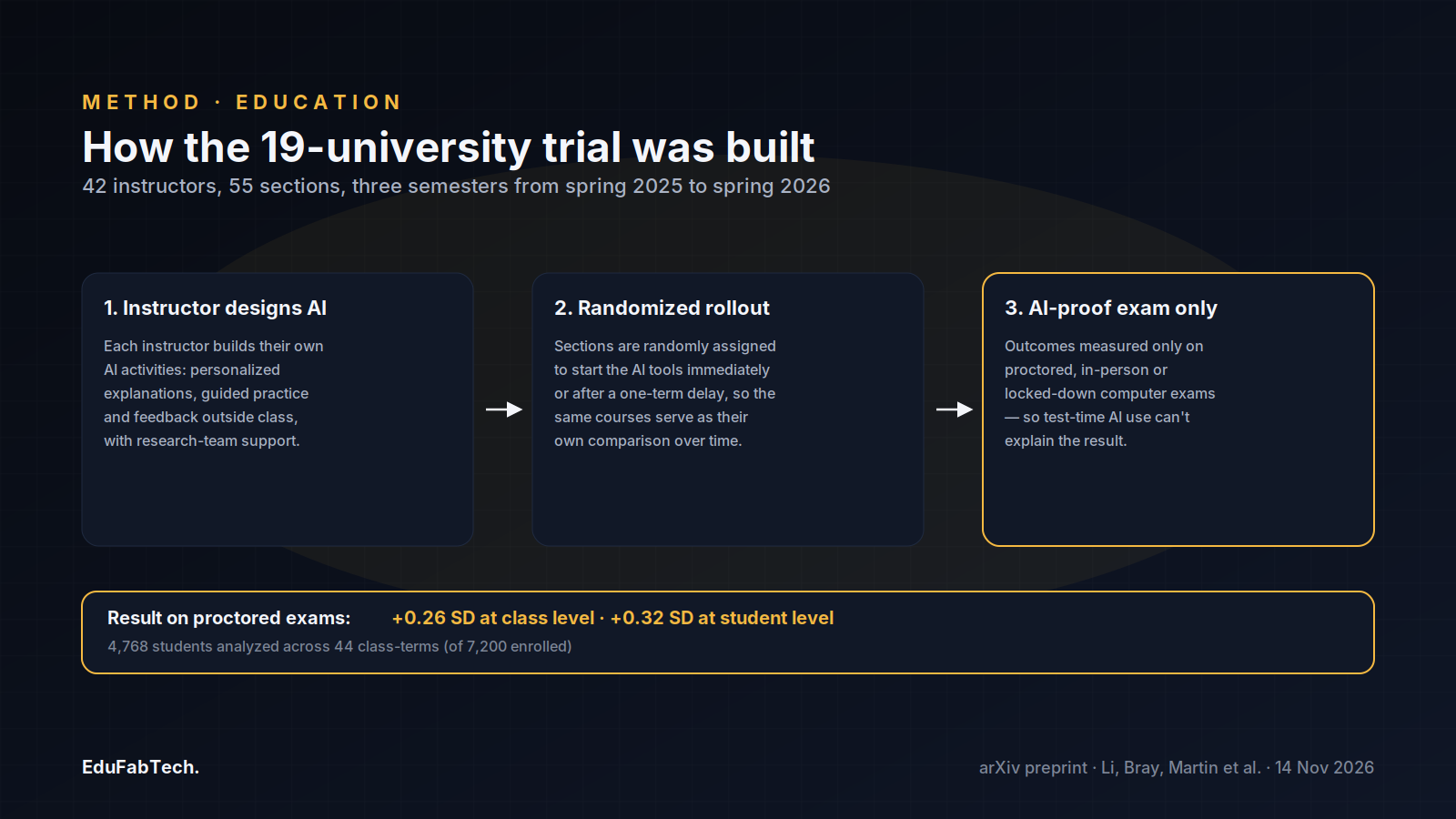
The study recruited 42 instructors teaching 55 sections of applied STEM courses at participating institutions, which included the University of Michigan, Northwestern University, Cornell University, Georgetown University, the University of Pennsylvania, Yale University, Purdue University and other US universities, alongside the University of Hong Kong, Fudan University and the Indian Institute of Management Ahmedabad, according to the preprint. In total, 7,200 students took part, with 4,768 students included in the exam analysis across 44 class-terms, the preprint reports.
Rather than deploying a single commercial chatbot, instructors in the treatment group designed their own AI activities — personalized explanations, guided practice and feedback delivered outside scheduled class hours — with technical support from the research team, the preprint states. Classes were randomly assigned to introduce these instructor-built AI tools immediately or after a one-term delay, allowing the same courses to serve as their own comparison over time.
How learning was tested
To rule out students simply using AI during the test itself, the researchers measured outcomes only on what they call AI-proof assessments. The preprint defines these as "proctored, in-person examinations, most of which were paper-based, and the rest strictly monitored, computer-based examinations that used surveillance software, such as LockDown Browser, or restricted-access computers at university-managed testing centers."
On those exams, the researchers report a gain of 0.26 standard deviations at the class level (standard error 0.12, p=0.038, 95% CI 0.02–0.51) and 0.32 standard deviations at the student level (standard error 0.13, p=0.019, 95% CI 0.06–0.59), according to the arXiv preprint. Those confidence intervals are wide, meaning the true effect could be considerably smaller or larger than the point estimates suggest.
A different picture from other trials
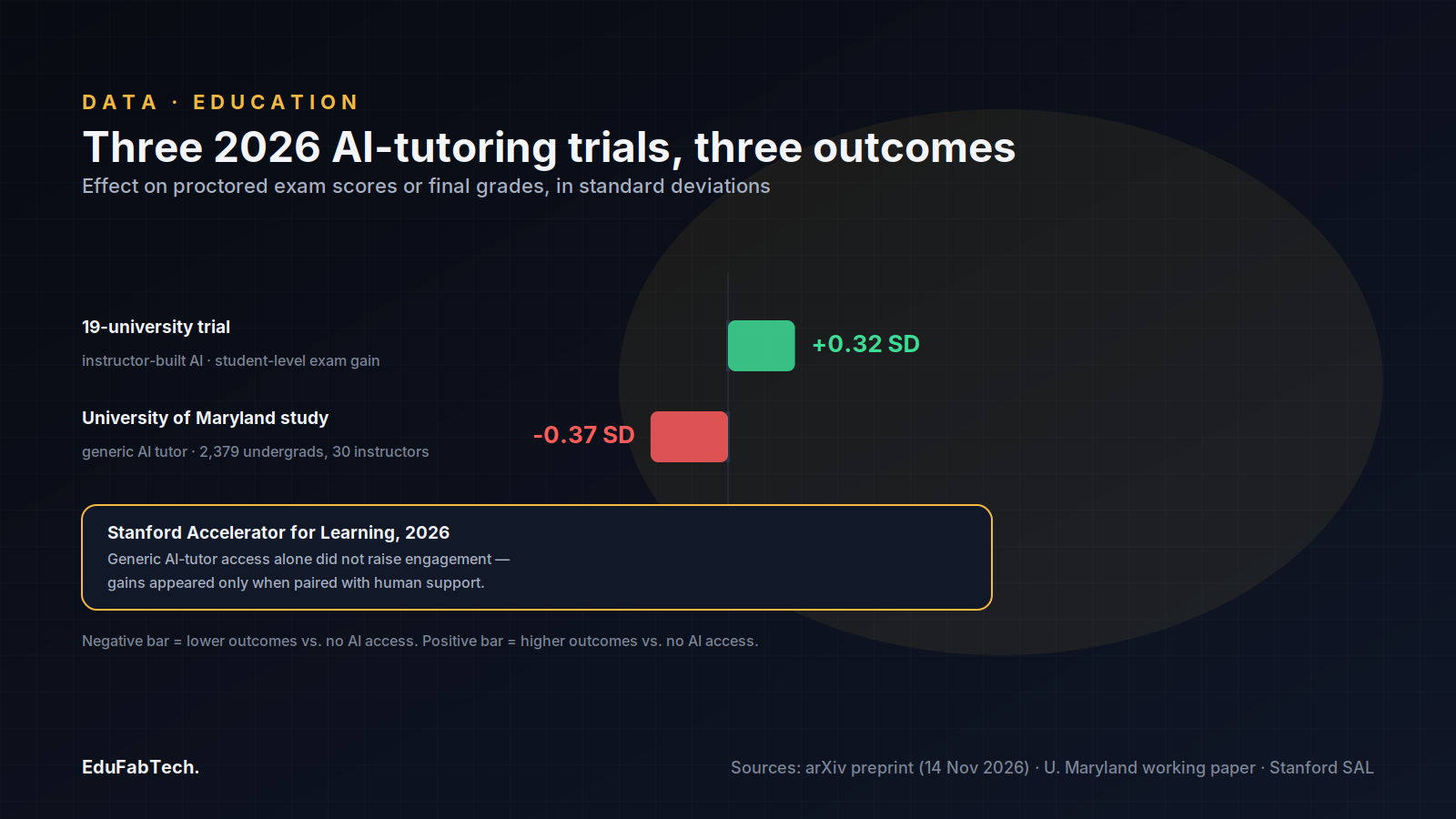
The result stands apart from two other 2026 studies of AI tutoring tools. A working paper from the University of Maryland involving 2,379 undergraduates across 30 instructors found that access to a general-purpose AI tutor reduced final grades by 0.37 standard deviations and cut learning-management-system participation by 0.90 standard deviations, relative to students without access. Separately, the Stanford Accelerator for Learning's National Student Support Accelerator reported in 2026 that giving students access to an AI tutor was not enough on its own — engagement rose only when the AI tutoring was paired with human support.
The authors of the 19-university trial argue that who designs the AI matters as much as whether students use it. The preprint contrasts its "frontline-driven AI" with what it calls "one-size-fits-all AI tools—either generic AI chatbots or centrally-planned AI agents—which are not amenable to instructor customization," writing that instructor-led design "leverages their unique knowledge of their classes and their students."
What the authors flag as limitations
The researchers are explicit about the trial's boundaries. The participating classes were, in their words, "primarily applied STEM," so the result may not generalize to humanities or social-science courses. Few classes were observed during a second or third round of implementation, limiting evidence on whether the effect holds up as instructors refine their tools over time. Engagement data "varied across sites and courses," and the authors say the study lacks the statistical power to distinguish which specific AI innovations — among the wide range instructors built — drove the improvement.
What it means for teaching staff
For instructors and departments weighing whether to adopt AI tools in their courses, the trial's design offers a concrete distinction to test locally: a tool built around a specific course's syllabus and assessments, versus a general-purpose chatbot handed to students with no instructor input. The 19-university sample, spanning large US research universities, two institutions in Hong Kong and mainland China, and a leading Indian management school, gives the finding more geographic range than most single-campus AI studies, though the result has not yet been through peer review. Students preparing for proctored exams in courses that introduce instructor-built AI activities may be looking at the kind of setting in which this trial recorded gains — applied STEM classes with paper-based or locked-down digital testing — rather than a guarantee that any AI tool, in any course, will have the same effect.
A quick question for readers
Which study method makes things stick for you until the exam?
Research says some methods work far better than others. Vote first, then see whether students agree with the evidence.
Pick an answer, create a free account in a minute, and your vote counts. Already a member? Sign in
Comments 3
Comment-
The number that needed a harder look is 4,768 out of 7,200 — a third of the sample didn't make it into the exam analysis, and the preprint d…
-
The number that should get top billing is the width of those confidence intervals, not the point estimate. A 95% CI of 0.02–0.59 at the stud…
-
The thing I'd want to pull apart is the Maryland result sitting right next to this one: a generic AI tutor cut grades by 0.37 SD, while inst…
Join free to read the full comments and reply Comments are between members; an account takes a minute.
Source: arXiv preprint (Jun Li, Robert Bray, Sébastien Martin et al.)
Sources (3)
- Jun Li, Robert Bray, Sébastien Martin, Nils Van den Steen, Andrew Wu, Xiao Ni, et al.. Instructor-designed AI improves learning in a randomized trial across 19 universities. arXiv preprint, 2026. arxiv.org ↗ · checked 28 Nov 2026
- Jing Liu, Tracy Sweet, Marty Haoyuan Chen, Jonathan Engelberg, Megan Masters, Martyn Clark, Axel Persaud, Alia Lancaster, Jeffrey Hollingsworth, Jennifer King Rice. The Effects of Course-Integrated AI Tutoring on Student Performance and Engagement: A Randomized University Trial. Annenberg Institute at Brown University (EdWorkingPapers) / University of Maryland, 2026. edworkingpapers.com ↗ · checked 28 Nov 2026
- Carly D. Robinson, David Gormley, Ana Trindade Ribeiro, Susanna Loeb. Access is Not Enough: Human Support Improves Engagement with AI Tutoring. National Student Support Accelerator, Stanford Accelerator for Learning, 2026. nssa.stanford.edu ↗ · checked 28 Nov 2026