Stopped Early: Trial Finds Intermittent Dialysis Carries Higher Mortality Than Continuous Therapy in AKI
A 554-patient French trial testing dialysis strategies in critically ill patients was halted after interim data showed higher death rates with intermittent hemodialysis, NEJM reports on 14 October 2026.
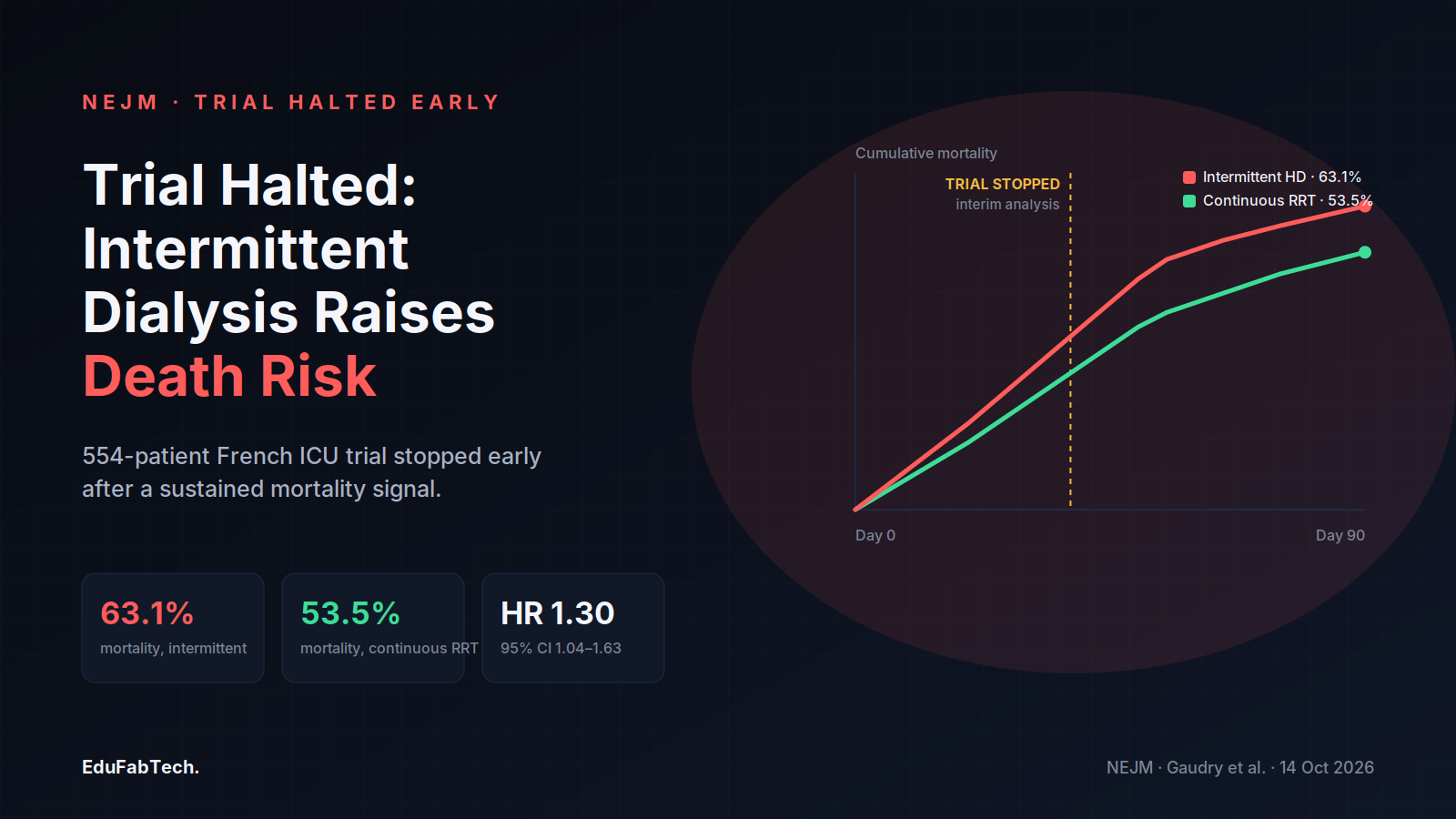
A multicenter trial testing which of two standard dialysis strategies is safer for critically ill patients with acute kidney injury was stopped early after interim analyses showed higher mortality in one of the two groups. The trial, called ICRAKI and led by Stéphane Gaudry of Assistance Publique-Hôpitaux de Paris, was published in the New England Journal of Medicine on 14 October 2026. It compared intermittent hemodialysis against continuous renal-replacement therapy (CRRT) as the initial treatment for patients in intensive care units across France.
What the trial tested
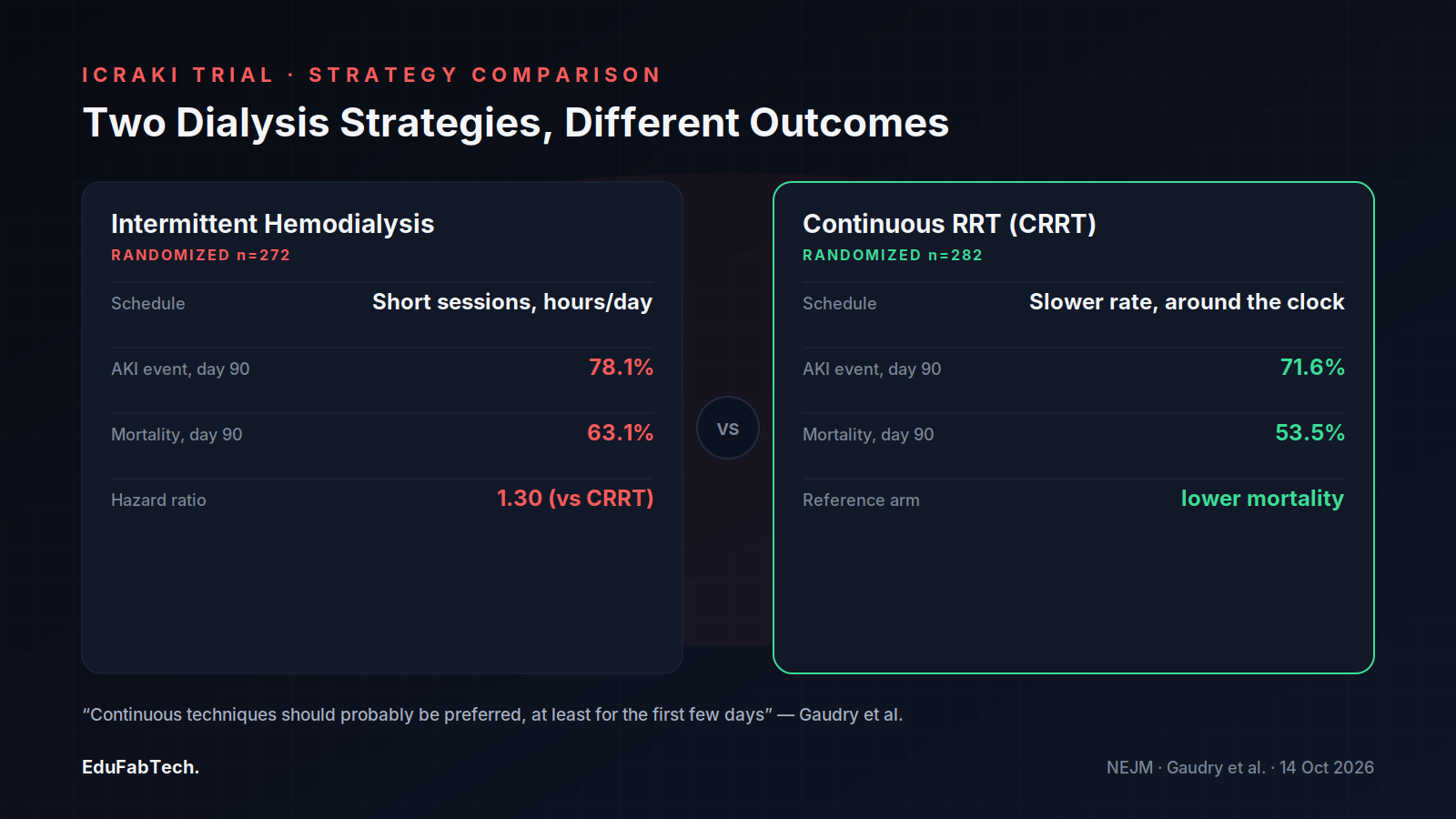
Acute kidney injury is common in intensive care, and when it is severe enough to require dialysis, clinicians have long had two broad options: intermittent hemodialysis, which runs in short sessions of a few hours, or continuous renal-replacement therapy, which runs around the clock at a slower rate. Both are used worldwide, and prior trials had not settled which approach, if either, is safer for the sickest patients. ICRAKI was designed as a multicenter, open-label, noninferiority trial to test whether intermittent hemodialysis could be shown to be at least as good as CRRT as the initial strategy, according to the NEJM paper.
The trial randomly assigned critically ill adults with acute kidney injury who had an indication for renal-replacement therapy to start on one of the two approaches. Patients were followed for a primary outcome called a major adverse kidney event, defined by the trial as death, dependence on renal-replacement therapy, or a serum creatinine concentration more than 25% above the patient's baseline value, assessed at day 90, as reported in the NEJM study.
Why it stopped early
A total of 554 patients underwent randomization — 272 to intermittent hemodialysis and 282 to CRRT — before the trial was halted, according to the NEJM paper. It was stopped after sequential interim analyses showed what the authors describe as a sustained signal of higher mortality in the intermittent hemodialysis group compared with the continuous group, reports Medical Xpress, which reviewed the published trial.
The results
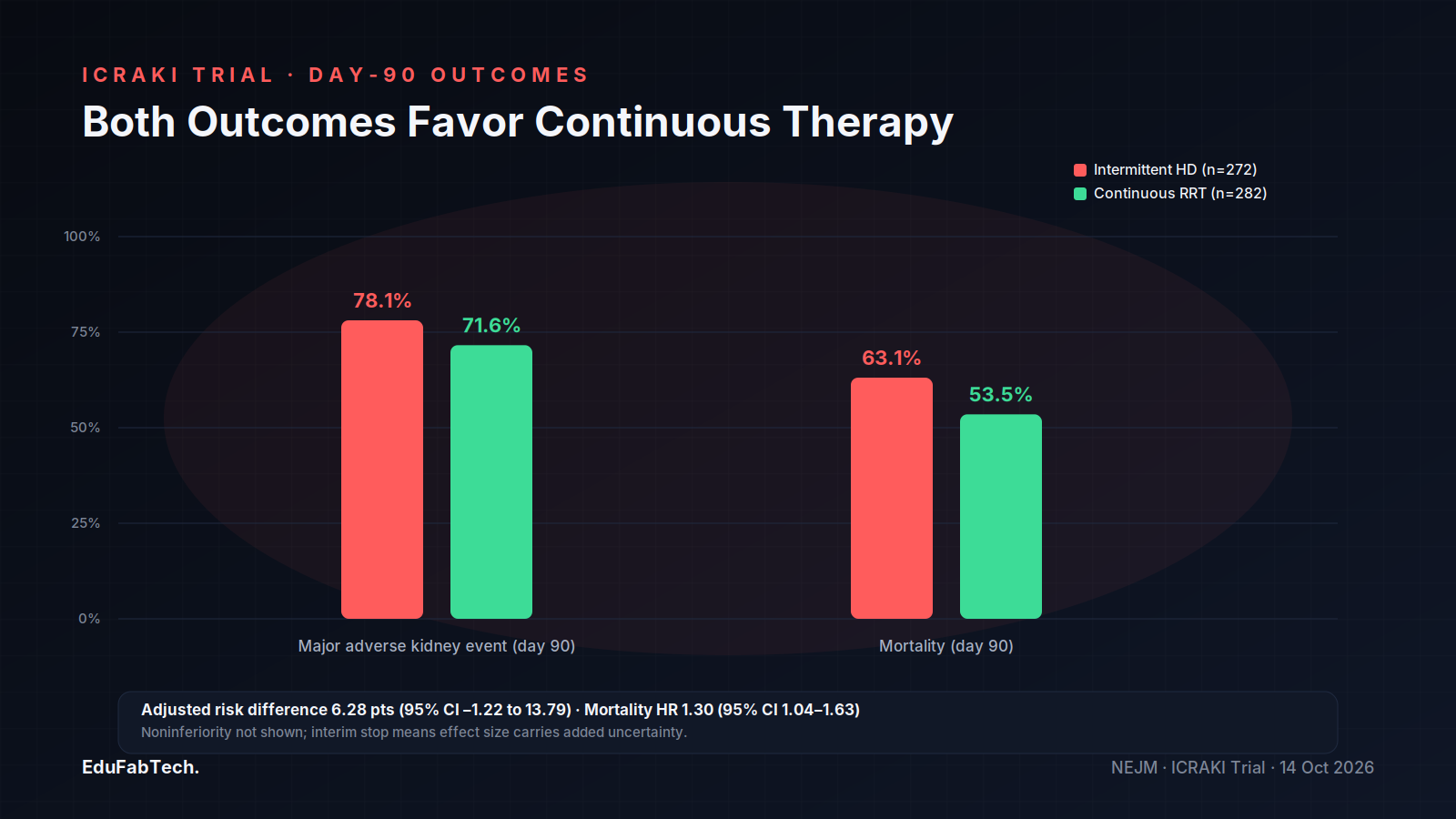
A major adverse kidney event by day 90 occurred in 78.1% of patients assigned to intermittent hemodialysis compared with 71.6% of those assigned to CRRT, an adjusted absolute risk difference of 6.28 percentage points (95% confidence interval, −1.22 to 13.79), according to the published trial. Because that confidence interval crosses zero and extended past the trial's prespecified noninferiority margin, the authors concluded that intermittent hemodialysis was not shown to be noninferior to CRRT on the primary composite outcome.
At day 90, mortality was 63.1% in the intermittent hemodialysis group versus 53.5% in the CRRT group, a hazard ratio of 1.30 (95% confidence interval, 1.04 to 1.63), as reported by Medical Xpress's and Healio's accounts of the trial. The authors state that intermittent hemodialysis as an initial strategy was associated with higher mortality than CRRT, while cautioning, per Medical Xpress's summary of the paper, that the magnitude of the mortality difference should be interpreted with caution given the trial's early termination — a standard statistical caveat, since stopping a trial early on an interim mortality signal can sometimes exaggerate the true size of an effect.
What it means for the ICU
Dialysis-strategy choice in the ICU is not a settled question elsewhere in the literature; earlier randomized trials, including comparisons of early versus delayed initiation of renal-replacement therapy, have shown mixed results on which approach benefits which patients. ICRAKI adds a large, prospectively randomized, multicenter comparison run specifically on the intermittent-versus-continuous question in severe acute kidney injury, rather than on timing of initiation. Gaudry and colleagues write, in the quote carried by Healio, that "continuous techniques should probably be preferred, at least for the first few days after dialysis initiation."
Reading the result carefully
For students and clinicians following critical-care research, ICRAKI is a useful case study in how a noninferiority trial can fail to show noninferiority and simultaneously surface a safety signal that was not its primary question. The trial was powered and designed around the composite kidney-event outcome, not mortality alone, and its early stopping means the mortality estimate comes from a smaller, less mature dataset than a trial that ran to its planned conclusion. That matters for how confidently the mortality hazard ratio of 1.30 can be read: a real effect, flagged early, but one whose precise size carries more uncertainty than it would otherwise, as the authors' own caution about interpreting the mortality difference reflects.
The trial was conducted across intensive care units in France, and its applicability to settings with different nursing ratios, dialysis equipment or baseline patient case-mix is not addressed in the summaries reviewed. Researchers and practitioners weighing dialysis-modality choice for their own units will want to read the full trial and its accompanying statistical detail in the New England Journal of Medicine rather than relying on the topline percentages alone.
A quick question for readers
Which study habit do you think is most overrated?
Some popular habits have little evidence behind them. Which one do you think gets too much credit?
Pick an answer, create a free account in a minute, and your vote counts. Already a member? Sign in
Comments 0
CommentNo comments yet. Members start the conversation.
Source: New England Journal of Medicine
Sources (3)
- Stéphane Gaudry et al.. Intermittent or Continuous Renal-Replacement Therapy in Acute Kidney Injury. New England Journal of Medicine, 2026. nejm.org ↗ · checked 20 Oct 2026
- Medical Xpress staff. Intermittent hemodialysis not noninferior to continuous renal-replacement therapy, trial finds. Medical Xpress, 2026. medicalxpress.com ↗ · checked 20 Oct 2026
- Healio staff. Mortality risks higher with intermittent vs. continuous renal replacement therapy in AKI. Healio, 2026. healio.com ↗ · checked 20 Oct 2026