JAXA's MMX Spacecraft Set to Launch 20 October 2026 to Sample the Moon Phobos
Built with NASA, ESA, CNES and DLR, the five-year Martian Moons eXploration mission aims to land on Phobos and bring back at least 10 grams of material by 2031.
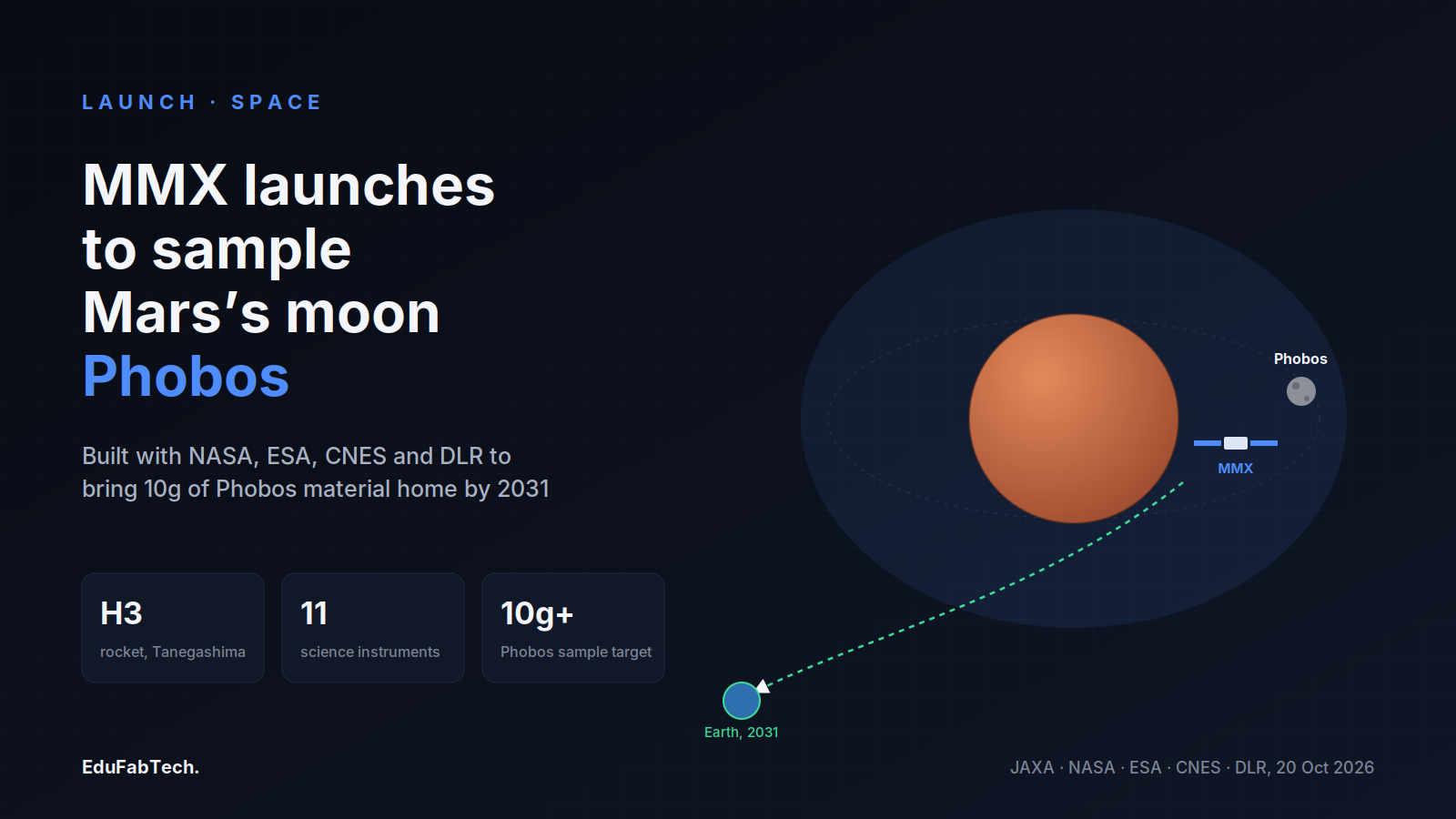
The Japan Aerospace Exploration Agency is scheduled to launch its Martian Moons eXploration spacecraft, known as MMX, at 04:41 Japan Standard Time on 20 October 2026 (19:41 UTC on 19 October) aboard an H3 rocket from the Tanegashima Space Center, according to JAXA's mission page. The spacecraft is built to orbit Mars, study both of its moons, land on Phobos to collect surface material, and bring that sample back to Earth — a feat no mission has previously attempted on a moon other than our own.
MMX is led by JAXA, with instrument and operations contributions from NASA, the French space agency CNES, the German Aerospace Center DLR and the European Space Agency, according to ESA's mission announcement. ESA is coordinating access to the returned samples for European researchers through announcements of opportunity arranged with partner agencies, the same release states.
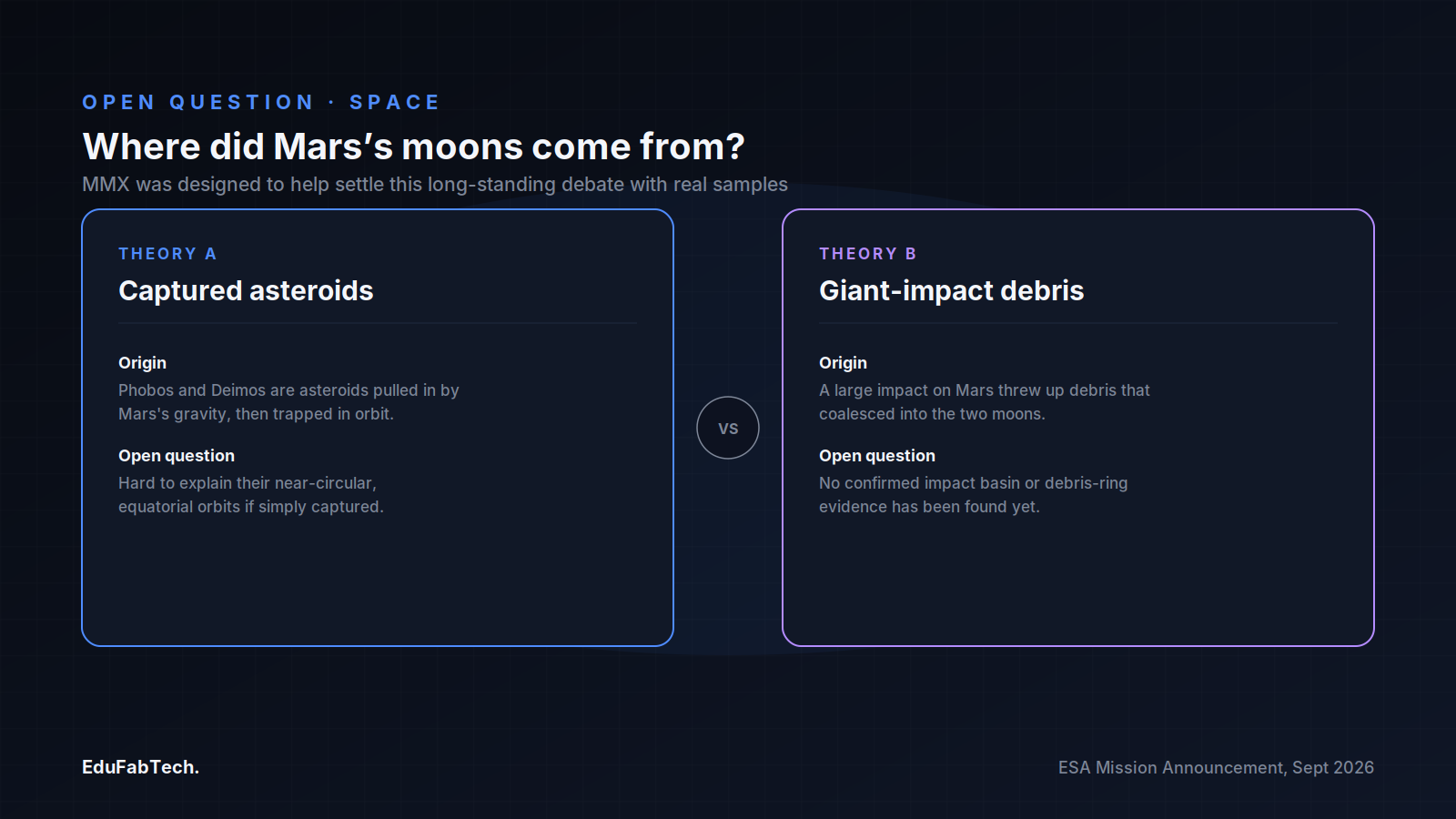
The central scientific question is how Phobos and Deimos came to orbit Mars. ESA MMX project scientist Elliot Sefton-Nash is quoted in the agency's announcement saying "the data and samples returned by MMX are a window to study the evolution of Mars and the Solar System," and that "bringing samples to our most sophisticated labs here on Earth is a multiplier for discoveries, because our most precise instruments are too large, complex or sensitive to send to space." The mission is designed to help settle whether the moons are asteroids captured by Mars's gravity or debris thrown up by a giant impact on the planet, a question ESA's release describes as a long-standing unknown.
What the spacecraft carries
According to ESA, the mission carries 11 science instruments in total: seven mounted on the main spacecraft and four on a 25-kilogram rover named Idefix. The rover was developed by DLR and CNES, according to SpacePolicyOnline's reporting. The main spacecraft's sampling hardware includes two different collection devices, and the rover is intended to study the surface composition and texture of Phobos directly.
NASA's contribution includes the MEGANE instrument, a gamma-ray and neutron spectrometer built by the Johns Hopkins University Applied Physics Laboratory that will measure the elemental composition of Phobos during close flybys, and a pneumatic sample-collection mechanism called the P-Sampler built by Honeybee Robotics, according to SpacePolicyOnline's reporting. That same report states the P-Sampler was previously tested in the Mojave Desert and flew on Firefly Aerospace's Blue Ghost Mission 1 lunar lander in 2025, and puts NASA's lifecycle cost for its MMX contribution at $87 million through mission completion, with NASA set to receive at least 15 percent of any returned Phobos material for analysis.
A mission measured in years, not months
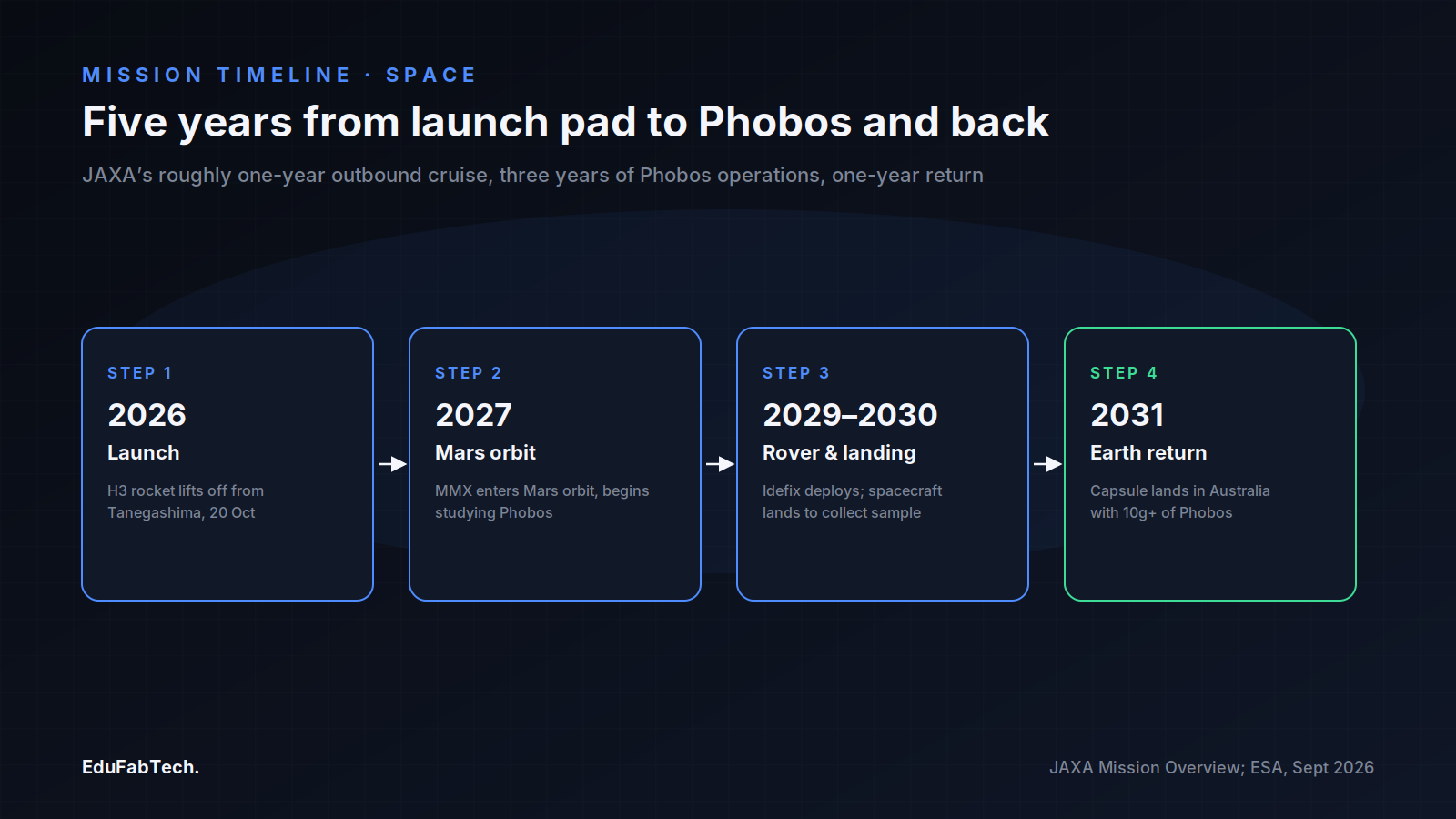
Per ESA's release, MMX is expected to enter orbit around Mars in August 2027, begin orbiting Phobos from September 2027, deploy the Idefix rover onto Phobos in early 2029, and have the main spacecraft land to collect its sample in 2030, before the return capsule lands in Australia in 2031 and is transferred to Japan for extraction and cataloguing. SpacePolicyOnline's report gives a slightly different near-term marker, citing Mars arrival in August 2027 and sample collection no earlier than December 2028, with return to Earth likewise placed in 2031. JAXA's own mission page describes the roughly five-year flight profile as one year to Mars, three years of operations at Phobos, and one year for the return journey, with a target of 10 grams or more of material brought home.
Why it matters beyond the launch pad
For researchers, the appeal of MMX is access: a returned sample lets laboratories apply far more sensitive and varied analytical techniques than any instrument that can be flown into Mars orbit, which is the point Sefton-Nash makes in ESA's announcement. If MMX succeeds, Phobos material would join the small set of extraterrestrial samples — alongside lunar material and asteroid samples from missions such as Hayabusa2 and OSIRIS-REx — available to the wider scientific community rather than just the agency that collected them, since ESA's release describes sample access being opened to partner-agency scientists through formal proposal calls.
For students tracking planetary science, MMX is also a multi-year case study in how large missions are actually built: a Japanese-led spacecraft carrying American, French and German hardware, launched on Japan's H3 rocket. ESA's own description of the mission's sample-return timeline, stretching to 2031, is a reminder that answers to basic questions like "where did Mars's moons come from" can take over a decade from launch to answer, even once the spacecraft is already built and ready to fly.
A quick question for readers
Which study habit do you think is most overrated?
Some popular habits have little evidence behind them. Which one do you think gets too much credit?
Pick an answer, create a free account in a minute, and your vote counts. Already a member? Sign in
Comments 0
CommentNo comments yet. Members start the conversation.
Source: JAXA (Japan Aerospace Exploration Agency)
Sources (3)
- JAXA. Martian Moons eXploration (MMX). Japan Aerospace Exploration Agency, 2026. mmx.jaxa.jp ↗ · checked 19 Oct 2026
- ESA. Mars moon lander set to launch on 19 October. European Space Agency, 2026. esa.int ↗ · checked 19 Oct 2026
- Jeff Foust. JAXA's MMX Mars mission readies for launch with two NASA instruments. SpacePolicyOnline, 2026. spacepolicyonline.com ↗ · checked 19 Oct 2026