17 Countries Sign the Kyoto Vision for AI-Driven Science — China and India Stay Out
An October 4, 2026 declaration from Kyoto commits 17 governments to "endeavor" on AI-driven research reform, using softer language than the White House's own summary of it.
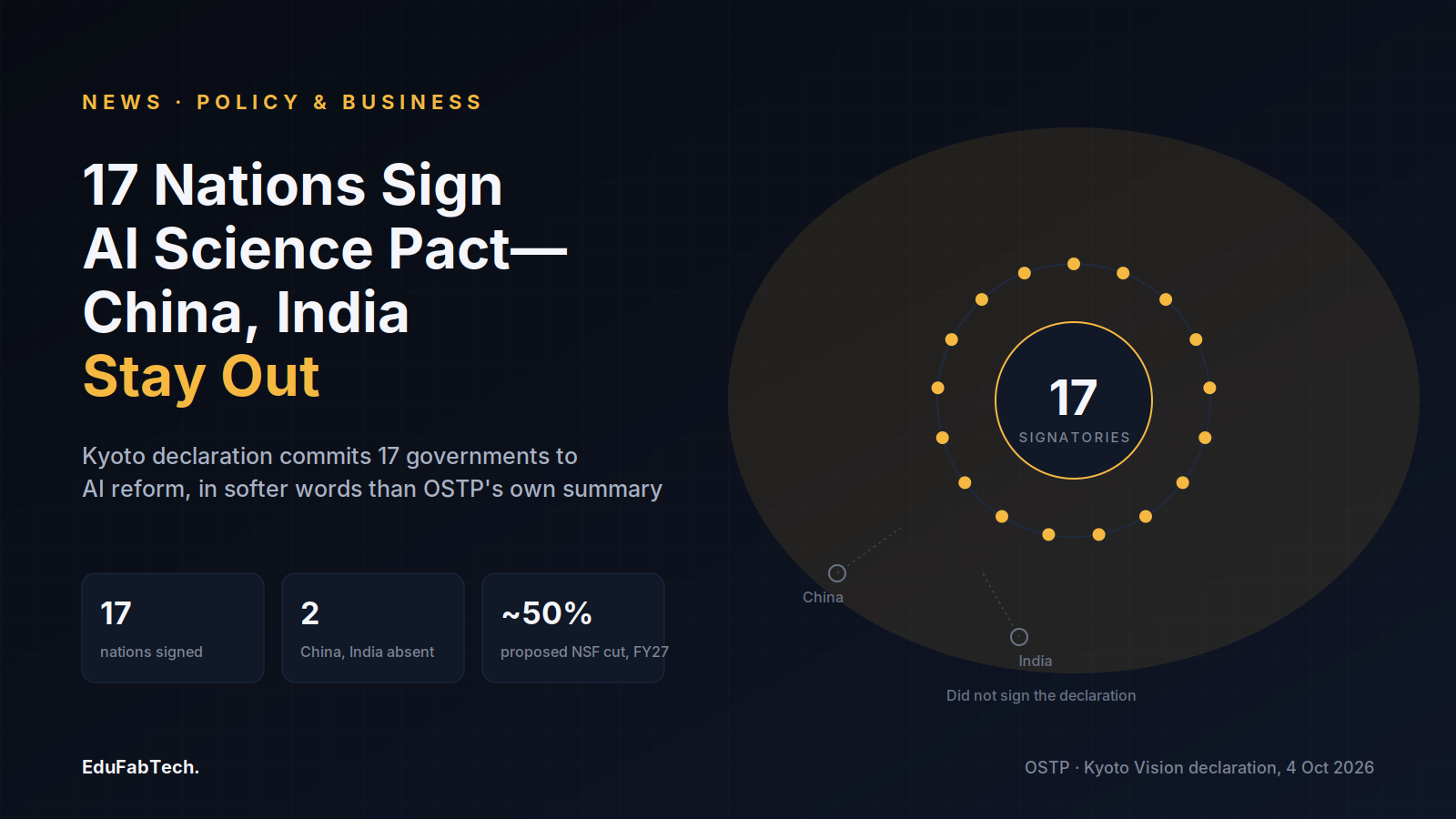
On October 4, 2026, science ministers and senior officials from 17 countries meeting alongside the Science and Technology in Society Forum in Kyoto endorsed a joint statement called the Kyoto Vision for a Golden Age of Science, according to a release from the U.S. Office of Science and Technology Policy (OSTP), which led the effort. The signatories were Argentina, Bulgaria, Chile, Cyprus, Germany, Greece, Indonesia, Italy, Japan, Kazakhstan, the Republic of Korea, New Zealand, Poland, Singapore, the United Arab Emirates, the United Kingdom and the United States.
The declaration calls for governments to reorganize how they fund and run scientific research around artificial intelligence, which the text labels "Super Intelligence" (SI), and around metascience, the empirical study of how research itself is conducted, funded and organized. OSTP Director Michael Kratsios said in the release that "Super intelligence applied to science will be the greatest force in history for democratizing research."
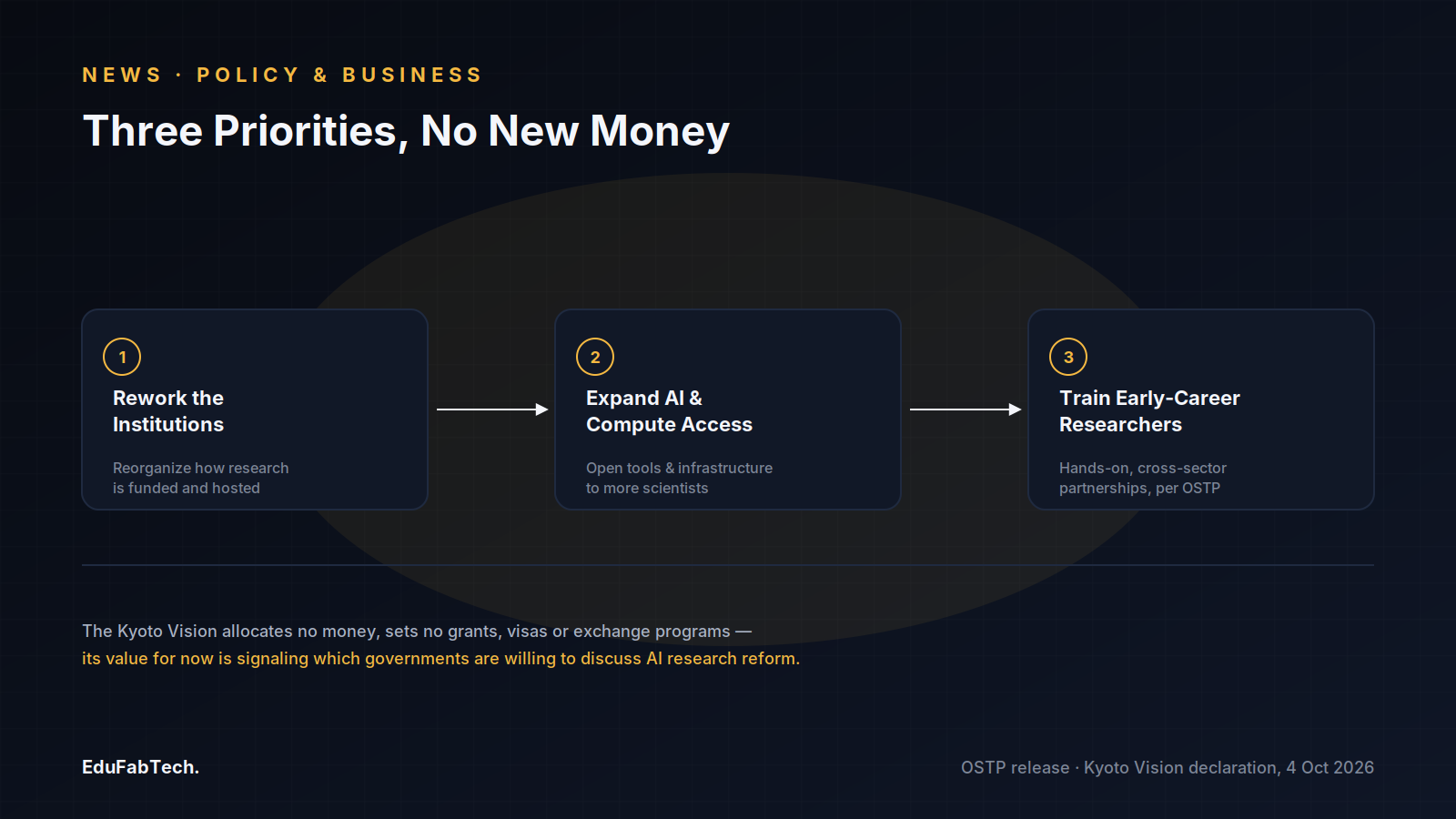
For students and early-career researchers, the document matters less for what it funds — it allocates no money — than for the direction it signals. Three stated priorities run through it: reworking the institutions that fund and host research, expanding access to AI tools and computing infrastructure for scientists, and investing specifically in training early-career researchers and technicians through what the OSTP release describes as hands-on, cross-sectoral partnerships.
Who signed, and who didn't
The spread of signatories runs across very different research systems, from large economies with established national AI strategies (Germany, Japan, South Korea, the UK, the US) to smaller or middle-income research systems (Argentina, Bulgaria, Cyprus, Indonesia, Kazakhstan). That breadth is part of the document's intended signal: that AI-driven research reform is not confined to the handful of countries that already dominate AI model development.
What stands out is who is missing. China and India — two of the world's largest producers of research output and graduates — did not join, a gap Tech Times reported is consistent with a broader pattern of the US building coalitions of aligned partners rather than pursuing universal bodies for AI governance in 2026. Neither government has publicly explained its absence, and the declaration itself does not address non-signatories.
The split matters for comparing national systems: a declaration on AI and research institutions that excludes two of the largest sources of STEM graduates and research papers worldwide describes only part of the global research landscape, not a consensus covering it.
Stronger words in the press release than in the text
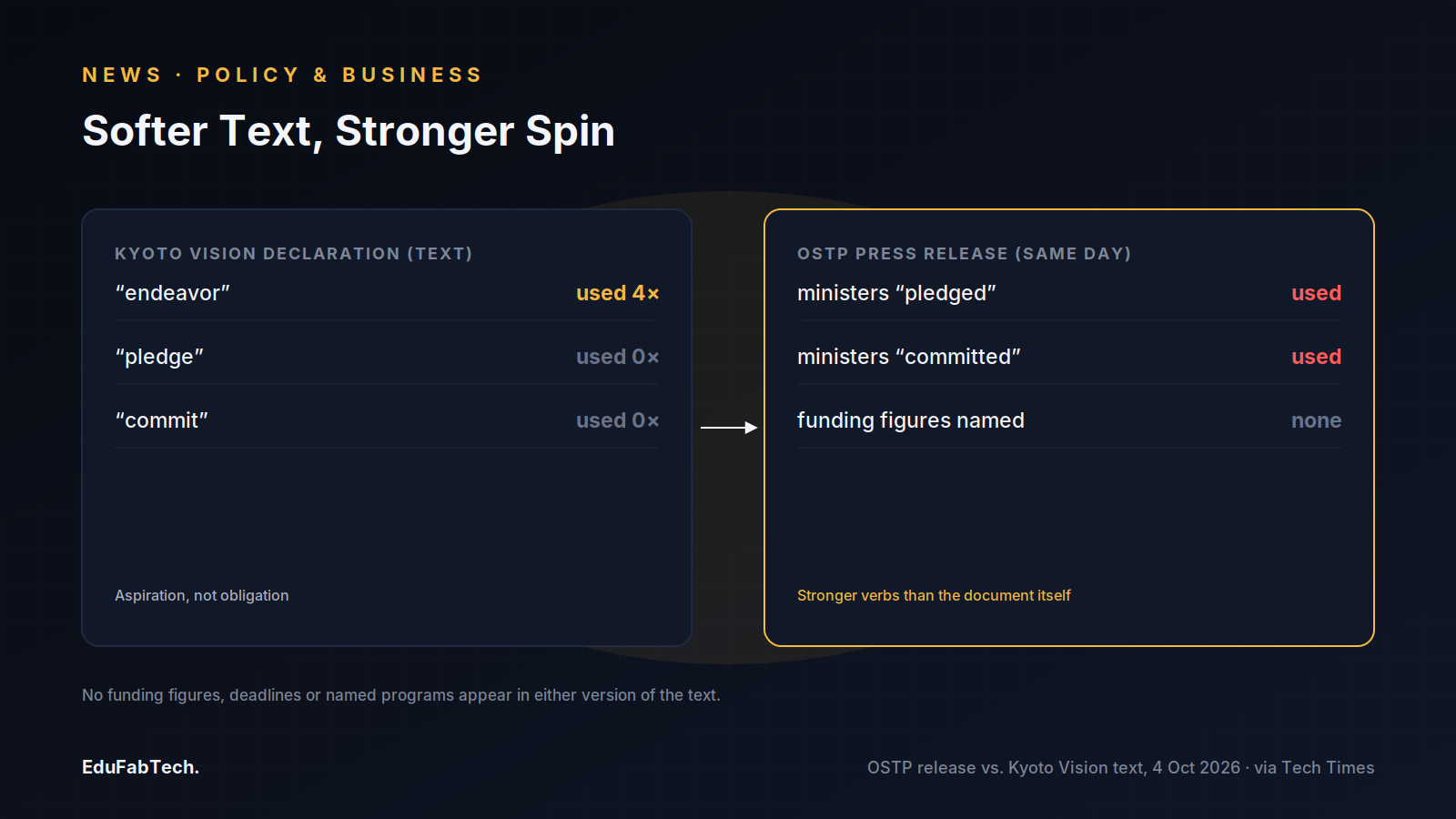
A close reading of the declaration against how the White House described it, flagged by Tech Times, shows a gap in verb strength. The declaration text itself uses "endeavor" four times and contains no instances of "pledge" or "commit" — the language of aspiration rather than obligation. The OSTP release describing the same document, by contrast, states that ministers "pledged" and "committed" to specific actions. No funding figures, deadlines or named programs appear in either version.
Mixed reactions among researchers
Reaction from people who study research policy has been divided. Jenn Gustetic, director of metascience and research and development policy at the Institute for Progress, a US think tank, told NBC News that "metascience efforts have built momentum in the U.K. and the U.S., and it's encouraging to see other nations embrace this mindset of experimentation and evidence building," framing the spread to 15 more countries as progress regardless of the document's lack of enforcement.
Gretchen Goldman, president and CEO of the Union of Concerned Scientists, was more skeptical, telling NBC News that "it's hard to take seriously any promises of increased trust and transparency when you look at the actions they've taken." Her skepticism, NBC News reported, is rooted in the Trump administration's proposed fiscal year 2027 budget, which would cut National Science Foundation funding by about half, along with cuts to the National Institutes of Health.
For researchers and students outside the 17 signatory countries, the practical upshot for now is limited: the Kyoto Vision sets no new grants, visas or exchange programs, and nothing in it binds any government to a timeline. Its near-term value is as a marker of which governments are currently willing to put AI and metascience experimentation on a shared agenda — and which are not yet part of that conversation.
A quick question for readers
Have you ever run into a rental scam or a fake room listing?
Scams target students every term. Sharing how common they are helps others stay alert.
Pick an answer, create a free account in a minute, and your vote counts. Already a member? Sign in
Comments 0
CommentNo comments yet. Members start the conversation.
Source: The White House (Office of Science and Technology Policy)
Sources (3)
- Office of Science and Technology Policy. U.S. Leads International Coalition to Endorse Kyoto Vision for a Golden Age of Science. The White House, 2026. whitehouse.gov ↗ · checked 8 Oct 2026
- Isaiah Richard. Kyoto Vision Rallies 17 Nations for AI-Powered Science: No Budget, No Binding Vows. Tech Times, 2026. techtimes.com ↗ · checked 8 Oct 2026
- Evan Bush. Global tech policymakers agree to embrace AI in science. NBC News, 2026. nbcnews.com ↗ · checked 8 Oct 2026