Linux 7.4 Merge Window Swells to Near 20,000 Commits as Torvalds Welcomes Earlier AI Patches
On 1 November 2026 Linus Torvalds released Linux 7.4-rc1 after a merge window LWN.net reports grew to nearly 20,000 commits, saying AI-suggested patches arriving earlier in the cycle make for a healthier process.
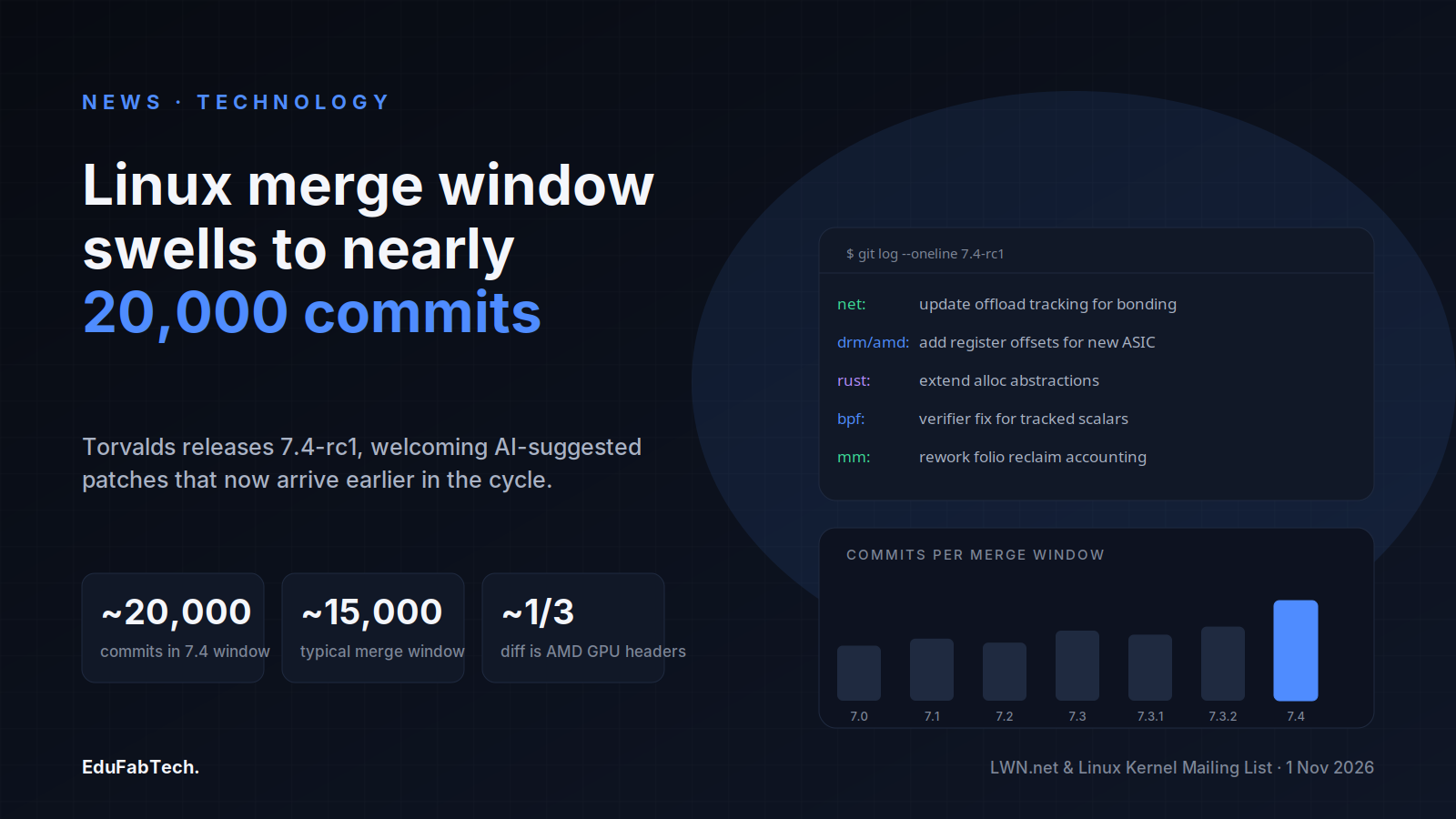
Linus Torvalds closed the two-week merge window for the next Linux kernel on 1 November 2026, releasing version 7.4-rc1. His announcement on the Linux Kernel Mailing List, and the summary of it published by LWN.net, both describe the window as unusually large — and both tie part of that growth to when AI-suggested patches are arriving in the development cycle.
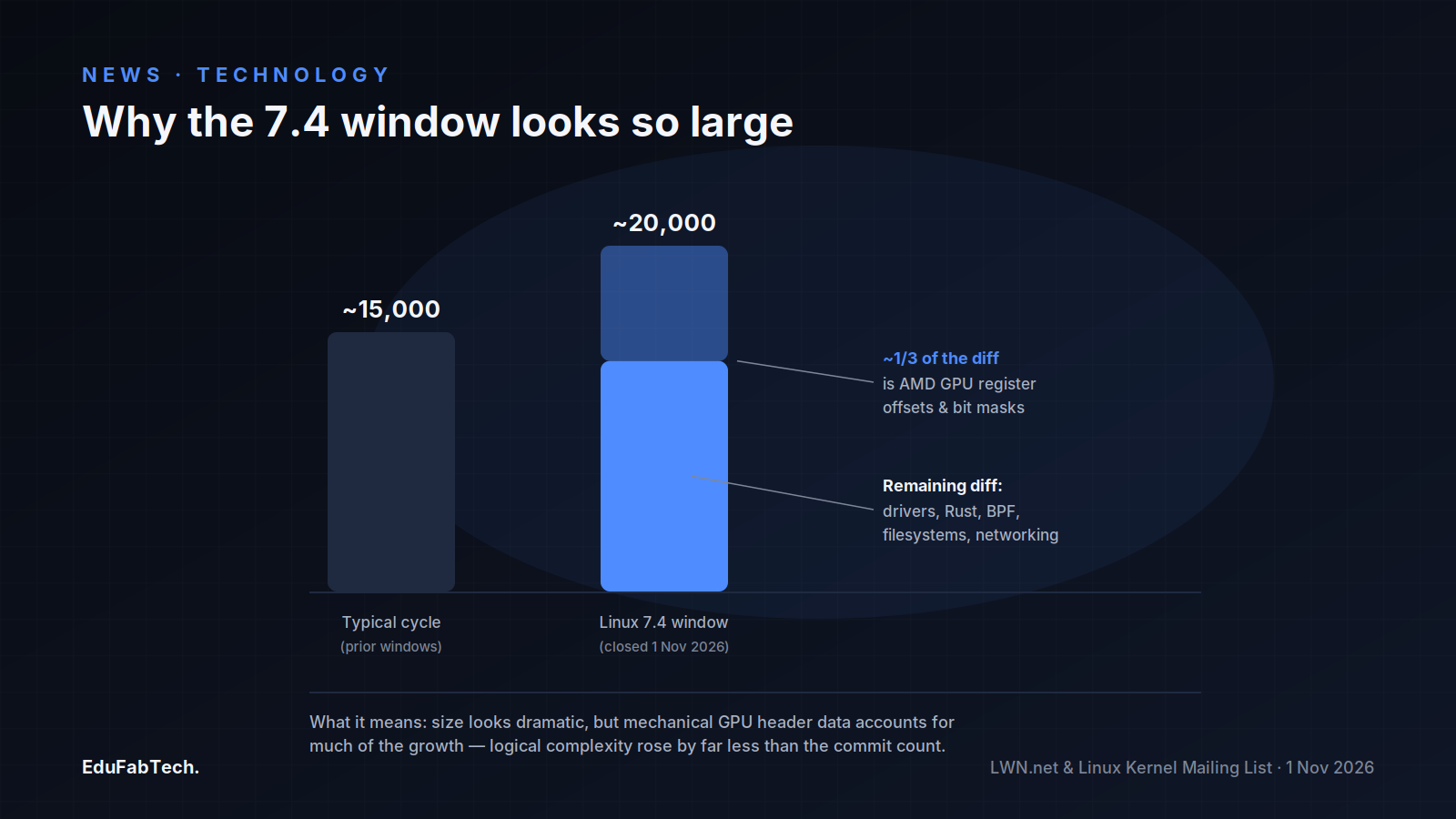
LWN.net reports that the 7.4 merge window took in nearly 20,000 commits, against a more typical cycle of roughly 15,000. Torvalds, in the message archived by the Linux Kernel Mailing List, called it "a *BIG* merge window."
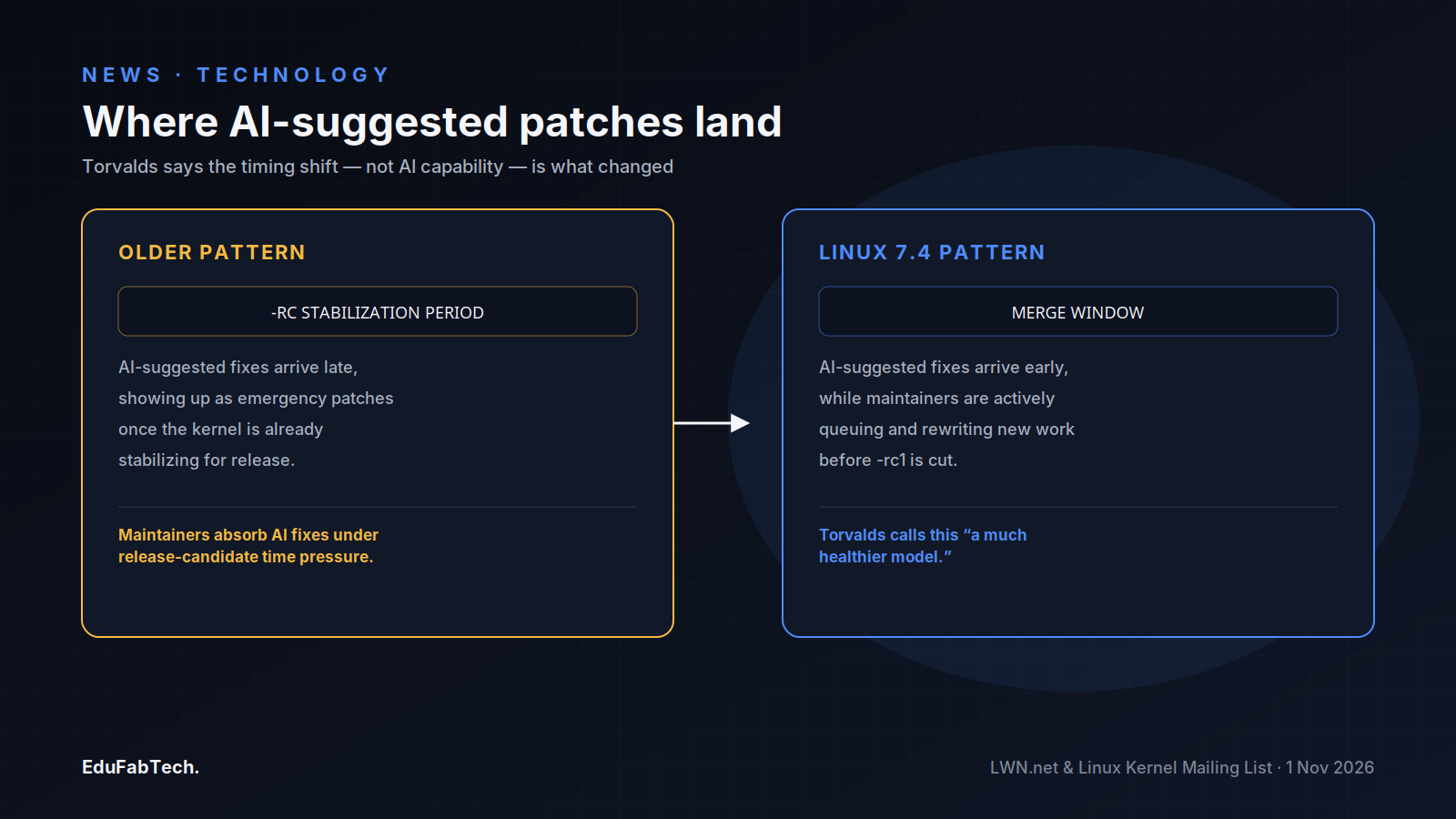
What stood out to Torvalds was not just the size but the timing of AI-assisted work. "I'm *much* happier with the flood of AI triggered work going into the merge window than it showing up mainly as extra fixes during the -rc period," he wrote, adding that patches are "increasingly...suggested by AI too, although they often get rewritten" before merging — a pattern he summed up as "a much healthier model."
Why the Window Grew
Torvalds pointed to two separate drivers of the larger window. One is the shift described above: AI-generated bug reports and proposed fixes are increasingly landing during the two-week merge period, when maintainers are actively queuing new work, rather than trickling in as emergency fixes once the kernel enters its release-candidate stabilization phase. The other, independent of AI, is that 7.4 is expected to become the next long-term-support release, which historically draws in more work as maintainers try to land features before the LTS cut.
Size alone does not tell the whole story. Torvalds also noted that a disproportionate share of the diff — about one third, by his estimate relayed in the same announcement covered by LWN.net — consists of AMD GPU register offsets and bit masks, the kind of large but mechanical header data that inflates line counts without reflecting a comparable rise in logical complexity.
What Ships in 7.4
Beyond the commit count, LWN.net's rundown of the pull requests Torvalds accepted describes the usual spread of subsystems: driver updates accounted for roughly half of the changes once the GPU header data is set aside, alongside architecture-specific work, filesystem and networking changes, and continued activity in the kernel's Rust integration, BPF subsystem and memory management code.
The AI angle is not confined to volume. How-To Geek's coverage of the release describes AI-generated contributions as becoming an increasingly organic part of the kernel's development process, rather than treating Torvalds' comments as an unqualified endorsement of AI tools — the patches, in his account, still need rewriting by human maintainers before they are fit to merge, and his remarks were specifically about when in the cycle that review happens, not about AI replacing it.
What It Means for Developers and Researchers
For software engineers and computer science researchers, the episode is a concrete data point in an area that is mostly argued over in the abstract: whether AI-assisted contributions to large, safety-critical open-source codebases help or strain existing review processes. Torvalds' stated preference is specific and narrow — he is not saying AI tooling has become more capable in some benchmarked sense, only that the point in the release cycle at which AI-originated fixes arrive has shifted from the stabilization phase to the merge window, which he considers an easier load for maintainers to carry.
That distinction matters for anyone studying how AI tools are actually integrated into large collaborative software projects, as opposed to how they perform on isolated coding benchmarks. The Linux kernel's mailing-list workflow, where every patch is attributed, reviewed and often rewritten by a human maintainer before merging, gives researchers a rare public, fully logged record of AI-suggested changes moving through a process that has not altered its review standards to accommodate them.
A quick question for readers
Which skill will matter most for getting a job in 2030?
Everyone has a prediction. Add yours and see what students are betting on.
Pick an answer, create a free account in a minute, and your vote counts. Already a member? Sign in
Comments 3
Comment-
The number that actually matters here is one third of the diff being AMD GPU register offsets and bit masks - that's Torvalds himself discou…
-
The one-third-is-AMD-GPU-headers claim is doing the real work here and it's just Torvalds's own estimate, relayed secondhand through LWN. No…
-
The one-third-of-the-diff-is-AMD-GPU-headers detail is the bit that actually explains the scary 20,000-commit number, and I wish that framin…
Join free to read the full comments and reply Comments are between members; an account takes a minute.
Source: LWN.net
Sources (3)
- Linus Torvalds. Linux 7.4-rc1 announcement. Linux Kernel Mailing List, 2026. lkml.iu.edu ↗ · checked 3 Nov 2026
- LWN.net staff. Linus 7.4-rc1. LWN.net, 2026. lwn.net ↗ · checked 3 Nov 2026
- Jefferson Mangubat. Linux 7.4 lands with a massive flood of AI patches and record commits. How-To Geek, 2026. howtogeek.com ↗ · checked 3 Nov 2026