ExoMars Orbiter Detects Hydrogen Chloride Over Mars Fissures, a Possible Sign of Dormant Volcanism
A Science Advances paper published 4 November 2026 reports repeated hydrogen chloride detections above fissures on Mars's Alba Mons volcano, which the authors call a potential, not proven, signature of magma still degassing underground.
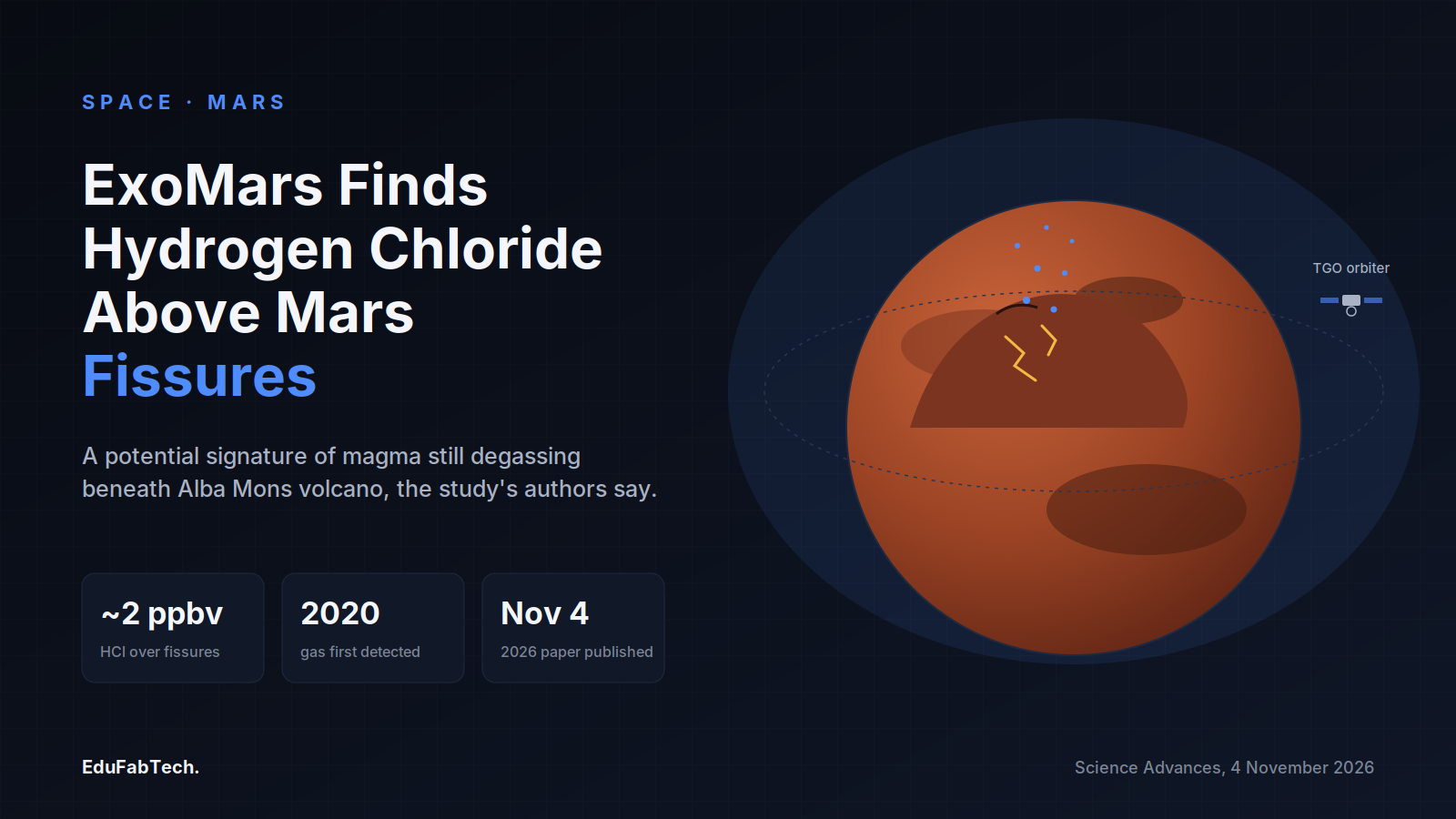
On 4 November 2026, the journal Science Advances published a study reporting that the European Space Agency's ExoMars Trace Gas Orbiter (TGO) has repeatedly detected hydrogen chloride gas above a cluster of fresh fissures on Alba Mons, one of Mars's large volcanic structures in the northern Tharsis region. The paper, led by Alexander Trokhimovskiy with co-lead author Daniel Mège of the Space Research Centre of the Polish Academy of Sciences, titles the finding "Enigmatic HCl detections as a potential signature of igneous activity on Mars" — language the authors chose deliberately, since the gas's origin is not settled.
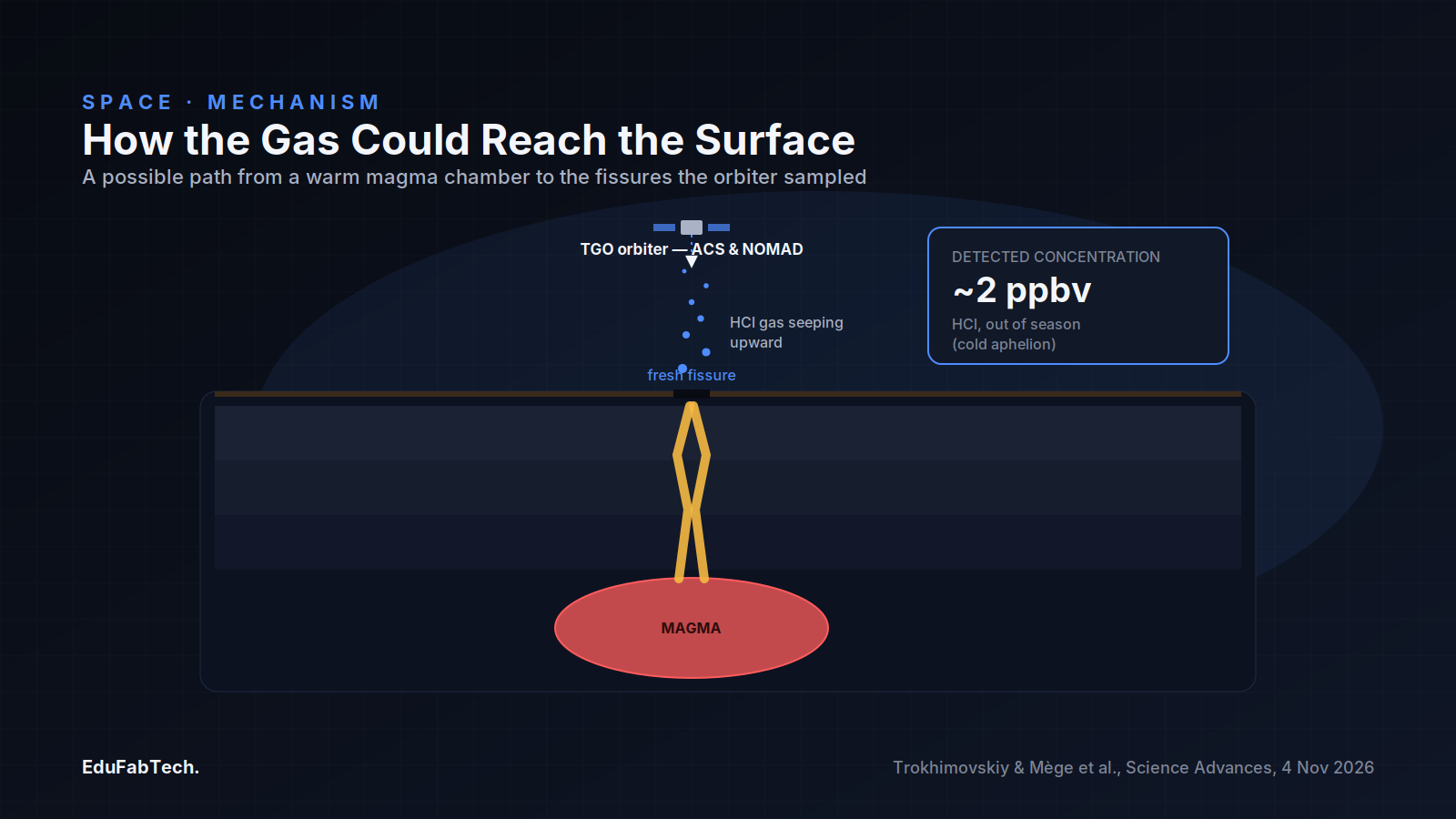
The detections came from the orbiter's Atmospheric Chemistry Suite (ACS) and NOMAD spectrometers, which measured hydrogen chloride at roughly 2 parts per billion by volume in the atmosphere above the Alba Mons region, according to the ESA blog post describing the mission's findings. What drew the team's attention was timing: the gas turned up during the planet's cold aphelion season, when Mars is farthest from the Sun and hydrogen chloride is not normally expected to be floating freely in the atmosphere.
Separately, the orbiter's CaSSIS camera had already spotted something unusual on the ground in the same area: fresh surface cracks, several hundred metres long and tens of centimetres wide, accompanied by colour changes in the surrounding terrain, as described in the ESA account of the discovery. Putting the atmospheric and surface observations together is what led the team toward a volcanic explanation rather than a purely chemical one.
Why the Timing Argues Against an Atmospheric Origin
Hydrogen chloride can, in principle, form through chemistry in the Martian atmosphere itself, or be released seasonally from chlorine-bearing salts and permafrost as surface ice warms and cools. The research team says it examined these alternative, non-volcanic pathways before settling on an igneous explanation, concluding that magmatic seepage was "the more likely" source among the possibilities they considered. The case rests partly on the fact that the gas appeared out of season, at a time when the known atmospheric chemistry and permafrost-release mechanisms don't predict it should be present at these levels.
Kevin Olsen, who worked on the data while at the University of Oxford's Department of Physics and has since moved to the Canadian Space Agency, put the puzzle in context: "These observations have been puzzling us for a long time. Ever since first finding HCl in 2020..." The gas has, in other words, been an open question for the Trace Gas Orbiter team for several years, and this paper is their attempt to explain it with the fissures CaSSIS had already imaged nearby.
A "Potential Signature," Not a Confirmed Eruption
The paper's own title keeps the finding conditional, and the authors are explicit that they are not claiming Mars is currently erupting. Daniel Mège, the study's co-lead author, framed the conclusion this way in the ESA blog post: "Our findings suggest that Mars has retained enough internal heat to support volcanic activity until recently, and possibly still does." That is a statement about residual heat and a possibly dormant or semi-active magma chamber beneath Alba Mons, not about lava reaching the surface.

What It Means for Planetary Science and Astrobiology
The ESA account of the discovery credits a chance introduction for the breakthrough: Colin Wilson, ESA's project scientist for the Trace Gas Orbiter mission, connected Mège with Kevin Olsen's atmospheric-chemistry team at Oxford. Mège says the delay in explaining the signal was partly instrumental: earlier spacecraft "were not adapted to the potential detection of volcanic gases in very small quantities, which we call traces."
The University of Oxford's account of the study points out the broader stakes for astrobiology: if a magma chamber beneath Alba Mons is still warm, and if underground water or ice is anywhere nearby, the combination could create a hydrothermal system of the kind associated with habitable conditions on Earth. As Mège put it in that account, "looking for Martian life in the seeping fissures of the Alba Mons region would make a lot of sense" if such a system is active — a suggestion for future work, not a claim that one has been found.
For students and researchers following planetary geology, the episode is also a useful case study in how orbital missions build evidence incrementally. The hydrogen chloride signal was first noticed in 2020, sat unexplained for years, and only became interpretable once CaSSIS imagery of the fissures was matched against the gas data and weighed against non-volcanic explanations such as seasonal permafrost release. The Trace Gas Orbiter continues to operate in Mars orbit, and the authors' own hedged title signals that confirming — or ruling out — present-day volcanism at Alba Mons will depend on further observations rather than this single paper.
A quick question for readers
Which study habit do you think is most overrated?
Some popular habits have little evidence behind them. Which one do you think gets too much credit?
Pick an answer, create a free account in a minute, and your vote counts. Already a member? Sign in
Comments 3
Comment-
Two parts per billion of HCl, appearing out of season, next to fissures CaSSIS already photographed — that's a real pattern, but notice how…
-
What I'd want to see spelled out is how 'more likely' was actually weighed against the alternatives, because right now that phrase is doing…
-
The part that'd make me pause is the instrumental excuse: Mège says earlier spacecraft "were not adapted to the potential detection of volca…
Join free to read the full comments and reply Comments are between members; an account takes a minute.
Source: Science Advances (AAAS)
Sources (3)
- Alexander Trokhimovskiy, Daniel Mège, Oleg Korablev, et al.. Enigmatic HCl detections as a potential signature of igneous activity on Mars. Science Advances, 2026. science.org ↗ · checked 10 Nov 2026
- European Space Agency. Geological intuition for Mars. ESA Rocket Science blog, 2026. blogs.esa.int ↗ · checked 10 Nov 2026
- University of Oxford, Department of Physics. European orbiter detects hints of volcanic activity on Mars. University of Oxford, 2026. physics.ox.ac.uk ↗ · checked 10 Nov 2026