Mistral AI Launches Large 4, a 1-Trillion-Parameter Model Headed for Open Weights
Released October 6, 2026, the mixture-of-experts model activates 49 billion of its trillion parameters per token, with open weights due roughly three weeks later for outside testing.
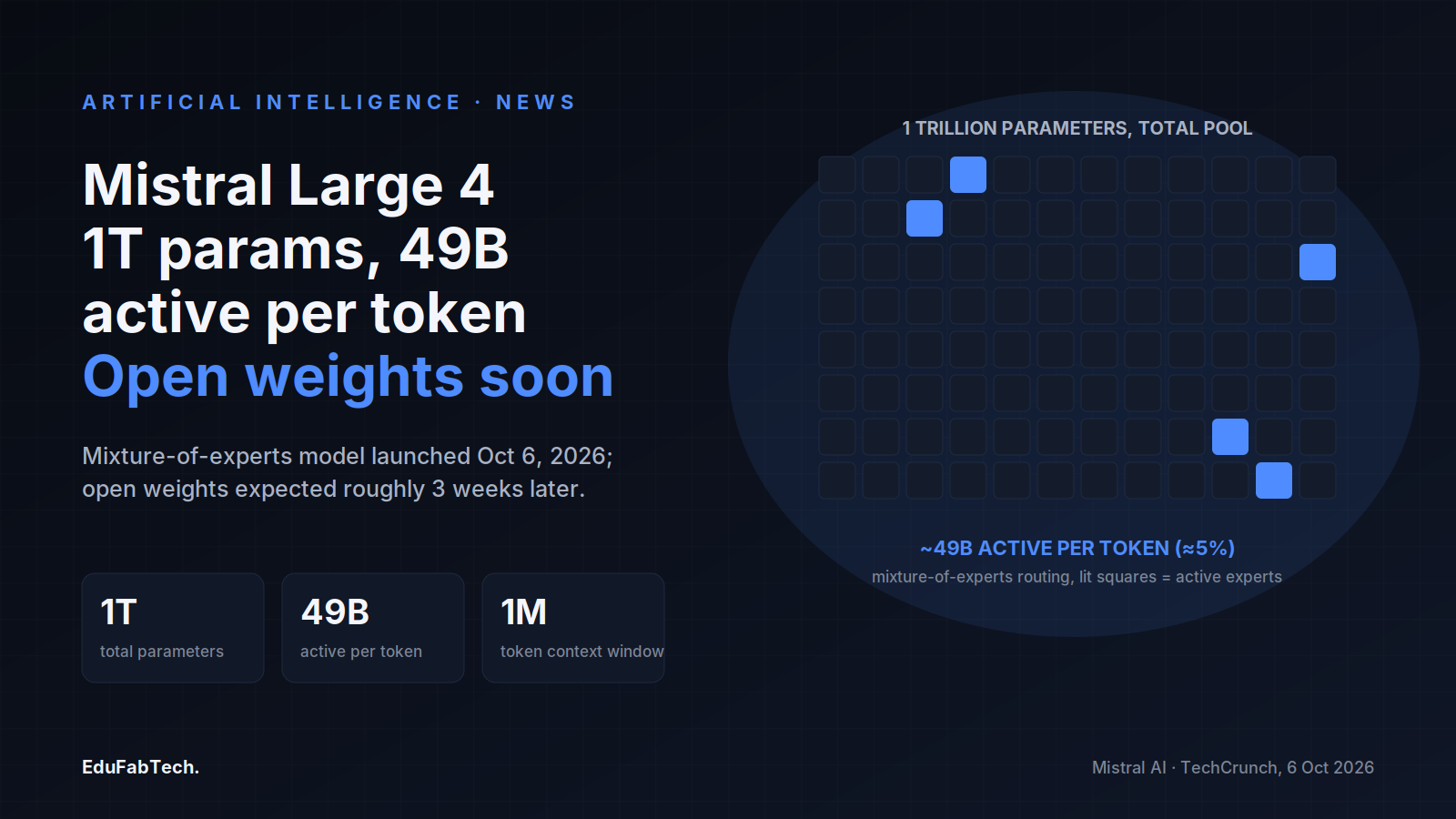
Mistral AI opened public preview access to Mistral Large 4 on October 6, 2026, its largest model to date, according to Mistral AI's announcement. The release is the first built on the Paris-based company's €3 billion Series D round, which Mistral says funds its product roadmap and which TechCrunch reported closed in September 2026. The model, unofficially nicknamed "Le Chonk," is a mixture-of-experts system with 1 trillion total parameters that activates only 49 billion of them for any given token, a design meant to keep inference costs down while retaining a large total model capacity.
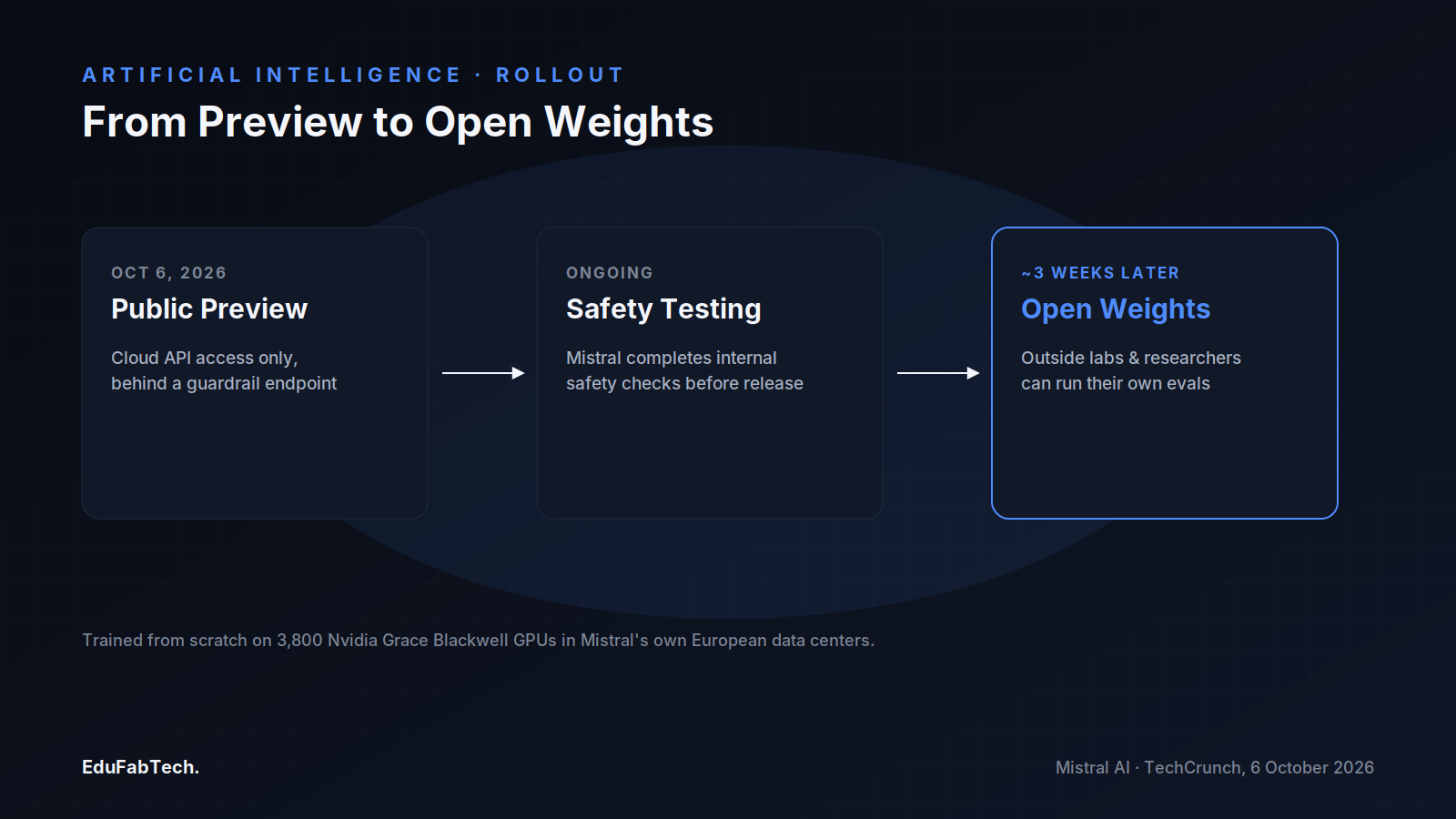
According to Mistral AI, the model was trained from scratch on 3,800 Nvidia Grace Blackwell GPUs in the company's own European data centers, is natively multimodal with a 1.6-billion-parameter vision encoder, and supports a 1-million-token context window across more than 160 languages. Mistral AI's VP of science, Pierre Stock, told TechCrunch that the training run used "two to three times less" compute than the company's Chinese open-weight competitors and significantly less than closed-source rivals. TechCrunch reported that, at the time of its story, Mistral's benchmark results were still pending independent verification — meaning the compute-savings figure, like the capability scores below, currently rests on the company's own account.
That distinction matters because Mistral Large 4 is not yet downloadable. The model is reachable only through Mistral's cloud API in public preview, behind a guardrail endpoint, while the company completes safety testing; TechCrunch reported that open weights are expected roughly three weeks after the October 6 launch, which would let outside labs and individual researchers run their own evaluations instead of relying on the company's own numbers.
What Mistral AI Is Claiming
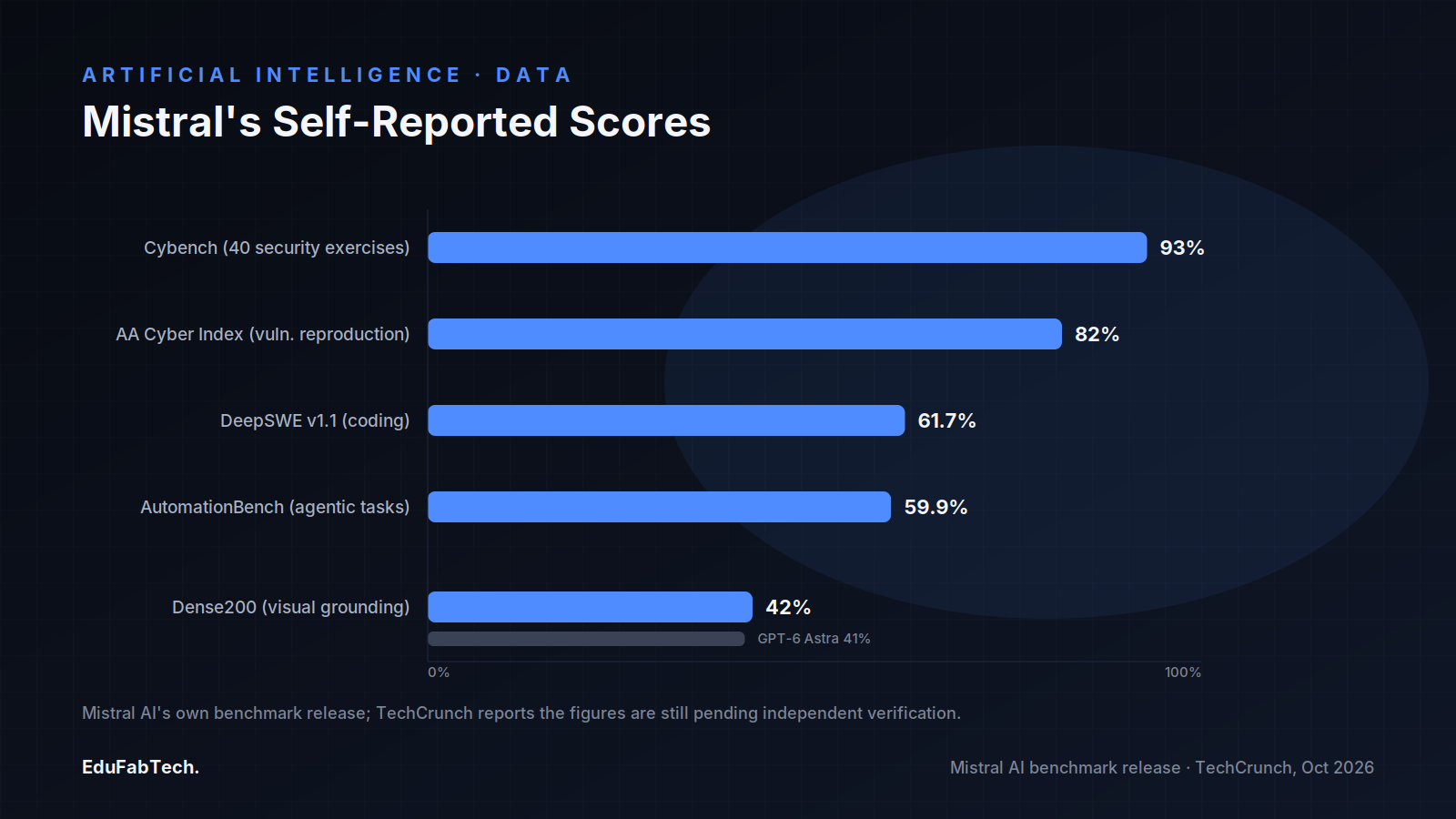
Mistral AI's own benchmark release, published alongside the model, reports the following self-measured scores:
| Benchmark | Area | Mistral Large 4 score |
|---|---|---|
| AA Cyber Index (vulnerability reproduction) | Cybersecurity | 82% |
| Cybench (40 security exercises) | Cybersecurity | 93% |
| DeepSWE v1.1 | Coding | 61.7% |
| AutomationBench | Agentic tasks | 59.9% |
| Dense200 | Visual grounding | 42% |
Mistral AI says the Dense200 visual-grounding score edges out OpenAI's GPT-6 Astra, which it lists at 41% on the same test, and that the model leads open-weight systems outside China on the AA Cyber Index. SiliconANGLE's review of the release confirmed the one-point edge on Dense200 but found that on the industry's most-used coding benchmarks, Large 4 "falls well behind frontier models such as Astra," while still beating open-weight rivals Qwen3.8 Max and DeepSeek V4 Pro. SiliconANGLE also pointed out that AutomationBench is built from comparatively simple tasks, while the AA-Briefcase benchmark Mistral cites for agentic performance includes assignments designed to take humans weeks to complete — a reminder that benchmark names alone don't indicate difficulty.
An Argument About Who Gets to Refuse
Mistral AI frames the cybersecurity scores as evidence of a different safety trade-off: the company's own description credits Large 4's results partly to fewer provider-level refusals, which it says lets security researchers use the model for legitimate vulnerability research that more restrictive closed models decline to help with. The company reports a 93.3% resistance rate on its B3 attack-resistance benchmark and says Large 4's average refusal rate on malicious cyber prompts is still higher than any other open-weight model it measured — a claim that, like the capability scores, has not yet been checked by an outside evaluator.
Why This Matters Beyond the Benchmarks
For researchers and engineers, the practical story is less about any single score and more about what becomes testable once the weights are public. A trillion-parameter open-weight model with a 1-million-token context window and native multilingual support gives academic groups a large-scale system to study without paying for API access to a closed competitor — provided the hardware exists to run it, since even with only 49 billion active parameters, serving the full 1-trillion-parameter model still requires loading all of it into memory. Mistral AI positions the release explicitly as a sovereignty play: customers can run Large 4 on their own infrastructure or through a European Mistral region governed by EU law, rather than depending on a single US or Chinese provider.
Until the weights ship and independent groups rerun the evaluations, the honest summary is narrower than Mistral AI's own framing: a European lab has shipped a very large model with strong self-reported scores in several niches, built more cheaply than some rivals by the company's own account, with open weights to follow — and the test of those claims, not the announcement, is the three-week wait that follows.
A quick question for readers
Which skill will matter most for getting a job in 2030?
Everyone has a prediction. Add yours and see what students are betting on.
Pick an answer, create a free account in a minute, and your vote counts. Already a member? Sign in
Source: Mistral AI
Sources (3)
- Mistral AI. Introducing Mistral Large 4. Mistral AI, 2026. mistral.ai ↗ · checked 7 Oct 2026
- Mistral AI (via TechCrunch). Mistral's new 1T model aims to leapfrog closed and open rivals. TechCrunch, 2026. techcrunch.com ↗ · checked 7 Oct 2026
- SiliconANGLE. Mistral launches open-source Mistral Large 4, details AI roadmap. SiliconANGLE, 2026. siliconangle.com ↗ · checked 7 Oct 2026